Chapter Three
Wholeness and the Theory of Centers
1 / Introduction
I believe we can understand how "life" is made in buildings, and I offer in what follows a language within which we can begin to describe the phenomenon.
In order to understand life as a phenomenon, it is necessary to define something which I call "the wholeness" and also certain crucial entities which I call "centers," the building blocks of wholeness. These concepts -- and therefore the chapter too -- are rather abstract. However, I must ask the reader to try to grasp and use these concepts, because the wholeness as I define it, and the centers I shall define as the building blocks of wholeness are, in my view, the indispensable tools needed to understand life. With these definitions, we shall be able to see the way that life comes about (chapter 4), the structural features which all life has (chapter 5), the nature of function and ornament (chapter 12). Allow these pages to prepare the groundwork for our ability to understand life as a structure.
2 / the Idea of Wholeness
Intuitively we may guess that the beauty of a building, its life, and its capacity to support life all come from the fact that it is working as a whole. A view of the building as a whole means that we see it as part of an extended and undivided continuum. It is not an isolated fragment in itself, but part of the world which includes the gardens, walls, trees, streets beyond its boundaries, and other buildings beyond those. And it contains many wholes within it -- also unbounded and continuous in their connections. Above all, the whole is unbroken and undivided.
This rather obvious idea, though we may assume it to be true, does not yet have a precise counterpart in our professional or scientific analysis of buildings. As a general idea, wholeness has been widely discussed by many writers in the 20th century: it is one of the main themes of contemporary thought.' In physics, the local behavior of an electron is affected by the larger configuration of the experiment in which it moves.? The local behavior of a gravitational particle is affected by the large-scale gravitational field that is created by the particles. In biology, Hans Spemann's experiments have shown how the growing cells in an embryo are affected by their position in the whole.' In neurophysiology, Karl Lashley's experiments on the engram led to his discoveries that any particular memory is encoded not at some locus, but somehow throughout the whole.' In medicine, J. S. Haldane's discussion of the lung and his explanation of the impossibility of drawing any definite boundary around the organism showed that there is an inseparable quality in which organism and environment are bound together and exist as one whole.® In cosmology, there is Ernst Mach's principle: the idea that the gravitational constant, G (and hence the force of gravity), is somehow a function of all the matter existing in the universe.' Recent work on the overall ecology of Earth has even shown benefits in regarding the whole planet as a single organism.®
In all these examples, the wéoleness is the important thing: the local parts exist chiefly in relation to the whole, and their behavior and character and structure are determined by the larger whole in which they exist and which they create.
Although wholeness has, in this intuitive sense, played such a role in contemporary thought, no one has shown how to represent wholeness. We can talk about wholeness, we can be aware of the necessity of seeing things in their wholeness -- but no one has yet formulated a way of understanding just what this wholeness is, in precise terms. We have not been able to represent the whole, or even to isolate, in precise mathematical language, what we mean by the whole.
Most artists and architects know, intuitively, that buildings also work primarily as wholes, and that the built world must therefore also be seen in its wholeness. But again -- as in the other cases from the recent history of science -- we do not yet have the intellectual tools which show us how to do it. We do not yet have a precise
model of a structure we might call "the wholeness" of the built world, or any clear picture of the way this "wholeness" might then contribute to the behavior of the buildings and spaces, what happens there, how it affects us. Nor do we know why it would make sense to say that it is only accurate to see a building working "as a whole."
After many years of thinking, I believe that I have been able to define, in precise language, what we mean by the wholeness of a given situation. The fundamental idea is that we can define wholeness exactly as a structure. This structure is defined in mathematical language in appendix 1. It is a rather complex structure, analogous in some ways to the underlying structures defined in topology. In the following sections I shall try to explain this idea in informal language, by means of examples.
3 / an Example of the Wholeness in a Simple Case
The general idea is that the wholeness in any part of space is the structure defined by all the various coherent entities that exist in that part of space, and the way these entities are nested in and overlap each other.
To come to grips with this idea, I start by considering a very simple structure, and examining it from the point of view of its wholeness. On the right is a sketch of a blank sheet of paper. Then I place one dot on it. Although the dot is tiny, its impact on the sheet of paper is very great. The blank sheet of paper is one whole, one kind of wholeness. With the introduction of the tiny dot, the wholeness changes dramatically. Its gestalt changes. We begin to experience a subtle and pervasive shift in the whole. The space changes throughout the sheet of paper (and not only where the dot is), vectors are created, differentiations reaching far beyond the dot itself occur within the space. As a whole, an entirely new configuration has come into being, and this configuration extends across the sheet of paper as a whole.
Any reasonable description of wholeness must capture this subtle and pervasive effect. But how is it to work?
What is the configuration which exists after I place the dot? It may be described like this: around the dot, there is a kind of halo. Where the dot has been placed, a larger entity of some kind is created. Also, on each side of the dot, passing the dot tangentially, rectangles of white paper become visible, as further 'latent' entities (see diagram on next page). There are four of
Blank sheet with a single dot
A blank sheet of paper
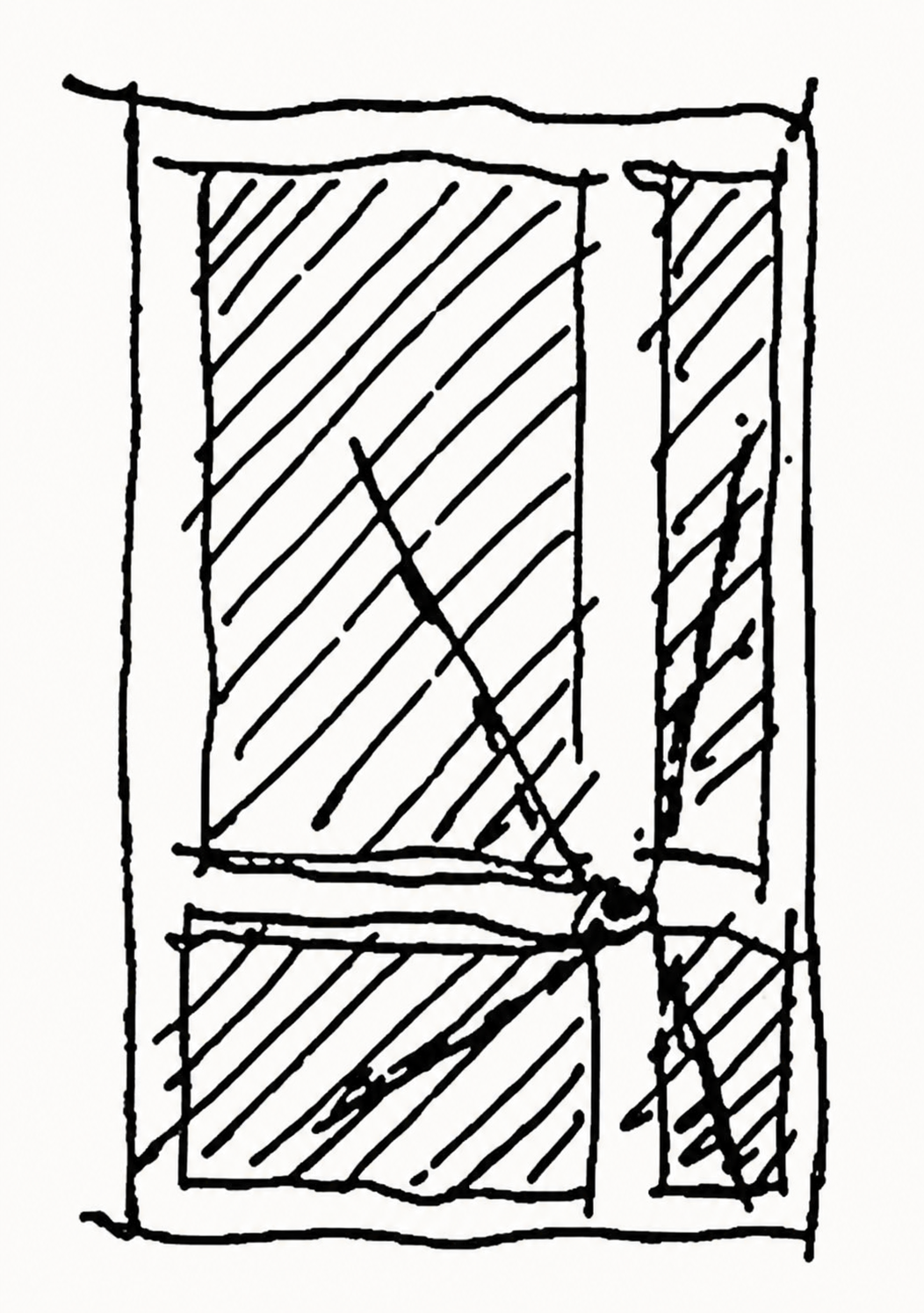
Four largest latent rectangles, creating four other
System of rays rectangles in the corners, by their overlap. These are seen on the right.
these rectangles, and where they cross four other rectangles are formed in the four corners of the sheet (again, see diagram). These corner rectangles are formed by the overlap of the other rectangles, but are also induced by the presence of the dots. In addition, there are rays visible: four white rays going out from the dot parallel to the sides and forming a cross; and four other rays going from the dot towards the four corners. These four rays are not all equally strong. Their relative strength depends on where the dot is on the paper.
Therefore, including the main entity of the sheet itself, there are at least twenty entities created in the space of the paper by the dot. Just what these entities are, is not yet clear, but they are zones, visible as wholes in some fashion. All we can really say is that when we place the dot, these zones become marked in some way, they become visible, they stand out. In some fashion they become coherent, or differentiated, where before they were not. Although the precise nature of these entities is not yet clear, the thing that matters is that they have become more visible, marked, stronger.
In order to visualize the configuration, it is helpful to visualize its structure diagrammatically. We simply list those segments of space which are at the top of the list of relative strength as entities: 1. The sheet itself. 2. The dot. 3. The halo around the dot. 4. Bottom rectangle trapped by dot. 5. Left-hand rectangle trapped by dot.
6. Right-hand rectangle trapped by dot. 7. Top rectangle trapped by dot. 8. Top left corner. 9. Top right corner. 10. Bottom left corner. 11. Bottom right 12. The ray going up from dot. 133. Ray going down from dot. 14. Ray going left from dot. 15. Ray going right from dot. 16. The white cross formed by these four rays. 17. Diagon al ray from dot to nearest corner. 18. Diagon al ray from dot to next corner. 19. Ray from dot to third corner. 20. Ray from dot to furthest corner.
The basic idea of the wholeness, as I define it, is that these stronger zones or entities, together, define the structure which we recognize as the wholeness of the sheet of paper with the dot. I refer to this structure as the wholeness, or W. The formal, mathematical definition of wholeness, expressing it as a system of overlapping entities, is given in appendices r to 3."
corner.
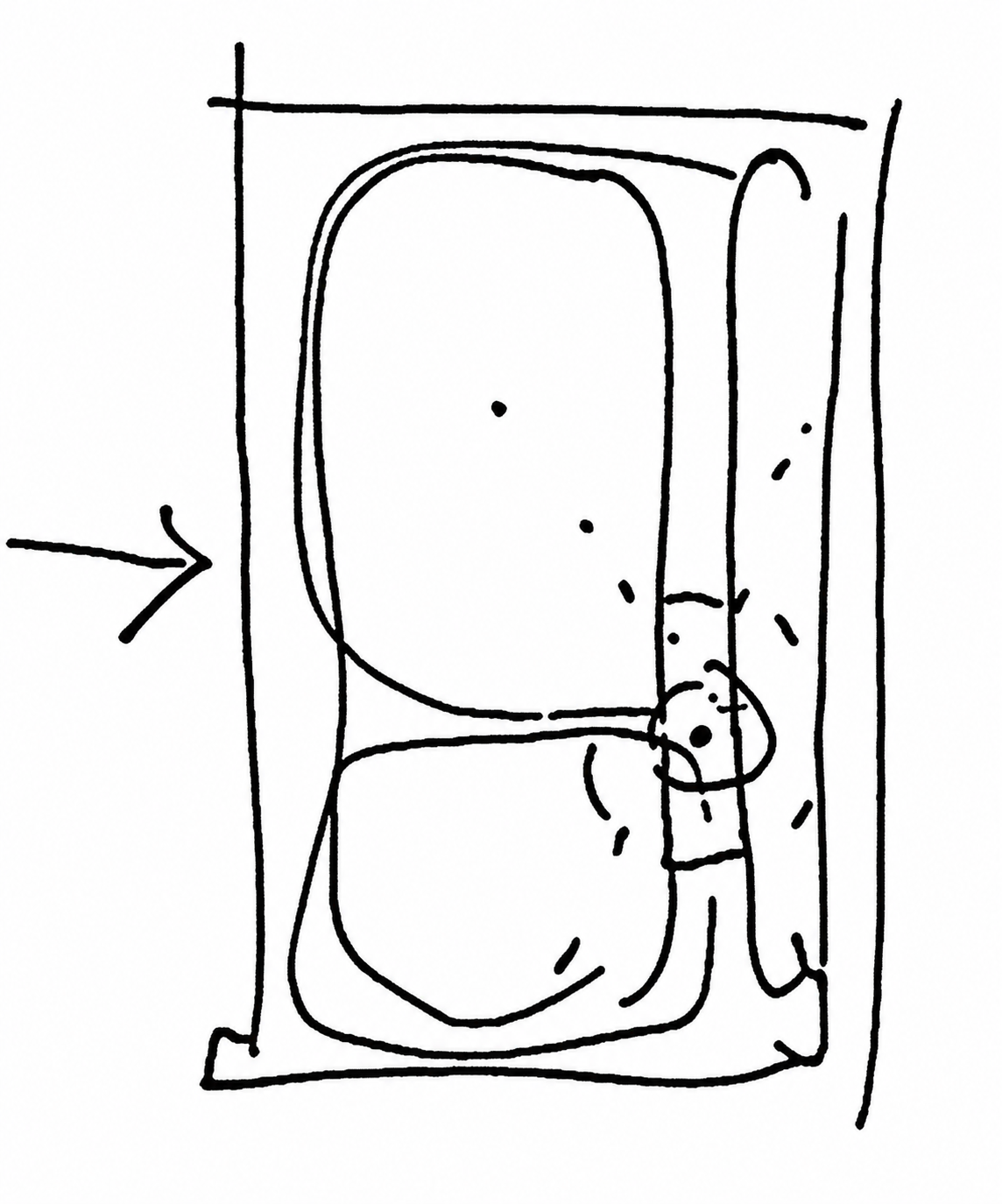
A diagram of the wholeness: here we see the system of all twenty most salient entities, overlapping each other and seen as one system. Bear in mind that this is the wholeness for a simple dot on a single rectangular sheet.
4 / the Origin of the Strength in Entities
What is the origin of the "strength" that makes a few special segments stand out as coherent entities to create wholeness? Their strength and centeredness come from a combination of factors that all depend on the overall configuration of the space.
In the example of the sheet with a single dot, we have some centers at the corners -- these are zones of space which are highly differentiated. The large rectangles which "fill" the page on the four sides of the dot are the largest symmetrical chunks of space which exist without running into an edge; they are the largest symmetries left intact by the presence of the dot. It is their homogeneity which marks them. The dot itself is marked, of course, because it has a physical differentiation of color. The lines forming rays from the dot to the corner are created again by local symmetries focused on the two points that form the ends of each ray.
We can begin to give general rules which will identify the zones of space that stand out as centers in any given configuration. For example:
+ The sets which appear as entities are often locally symmetrical -- but not always.
» The entities are usually bounded: that is, at their edge, there is often a sharp change of Structure.
+ Some of the entities are marked by an internal center where there is another change of continuity near the middle of the center itself.
- There is a simplicity and regularity about these sets which marks them as wholes, and makes them function as entities.
- They are often relatively homogeneous across their interior, compared with the surrounding Space.
- There is a topological connectivity in them which marks them as compact.
- They are usually -- not always -- convex.
This list of characteristics is incomplete, but it begins to suggest the kinds of features which cause the coherence of a segment of space to occur." Later (chapters 4 and 5) we shall see that more complex entities are formed in far more complex ways.
The entities which come into existence in a configuration are not merely cognitive. They have a real mathematical existence, and are actually occurring features of the space itself. They may be established mathematically according to the relative hierarchies of differentiation in the space. They are mathematically and physically real.
And they have different degrees of strength.
5 / the Concept of a Center
Let us now consider the nature of the entities from which wholeness is built. We may consider any configuration in the world, a building, a street, a room full of people playing cards, a crowd of people, a forest. Each has its wholeness. By that I mean that there are visible within that thing, a huge number of entities, at different scales, formed very much in the ways I have described, and that the totality of these entities with the way they are nested constitute the wholeness of that thing.'' We may think of these entities as parts (as they may sometimes seem to us) or as local wholes or sub-wholes. But, as I have illustrated in the case of the sheet of paper and the dot, these parts and entities are rarely pre-existing. They are more often themselves created by the wholeness. This apparent paradox (seeming paradoxical only because of the simpleminded way in which it is expressed) is a fundamental issue in the nature of wholeness: the wholeness is made of parts; the parts are created by the wholeness. To understand wholeness we must have a conception in which "parts" and wholes work in this holistic way.
To have a consistent way of talking about these entities, during recent years, I have learned to call them all (whether parts or or local wholes or hardly visible coherent entities), "centers." What this means is that each one of these entities has, as its defining mark, the fact that it appears to exist as a local center within a larger whole. It is a phenomenon of centeredness in space. Thus a human head, or ear, or finger is a discernible whole. It is also, both visually and functionally, a center. We experience it as a center. And it is, in the end, its centeredness which is its most clear, defining mark.
In using the word center in this way, I am not referring at all to a point center like a center of gravity. I use the word center to identify an organized zone of space -- that is to say, a distinct set of points in space, which, because of its organization, because of its internal coherence, and because of its relation to its context, exhibits centeredness, forms a local zone of relative centeredness with respect to the other parts of space. When I use the word center, I am always referring to a physical set, a distinct physical system, which occupies a certain volume in space, and has a special marked coherence. Even when the center is a social or cultural center, it is still ultimately spatial as well: it occurs in space, and always has a spatial locus."
There is a mathematical reason for thinking of the coherent entities in the world as centers, not as wholes. If I want to be accurate about a whole, it is natural for me to ask where that whole starts and stops. Suppose, for example, I am talking about a fishpond, and want to call ita whole. To be accurate about it in a mathematical theory, I want be able to draw a precise boundary around this whole, and say for each point in space whether it is part of this set of points or not. But this is very hard to do. Obviously the water is part of the fishpond. What about the concrete it is made of, or the clay under the ground? Is this part of the whole we call "the pond"? How deep does it go? Do I include the air which is just above the pond? Is that part of the pond? What about the pipes bringing in the water? These are uncomfortable questions, and they are not trivial. There is no natural way to draw a boundary around the pond which gets just the right things, and leaves out just the right things. In a very rigid way of thinking, this would make it seem that the pond does not really exist as a whole. Obviously this is the wrong conclusion. The pond does exist. Our trouble is that we don't know how to define it exactly. But the trouble comes from referring to it as a "whole." That kind of terminology seems to make it necessary for me to draw an exact boundary, including just those things which are part of the pond, and leaving out just those which aren't. That is the mistake."
When I call the pond a center, the situation changes. I can then recognize the fact that the pond does have existence as a local center of activity: a living system. It is a focused entity. But the fuzziness of its edges becomes less problematic. The reason is that the pond, as an entity, is focused towards its center. It creates a field of centeredness. But, obviously, this effect falls off. The peripheral things play their role in the pond. But I do not need to make a definite commitment about the edge, and what is in and what is out, because that is not the point. What matters in the existence of the pond as a coherent entity is that the organization of the pond is caused by a field effect in which the various elements work together to produce this phenomenon of a center. This is true physically in the actual physical system of the pond: water, edge, shallows, gradients, lilies -- all help in the formation of the pond as a center. And it is also true mentally in my perception of that pond. That is why it is more
useful, and more accurate, to call the pond a center rather than calling it a whole. The same is true for window, door, wall, or arch. None of them can be exactly bounded. They are all entities which have a fuzzy edge, and whose existence lies mainly in the fact that they exist as centers in the portion of the world which they inhabit.
There is yet another reason for preferring the term "center" to the term "whole." The entities we are concerned with in a building include the most ordinary elements like staircase, bathtub, door, kitchen sink, room, ceiling, door, doorway, window, curtain, and kitchen nook. Ultimately, in dealing with design, we have to ask, What is the proper relationship among these elements? Here again there is a powerful reason for using the term "center." From the point of view of relationships which appear in the design, it is more useful to call the kitchen sink a "center" than a "whole." If I call it a whole, it then exists in my mind as an isolated object. But if I call ita center, it already tells me something extra; it creates a sense, in my mind, of the way the sink is going to work in the kitchen. It makes me aware of the larger pattern of things, and the way this particular element -- the kitchen sink -- fits into that pattern, plays its role in that pattern. It makes the sink feel more like a thing which radiates out, extends beyond its own boundaries, and takes its part in the kitchen as a whole.
On the other hand, if] call the sink a whole I have more of a feeling of boundedness. I lose the relationships which exist among things. It is as if ] have drawn a skin around the sink, made it entire within itself, but cut it off more from what surrounds it. I am therefore less aware of the relationships it has, or will have, or should have, with the larger kitchen, and think of it more in itself, enclosed and shut off.
On one occasion, I was discussing the concept of centers, as it applied to some bedroom curtains, with my wife Pamela. She made the comment that the use of the word "centers," as I had explained it to her, was already changing her view of everything around her, even as we were talking: "When I look at the curtain in the room, and think of the curtain, the curtain rod, the window, the sky, the light on the ceiling, as centers, then I become so much more cognizant of the relatedness of all things -- it is as though my awareness increases, almost like eating the fruit in the garden of Eden; my eyes suddenly perceive everything in such a different way; I see the world in all its relatedness, and as it really is."
The same is true of all the entities which appear in the world. When I think of them as wholes, or entities, I focus on their boundedness, their separation. When I think of them as centers, I become more aware of their relatedness; I see them as focal points in a larger unbroken whole and I see the world as whole.
6 / Wholeness As a Subtle Structure
In order to understand the way that centers are induced by the surrounding wholeness, let us refer once again to abstract examples. It is essential to note that the centers always become centers as a result of the configuration as a whole. For example, if I make a square like the one in the drawing on the next page, then this square appears as a strong center. If 1 add two black triangles to the configuration, then even though the square is still there, the square is no longer very strong as a center, while other triangles have become relatively more strong and overshadow the original center, which has now "disappeared." Thus the strength of any given center is not merely a function of the internal shape which creates that center in itself, but comes about as a result of the influence of many other factors which extend outward in the given region of
In the first sketch, the square appears as a strong center, In the second sketch, after addition of the dark triangles, even though the square is still there, it no longer has the same strength as a center, because of the changed condition in the configuration as a whole.
space, always as a result of the configuration as a whole. This follows, anyway, from the list of mathematical features which are responsible for causing the strength. Symmetry, connectedness, convexity, homogeneity, boundaries, sharp change of features, and so forth are all functions of the configuration as a whole. The centers which make up any given wholeness do not exist independently, but appear as elements which are generated dy the configuration as a whole. It is the large-scale features of the configuration which produce the local centers and allow the local centers to 'settle out.'
The wholeness in any given part of space is highly fluid, and easily affected by very small changes of geometry. Indeed wholeness changes continuously through time, and is dependent on subtle -- sometimes even minute -- changes in the configurations in it and around it. This happens because the centers which occur are induced in a very subtle fashion, and therefore change quite markedly as even small changes are made in the fine structure of the configuration.
Consider again the sheet of paper and the dot. We have seen how one dot on the blank sheet of paper induces a widespread global structure in the wholeness of the sheet of paper. One little dot, whose area is no more than 0.0001 of the sheet, thoroughly changes the wholeness of the sheet.
Now look (Case 1, next page) at what happens when another dot is added. Entirely different centers are strengthened, and the structure suddenly becomes like a head. Or look (Case 2) what happens when the second dot is added in a different position. Again quite new centers are
created and, as a result, the structure suddenly becomes diagon al-like, with induced triangles and an upward-thrusting diagon al line like an arrow.
Like the first dot, each of these second dots is not more than o.0oor of the sheet. Yet again this tiny change (tiny in actual area or volume) utterly alters the wholeness of what is there. So in each case the structure, which I call "the wholeness," of a thing is extremely susceptible to relatively minor changes in its details. The wholeness changes globally -- and sometimes completely -- as a result of very small local physical changes.
Thus it is clear that the wholeness is a structure of great subtlety which is induced in the whole. It cannot easily be predicted from the parts, and it is useless to think of it as a relationship "among the parts." The wholeness is an autonomous and global structure, which is induced by the details of the configuration. It is a real physical and mathematical structure in space -- but it is created indirectly, by symmetries and other relationships which are induced in the geometry. To grasp the nature of this subtle structure fully, we must learn to avoid the danger of trying to see centers made up of parts. Present-day conventional wisdom (perhaps Cartesian and mechanistic in origin) tells us that everything is made of parts. In particular, people believe today that every whole is made of parts. The kev aspect of this belief is the idea that the parts come "before" the whole: in short, the parts exist as elements of some kind, which are then brought into relationship with one another, or combined, and a center is "created" out of these parts and their combinations as a result.
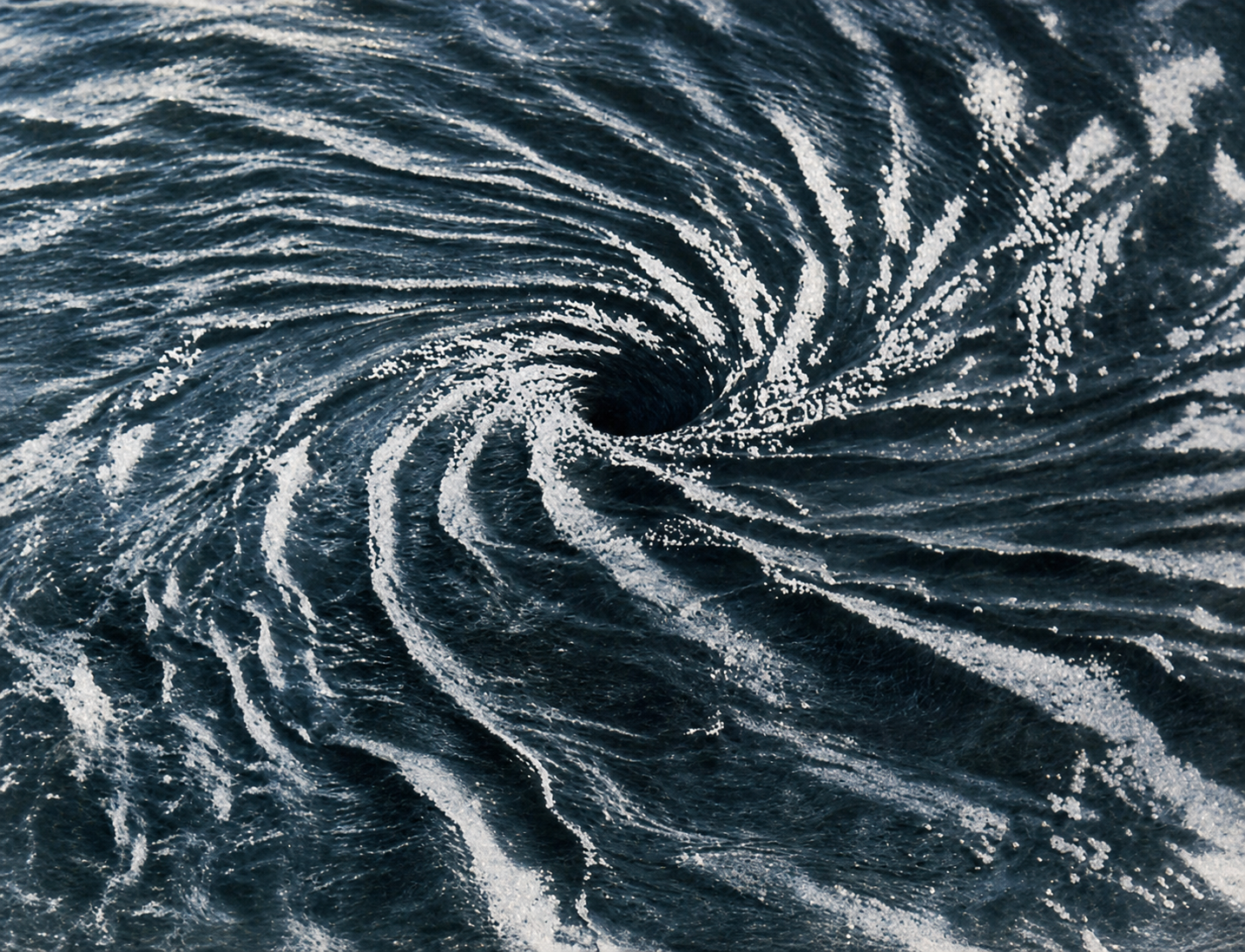
I believe accurate understanding of wholeness is quite different. When we understand what wholeness is really like as a structure, we see that in most cases it is the wholeness which creates its parts. The center is not made from parts. Rather, it would be more true to say that most of the parts are created dy the wholeness. They settle out from the wholeness, and are created by all of it. This is analogous to the way a
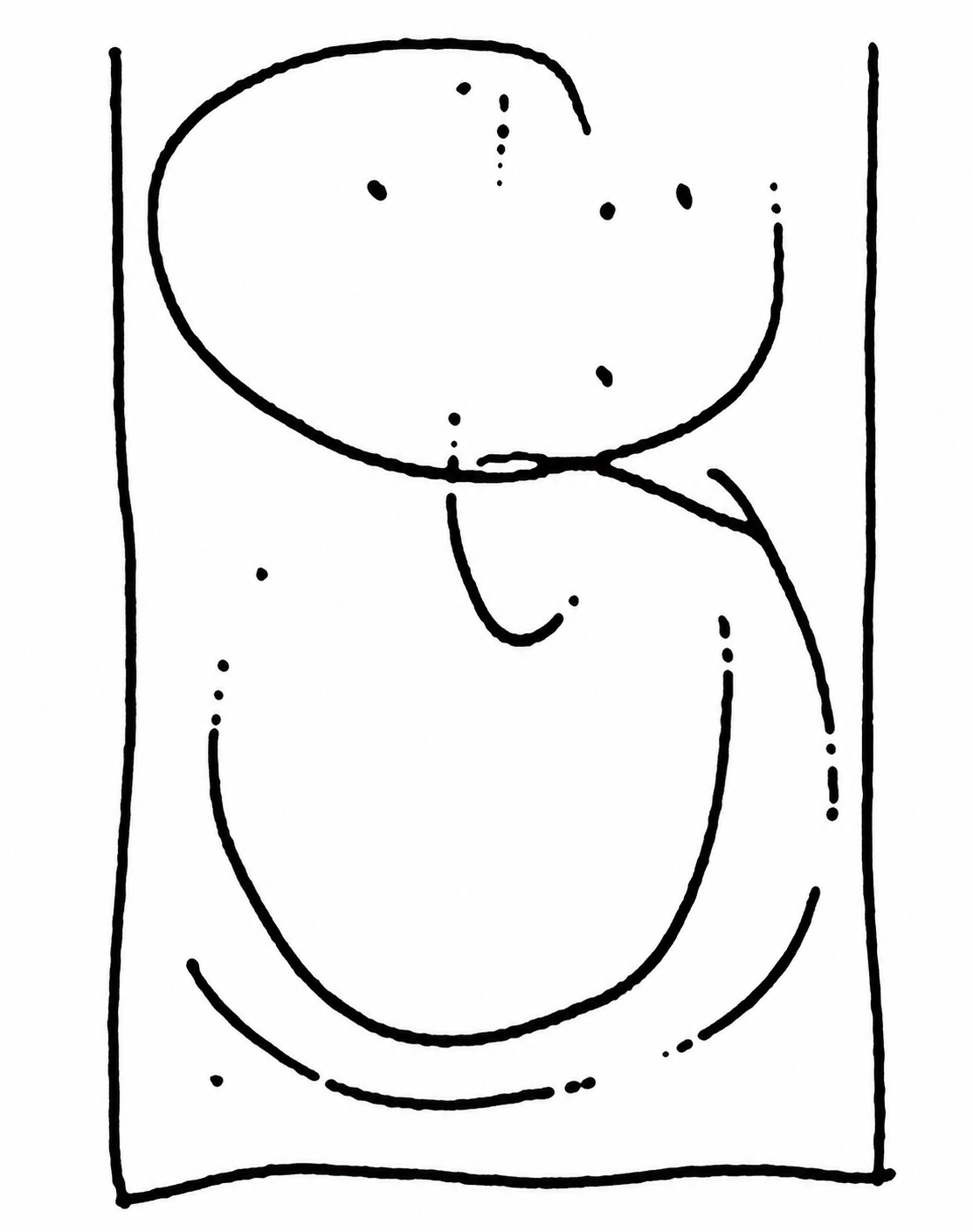
Two dots, Case 2: When the second dot is added in a different position, an entirely different configuration makes its appearance. This configuration includes a major diagon al center, and two triangular centers in the top left and bottom right of the rectangle.
whirlpool is created in a stream. The stream whirls, and the centers we see as the whirling (vortex, stream-lines, etc.) are created by the larger configuration of banks, rocks, and so forth. So, within this whirling, we observe a whirlpool which has formed. This is fundamentally different from the idea that wholes are made up from elements or built from parts.
We may see the phenomenon as I believe it to be in the two-dot examples, where the visible things that look like parts are induced by the whole. Thus the visible diagon al in the second case of two dots is something we might call one of its "parts." But it is not a pre-existing element. It is a part which is induced by the action of the whole. It "breaks out" naturally from the whole. In no sense at all is it an element from which the center is built.
The diagon al is not an element or part: it is a center which is generated in the wholeness.
When we understand things in their wholeness, this is the general rule. The sub-wholes -- or centers -- are induced within the wholeness, and come from the wholeness. And because of this, the parts are adapted and modified, in shape and size, by their position within the whole. The petals of a flower are not identical. They are similar, but each one is slightly different according to its position and history in the whole. When parts repeat we never have identical repetition. Instead we have repeated parts as centers which are changing and variable according to their position in the whole, as they repeat within the whole. In nature, this follows directly from the fact that parts are induced by the whole and created by the whole. The whole is not created out of them. The flower is not made from petals. The petals are made from their role and
position in the flower. This is an entirely different vision of reality from the one we have become used to. In this new vision, it is always the whole, the wholeness as a structure, which comes first.
Everything else follows from this wholeness, and from the centers and sub-centers which are induced within it.
7 / a Further Example of Wholeness
I hope the wholeness, MW, as I have defined it, actually is beginning to capture that character we intuitively think of as "the whole."
Consider these two drawings of arches, A and B. The drawings are superficially somewhat similar, but the feeling they have is very different. We are aware, if we pay attention, that as wholes, they have a pronounced and different gestalt.
"A" has an arch form, a marked center in the middle at the point of the arch, and an overall coherence. "B" is a simpler, rectangular version of the same thing. But the difference is greater than these words suggest. The two really have extremely different character.
If we focus on the space as a whole, we see how different they are. The pointed one, A, has a focus on the point of the arch. It is united. One sees two wedge-shaped swaths of space to the left and to the right, emphasizing the way the sharp point almost cleaves the space above. The point is also very strongly marked. The second arch, B, is much more blunt. The main thing one is aware of is the stillness of the large square of empty space above the arch. The top of the arch, chisel shaped, is also still. One sees the two legs
Drawing A
on either side as appendages. All this is what we mean by the "wholeness" of the two drawings.
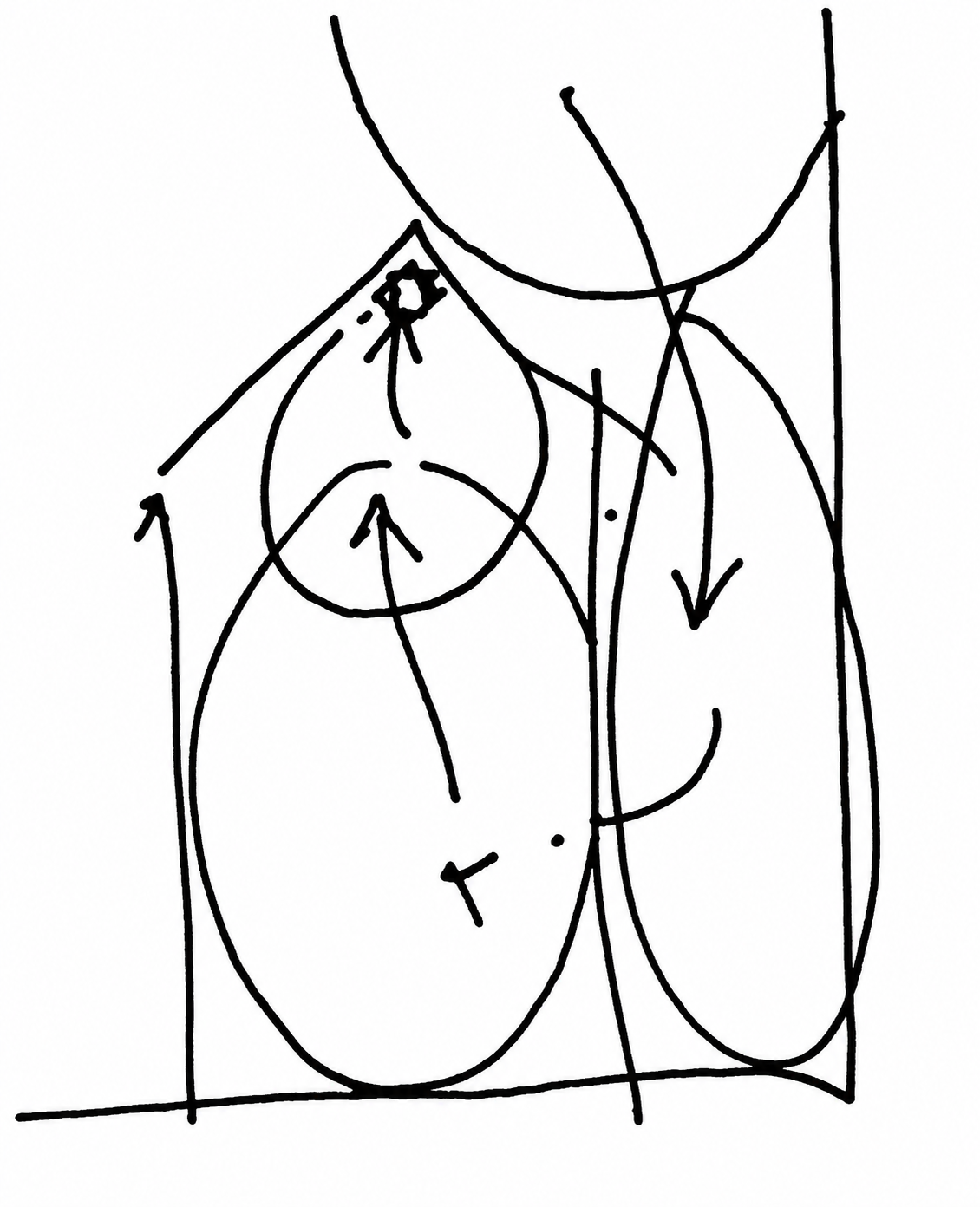
DRAWING A. In the drawing labeled "Structure of A," I have outlined the most salient centers which appear within the space of the drawing and form the wholeness W. We can see that the centers ] have marked form a kind of nested sequence. There is one at the vertex. There is another which is the triangle of space below the vertex that includes the vertex. There is another which is the whole arch. On the right and left of the arch, there are yet other upside-down trapezium-shaped wedges of space. Then there is a kind of rectangle of space next to the arch on each side of the arch.
Together these visible centers form a kind of swooping movement which starts at the top of the drawing, goes down either side, and then comes up the middle, culminating in the point of the arch. They form a nested structure, which emphasizes the point of the arch and supports the entity that és the arch. The wholeness that we experience -- the overall gestalt of the whole thing -- is precisely captured by the structure W.
Drawing B
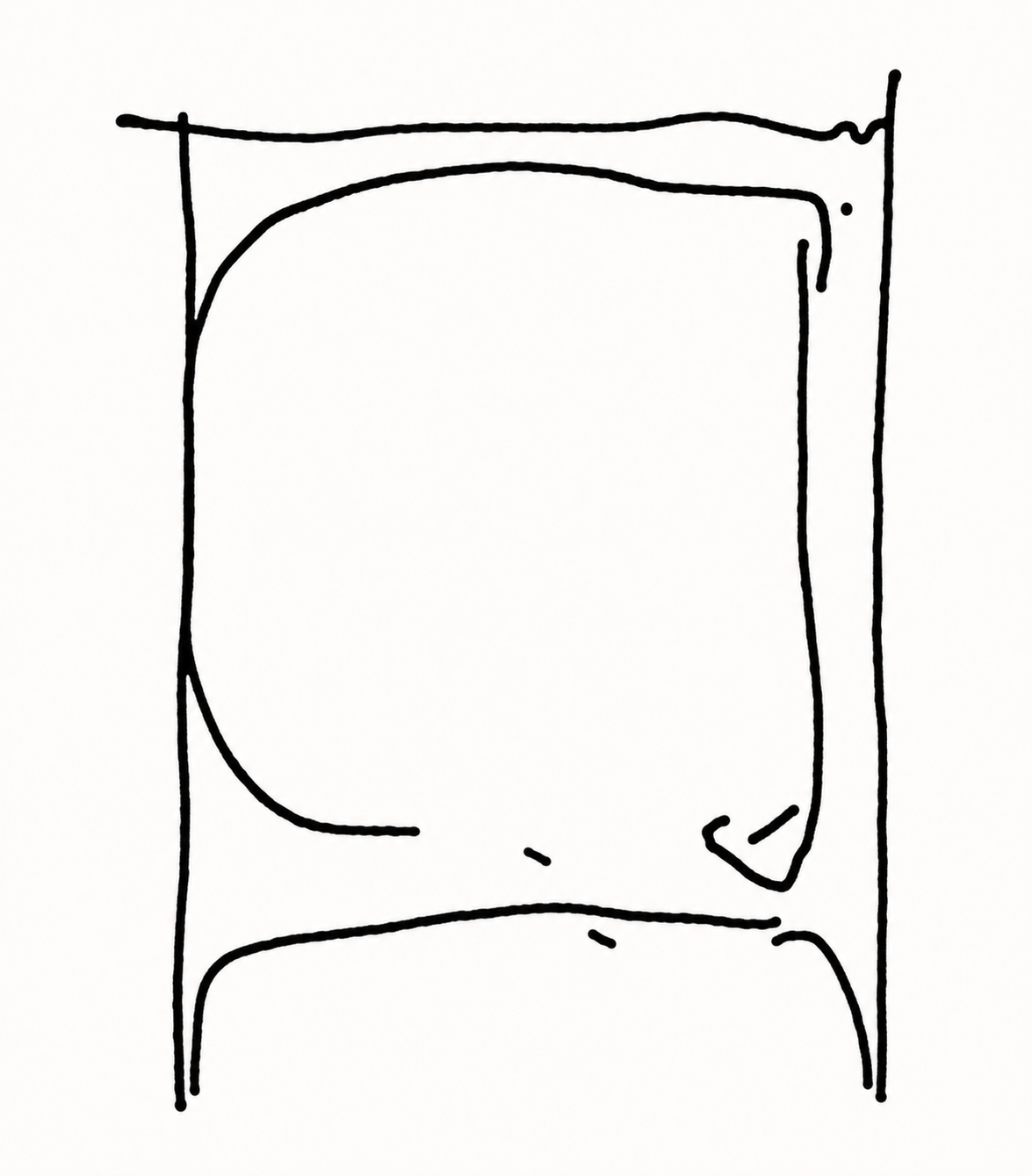
Structure of B, showing the main centers of which it is made.
DRAWING B. In the drawing labeled "Structure of B," I have again outlined the strongest centers which appear to form its wholeness. In this case the centers form a somewhat less coherent structure than in A. There is one center in the rectangle at the top, across the top. There is another down each side. There is one center in the arch. These centers fit together in a fashion that roughly resembles the structure of the centers in drawing A, but it is a different structure. For example in B the rectangle across the top is stronger and far more dominant than it is in A. The centers inside the arch are less nested and less dominant than in A. An overall structure exists in B as it does in A, but appears to be less coherent, less bound together.
In both drawings, the system of centers describes the wholeness we intuitively experience in the thing. And we have a hint of the way the wholeness Walso begins to describe, and explain, the difference in life between the two drawings. A has more life than B, even if only slightly, and we find this fact reflected in the more coherent structure of its wholeness.
8 / the Fundamental Entities of Which the World Is Made
Let us move on, now, to consider the appearance of the wholeness W in real world examples.
In the foregoing examples we saw how the wholeness of each drawing -- the broad sweep of the thing -- may be seen as the pattern of the main centers which exist in the space of the drawing. In the arch drawing, the centers are the plain and simple swaths of space and the special bits which stand out, like the apex of the arch or the point where the line of the arch meets the uprights. When we take these centers together, we see how they form themselves into still larger centers -- the sweep of the arch, the symmetrical system over the point of the arch, and so on -- and that it is then the pattern of all these centers working together which forms the whole.
What exactly, then, is wholeness? That is the crux of the matter. My answer is that the wholeness is not merely a way of focusing on the gestalt of the thing, but is instead a real structure, an actual "thing" in itself. It is a structure which exists in the world that includes what we intuitively perceive as the gestalt, the overview, the broad nature of a thing. It is the source of the coherence which exists in any part of the world.
This wholeness gets its strength from the coherent spatial centers of which it is made. If there are roses around a front door of a cottage, that is what you remember; if there is a pair of ducks in the garden, and a fishpond, it is the ducks and fishpond you remember; if there is a great and wonderful room with mattresses where everybody sleeps -- as in an Austrian mountain hut -- then that is what you remember. The roses, the ducks, and the mattresses are all centers, and it is these entities or centers which mark something as what it is, which make it memorable, remarkable.
The coherent centers define character, and create arrangement. The main coherent centers which exist in a place determine what it is like there, what kind of life it has. The centers are the most fundamental things we notice in what is happening. They affect us most. And this importance of the coherent centers, as the entities which govern the character of a thing, appears on a more physical level too. If a building has a room with an enormous gilded ceiling, it is that ceiling we remember. If the room has immense windows with hundreds of panes looking toward the soft east light, it is those windows we remember. The Stefansdom in Vienna has a huge: eagle on the roof. It is the roof we remember, and the huge eagle on it. If one building has columns which are blank concrete shafts, and another has capitals, with a wonderful shape, painted and round, it is these capitals we remember. If a building has a skating rink outside, like Rockefeller Plaza in New York, it is the skating and the skaters we remember.
These are the explicit, obvious centers. And they are not only spatial. Other centers, some hidden, some hardly visible in the space, but latent, or biological, or social, also control the behavior of the world. The arrangement, shape, and pattern of buildings, rooms, streets, and furniture come from the centers again. That which we commonly call "arrangement" -- as in the simple example of the two arches in drawings A and B -- is also created by centers. Even shape is dominated by the centers and sub-centers which form it. A cross is created by one center at the crossing point, four centers at the extremities, with their larger centers formed by their overlapping relationships to one another. A circle is created by a continuous system of identical centers forming short arcs around the perimeter, neighboring ones overlapping each other and coming back to join themselves, with larger centers in the void of the circle to form the core.
The wholeness of any portion of the world is this system of larger and smaller centers, in
WHOLENESS AND
Cottage with ros their connection and overlap. The wholeness of a window includes the coherent space which binds the window together -- its sill, glass, the sloping reveals, its mullions, the landscape outside, the light coming in, the soft light on the wall next to the window, the chair drawn up toward the window's light -- and the formation of larger centers which makes them one: the space of the window seat which binds the window reveals, seat, sill, and window plane; the view which combines chair, outdoor landscape, and the glazing bars; the light falling on the window reveal and on the floor. Here, as before, the wholeness is defined by the major centers -- entities -- and the way these centers are arranged to form still larger centers. Some centers are explicit. Like the dot, which we gl
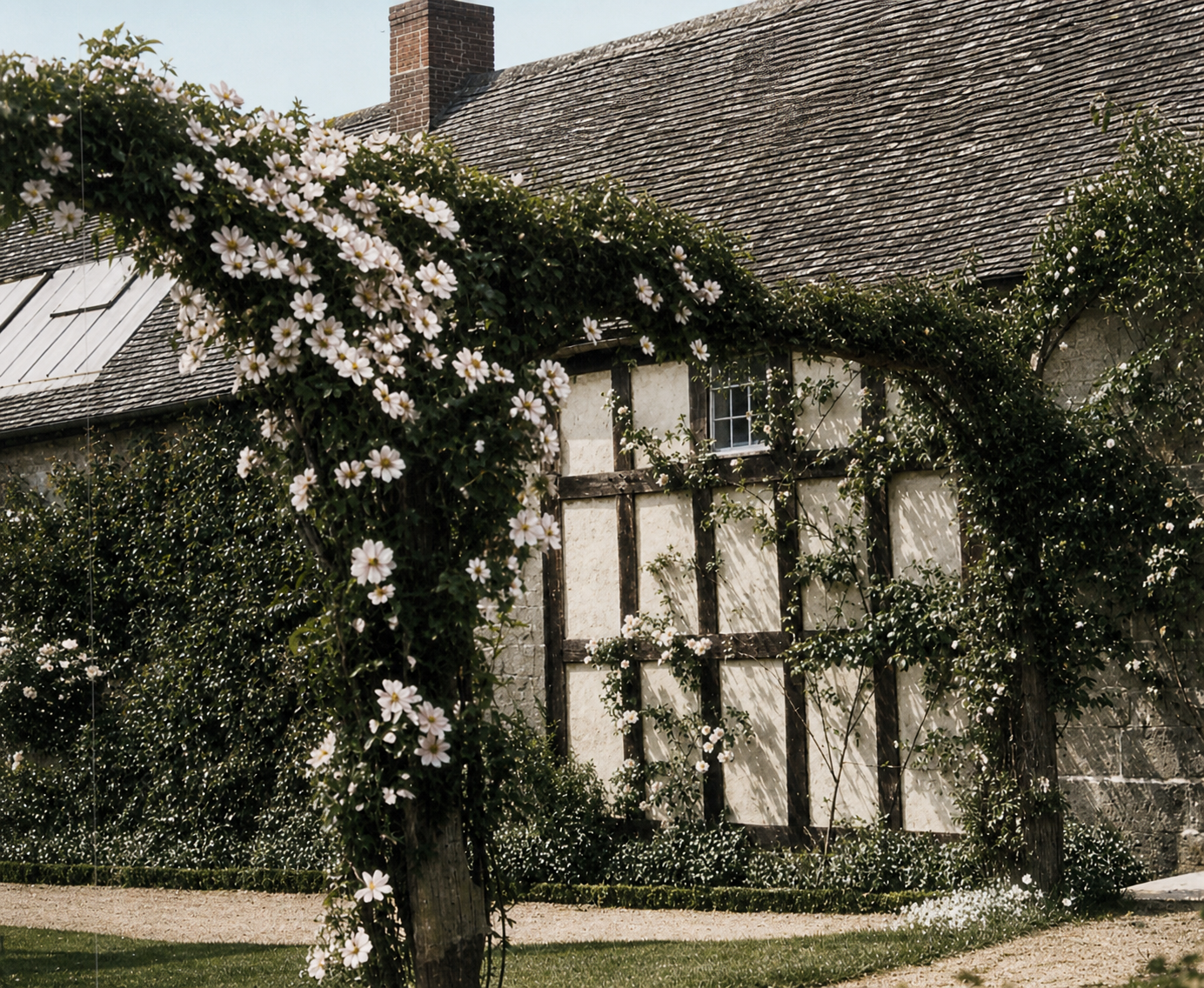
its character is given by its dominant centers, the roses, the arch of roses, the timber frame, the plaster squares.
see easily; others, like the space around the dot, we see with more difficulty, because it is more subtle. In the photograph on this pages, the cottage is given its character partly by the explicit and obvious centers -- the roses, the arched trellis on which the roses climb, the surface of the roof, the individual tiles which form that surface. And, partly, it is given its character by the less visible centers, formed and induced within the wholeness -- the "hole" of the archway beneath the trellis, the space in front of the cottage wall, the line in space which connects the archway to the small window in the cottage wall. All the centers together, explicit ones and hidden ones together, form the wholeness in this cottage, as they do in any given part of the world at any moment.
9 / the Subtlety of Centers Which Exist
Let us now consider a further example of the subtle wholeness as it appears in the real world. Look at the scene in the photograph on the right. We see a tree, a road, and a bicycle parked at the edge of the road under the tree. In our normal way of looking at this scene, we see various fragments which seem to be "parts" of the whole: the tree, the road, the bike, the cyclist.
Learning to see the wholeness as it is in a case like this, not muddled or contaminated by words and concepts, is extremely difficult, but it is possible to learn, consciously, to pay attention to this wholeness. (The difficulty is discussed at some length in appendix 3, where I also give one example of a technique for helping a person see wholeness as it is.'5)
When we see wholeness as it is, we recognize that these seeming parts -- the road, the tree, the bike, these particular centers -- are merely arbitrary fragments which our minds have been directed to, because we happen to have words for them. If we open our eyes wide, and look at the scene without cognitive prejudice, we see something quite different: a great swath of space, wider than the road, which extends to the distance and includes the flat land on either side of the road as one of the major centers in the scene (center #1 in the diagram). We see a space under the tree, between the road and the tree, as another obvious "place" or center within the scene. We see the spot where the
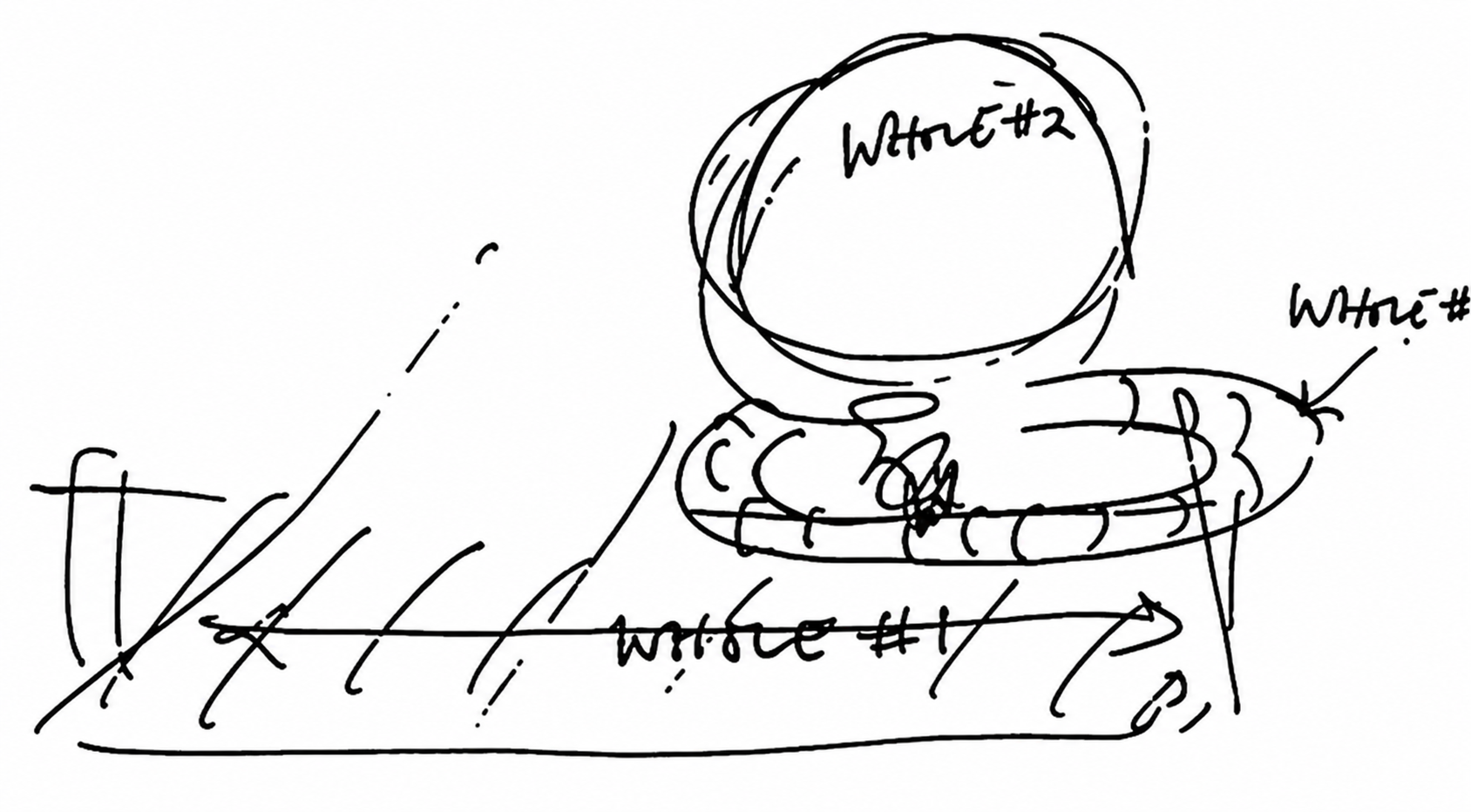
Three of the real centers of which this scene is made g2 person is leaning, on the right side of the tree, as a major point of concentration. Also, if we look carefully, we see a flat, ring-shaped swath of space under the tree, almost like a flat cylindrical donut, caused by the fact that the tree's foliage has been trimmed to just above head height all around (center #2 in the diagram). And we see the top of the tree, the wooly, beehive shape of the tree itself -- but it is not the tree which draws our attention as an entity -- it is the top of the tree without the trunk -- the mass of foliage (center #3 in the diagram). Thus the centers we see, when we look for wholeness, are not the centers which are captured by words, like "road," "bike," and "tree," but a different set of centers, which have no special words attached to them, and which are induced structurally by the overall configuration of this scene.
The wholeness of this scene is created by these centers, all of them together. They are really there, actually existing centers in the space. It is not our imagination, and not some conceptual occurrence. Their existence and their strength becomes visible when we make our minds blank and look without focusing at all parts of the page at once. In this unfocused or defocused state, we see the big swath of space over grass and road, we see the cottonwool top of the tree, we see the trunk and the ring of space around it as the strongest things. The things which have easy names -- the tree, the bike, the road (though they too have their relative degree of wholeness and centeredness) are less strong within the overall configuration. They are centers, too, but they are lesser centers within this configuration, and play a less important role within the structure as a whole.
For example, why does the rider of the bike put his bike under this tree? What invites him to stop, what invites the bike to be there at all,

tree itself. Thus the wholeness and its real system of centers, hidden and not-hidden, are the structures which have impact on the world. We __ rather more complex case: my family's garden in shall not understand how the world works un-
Consider, from this enlarged perspective, a West Sussex, England. What is most noticeable about the garden is the way it has life. The ducks come up from the pond, following one another, to the gate. The plum tree is on the sheep meadow. The tennis court, at one corner of the garden, is shielded by rows of apple trees, heavily laden with fruit. In the main flower border the roses bloom; the driveway comes up to the house between nettles and hawthorn hedges. The cats bring the rabbits they catch, and leave the innards of the rabbits on the back terrace. The meadow by the stream floods in the winter, and the following spring the meadow is thick with flowers.
What makes this a living structure is its wholeness. And what exactly is its wholeness? It is the white-washed brick house, standing foursquare and simple, unadorned in the field. Itis the huge kitchen, the largest room, lit on two sides by garden windows, with a big warm stove warming the kitchen constantly as it heats the hot water; the kitchen table, long, with eight rush chairs around it; the hallway, generous, uncluttered, a room in itself that you enter as you come into the house. The centers which make this farmhouse what it is, and the life which occurs in the farmhouse, are inseparable. It is the centers which create its behavior, its nature, its substance
Although one may be misled into thinking about design, the features which design seems to deal with are minor, have less importance. The centers -- the coherent entities which form the whole -- are life-affirming, massive in their effect, and tremendously concrete, so that minor changes in design could not sway them, or upset them, or change them.
For example: the duck pond, surrounded by the pasture on one side, by the chicken run, with the small seat on one side and the island where the ducks go to escape the fox at night. All these are the effective centers, which make the life of the ducks at the farm.
For example: the stone terrace outside the kitchen, leading out onto the lawn, with the cat door in it. It is the place where we sit, go out to cut flowers in the rose beds just beyond. The flagstones which form this center have an enormous role in the active life of the house.
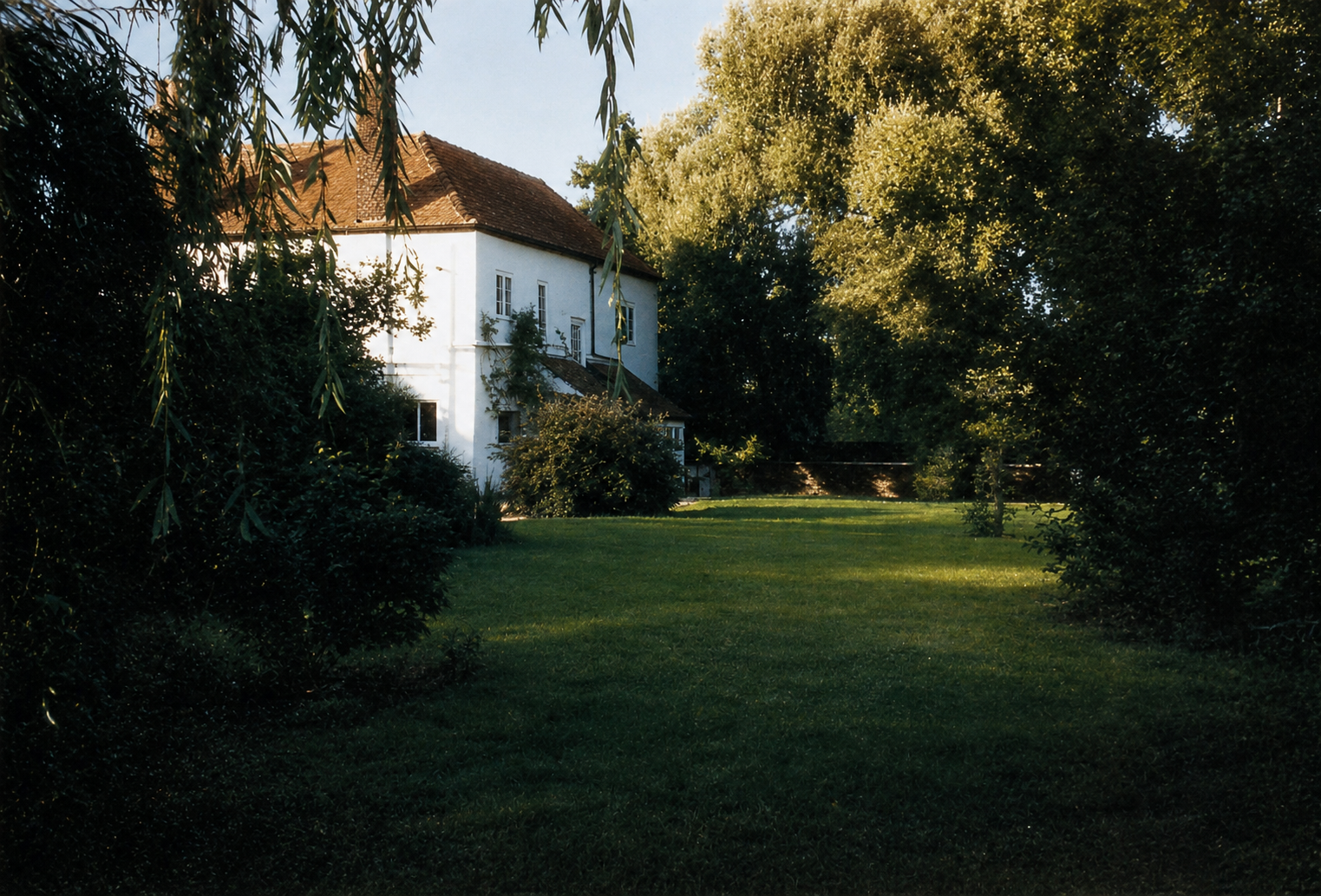
In the wholeness of this garden, we find that, once again, it is the rea/ centers -- the most coherent centers as they actually are, not those which happen to have convenient names -- which dominate the feeling and behavior of the place.
Consider the wholeness of the building and the lane together. Suppose there is a garden in front. Perhaps there is a porch, a stone platform at the door, flowers in the garden, a hedge along the lane, and at the back of the garden the wall of the house itself, windows in that wall, a roofline -- and so on.
What does it mean to see all this from the point of view of wholeness? I notice the sunny part of the garden itself as a space. The place where the roses are climbing near the kitchen catches my eye. The path to the front door, and the steps from the back porch, and the door itself, the door of the house, all work as a unit, as a continuous center about 40 feet long. The sunshine and the roof edge, with the rafters repeating under the eave, together form a pattern of light and shadow which leads my eye, and forms a boundary of the house against the sky. Perhaps there is a reflection from one of the windows. The window and its curtains form a frame for what I see behind in the darkness of the room.
All this is much more like a pulsating unity than the "conceptual" or intellectual image of the house. In our conceptual picture of the house, we have things called street, garden, roof, front door, and so on. But the centers or entities which hit my eye when I take it all in as a whole are slightly different. I see the sunny part of the garden where the sun is falling on the lawn as a center -- not the entire "garden." I see the swath of space which unites front steps, front path, and front stoop, not the "front door." I see the roofline and the light and shadow of the eave, not the "roof" as such. Also there is a thing which I might call "garden-plus-street" -- a center where the flowerbed meets the street. This is entirely different from the conceptual and verbal entity "street" or the conceptual and verbal entity "house." It straddles conceptual boundaries.
The difference is deeply functional, not just a matter of visual perception. The centers we see when we look at the thing in its wholeness are the ones which are responsible for its real behavior. For example, it is the sunny part of the garden which makes a difference to the way the garden really works, not the abstract or conceptual entity marked "garden" that is bounded by the house and the fence. It is the swath of space going from the front gate, over gravel, past the roses to the front door which actually controls the way we feel as we approach the house and enter it -- not the conceptual entity "front door." It is the bit of land where garden lawn meets fence and field where the sheep graze, backed up by the willow over the lawn, where we often pull our chairs in the shade, that allows us to sit there drinking our tea, watching the world go by -- and this affects the life and feeling of the house in its relation to the world much more substantially than any characteristic of the abstract entity we call the "garden."
Thus the centers we notice when we see the situation in its wholeness are not only more dominant to the eye. They control the real behavior of the thing, the life which develops there, the real human events which happen, and the feelings people have about living there. The house-garden complex seen in its wholeness is truer perceptually and more accurate functionally than any analytic vision of the house or lot or garden taken by themselves.
It is apparent, if we think carefully, that we are not used to seeing -- or looking at -- this kind of structure in the world around us. If we consider a garden and a house from this point of view, the deep centers hidden in the house and the garden are unexpected, just as they are in the sheet of paper with a dot. They are subtle, perhaps invisible to a casual observer. Yet it is these centers and their structure which give the thing its life.
10 / Wholeness As a Fundamental Structure
Everything that follows in this book is a view of physical reality dominated by the existence of wholeness as I have defined it.
I propose a view of physical reality which is dominated by the existence of this one particular structure, W, the wholeness. In any given region of space, some subregions have higher intensity as centers, others have less. Many subregions have weak intensity or none at all. The overall configuration of the nested centers, together with their relative intensities, comprise a single structure. I define this structure as "the" wholeness of that region.'*
This structure exists everywhere in the world. It exists in nature; it exists in buildings; it exists in works of art. It is a fundamental structure in space which not only encompasses the wholeness or gestalt of the thing; it also encompasses the obvious parts, or elements, from which this thing is made."
I am firmly convinced that the nature and behavior of buildings and other artifacts can only be understood within the context of this structure. In particular, objective recognition of the fact that some buildings have more life than others, and are objectively more beautiful and satisfying, can only -- I think -- be achieved in the context of this structure."
I believe, too, that life, in an ordinary biological sense, is itself also created from this wholeness: and that efforts to explain it in more mechanical fashion will go on failing, as they have in recent decades.
A crucial feature of the wholeness is that it is neutral: it simply exists. Determination of its details may be made by neutral methods, yet at the same time -- as we shall see in later chapters -- the relative harmony or "life" of a given building may be understood directly from the internal cohesion of the structure. Thus, the relative life or beauty or goodness of a given part of the world may be understood, I shall argue, without reference to opinion, prejudice or philosophy, merely as a consequence of the wholeness which exists.
11 / the Global Character of Wholeness
I have not yet emphasized the enormous power of the wholeness, W. This structure catches the overall character in a way which is almost mysterious, but goes to the heart of many things not easily explained. This happens because it is an overall field-/ike structure, a global, overall effect. It is distinct, completely distinct, from the elements or "parts" which appear in that wholeness; it is unusual in our experience, yet catches what we have often thought of as the artistic intuition about the whole.
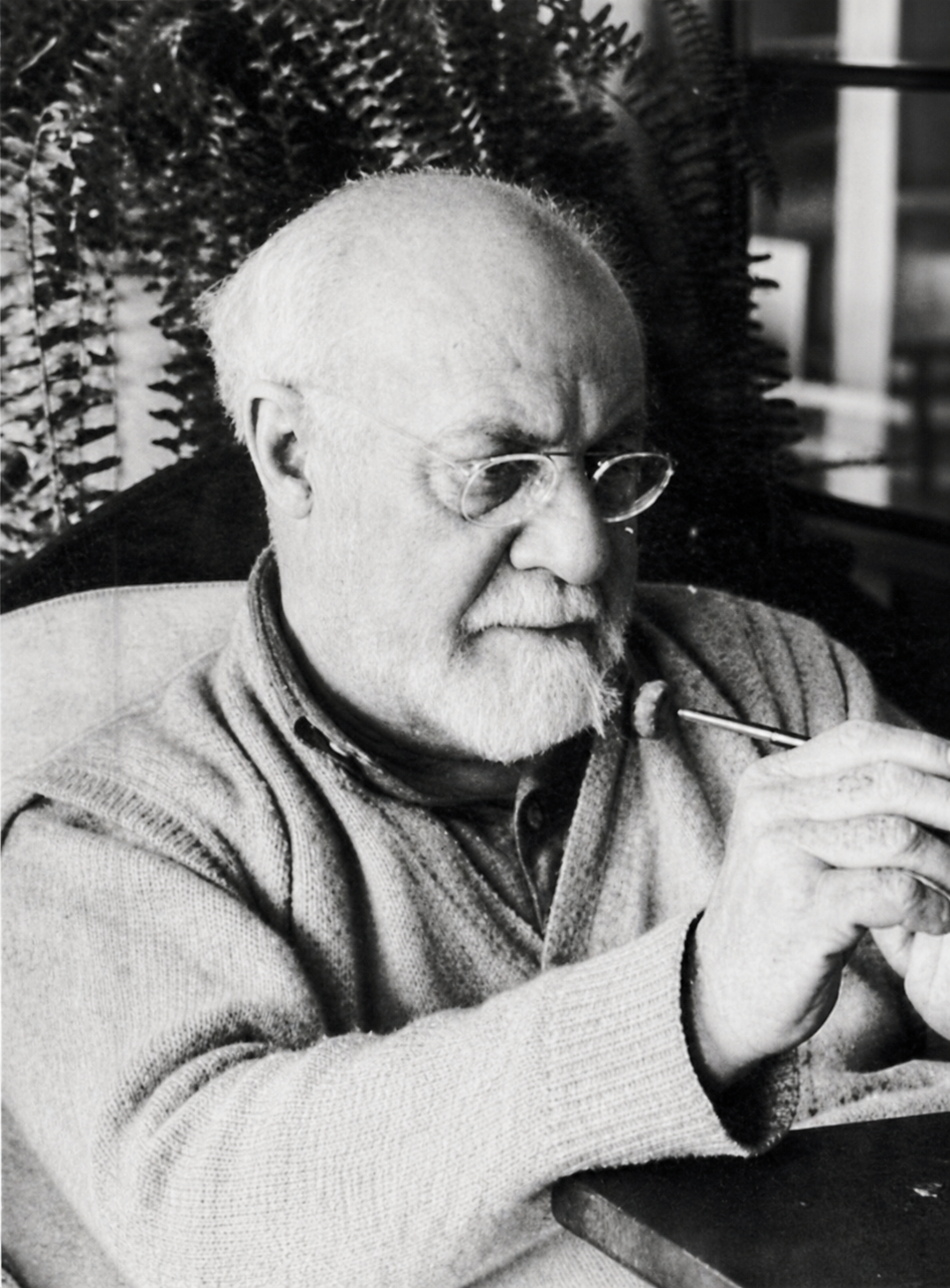
I know of no example which makes this more clear than a famous one which appears in an essay on portraiture by Matisse.'? He talks about the fact that the character of a human face is something which is deep in the person, deep in the face, and may not be captured by the local features in the normal sense at all. To make his point, he shows four drawings he made of his own face. These drawings, reproduced below, are remarkable. The features, in the normal sense, are different in each drawing. In one he has a weak chin, in another a very strong chin. In one he has a huge roman nose, in another a small pudgy nose. In one the eyes are far apart, in another they are close together. And yet, in each of the four faces, we see the unmistakable face and character of Henri Matisse. As Matisse says, the
clearly?
What in the world is going on? What is it that Matisse is seeing? How is it that we see Matisse's face, in each case, even though the features are so entirely different? What is this elusive "character" in a person's face which Matisse can see so well, and which we fail to see as
The answer is, this "character" is the wholeness. It is the overall vector, the overall qualitative structure, the overall field effect of the face. It is a global pattern-like aspect of the face which is the same in all four pictures. How should I describe this wholeness? It is the bald head with the eyes and with the eyes spreading concentrating downward, coming to a point somewhere around the mouth. Also the lower part, mustache, jaw, etc., somehow spreads outward again. We do not
gw => J
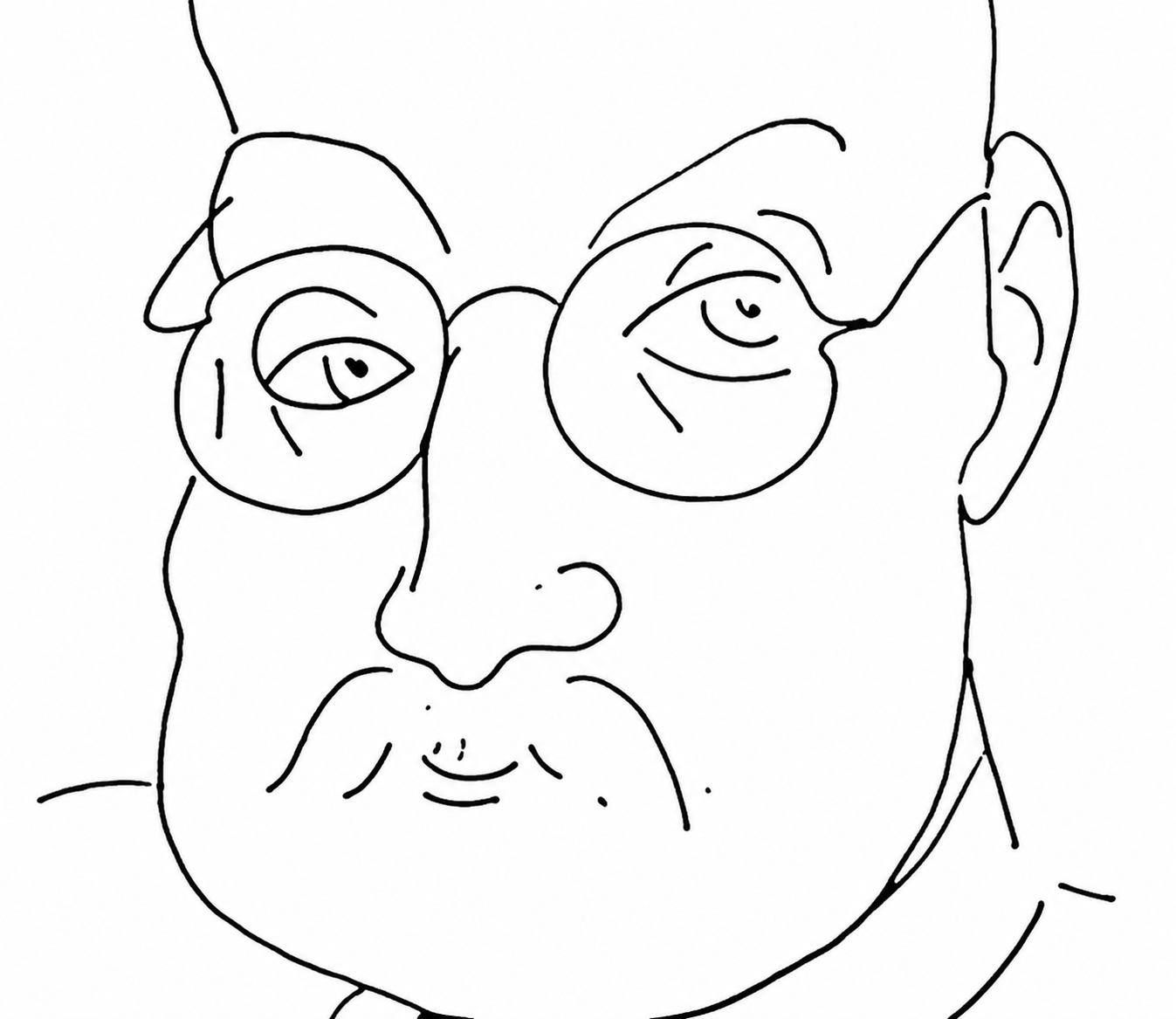
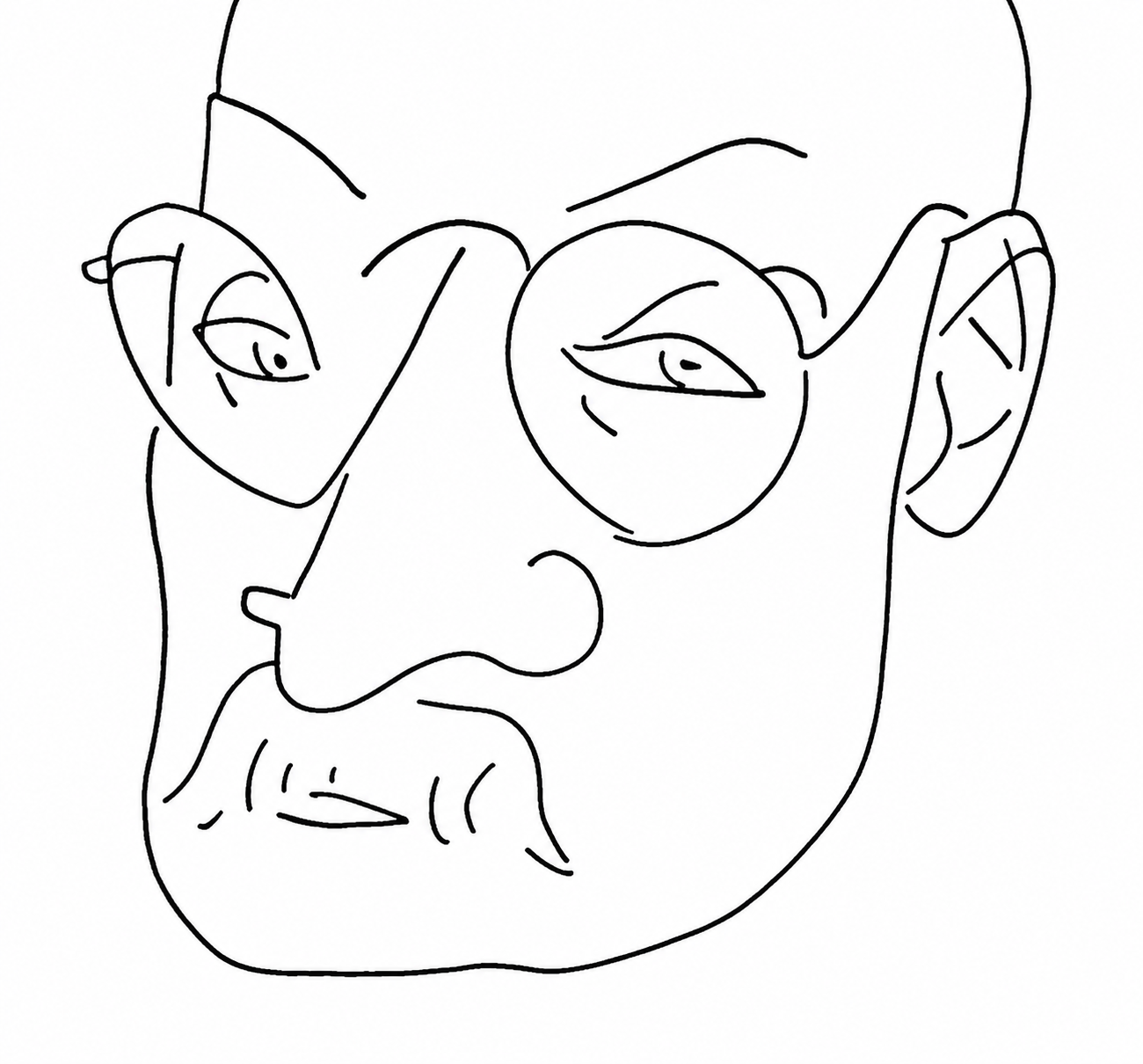
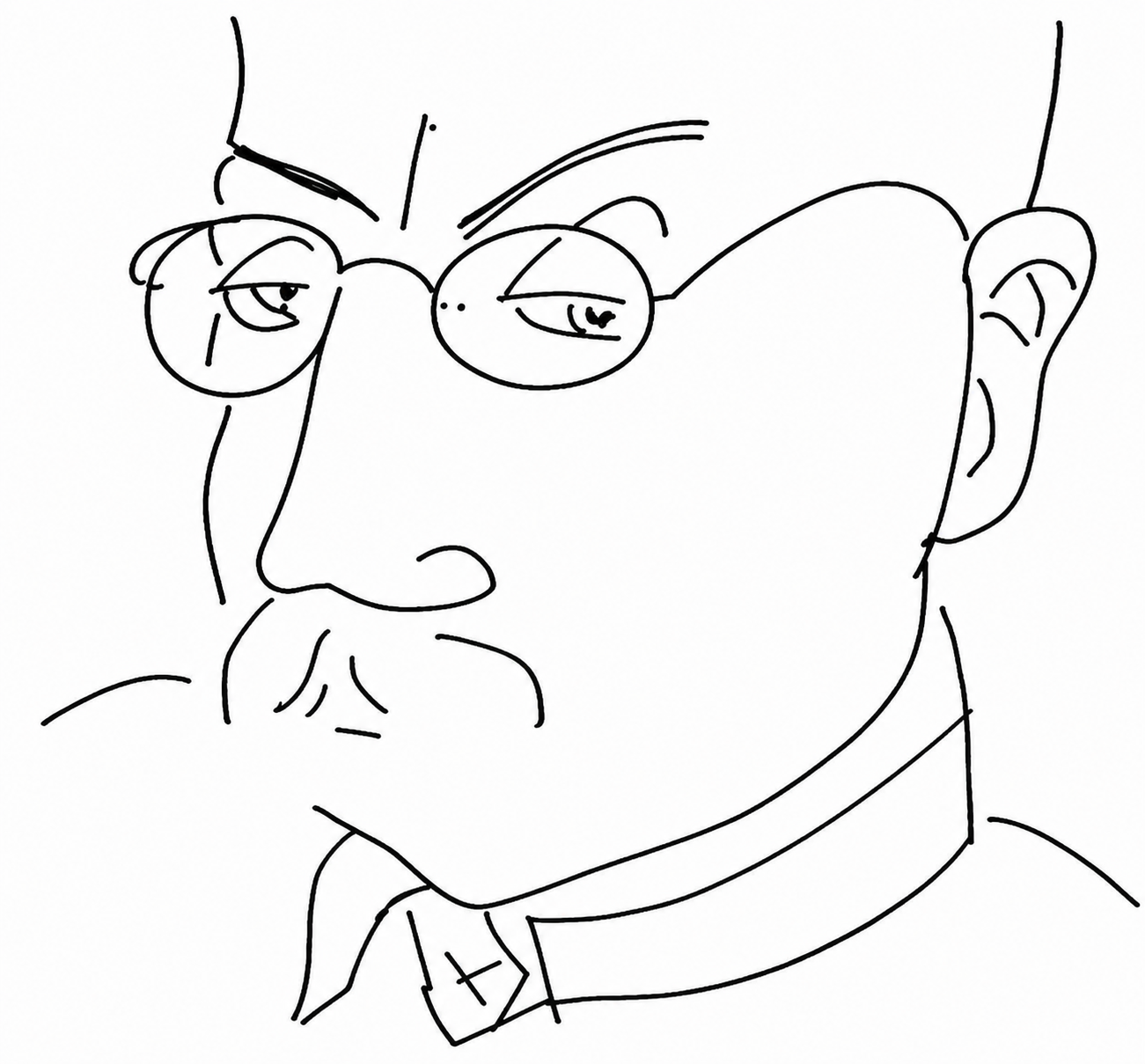
oF have an easy language for describing this kind of overall structure. But it is indeed this overall structure of the centers that is responsible for the wholeness. And, as far as this is concerned, it is the same in all four drawings. And it is the same, too, of course, in the photo of Matisse -- because that is actually what was in is face. The wholeness of this face is that thing which is common to all four drawings, and includes none of that which is different in the four drawings. Thus the drawings accurately reflect the wholeness of Matisse's actual face, even though this wholeness is produced in conjunction with local features which vary enormously.
This definition makes it clear how much the wholeness is a global thing -- easy to feel, perhaps, but hard to define. You cannot get the portrait of a person right unless you can see this underlying wholeness, this underlying inner character. Drawing the features correctly does not necessarily achieve a resemblance. How many artists, in their first attempts at portraiture, have found this out, in frustration? If you want to draw a person, you ave to draw the wholeness. Nothing else will get the likeness."
In portraiture, as in architecture, it is the wholeness which is the real thing that lies beneath the surface, and determines everything.
12 / wholeness As a Fundamental Part of Physics
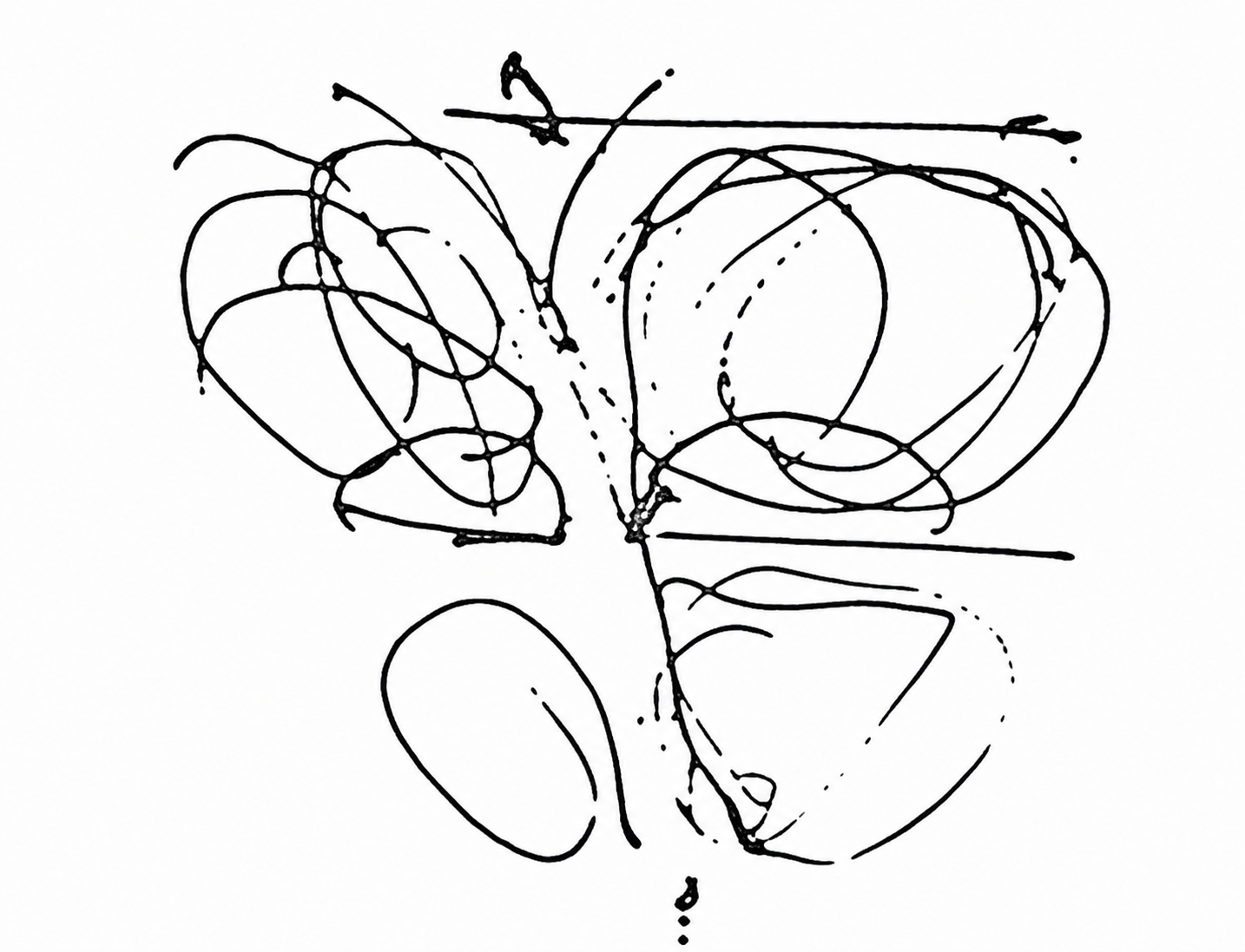
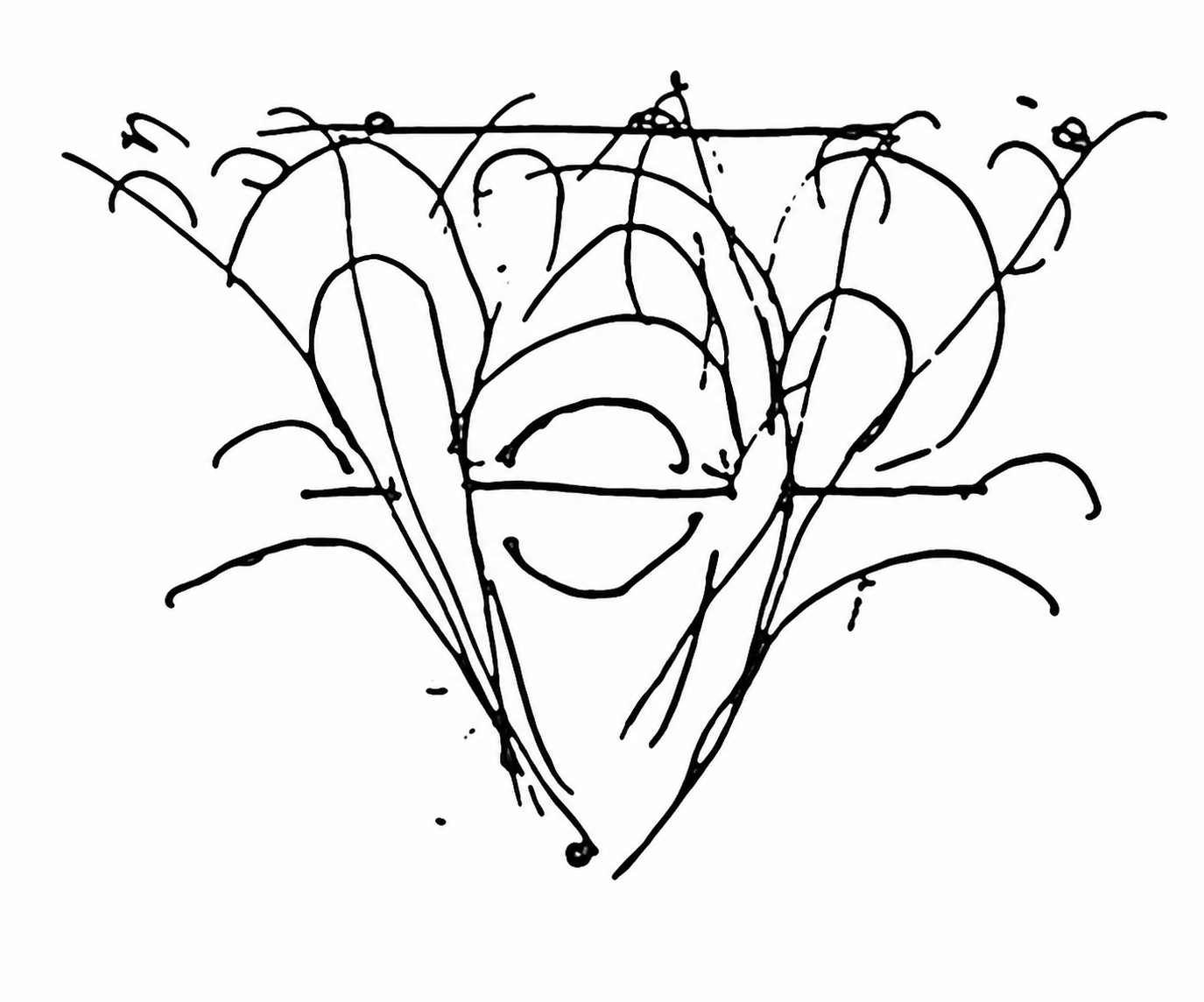
The vital part played by wholeness as the fundamental substratum that governs the behavior of the world extends far beyond architecture and art. Even in modern physics, the "toughest" of the sciences, revolution ary experiments made during the 20th century have indicated that the most mechanical events -- for example the path taken by an electron flying through a geometric pattern of slits -- are also governed by the wholeness of that field, not only by the classical forces acting on the electron.
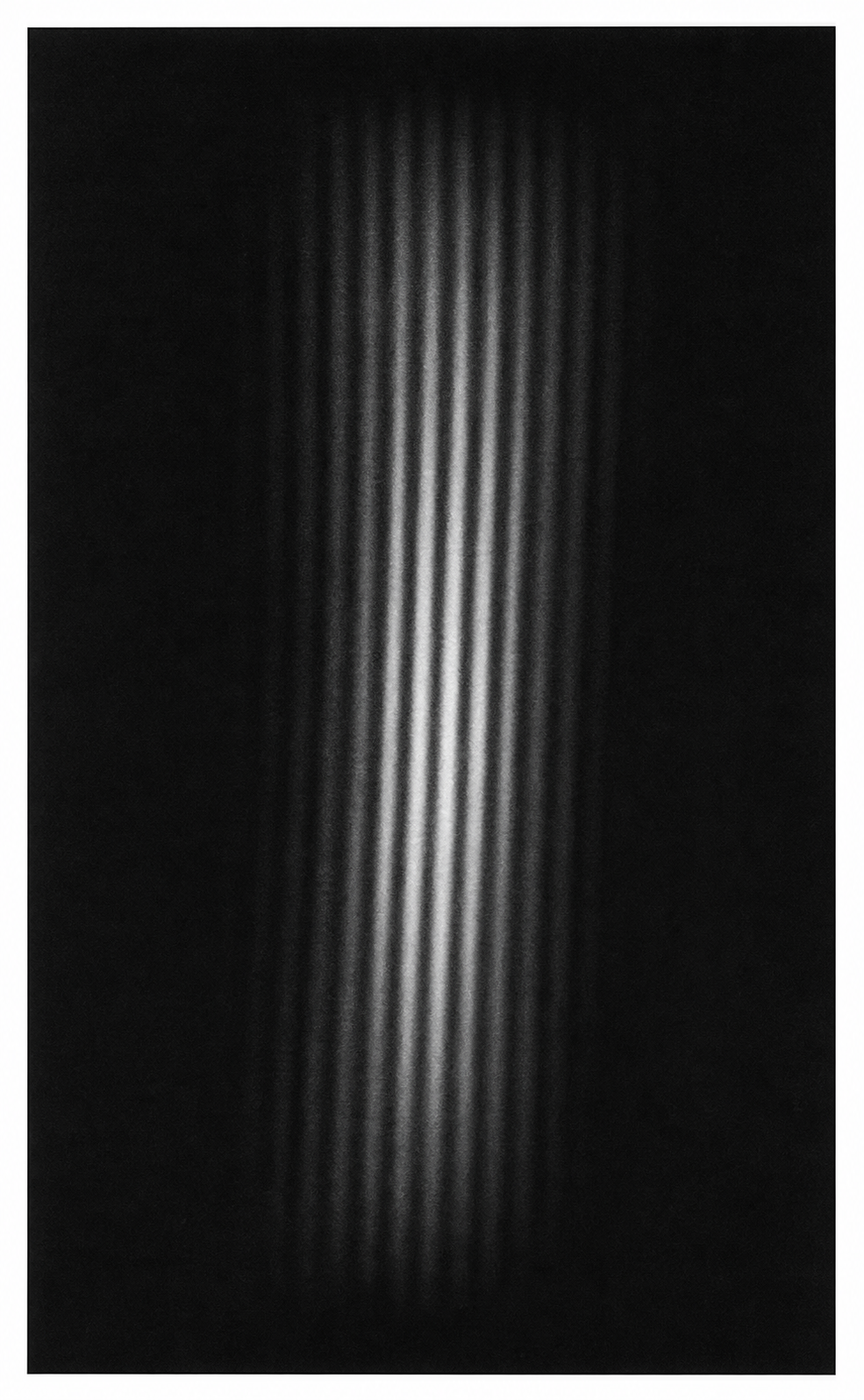
One of the most puzzling experiments of the 20th century is the two-slit experiment. In this experiment, electrons pass through a pair of slits, and then land on a wall: the experiment counts the electrons arriving at different positions on the screen. What has been shown conclusively is that the pattern of electrons arriving on the wall cannot be explained by the normal classical picture of mechanical forces acting on the electron.
Physics has concluded that, in some way, the electron is guided by the wholeness of the experimental configuration."! The mathematics is well understood. But the physical interpretation is not understood, even to this day. Although the analysis and interpretation of the way wholeness should be understood has not yet been agreed upon, there are strong reasons for thinking that the wholeness which causes the motion of the electron is essentially the same wholeness we have already defined: the system of centers created by the spatial configuration of the experiment." What is most remarkable is that it appears that this wholeness influences the movement of electrons in a way that exists over and above any mechanical effects caused by electromagnetic fields and conventional nuclear forces. Thus the wholeness has a fundamental part to play in governing the behavior of matter.
Further details of this experiment, and its interpretation in terms of wholeness, are given in appendix 5. But the essential point for the reader is to recognize that the wholeness, defined as the pattern of centers in some part of space, is not only the underlying causative structure in matters of architecture and art -- but that even the behavior of subatomic particles, electrons, is also governed by this wholeness. Wholeness is a truly pervasive structure, which acts at all scales.
Thin metal \ plate
Pr P2
eo we woe
Hectron \ \ Stit
"Elements Slit open Slit 2open
/ A) Boll eee of phosphor Siit2 closed. Slit 1 closed detector screen
Number of electrons arriving at each detector (in a fixed time)
Diagram of the electrons passing through the slits there.
In appendix 2 and appendix 3, and above all in appendix 6, I give other examples of the power which the wholeness, W, has to explain hitherto unexplained phenomena, because it emphasizes, and makes concrete, the wholeness that is really
13 / Wholeness As the Underlying Substrate
Seeing the power of the wholeness in matters of psychology, and art, and physics, we get some inkling of its potential. I believe that it holds the key to much of what happens in the world, and certainly the key to what happens in buildings, their effect on us, their life. The real character of the world, its flesh, is governed by the centers in the geometry.
Look at the street illustrated in the picture below. What is the origin of its life ac this moment, the basis of its nature? It is the pattern of hydrants on the sidewalk and the centers which they form, the centers formed by the front steps and windows together with the street. These things do not have names, but once again it is the wholeness from which its life originates. It is the

WHOLENESS AND

particular system of centers, peculiar to this street, and the life which emanates from them.
Similarly, even the strange mood of these rooms in the Middle East, haunting, perhaps a brothel, perhaps a harem -- depends entirely on its centers. The dark-eyed women, veils, heavily patterned wallpaper, rooms, and doorways leading on -- this mood is formed by the centers.
In traditional Japan, there is a small garden, a bridge, tatami mats on the floor, a sliding
screen, paper on the sliding screen. These centers are particular to traditional Japan. In India people are comfortable sitting on the ground, even in a public railroad station, because they view their ownership of the ground in another way unfamiliar in the West; to them, all ground is really theirs to use as they wish.
Such centers, each typical for its culture, are carried by culture, and define centers in society and in the built world. Thus one cultural fact of

India exists in the fact that there are some centers made of people sitting and lying on the ground, in railway stations, others carry the same feeling even into a forest as in the scene above. These are peculiarities of India. The two Indian scenes ilthe loose aggregation of space, the trees spaced apart, the flowing saris and the space which they create lustrated are formed by such centers: on the next page, people sitting and lying in a public place during a storytelling episode; above, in the forest, the loose aggregation of space, the trees spaced apart, the flowing saris and the space
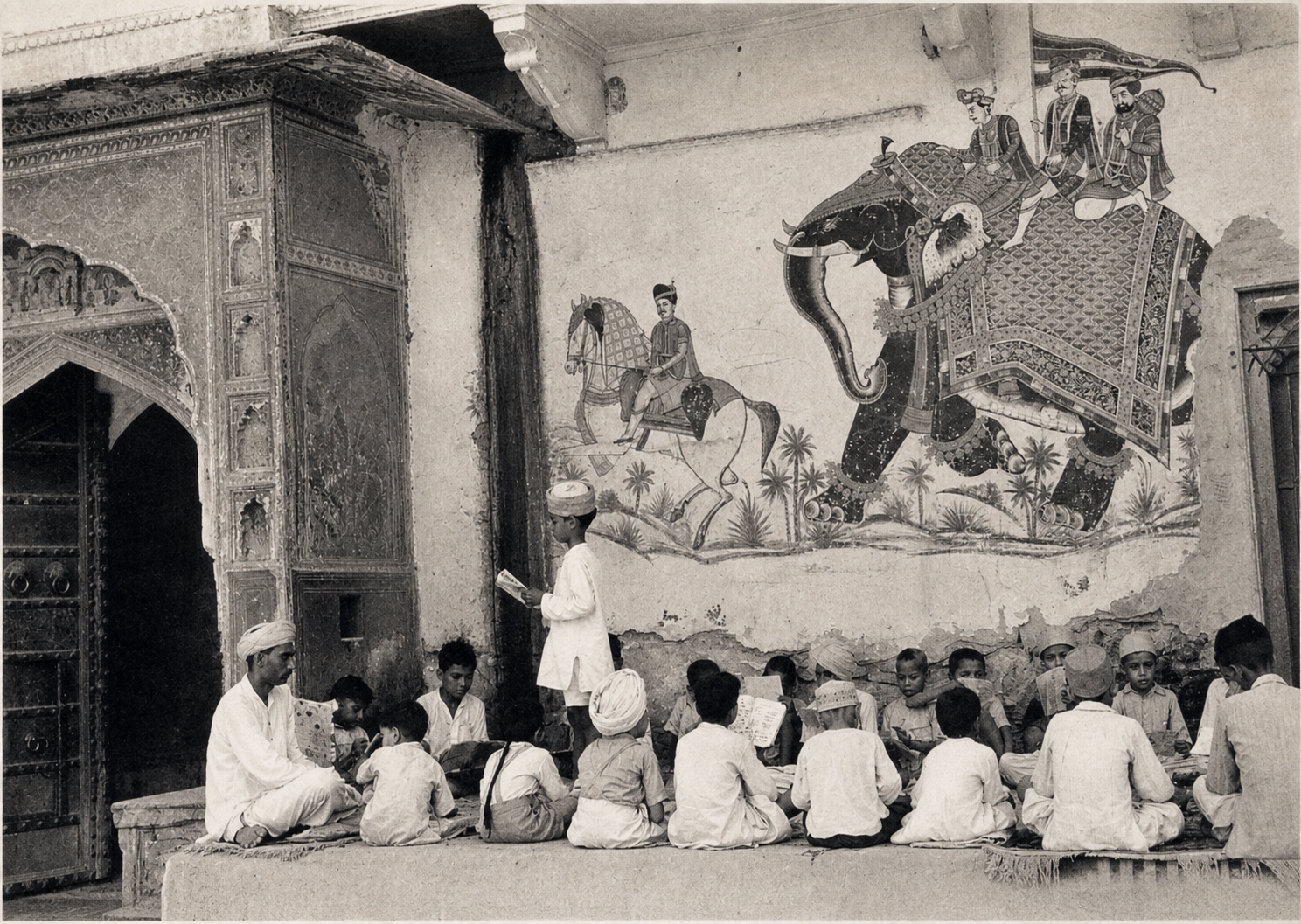
In human society, the wholeness of a given part of space always includes the cultural milieu. In India, the wholeness includes the pervasive existence of centers in which people sit, squat, sleep on the ground. In America this would be an aberration, for which a person might be arrested.
All this depends on the wholeness, W, and its particular state in various parts of the world. W -- that is, the particular system of centers -- governs and defines the cultural variation which we experience in the world.
In a large building, consider the organization: approach, gardens, entrance, main rooms, main structure, doors, windows, ceilings, stairs, the character of the movement from room to room, the character of space in any given room -- all this is given by centers. And the life that happens there -- the social life, the gather-
ings, meetings, the private conversations, individual workplaces, the place to sit, the meals, the welcoming, and leave-taking -- all this too, is embodied in the centers of the building.
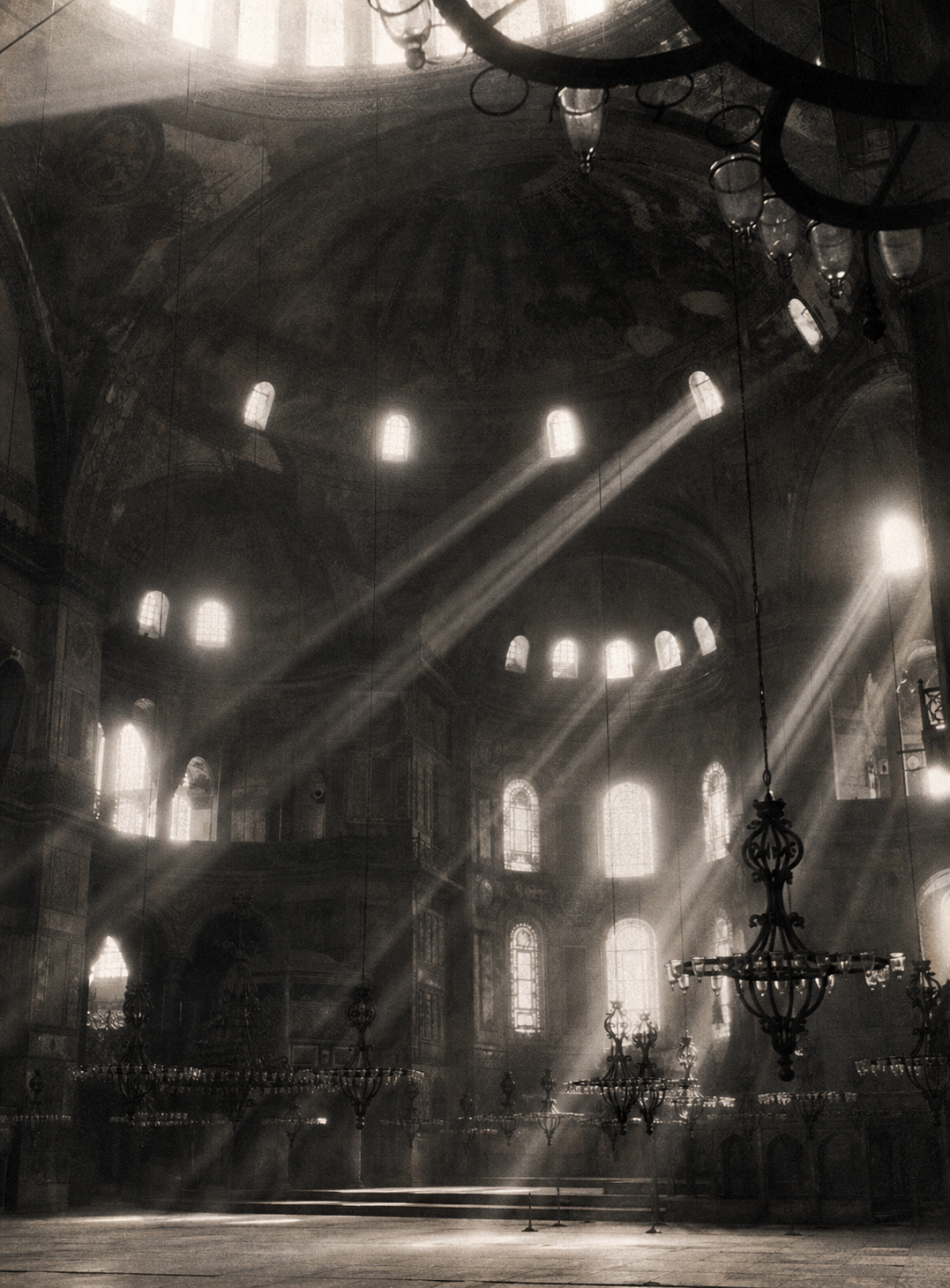
Look at the interior of the Hagia Sophia, on the previous page. One system of coherent entities we observe are the light rays. These centers are changing -- as the sun moves, so the light rays move. The centers which appear and disappear are evanescent, impermanent, in flux. Further, the homogeneity which forms these centers is subtle. Here the material, which is air, is continuous throughout the space. But some dust particles floating in the air catch the light, so it is these lit dust particles that form the ray and, of course, the actual waves of light, which pass through the air and illuminate the space. This example broadens our idea of architecture, because we recognize that these kinds of transitory event-like centers play as huge a role in the way a building is and works as the more obviously fixed elements like columns and floors.
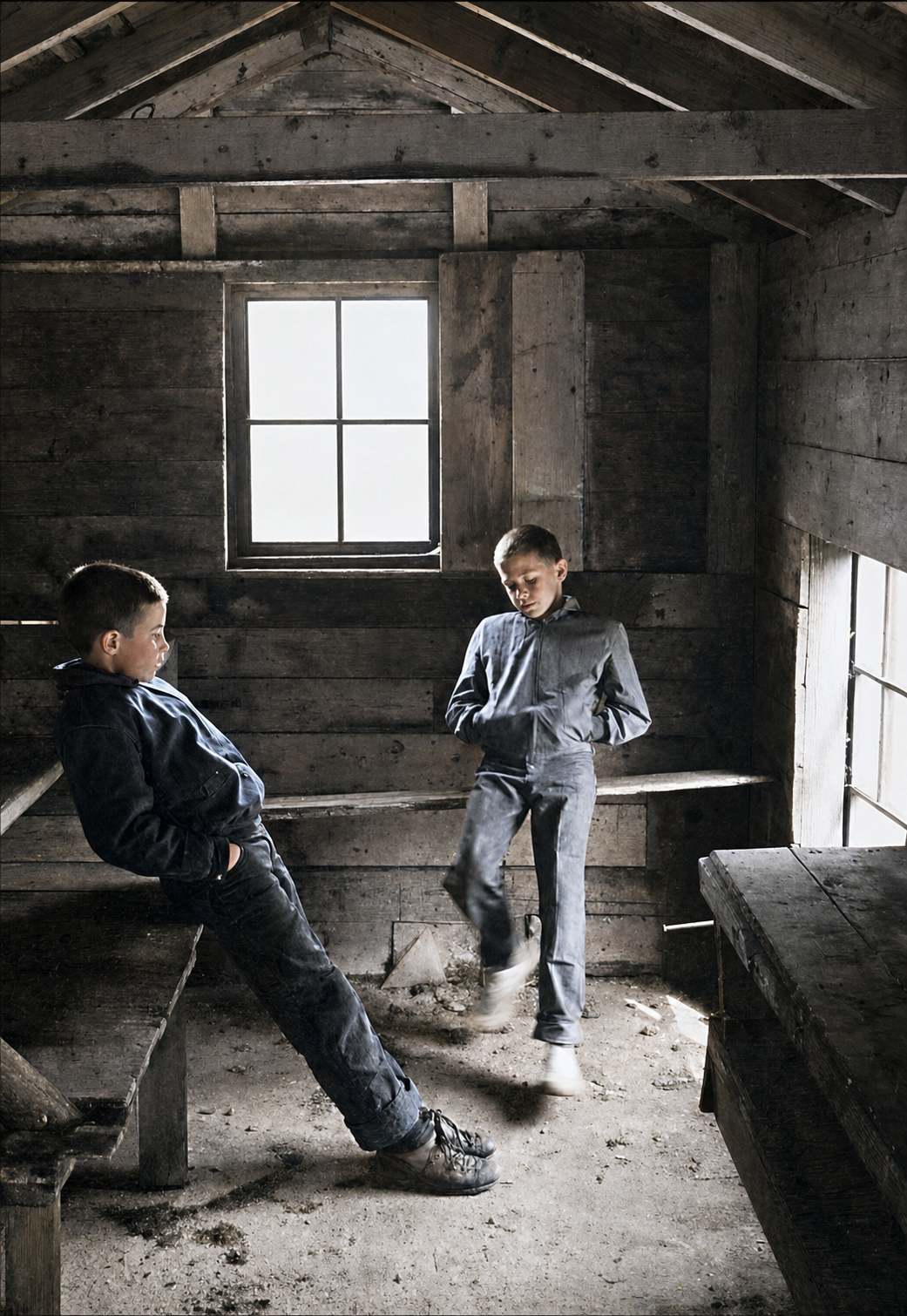
Consider another case. Two boys, whispering, talking about their secrets, in a shed. Here
WHOLENESS AND
again we have a situation which is of the essence of architecture. It is this moment, long remembered -- unconsciously if not explicitly -- which makes the magic of those y, and it is this shed, able to nurture those private conversations, which is a living part of the world. In this ca what are the centers? They are even more evanescent than the sunbeams. It is the human situation, the two boys together: it may last five minutes, then fall apart. It is a human association, a living moment, which existed at that moment when the photograph was taken, and is now gone forever. It may have recurred, in slightly different form, hundreds of times. But again, the centers which form when these boys talk together, which is this association between the boys, is essential to a proper understanding of architecture: here we have a case which is almost purely human.
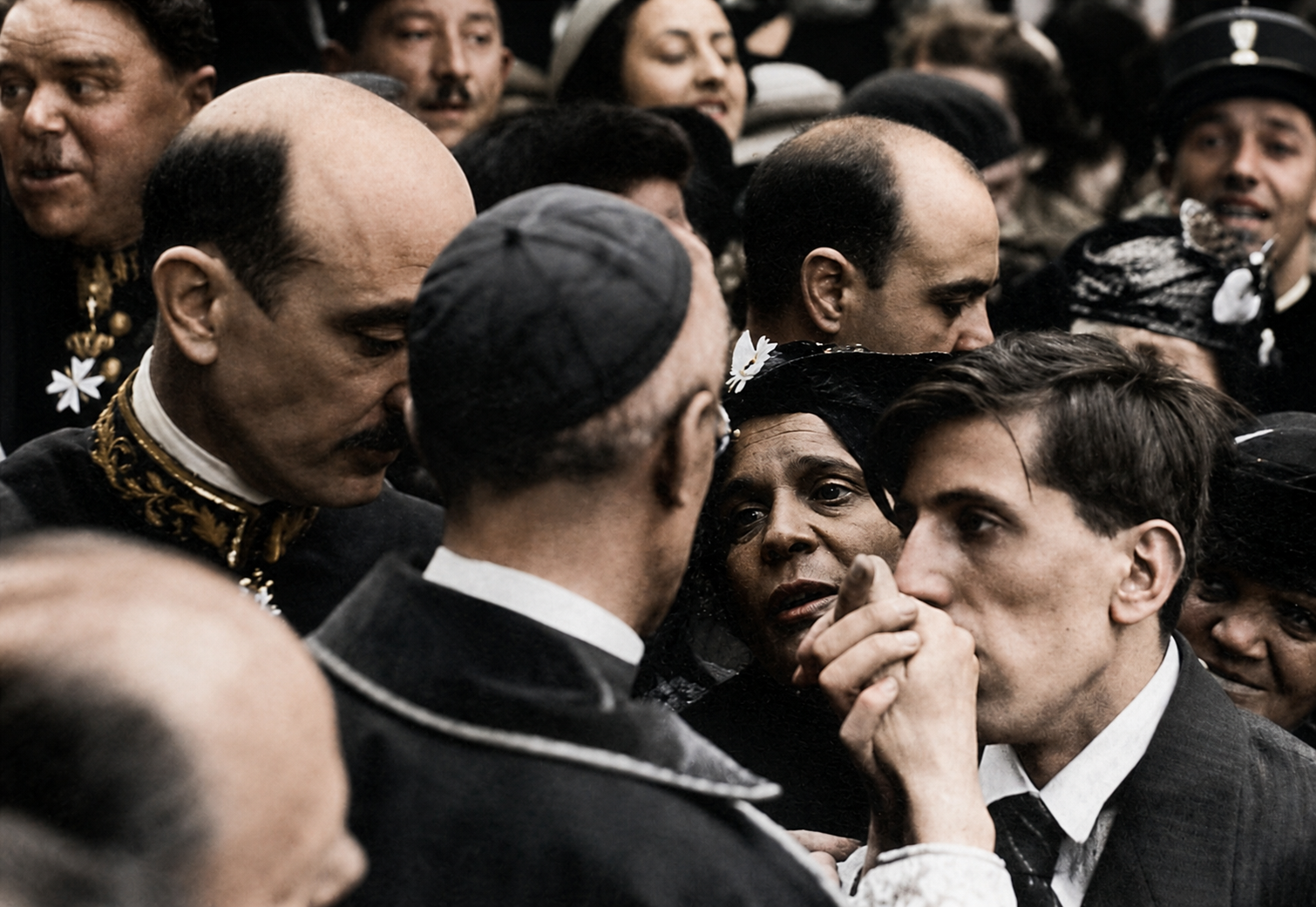
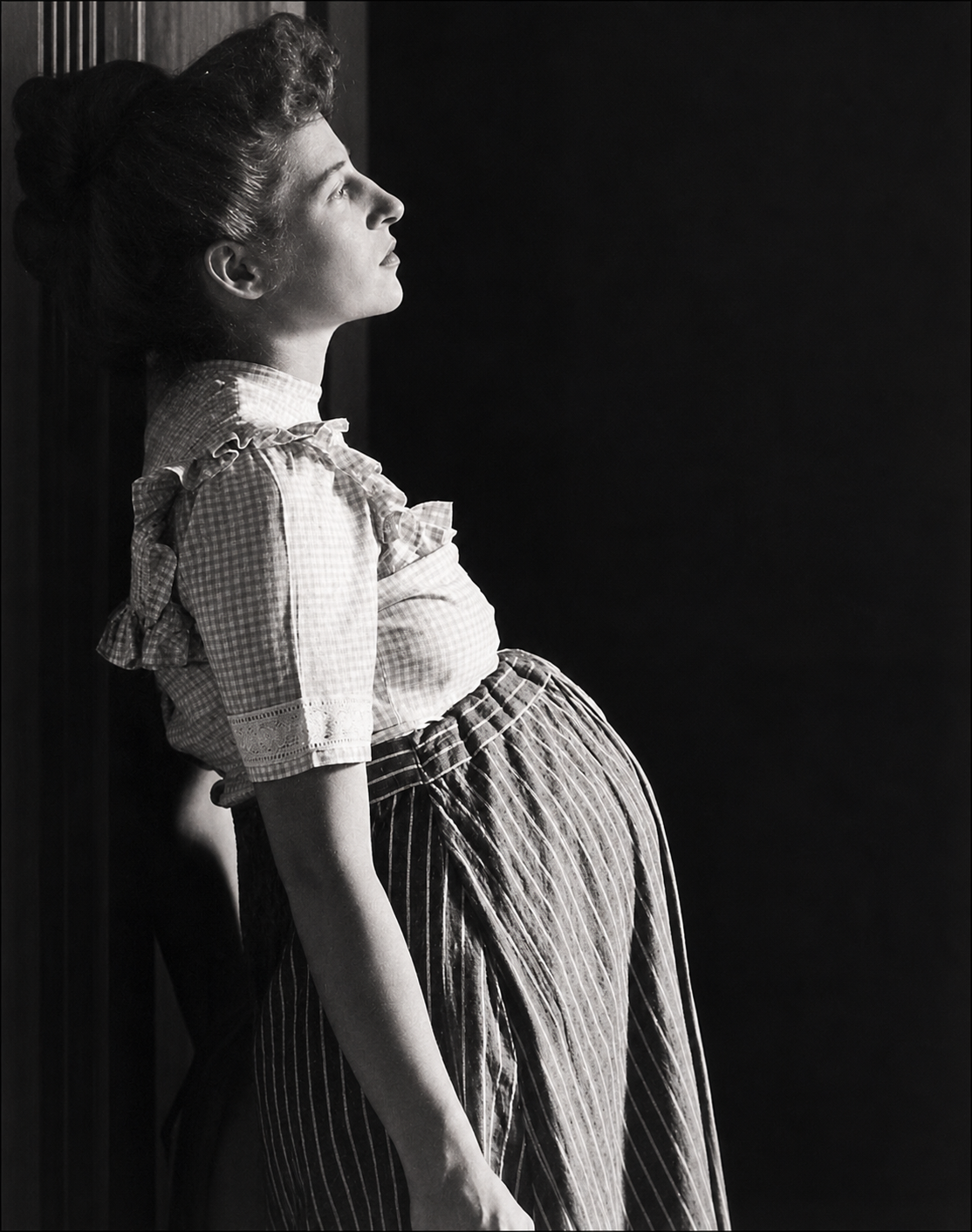
Finally we may consider even less architectural cases: the pregnant woman, with the baby in her belly; the young man kissing the hand of the priest; the players of some string quartet, playing, sitting together, looking at their music on the music stands, making the violins sing. It is the swollen belly and the child within; the fervent kiss; the sound and motion of the violin players -- these centers again are the real stuff of which the world is made, in our experience, in its emergent actuality. A gathered fistful of flowers, pushed into a jam-jar, then set upon a table -- this is a center which gives the afternoon its meaning.
Are these several very different kinds of centers all of one kind? And is it reasonable, fair, accurate, to speak of a kind of wholeness which
embraces all of them together? For reasons that are explained more fully in chapter 11, I believe that all centers that appear in space -- whether they originate in biology, in physical forces, in pure geometry, in color -- are alike simply in that they all animate space. It is this animated space that has its functional effect upon the world, that determines the way things work, that governs the presence of harmony and life.
But it is no small thing to see the world like this: a unitary source of organization, all of it anchored in space, with space itself the stuff that comes alive. That is the enigma. But it is also that which forms the effective substrate of the view I am presenting here, which gives us the possibility of understanding life at all.
14 / Life Comes Directly From the Wholeness
The essence of the wholeness, as I have defined it, is neutral: it simply exists.
At each place in the world -- with its natural habitat, ecology, buildings, materials, actions, and events -- there is, at any instant, some given wholeness; that is, some definite, well-defined system of centers that creates the organization of that part of the world. And the wholeness always exists in some form, whether that place is good or bad, lifeless or alive.
But we shall see next that the degree of life which exists at that place and time also comes from the wholeness, and only from the wholeness. The neutral wholeness spawns characteristics which are far from neutral -- characteristics which indeed go to the very origin of right and wrong. As we shall see in the next chapter, the life which occurs is specifically dependent on the system of centers, and the degree of life, the intensity of life, arises from the wholeness. Whether it is an apple-orchard, a dining-room, a harem, a dung heap in the garden, a painting, the wall of a building with its windows, the glaze of an earthenware pot, or the fervent kiss of a boy -- in every case, the life which that thing has arises from its wholeness.
So -- this neutral wholeness, which lies under the surface of every place, at every time, in buildings, meadows, streets -- is the natural origin of life. Life comes from it. Life comes from the particular details of the ways the centers in the wholeness cohere to form a unity, the ways they interact, and interlock, and influence each other. The academic and difficult task of grasping the nature of this wholeness will pay us back, by giving us the origin of life.
Notes
1. The general idea of wholeness, or relative wholeness, as fhe fundamental primitive, has been discussed by many authors, for example Jan Christian Smuts, HOLISM AND EVOLUTION (London: Macmillan, 1926); Wolfgang Kohler, cestatr psycHoLocy (New York: Liveright, 1929) and THE PLACE OF VALUE IN A WORLD OF FACTS (New York: Liveright, 1938); Kurt Koffka, PRINCIPLES OF GESTALT psycHoLocy (London: Routledge & Kegan Paul, 1955); Gregory Bateson, MIND AND NATURE: A NEcEssARY UNITY (New York: Dutton, 1979). It has been discussed most notably perhaps by Whitehead in process AND REALITY, AN ESSAY IN COSMOLOGY (Cambridge: The University Press, 1929).
2. For example, John Wheeler and Wojciech Zurek, QUANTUM THEORY AND MEASUREMENT (Princeton, N,J.: Princeton University Press, 1983); or David Bohm, Quantum THEORY (New York: Prentice-Hall, 1951).
3. For example, Charles Misner, Kip Thorne, John Wheeler, GRAVITATION (San Francisco: Freeman, 1975).
4. A piece of tissue, transplanted from a newt's eye, if transplanted to the tail, becomes a tail. A piece of growing tail, transplanted to the eye, becomes an eye. It is the larger configuration which determines the destiny of the growing material, not its local or internal structure. See H. Spemann, "Experimentelle Forschungen zum Determinationsund Individualititsproblem," NaTuRWwiIs- SENSCHAFT 7 (1919), described in Ludwig von Bertalanffy, MODERN THEORIES OF DEVELOPMENT (New York: Harper & Brothers, 1962), 121-22.
5. No one spot in the brain holds a particular memory. Each memory is suffused throughout the brain, and is apparently global, not local. Karl Lashley, "In Search of the En-gram," PROCEEDINGS OF THE SOCIETY FOR EX- PERIMENTAL BIOLOGY 4 (1950): 454-82, reprinted in F. A. Beach, D.O. Hebb and C.T. Morgan, THE NEUROPSY- CHOLOGY OF LASHLEY (New York, 1960).
6. See J.S. Haldane, THE LUNG AND THE ATMO- SPHERE AS A SINGLE SYSTEM IN ANIMAL BIOLOGY (Oxford, 1927).
7. Ernst Mach, DIE MECHANIK IN IHRER ENT- WICKLUNG HISTORISCH-KRITISCH DARGESTELLT (Leipzig: Brockhaus, 1912).
8. James Lovelock, Gaia (Oxford: Oxford University Press, 1979).
g. The wholeness Wis fully defined in mathematical terms in appendix 1.
10. More detailed study of the geometrical and structural factors which make segments of space function as centers is given in chapter 5. In the literature the definition of these features which cause centers to stand out or "settle out" has, in the past, usually been thought of as psychological, and the study of these features has usually been considered as a branch of cognitive psychology. The fact that the level of wholeness of different centers is objectively given, and may in principle be determined, was described by the gestalt psychologists Max Wertheimer, Wolfgang Kohler and Kurt Koffka, who formulated the laws of "praegnanz" as the determining features of a whole, which gives it its strength. See Wolfgang Kohler, GESTALT PsycHOLocy (London: G. Bell and Sons, 1929); Kurt Koftka, PRINCIPLES OF GESTALT PSYCHOLOGY (New York: Harcourt, Brace, 1935). One of the most detailed accounts was given by Marian Hubbell Mowatt, "Configuration al Properties Considered Good by Naive Subjects," AMERICAN JOURNAL OF PSYCHOLOGY 53 (1940): 46- 69, reprinted in David Beardslee and Michael Wertheimer, READINGS IN PERCEPTION (New York: Van Nostrand, 1958), 171-87.
i, Entities appear in the world because different parts of space have different levels of coherence. In ancient times, one of the first writers to notice this explicitly was Chuang-tzu, who saw how the order of a piece of meat depended on the fact that some pieces were more knit together than others, and that "understanding" anything in the world consisted of grasping correctly the way that thing could be divided into pieces which are relatively more or less coherent. The butcher who hacks at his meat blunts his knife quickly. But the butcher who has attained wisdom presses his knife into the soft spots, the crevices of the meat, and almost makes the meat fall apart according to its own structure. This butcher keeps his knife sharp for a hundred years. The image of this butcher who sees the world as it really is, is fundamental to all Taoist texts. In modern times, the importance of coherence, and the relative coherence or wholeness of different entities, was first studied by Kohler and Wertheimer -- who described the ways that collections of dots form groupings, and that some groups are more coherent than others. They formulated this idea as the laws of "pracgnanz," or laws of coherence, which was their first attempt to state the laws which created relatively more and less coherence in different parts of space. See Kéhler, GESTALT PSYCHOLOGY.
12, For years, I struggled with the idea that everything -- all form -- was made of entities. I first struggled with it in a lost manuscript, THE UNIVERSE OF FORMS (a manuscript written 1965-1967, and then unfortunately burned, without any copy being preserved). I had formulated a theory in which I tried to show how all order and all form could be understood by building things up from the coherent wholes which appear in space. Years later, in 1970-1975, I came back to the same ideas and struggled with them again in THE TIMELESS WAY OF BUILDING and A PATTERN LANGUAGE. In these books I showed how the significant relationships which appear in buildings are all patterns of wholes, and that once again it is the entities shemselves which play the fundamental role. Alfred North Whitehead had formulated similar notions of "organisms" (his word for entities) carly in this century. However, my attempt to catch the solidity of these entities as the fundamental elements of order never really came out right; it never worked as the fundamental notion. I began trying to get this straight in the later versions of A PATTERN LANGUAGE, where I noticed that even the entities which formed a pattern were in effect patterns, too, so that properly a pattern was not a pattern of entities, but a pattern of patterns. This brought the entity concept into doubt by stressing the fact that the things which appeared to be entities were fluid, not fixed, not bounded, not really "things" at all. All this finally became clear to me about ten years ago when I finally understood that all these troublesome entities, which were so important as the building blocks of nature, were not truly bounded entities but were in fact nonbounded centers: Centers of influence, centers of action, centers of other centers -- centers of some kind, appearing in the seething mass of the wholeness. About fifteen years ago, I finally realized that this way of looking at things was logically consistent, solved all the earlier problems of "entities," and was a solid footing on which a theory of order could properly be built.
13. One book which discusses the idea of centers in a fashion that has some kinship to my discussion here is Rudolf Arnheim, THE POWER OF THE CENTER: A STUDY OF COMPOSITION IN THE VISUAL ARTS (Berkeley: University of California Press, 1982). Another, much earlier work from the 18th century, which tries to establish point centers as the foundation of an all-embracing physics, was Roger Joseph Boscovich, A THEORY OF NATURAL PHILosopHy (London, 1763; reprinted Cambridge, Mass.: MIT Press, 1966).
14. The theory of fuzzy sets, put forward in topology by Christopher Zeeman "Tolerance Spaces and the Brain," in C. H. Waddington, TowaRDS A THEORETICAL BioLocy (Chicago: Aldine, 1968), 140~51, makes an attempt to solve this difficulty. However, in my opinion, it does not penetrate to the core of the matter.
15. Here we come back to Chuang-tzu again, and the difficult task of seeing the world as it really is, by seeing the entities in their proper order of saliency, not a distorted one. The same point has also been made forcefully by David Bohm, FRAGMENTATION AND WHOLENESS (Jerusalem: The Van Leer Jerusalem Foundation, 1976). Sec also appendix 3.
16. The structure is defined mathematically in appendix 1.
17. The idea of representing any given pattern as a system of selected coherent sets also appears in the foundations of topology. A particular topology is defined by the way in which the coherent sets are nested. But in this case, the definition of "coherent set" is much more restricted and less interesting. The fundamental idea expressed in this book is that the levels of coherence of different sets of centers may be continuously variable, and defined by much more subtle criteria. See appendix 1.
18. Concepts presently available to us in mathematics are not yet powerful enough to let us grasp this structure fully. For this reason many of the techniques, tests, and methods which I describe in this book are cognitive. The empirical methods which are described in this book (chapter 9) are the best I have been able to develop to get to grips with the structure.
19. Henri Matisse, "Exactitude Is Not Truth," first published in HENRI MATISSE: RETROSPECTIVE (Philadelphia: Philadelphia Museum of Art, 1948), reprinted in Jack D. Flam, Matisse on art (New York: Dutton, 1978), 117-19.
20. My understanding of this point has been enlarged very greatly by conversations with my daughter Lily. It was not until she explained it to me, by drawing her own sketches of people and telling me how she saw, and was able to catch, this underlying character in a person, that I really understood this short essay of Matisse, even though I had been studying it for years.
21. A key formulation of this matter was given by Niels Bohr, the father of quantum mechanics, who said that we can only understand the behavior of the electron in this experiment if we understand that, somehow, the electron moves as a function of the entire experimental setup. Niels Bohr, "Discussion with Einstein on Epistemological Problems of Atomic Physics," first published 1924, reprinted in Wheeler and Zurek, eds., QUANTUM THEORY AND MEASUREMENT (Princeton, N.J.: Princeton University Press, 1983), 30.
22. One coherent account of this phenomenon, and one which directly approaches the structure I define as the wholeness, is David Bohm's WHOLENESS AND THE IMPLICATE ORDER (London: Routledge & Kegan Paul, 1980), where he also describes the underlying structure of space that determines the path of the electron. In a series of meetings between the two of us, held in Ojai, California, in 1988, Bohm told me that he believed what he defines as the implicate order, and what I define as the wholeness, are essentially one and the same thing. This is also discussed more fully in appendix 5.