Part Two
Chapter Seven
The Personal Nature of Order
1 / Introduction:
FOR SOMETHING
Tn our present world-view, the word "personal" is often taken to mean "idiosyncratic." Something is personal if it reflects the peculiarities of a given individual: the fact that you like motor bikes, perhaps; the fact that my favorite color is green, and so on.
To my mind, this is a very shallow interpretation of what "personal" really means. A thing is truly personal when it touches us in our humanity. Thus, for instance, this miniature sketch of a synagogue is personal. It is personal because it raises feelings of a human and personal nature in us when we look at it. It makes us feel vulnerable, slightly weak at the knees. It raises the childish in me. It touches me in some vulnerable part.
None of this has anything to do with the idiosyncrasy of the maker. Nor does it come from my own idiosyncrasy as the recipient. It is a universal childishness which exists in all of us.

Look at the painting of boats by Vincent van Gogh, on the opposite page. Once again, it may seem easy to say that "the painting feels personal." But even if we agree that it is personal, we should again ask just exactly what this means. The trivial meaning of the word "personal," here, might mean that the picture is somehow peculiar to van Gogh, that it stems from his intensity as an individual -- his idiosyncracy, perhaps connected to the fact that he lived an unusual life, later became crazy, cut off his ear, and so on. Yet what it really means, and what we feel in these simple-seeming boats is that the painting touches the personal in us. It somehow makes us feel the world more deeply. It is something which comes from, and penetrates to, the most personal feelings we have about the world -- the feelings in which we are, like lovers or little children, more absorbed, more happy, more carefree, and more vulnerable.
The trivialization of the word "personal" is part of our present popular culture, immersed in mechanistic cosmology. But from the point of view of the world-picture in this book, "personal" is a profound objective quality which inheres in something. It is not idiosyncratic but universal. It refers to something true and fundamental in a thing itself.
I believe all works which have deep life and wholeness in them are "personal" in this sense. Indeed, this quality is an essential and necessary part of what I have identified as life in things. When we deal with the field of centers, we are dealing with a realm of personal feeling in which feeling is a fact -- as much a fact as the radiation from the sun, or the swinging of a pendulum.
When the field of centers is authentic, it is always personal. If it appears to have the right structure but is not personal, it is empty
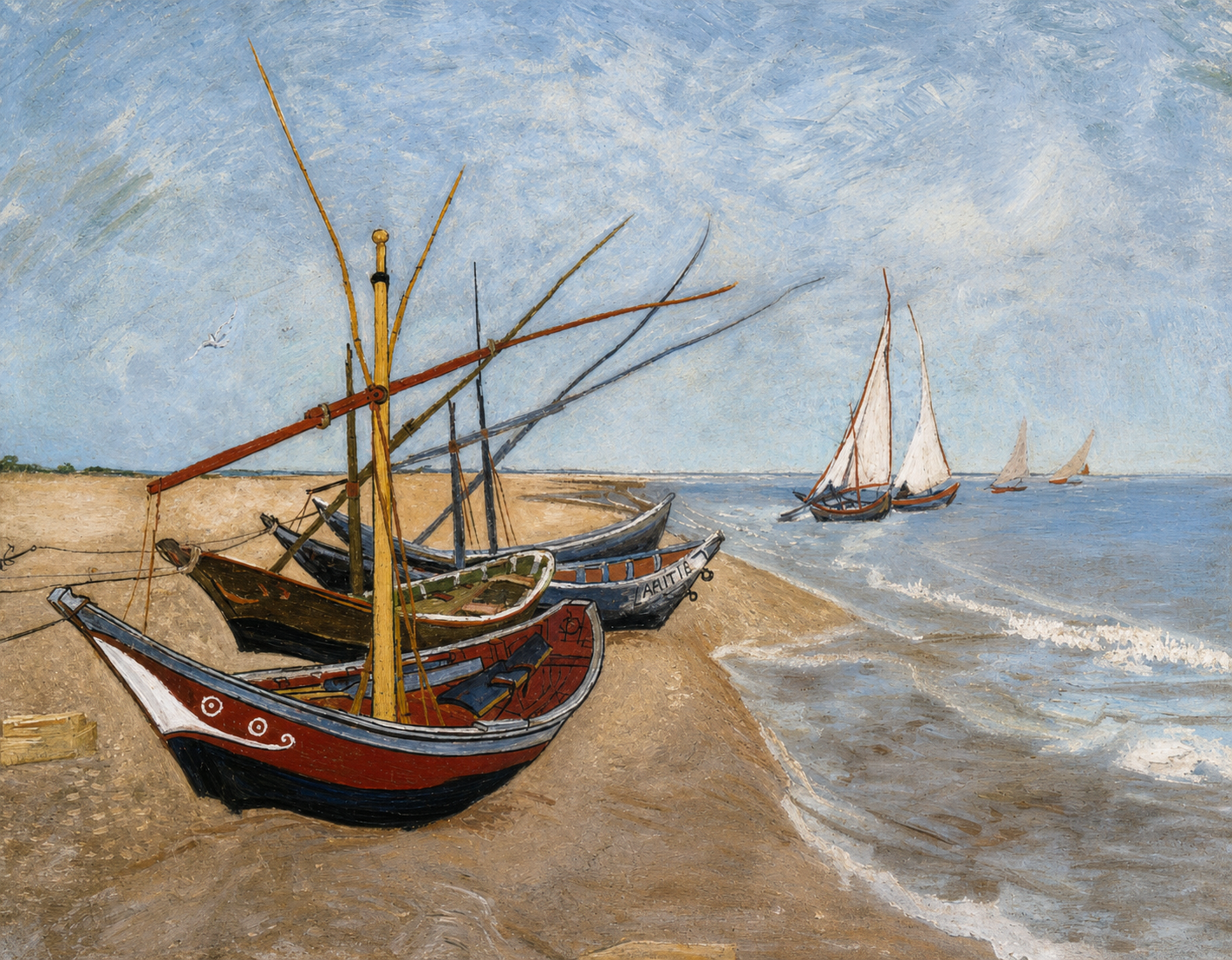
Boats upon the Shore, Vincent van Gogh structure, only masquerading as life -- and, in every case like this, it will turn out that we have misjudged it s¢ructurally. The existence of a personal feeling in a thing or system is not a subjective quality of limited validity, but an objective quality whose existence is as fundamental to any given situation as the more mechanical facts to which we are accustomed.
2 / Our Everyday Personal Feeling and the Field of Centers
To make it more clear how the field of centers and our deep personal feeling are connected, it is useful to consider some everyday examples.
For instance, almost everyone loves flowers. Few things in the world are quite as moving as a meadow full of wildflowers in early spring: buttercups, daisies, tiny orchids, forget-me-nots, wild roses, cowslips, primroses, wild hyacinths, and dozens of tiny flowers so common that we hardly know their names -- white lilies of the valley, yellow ragwort, sky-blue bluebells, scarlet pimpernels. I don't know if anyone has ever asked just why flowers, of all things, should seem so especially lovely, so beautiful to us. But the idea of wholeness explains it very well indeed. A flower is one of the most perfect fields of centers that occur in nature. And flowers in groups, on bushes, clumped, strewn in a meadow together
create highly complex living fields of centers, perhaps among the most beautiful in nature. Ifit is true that the field of centers, by itself, is so deeply connected to us, and stirs our feelings, our passion, then of course a meadow full of flowers -- one of the most elaborate and simple fields of centers -- will have those touching quality we know: depth, tenderness, and longing.
The same phenomenon, the same emotional power, exists in other ordinary things. Consider, for example, a child's birthday party and the high point of the party, the moment when the cake is brought in with the candles lit, and placed in the middle of the table. The table itself is LOCALLY SYMMETRICAL with a BOUNDARY and a STRONG CENTER. To make the boundary more solid, we put the place settings around the edge, each one itself destined to be a center. And to mark the main center, we place there a great jug of flowers, or the cake itself, making a GRADIENT toward the middle. And then, at each place setting, we put a small place mat, with the knives and forks arranged around it in symmetries to create the center more firmly, and to create detail at the boundary of this smaller center. To make the place even nicer, we will perhaps use a lace table mat, which itself has a major center and a lacy, imbricated edge, again making still smaller centers around the center.
The big jug of flowers that fills the center of the table might perhaps have two candles, one on either side, to mark it and to form its edges. The minor center, the birthday cake itself, is also decorated with a ring of small birthday candles in ALTERNATING REPETITION, marking its boundary, forming a chain of centers, leaving the central space in the middle of the cake empty (THE voip) for the name of the person, or an ornament.

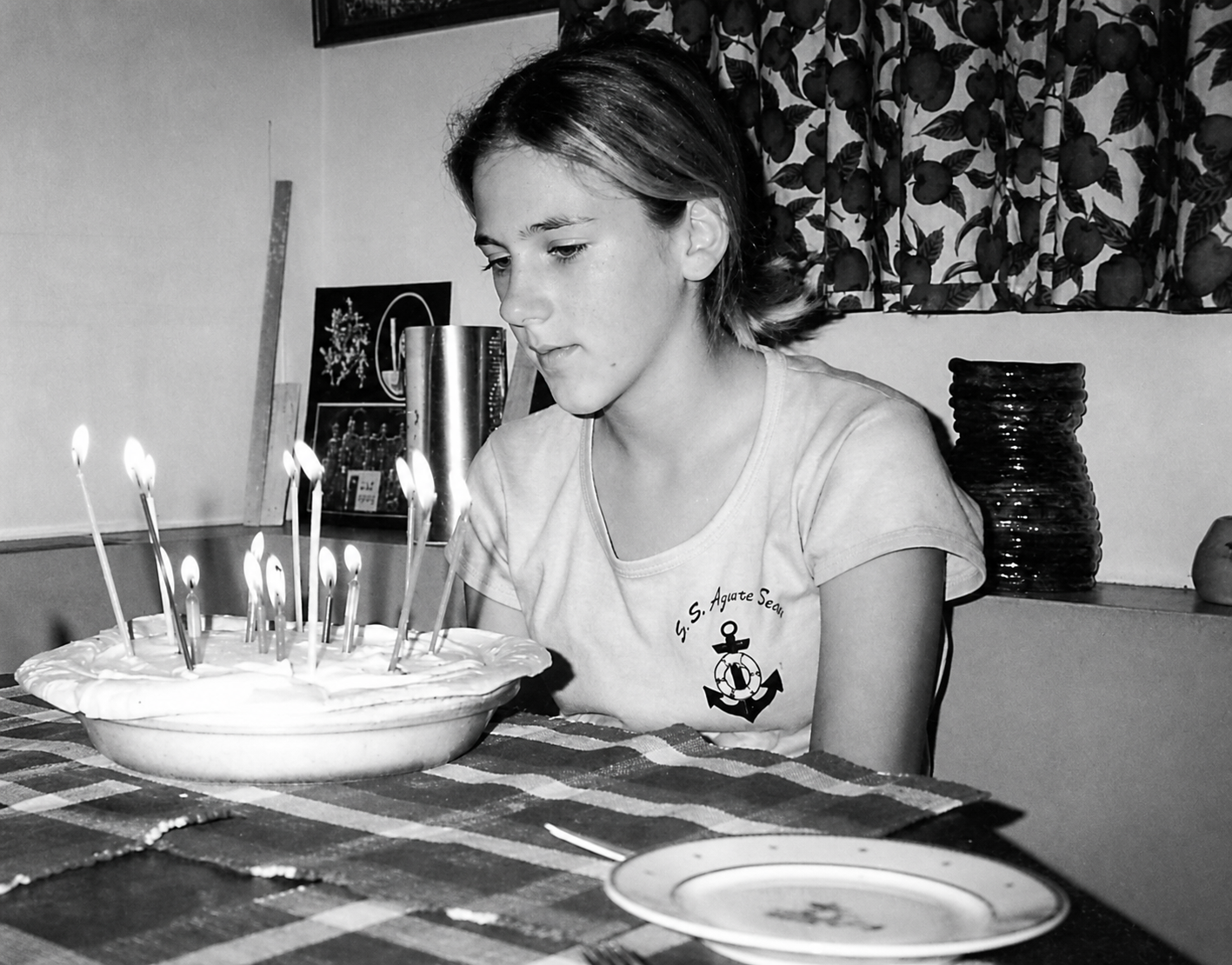
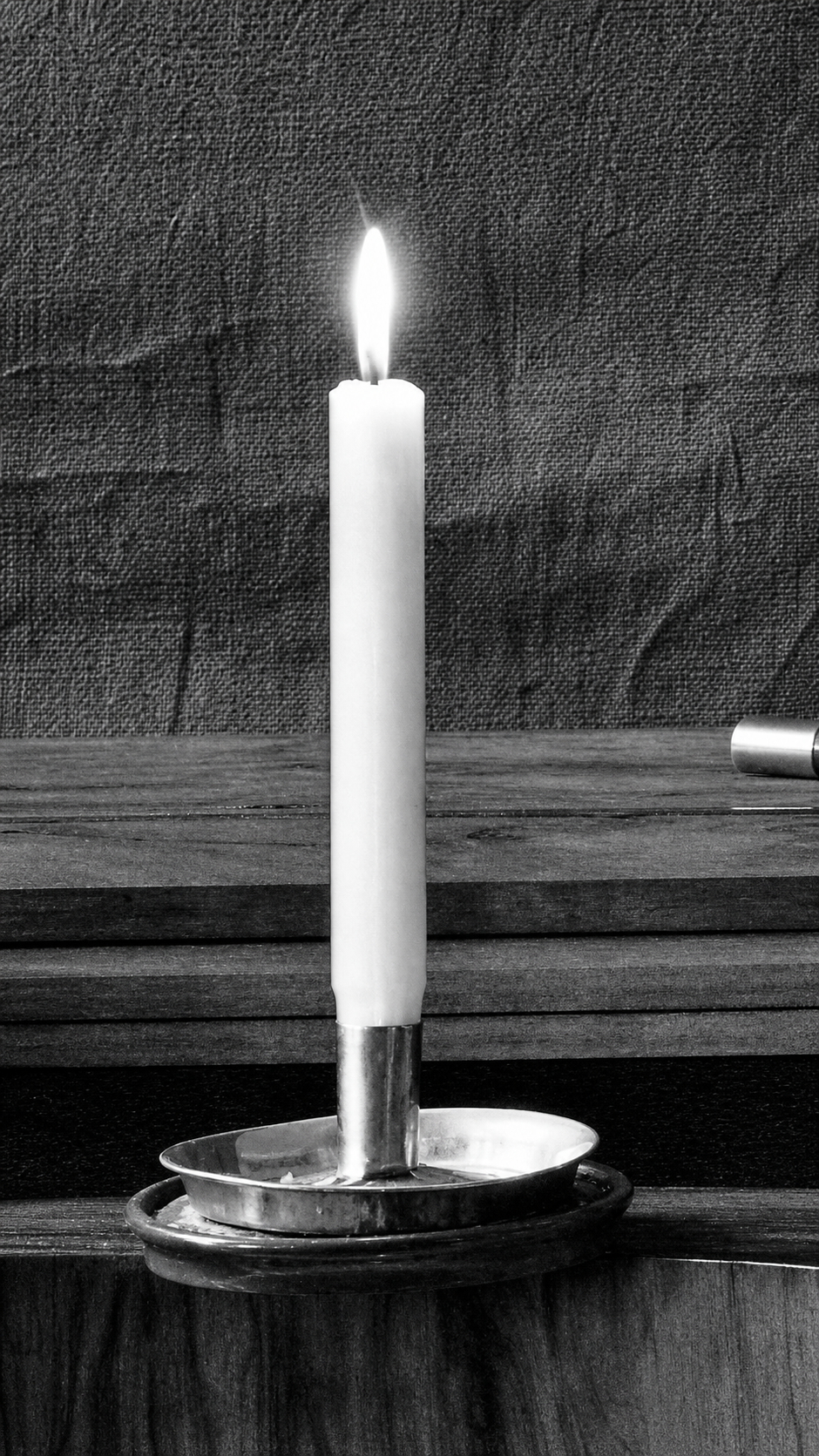
Birthday cake
Each individual candle itself even has the same structure: a body marked at the top end by a boundary -- the flame -- which is itself a strong center, dark in the middle where the wick is, and bright around the edge, where the flame is burning. CONTRAST exists in the color of the inner flame and outer, and GOOD SHAPE is found in the licking of the outer flame.
We might say that the presence of this structure is incidental to the birthday, that what moves us, what touches us, is the importance of
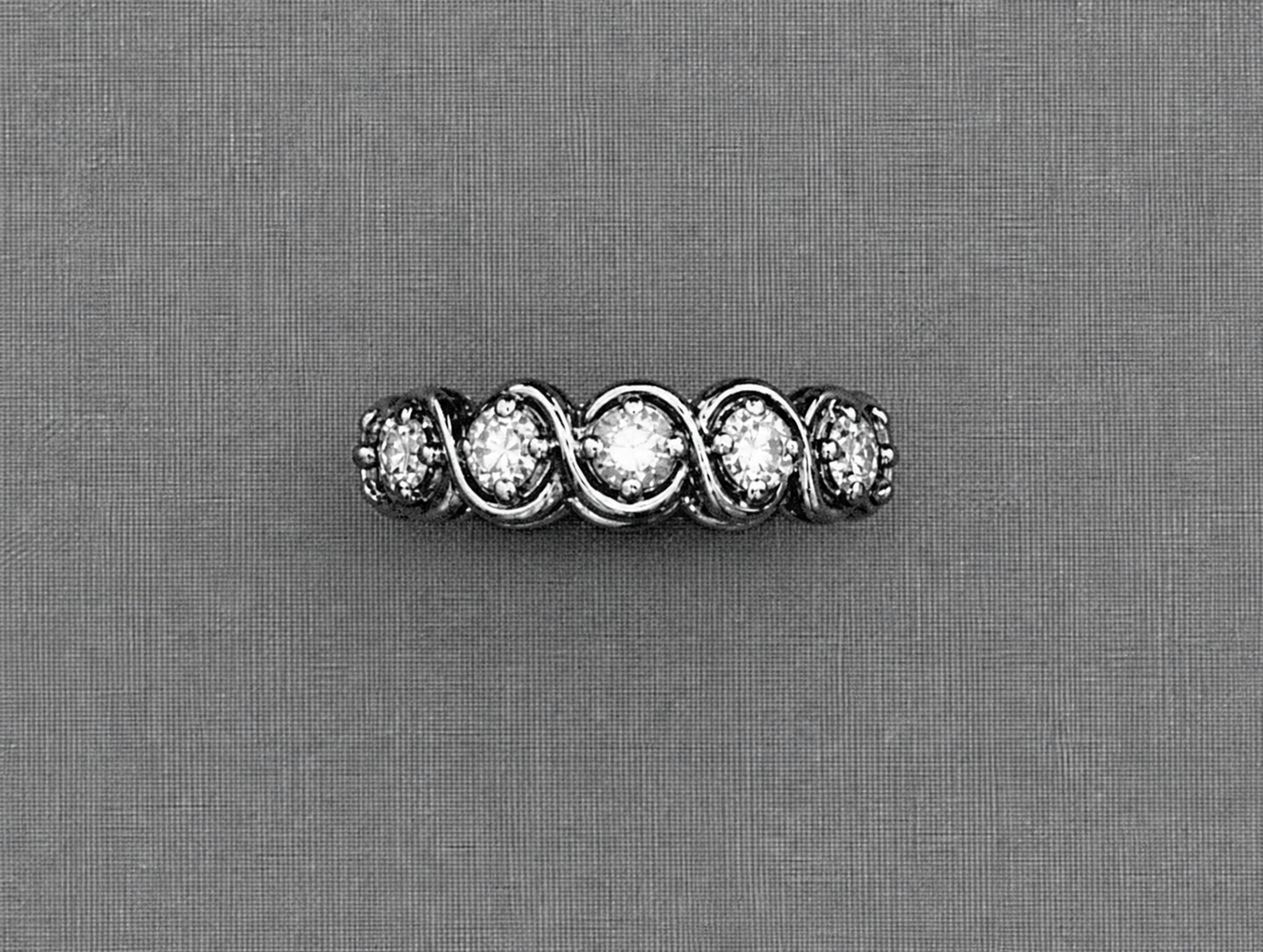
Wedding ring

the occasion, the friends gathered, the presents, the excitement. But the pointis that it is Ais structure precisely -- the field of centers in a simple and pure form -- which we use, at just this kind of moment, to cement the occasion, to celebrate it. It is Ais structure which has the power to give the occasion meaning, and which leaves such touching feelings in us, such poignant memories, and so increases our power to feel.
The same occurs in other everyday structures connected with deep feeling. Consider, for example, a woman's wedding ring. The ring itself is a center, the jewel set about with smaller jewels. Or, more strikingly, traditional costumes. Look, for example, at this African woman, and the way her dress, over and over, contains the field of centers to a high degree. One might say this is accidental. But can it be accidental that the other dresses and costumes which people wear for more ordinary occasions so conspicuously have less of this structure in them?
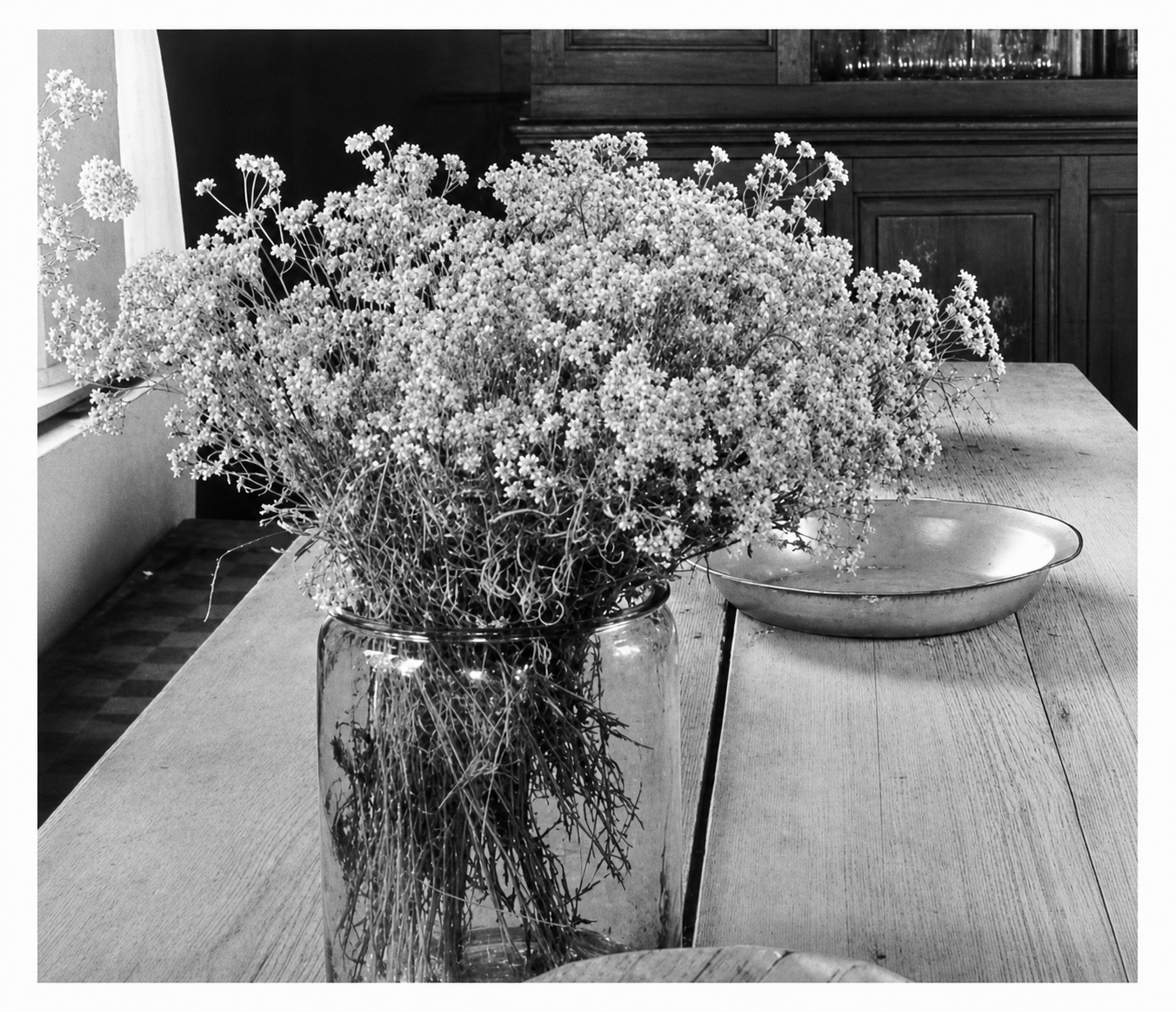
Or consider a simple jar of flowers. This has the structure of centers in it to a great extent. It is so ordinary, so humble, but it has this power in it. And if you doubt that, ask yourself why all the possible related things which have less of this structure in them are so much less touching, so much less deep. A vase with beautifully chosen branches in it, for instance, may be pleasant, a tribute to nature, even highly aesthetic in a sophisticated sense, but it is not likely to have the same power to touch us unless we choose branches which have leaf buds on them in spring -- when once more it begins to have more of the fundamental structure in it. Or consider a flat plate with flowers strewn on it -- also very nice, but again with much less of this structure and much less power to touch us unless it is, perhaps, a single deep plate with a single blossom floating in the middle, as we might find in Tahiti or Japan.
Even a simple act like shaking hands, as a structure, has these properties in it. There is the LOCAL SYMMETRY of the two arms, the knot, the DEEP INTERLOCK when the hands clasp, the creation of a BOUNDARY and of a center in the same moment, the ALTERNATING REPETITION formed by the actual motion, by the shaking itself, the NOT-SEPARATENESS formed between the people. It may seem absurd to insist on these details in something so commonplace as shaking hands. Yet we all feel the power of the gesture, and we shall make no progress in our efforts to shape the physical world until we fully understand the presence of this structure in nearly everything that takes on meaning.
The same is true with the Indian namaste, the greeting in which palms are placed together, as in the western mode of prayer. Once again, the hands form a LOCAL SYMMETRY, with a profound STRONG CENTER being formed by the hands, the body, the face, and the body of the other person -- the field of this center magnified by the GRADIENT of the fingertips stretching upward, forming a voip above.
The process of producing and responding to centers is one of the most fundamental of all human processes. It is completely natural in the
most ordinary way. A daisy chain, a birthday cake, a wedding ring, a bunch of flowers, the setting of a table -- each of these widespread and common things is an example of the field of centers in everyday life. Each brings with it connections to an ocean of personal feeling.
Much of the concentration of feeling in a culture is placed into these vessels and others like them. It is the field of centers which reinforces the feeling in these things. It is the field of centers which thus helps give the most ordinary events their meaning.
3 / wholeness and Feeling
Living structure is, by its very nature, personal and feeling-endowed. The field of centers exists in a thing ¢o that degree to which the thing has personal feeling. To show that it is indeed a matter of degree, visible in shadings, I start with a simple comparison. I take two blank sheets of paper, and put them a few inches apart, side by side. I leave the left one blank. On the right one, I draw a small diamond-shaped dot in the middle of the page.
Most people will agree that there is more feeling in the right-hand paper. It is more personal. It is also true that the field of centers is more strongly present on the second sheet than on the first.
You may say, "Why did you choose to put a diamond in the middle of the paper?" Suppose I had put a little irregular curved line somewhere on the page. Would this still do it? Wouldn't almost anything put on the piece of paper have more feeling than a blank sheet? After all, a blank sheet of paper is so impersonal that the comparison doesn't prove much.
So let us also take a third piece of paper, and draw an irregular squiggle on it, and let us now put this piece of paper to the left of the blank one, thus, as in the second row of drawings (next page). In this case, the paper on the left, with the squiggle, has less feeling and is less personal than the one with the diamond. It has even less feeling than the sheet which is blank.
Let me explain this in terms of the field of centers. If I look at the right-hand sheet of the three, the world seems to tie itself together, it cen-
Which is more personal? The one on the right.
[
When I add the one with an asymmetrical loose ''squiggle,'' the one on the right is still the most personal of the three.
ters in on the diamond, I feel a focus or a concentrated knot in the fabric of things. This simple field of centers is coherent. In the middle sheet, I do not feel this so intensely, but still the page fits, in a reasonably calm way, into the world: there is still a coherent field of centers, so that there is still connectedness, though not as much as in the right-hand sheet. In the one on the left, there is a sense of disturbance: the squiggle interacts with the page in such a way that even the page itself no longer fits nicely into the world around it. The field of centers is incoherent, and the overall connectedness has been disturbed.
In the sense I am describing, the sheet with the diamond-shaped dot in the middle creates the most wholeness in the world. The one with the squiggle creates the least. In addition, the one with the diamond has the most personal feeling, and the one with the squiggle has the least.
Why doI say that the one with the diamond has the most personal feeling in it? I can explain that by using the following experiment: suppose, as in chapter 9, I ask you to tell me which of the three you would pick as a picture of your wholesome self, or your own soul. I think you will pick the right-hand one first, the middle one second, and the left-hand one third. You may agree with this, but still wonder why I call the diamond personal. It perhaps does not seem personal in the ordinary sense.
To convince you that it is indeed more personal than the others, let me propose another thought experiment. Suppose you are with a person you love very much. Imagine you are comfortable, happy, loving, and childish with this person -- also vulnerable, and not afraid of being vulnerable. Perhaps you may even feel like a little five-year-old in the degree of your trust and vulnerability. And suppose you have just made the three pieces of paper we have been looking at.
Imagine now that you wantsimply to give one of these pieces of paper to this person as a funny, special present, as an expression of your feeling -- a tiny gift, which will flutter away in the wind five minutes later, but which you want to give in such away as to share your inner secret with this person. Which of the three will you give? Most likely, you will give the one on the right. The one with the diamond feels valuable, feels worth giving, feels the most intimate of the three.
I do not insist that this is true. But I ask you to make a note of the fact that it might be true that what is personal can be directly and clearly identified in the realm of feeling -- and that it happens to correspond to the presence of the field of centers.
Let us go on to a more complicated case. Here are three drawings of women by famous 20th-century artists: Pablo Picasso, Henry Moore, and Henri Matisse. The same distinctions of degree in the "personal" that are illustrated in the three tiny sheets of paper also occur in these more complex drawings. After careful examination, comparison with the fifteen properties, and so on, I believe we shall conclude that the Matisse has the strongest field of centers.
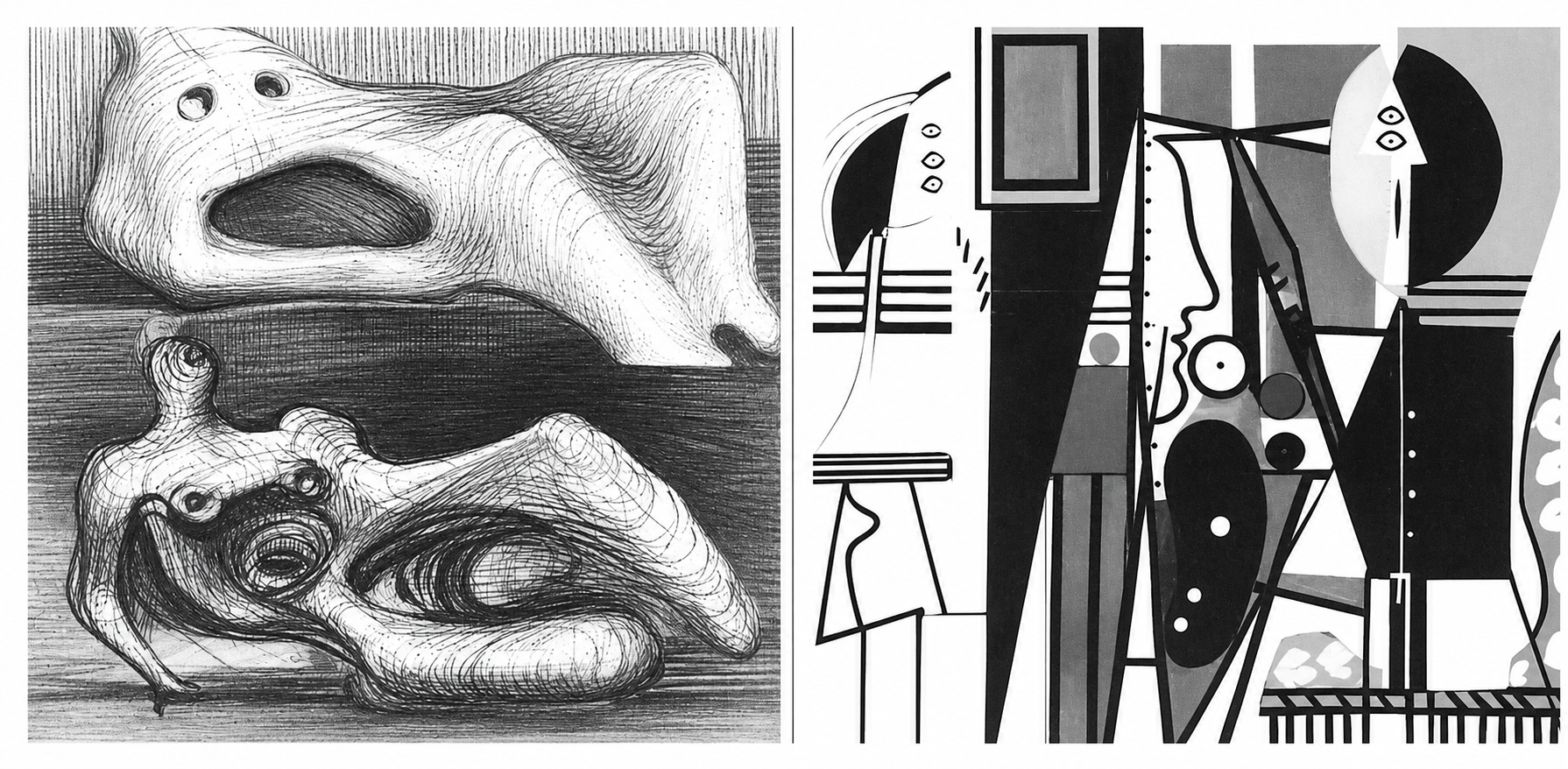
Wonten drawn by Pablo Picasso
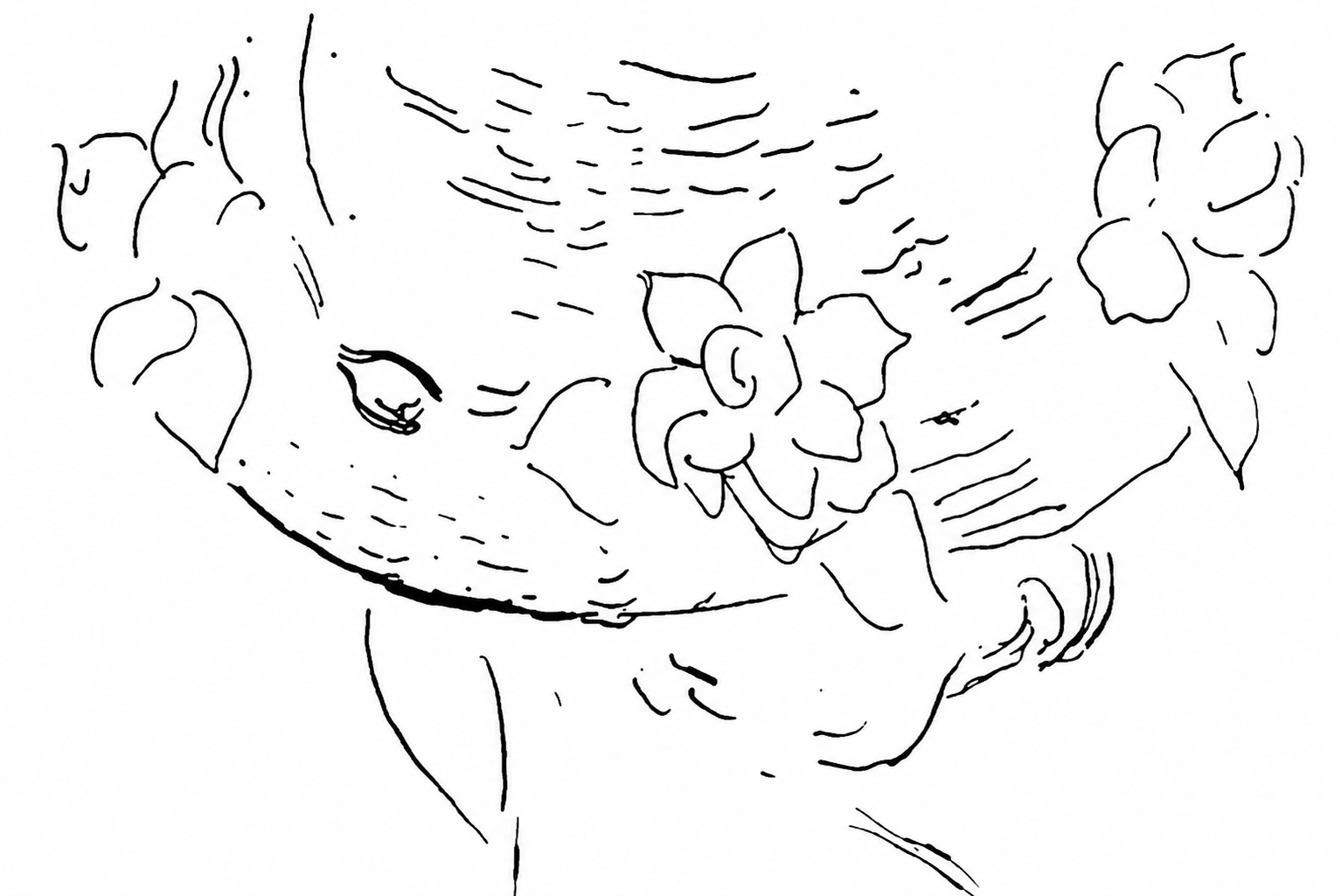
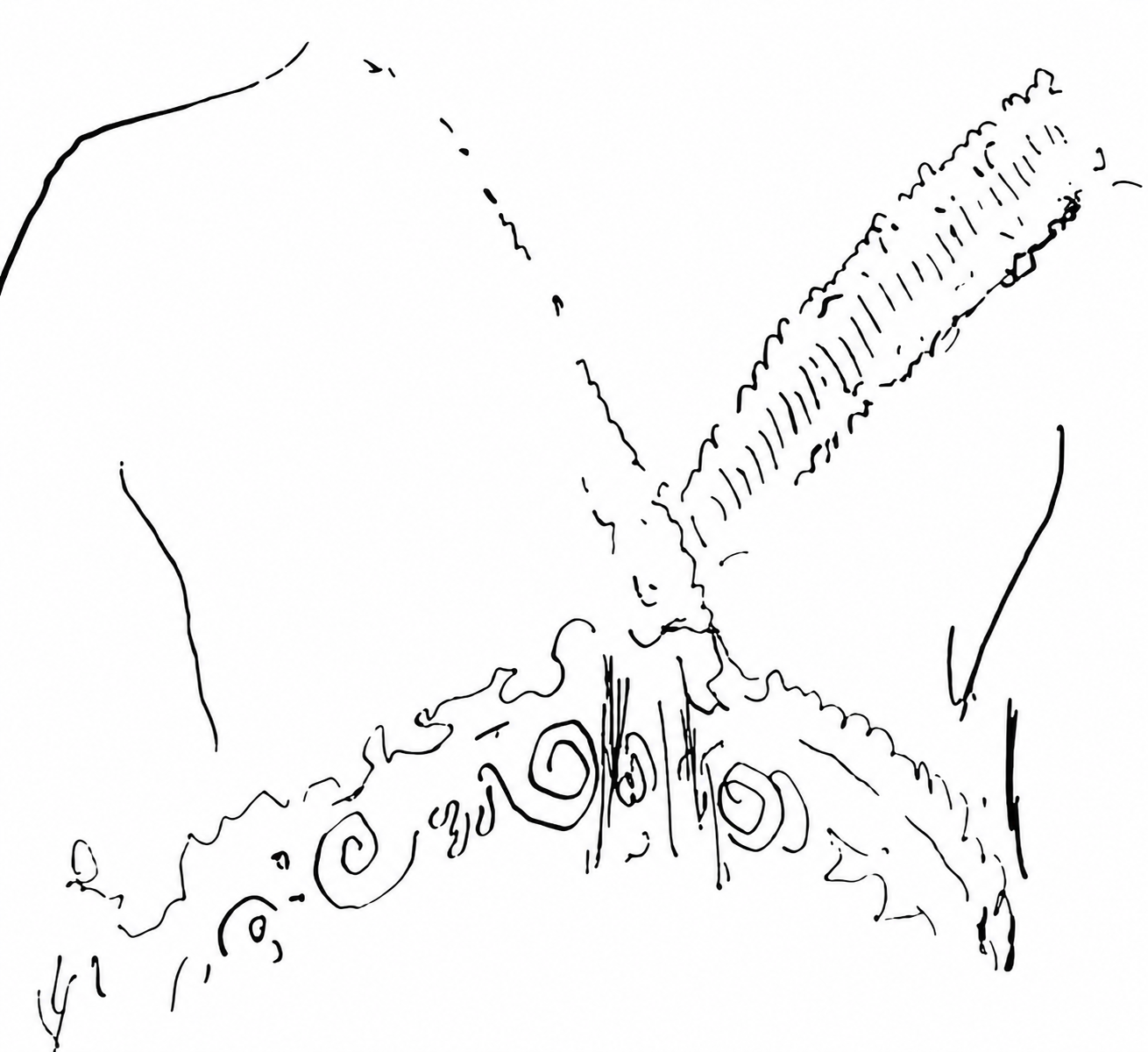
It has the most centers, the most powerful centers, and the strongest relationship of support among the centers. It most closely follows the structure described in chapter 4.
The Matisse also has the most subtle feeling, and the most personal feeling. This is true, I believe, regardless of how you evaluate the three artists. You may think that it depends on what kind of feeling we are talking about. Are we talking about bold feeling (like the Picasso),
Oe)
eerie feeling (like the Moore), soft feeling (like the Matisse)?
But I don't mean anything so complicated. T only ask you to say which of the three comes closest to your own most vulnerable and most personal feeling. In that case, I believe that you will choose the Matisse. Once again, the one which has the strongest field of centers and the one which has the deepest personal feeling are the same.
4 / Simple Happiness
Perhaps we are beginning to see that life -- because of its structure, the field of centers -- is inextricably connected with human feeling. If we look back over the examples of buildings, places, landscapes, paintings, and objects that I have shown as having life, we can see that they also are bound up with, and cause in us, deep personal feeling. They ave deep feeling. They awaken feeling in us. They make us feel our own existence. It is this increased feeling of life which we experience in ourselves that lets us know these things are important. We cannot separate them, or our awareness of them, from the fact that they have feeling and induce feeling in us.
This deep feeling is indeed a mark of life in things. It is, from a human point of view, perhaps the most important aspect of life in buildings -- because it is the aspect which connects that life, most directly, and most wonderfully, with our own existence, with what it is to be alive. And it shows us that the life in buildings, which makes them work, which makes them alive in themselves, also is connected to us, is personal.
Although within the canon of normal contemporary science we cannot imagine a kind of objective truth which is also personal in nature, this combination is one of the most extraordinary and important aspects of the new structure which I call the wholeness. As the centers deepen, the personal feeling of the structure increases. If its personal feeling does not increase, its structure is not really getting deeper. Precisely shis feeling component is its extraordinary property.
Further, and very fundamentally stated, we become happy in the presence of deep wholeness. When I am in a building which has life, I have a happiness in me, a comforting and profound wholesomeness. Unlike those structures pursued by science, which are remote from us and have only mechanical reality, the field of centers is somehow part of us, connected with the very essence of being human.
As a maker of buildings, I simply have the task of making something which creates this happiness in all of us. The nature of the wholeness is such that, when it makes this happiness in me, it also makes it in anyone else who comes in touch with it.
The proper understanding of the connection between objective life in a thing and my own deep-seated happiness is fundamental and goes to the very nature of order itself. Once understood, this connection is capable of healing a rift between us and our understanding of the universe which has existed since the r7th century. In this new understanding, even though we continue to recognize wholeness as a structure which exists "out there," we learn that it is also a real unity which exists "in here," in each person's heart.
In this idea, we shall cross the nearly uncrossable gulf created by the Cartesian view of things and extend our grasp to a new post- Cartesian view. In the Cartesian view, the objective structure of the world is one thing, our own
happiness is something entirely different and remote from it. In the post-Cartesian view, the wholeness of the world and our feeling of happiness together are understood to be two complementary things which form a single unity.
5 / Feeling As the Inward Aspect of Life
Very gradually, as we move through these four books from Book 1 to Book 4, I shall work my way towards the theme that the personal is something inherent in the nature of order and in the universe -- not a late comer to blind matter as scientists have thought, but rather, since the origins of time, a vital substrate underlying matter.
This theme -- to some ears possibly fantastic -- can in no way be regarded as proven. In these four books I merely take a few first steps toward the possibility that it may be so, and that it may one day be recognized -- and, further, that architecture, our mother-art, must itself be steered in a direction which allows this to be recognized in our experience. Since I can only walk gradually towards this goal, but since I do also want the reader to see the goal in the distance and be conscious of moving towards it, I shall end this chapter with a few words that perhaps touch too closely on the poetic: but they may help us to steer more successfully when we once more take up sober reason in chapter 8.
I believe the personal feeling I have touched on in this chapter, which is directly connected to order and life, is a mobilization in which my vulnerable inner self becomes connected to the world. It increases my feeling of connection and participation in all things. It is feeling, not emotion. It does not -- directly -- have to do with happiness, or sadness, or anger.
Rather, it is the feeling of being part of the ocean, part of the sky, part of the asphalt on the road.
Thus the personal nature of order appears in nature as much as in buildings and artifacts. The waves shown on the next page are not just beautiful. The wild rage and beauty which is in them is personal in the same sense, and has feeling. It is personal, even when it occurs in nature, because somehow it awakens "person-stuff"; we may even sense that it is made of person-stuff, and that it connects with the person-stuff in us. To understand order, we must understand that it is profoundly like shis. Life is the person-stuff. Recognizing this life in things is equivalent to saying, "The universe is made of person-stuff. I always thought it was made of machine-stuff, but now I see that it is not."
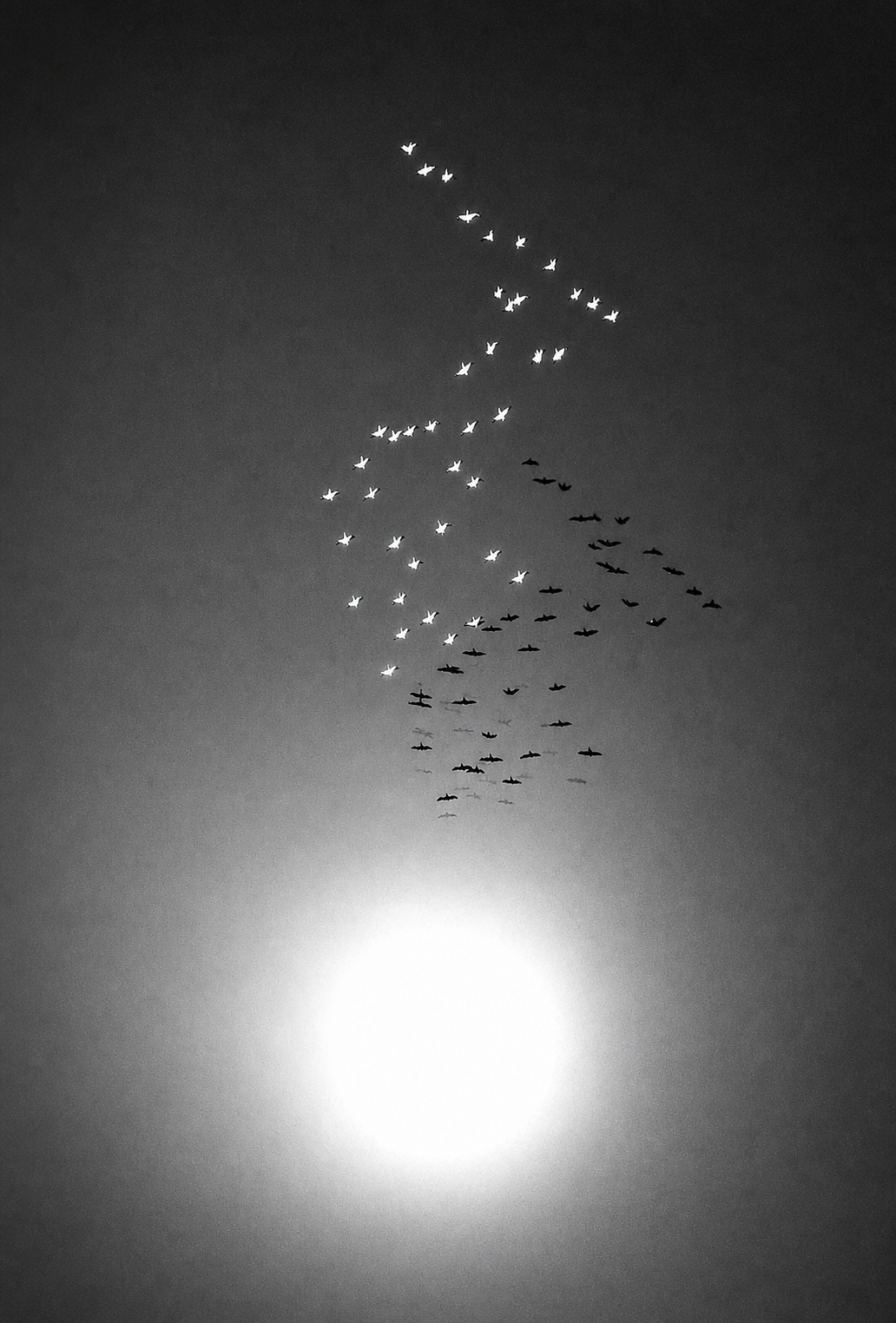
The ocean, with its wild waves, is like this too. It is the personal matter of the universe, reaching its form in us. Even the flock of wild geese in the last photograph in this chapter is ultimately personal -- and that is why it is so lovely to us. And when one of us makes a building, we should also be trying to bring this person-stuff to life, to awaken the person-stuff in matter.
Once we recognize that feeling and life are somehow one and the same thing, and that the structure we call wholeness is connected with a ground where matter becomes personal, then we begin to see the depth of the revolution in thought to which the idea of wholeness leads. The external phenomenon we call wholeness or life in the world and the internal experience of personal feeling and wholeness within ourselves are connected. They are, at some level, one and the same thing.
In chapters 3 to 6, I discussed the idea of a center as a focused zone in space where the space begins to come to life. I have wrestled with the

-- extraordinary at possible meaning of this ide: least to the conceptions of Cartesian mechanics. Now we begin to see that the idea of a center is something which unites objective life -- as a quality which exists in space -- and the personal feeling that can occur in us. When the center occurs, is intensified, we shall see in the next chapter that the space there begins to resemble the human self, begins to be connected to the personal. A structure which has life becomes more and more personal as it reaches more and more wholeness, because it becomes more and more deeply imbued with self, with the feeling of which my experience of self is made. Thus the very odd thing which happens is that space itself becomes more deeply functional -- more well organized -- as it begins to resemble more and more deeply the human person. This is not a comment about psychology, or about the psychological character of art. It is, I suggest, a fact about nature, something which is as much true in untouched nature as it is in buildings.
The ultimate criterion for whether something works in nature, just as in buildings, therefore also depends on the extent to which it resembles the healthy human self. This extraordinary conclusion will give us a clear and succinct summary of the vast gulf between Cartesian mechanics and the view of the universe which I put forward in this book. It also points to the inspiring depths which may exist in the making of a building, and shows us why art is not a trivial, interesting practice -- but something utterly fundamental to our human existence, and to the nature of things as they are.
Whenever life exists at all, I believe that it is personal in nature. The waves, the geese flying, the flowers in the meadow are deeply whole and hence alive -- and because they are deeply alive, they are deeply personal. Those works of building we aspire to, the greater works, are also those which are most deeply whole, most filled with life. And this life will occur in buildings, as it does in the flowers of a meadow, at that moment when the buildings are most deeply personal.
The connection between order and feeling is fundamental. In some fashion, profound order makes us feel our own existence: it causes deep feeling in us when we come in contact with it. It has deep feeling within itself. Wholeness, even though it is an external phenomenon, is inseparable from our own reality which is presumably internal. Our understanding of building and the way we make buildings within the understanding of this phenomenon have the capacity to close the gap between objective and subjective, and will allow us to live and work in a world where what is outside ourselves and what is inside ourselves are properly connected.
Wholeness and feeling are two sides of a single reality. Within the modern era, we have become used to the idea that feeling is something we experience subjectively -- while life, if it exists, is something that exists objectively out there in the world of mechanics. In such a mental framework, the idea that feeling and wholeness are two sides of a single thing can hardly even be understood.
But as we study the phenomenon of wholeness, as I am trying to do, it teaches us to change our understanding, and to reach a reorganization of our ideas about the world in which this equivalence of living structure and deep personal feeling not only makes sense but is also the most fundamental fact of our existence.
When we experience something which has deep wholeness, it increases our own wholesomeness. The deeper the wholeness or life which we meet in the world, the more deeply it affects our own personal feeling. Centers which have life increase our own life because we ourselves are centers too. We feel more wholesome in the presence of things which have wholesomeness in them, because we, like other centers, are intensified by them.