Chapter Four
How Life Comes from Wholeness
From chapter 3 we have the idea of the wholeness as a neutral structure that exists in every part of space. Wherever we are in the world, there is a wholeness. Each wholeness, at whatever scale, is made of centers: the coherent entities which appear in that space, and the way they overlap. To form a wholeness the centers are rank-ordered by their degree of coherence. Mainly the wholeness is formed by the top centers, the most salient centers.
We do not yet have a clear idea of degrees of wholeness, degrees of life: how one thing comes to have more life than another. The key idea in this book is that life is structural. It is a quality which comes about because of the existence of a discernible structure in the wholeness -- and therefore explains what we perceive as the quality of buildings and artifacts. The structure is something I shall later define as "living structure."
This chapter will show, in detail, how life actually occurs because of wholeness. Somehow a kind of conjuring trick is done, almost as if spirit appears out of matter and space.' But it is not a trick. What I would like to demonstrate is the way that the creation of life is possible, and how it is done. There are four key ideas, all arising from the structure of centers described in chapter 3:
1. Centers themselves have life.
2. Centers help one another: the existence and life of one center can intensify the life of another.
3. Centers are made of centers (this is the only way of describing their composition).
4. A structure gets its life according to the density and intensity of centers which have been formed in it.
These four points, simple as they are, give us the secret of living structure, and of the way life comes from wholeness.
2 / the Hotel Palumbo
To start the discussion, I am going to describe a particular place which I like very much. In this example, we shall see that the wholeness in a part of space gets more life, or less life, according to
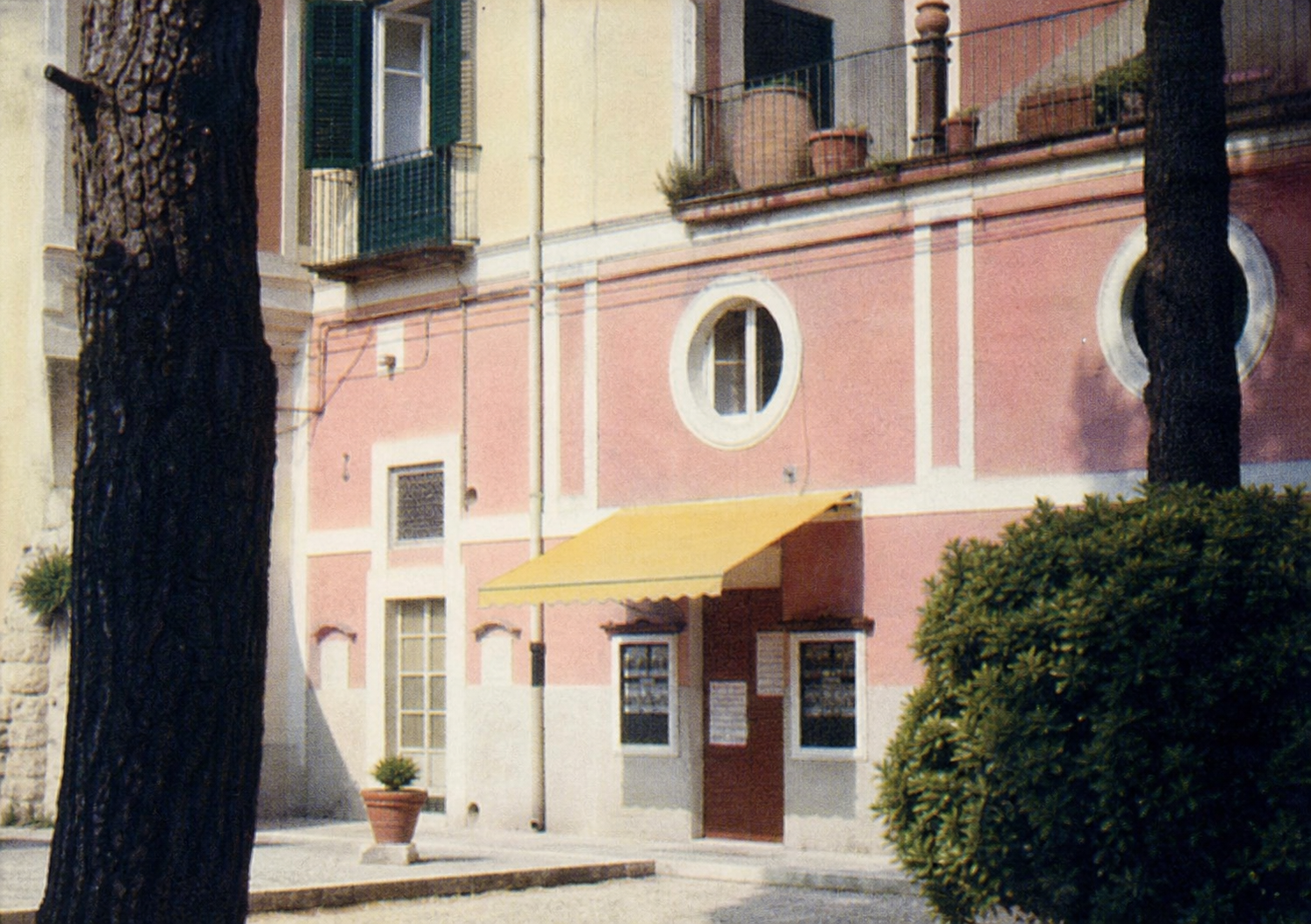
A few summers ago my family and I went to Ravello, a few miles south of Naples, high above the Mediterranean, looking down over the Bay of Salerno. We stayed in a small hotel, the Palumbo, first built as a palace in the 1th century. One of my favorite places in the hotel was the garden and terrace overlooking the gulf. The bay is soft blue, there is a perpetual haze, so that the blue of the sea and the blue of the sky are not divided and one looks out into a pale blue sphere of light. The hotel garden is quite small, filled with flowers, and has a lovely terrace right at the edge
ia) |
dtr! HT
jrtey
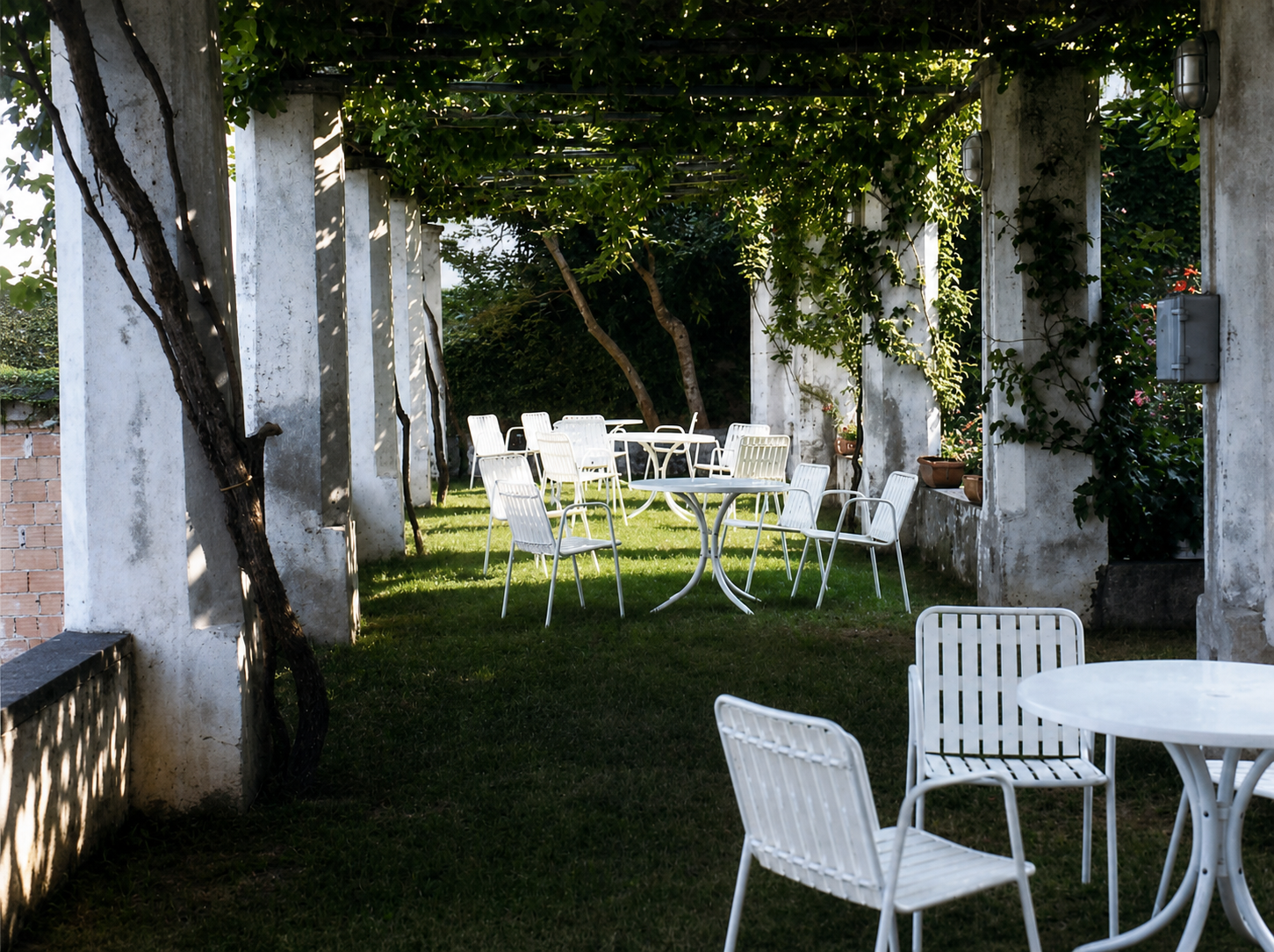
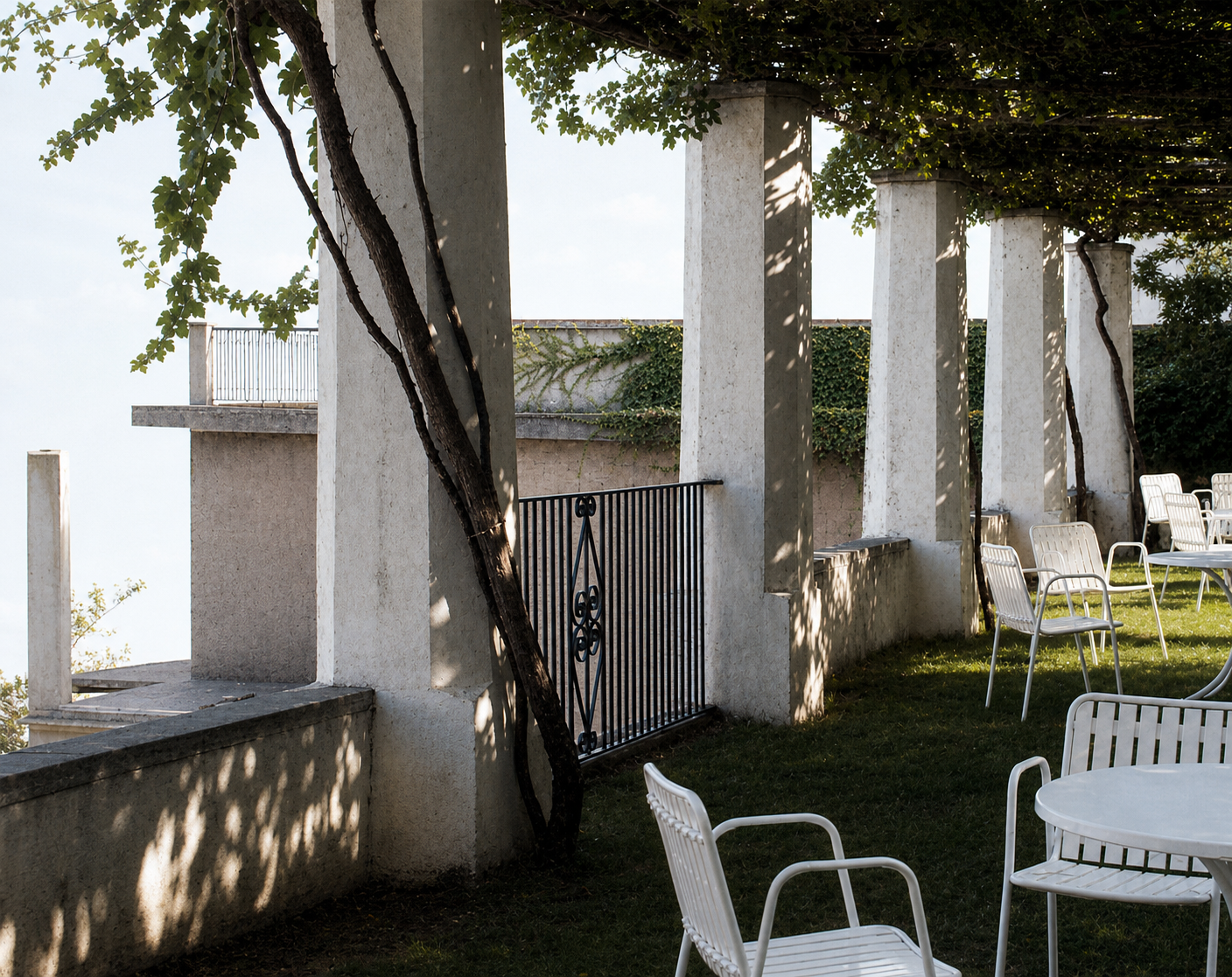
Garden terrace of the Hotel Palumbo of the cliff. If we asked for it, our breakfast was brought out to this garden, which we had quite to ourselves. Every morning we sat there for hours having our coffee, watching the gulf, while the children played among the flowers of the garden and tried to catch the lizards.
Following is a partial list of a few of the centers which formed the wholeness of this terrace. First are the architectural centers which are created in the geometry:
» The bays, formed by four columns
- The individual spaces of these individual bays - The big white columns
- The repetition of the bays
- The trellis of rounded branches
- The nine parts of the trellis
- The capital of the column
- The base of the column: The chamfer on the corner of the column
- The balustrade wall between the columns: The slight camber on the columns - The cap of the balustrade: The electric light on the columns
To complete the picture, we must add other equa lly essential, but non-architectural, centers:
- The individual tables and chairs - The grass of the lawn in the bays
- The grapes growing on the trellis: The stem of the grape vine - The view of the gulf through the columns
+ The visits of the waiter, bringing coffee - The coffee cups on the tables - The vines growing on the columns
- The blue shimmering sea beyond the cliff - The filtered sunlight dappling the grass
This describes a few of the hundreds of centers which together form the wholeness of the terrace.
Ill
It is hard to deny the life of the Palumbo Hotel terrace. The life of the place is tangible and immediate. But this wonderful life does not come about merely because of a vague beauty in the place. It comes about in a very definite way because of the centers in the wholeness and their relation to one another. In particular, it comes about because the different centers help each other.
It is this mutual helping among the centers which causes the life and is the crux of the whole thing. Here is one example of this "helping" between centers: The terrace is made of structural bays -- each made by four columns -- each roughly square, about 13 feet by 13 feet. Each of these bays is itself a center. At the corners of the bays there are columns. The columns are centers, too. And on each column, on each of its corners, there is a chamfer. The chamfer is once again a center in its own right.
Each of the four-column bays is helped to be alive by these tiny chamfers on the columns at
lo! -- aA | \ t_e4
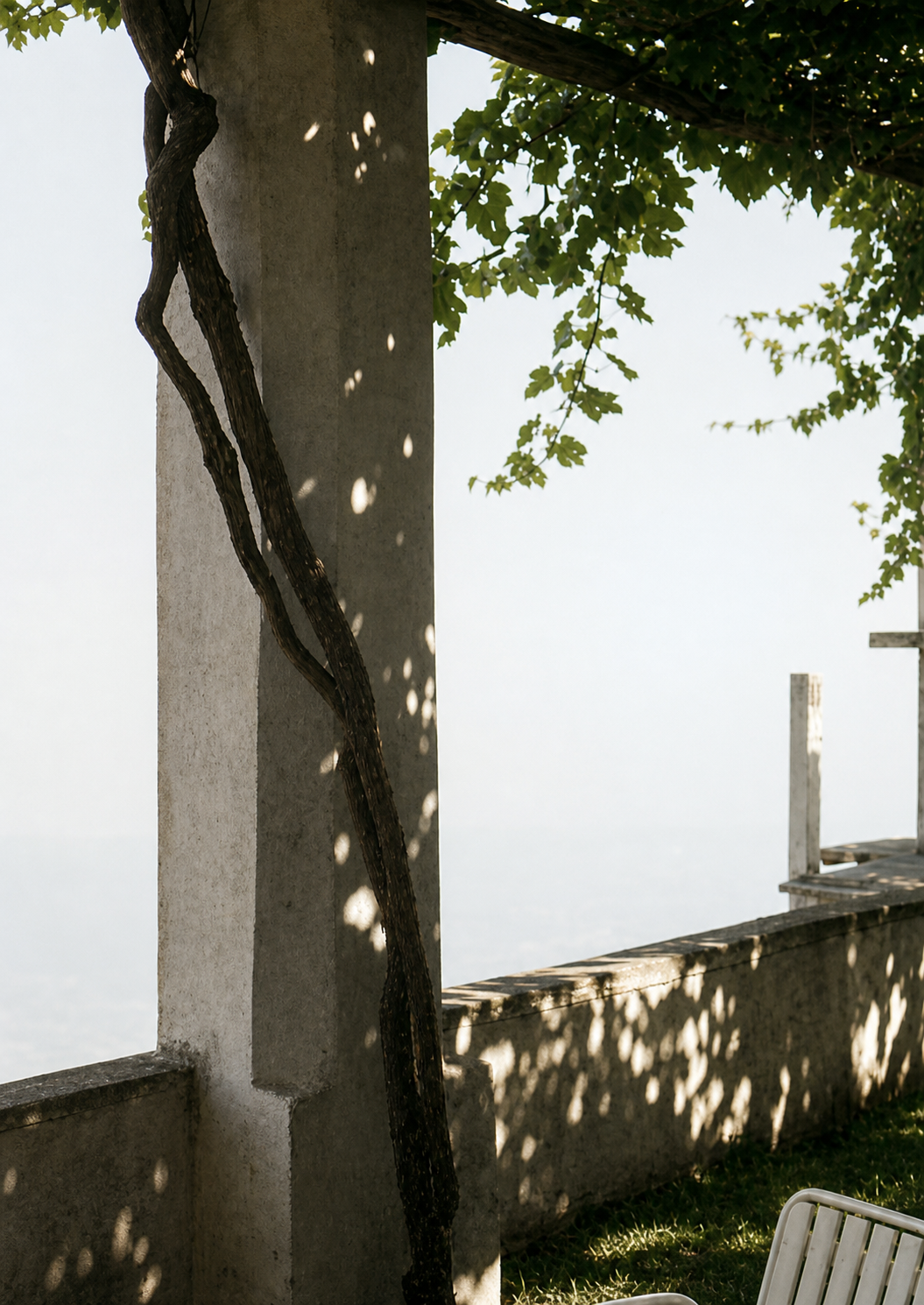
A single column with chamfers the corners of the bay. What I mean by this is that each bay becomes more of a center, and is more alive, because of the chamfer. Suppose, for example, that the columns had been made square, without the little octagonal chamfer on the corners. Then, as you can see on the facing page, each column would slightly eat into the space of the bay, thus disturbing the wholeness of the bay. Instead, the four chamfers help, geometically, to increase the unity and wholeness of the space in the bay. These chamfers, which are only two or three inches across, strengthen and intensify the structural bay which is created by the columns, and is some 13 feet across. At the same time, the chamfer also helps and intensifies the column itself. Thus we have the following helping relations between the space, the column, and the chamfer:
4 chamfers - column
4 columns - space of bay
16 chamfers - space of bay
The chamfer helps the column.
HOW
Helping: when the bay has octagonal chamfered columns, the chamfers form a subtly shaped octagonal bay. The column helps the bay, and the bay becomes more coherent.
Each bay has a system of twenty-one centers, in all, each getting life from the presence and cooperation of the others.
It must be emphasized that this helping relation between centers does not occur automatically. The columns could just as easily have been made in another way which would no¢ have this beneficial effect on the space. The corner of the column could have been given a shape which does not help to intensify the column. Creating a smaller center (in this case the chamfer) which successfully intensifies the column and also intensifies the bay (space made by four columns) is quite a trick.
Not helping: when the bay has square columns, the columns eat into the space of the bay; the bay is less coherent.
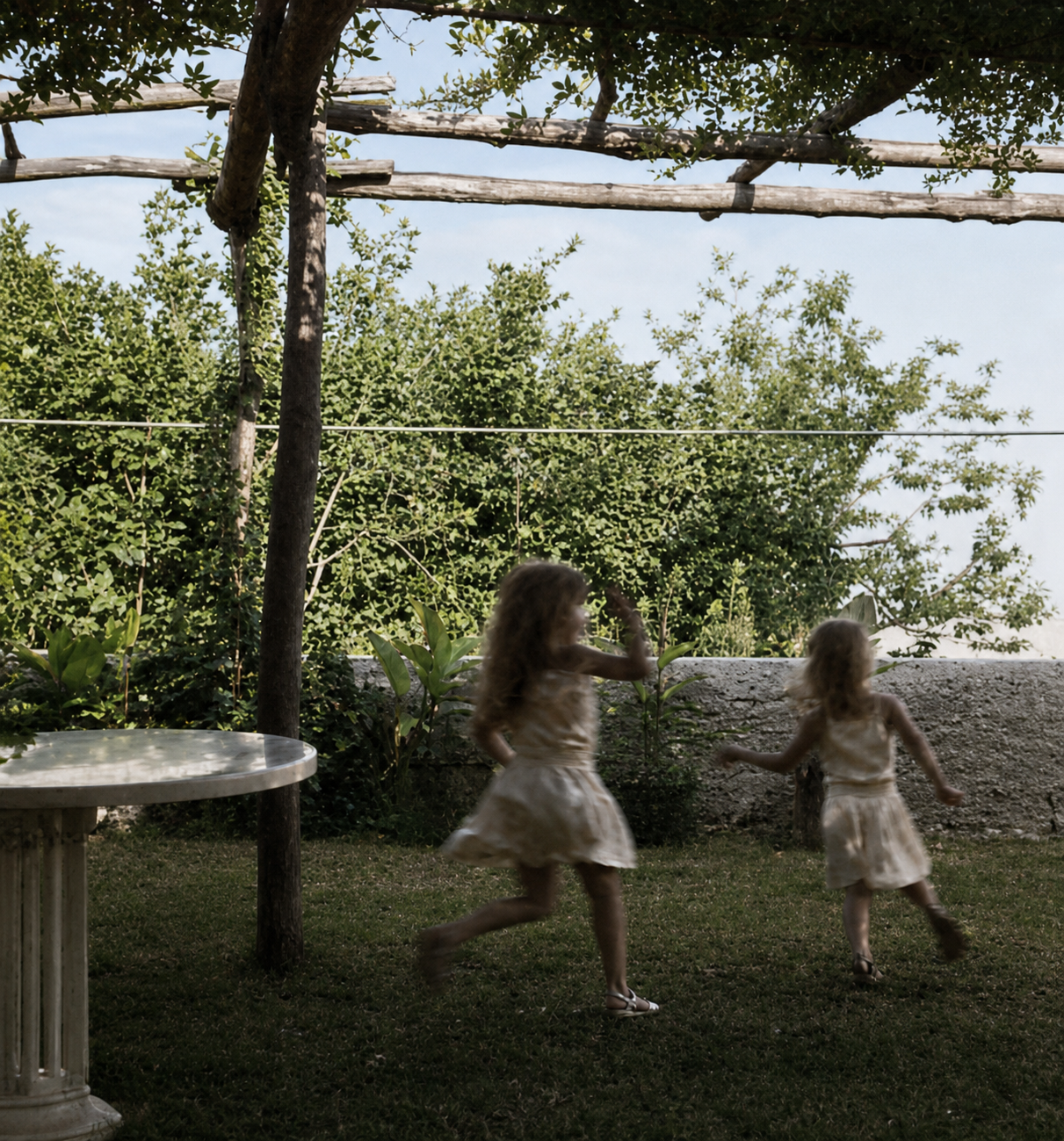
Let us look at another case. In the lower left-hand photograph, the children are playing in the small walled garden at the end of the terrace. The walled garden continues the space of the terrace, but encloses and "ends" it. The beauty of this closing is not only geometrical. As you can see, the children run the length of the terrace, then turn around in the end part, and come flying back. An old person strolling along would do a slower version of the same. The garden at the end, by forming a turning point, helps the terrace as a whole, makes it more of a living center than it would be without it. Again the result is not automatic. If the garden at the end
The small garden forms a center (A) at the end of the terrace, which helps the larger center B (the terrace itself), as children and old people run or walk to it, turn around, return. The one center's existence animates the other.
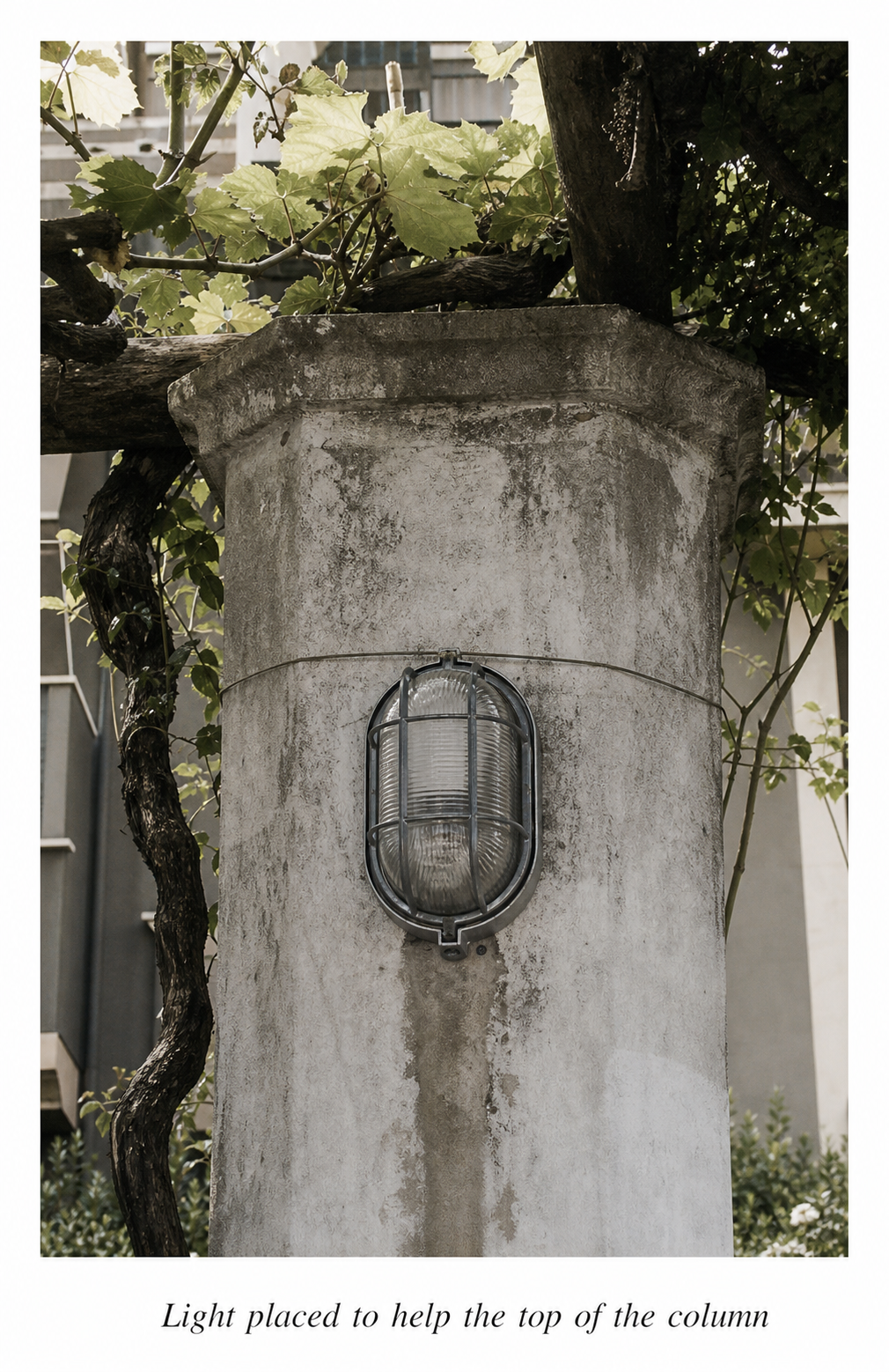
The cheap electric light fixture on the column forms a center (A), which helps and gives life to the center formed by the column itself (B).
were smaller, or larger, or differently walled, this effect would not occur.
Another example. There is an electric light mounted on the column, a very ordinary light that was chosen and placed so that it helps the capital. The capital becomes a little more intense because the lamp is just there. Again, this is not automatic. If the light were lower down, or asymmetrically mounted, or a more obtrusive shape, this would not happen.
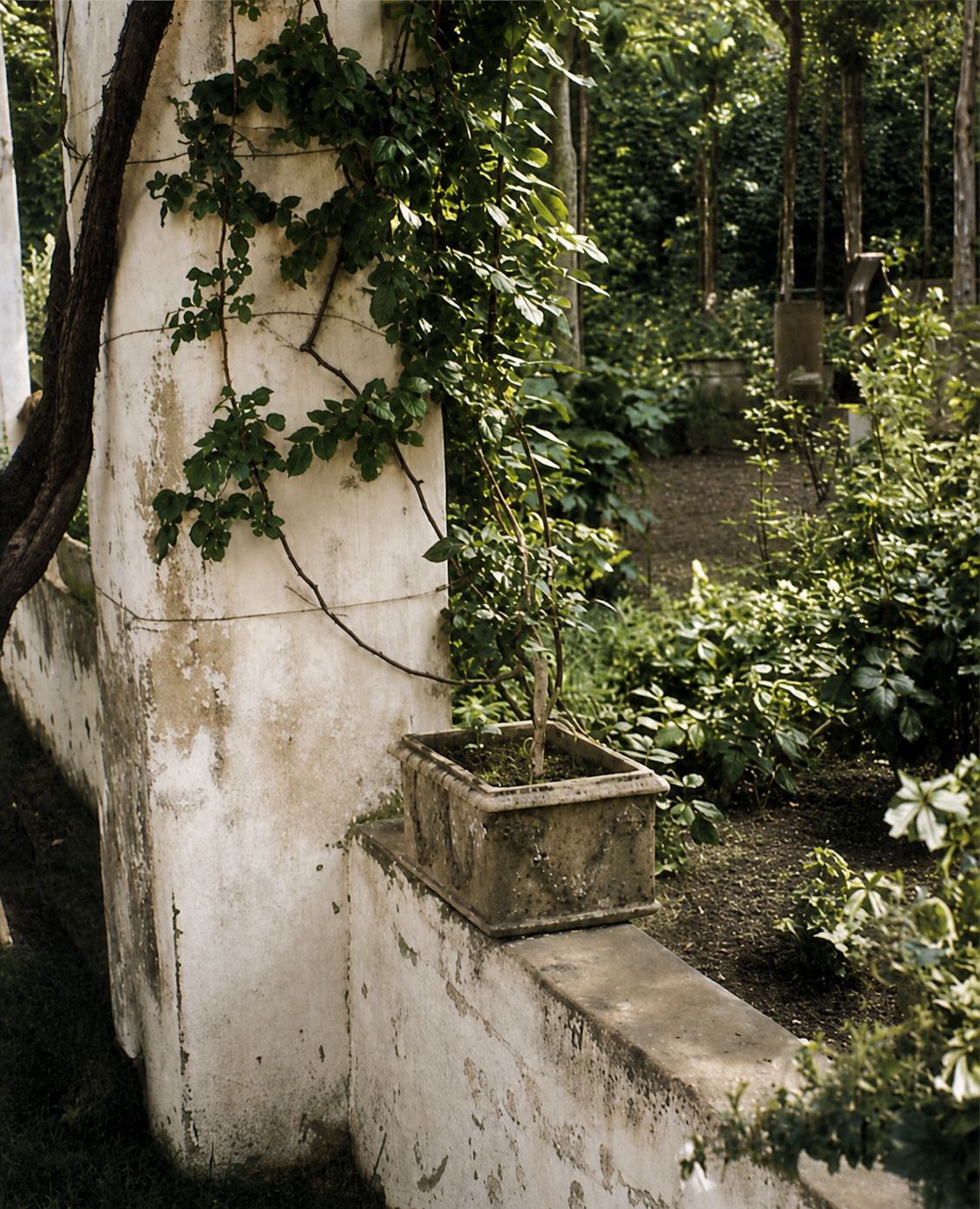
In each case, the helping relation between two centers, A and B, may be seen in the fact that the one center increases the life of the other (the life of A helps increase the life of B). For example, when I look at the flower box on the low wall, the life of the low wall is increased by the existence of the flower box. If I take the flower box away mentally (with my hand, by covering part of the photograph) I see the life of the low wall drop down, diminish.
Although, in one sense, the helping relation between centers is obvious, you may be puzzled as to how one might determine, operation ally, when one center is helping another one. Wouldn't it be possible to say that any two centers near each other are helping each other? How do we know when it is really happening? This quite reasonable question has a practical answer. Suppose we have two centers A and 3, and we want to know if B is helping A or not. We simply
HOW LIFE
look at A with B, and without B, and go back and forth between the two, using the criterion of life to decide which of the two, A with B or A without B, has more life. If, of the two, A with B has more life, then B is helping A'
In this terrace at the Hotel Palumbo there are dozens -- hundreds really -- of these helping relations between the centers. Here are some other examples:
- The capital of the columns is shaped to make the columns more alive.
- The nine-fold division of the trellis helps the bay become calmer and more alive.: The tables set in the bays help the bays come to life.
- The bays also intensify the tables.
+ The low wall between the columns intensifies the column bay between the water and the garden.
- The low wall helps the view.
IIs
» The view of the bay and the blue sky helps the individual bays.
- The grapes help the view.
- The grapes help the tables.
- The round tables help the bays.
- The chairs help the round tables.
- The lights on the columns help the columns and the bays.
- The flowers in the garden help the bays.
- The low wall helps the flowers.: The grass helps the terrace.
» The vines help the grass.
Some of the helping relations between centers are very large in scale. For example, one of the most important centers in the terrace is the view through the columns. Certainly at the Palumbo it is one of the most marvelous things: a vast entity extending out from the terrace towards the distant hazy blue of the sea. We
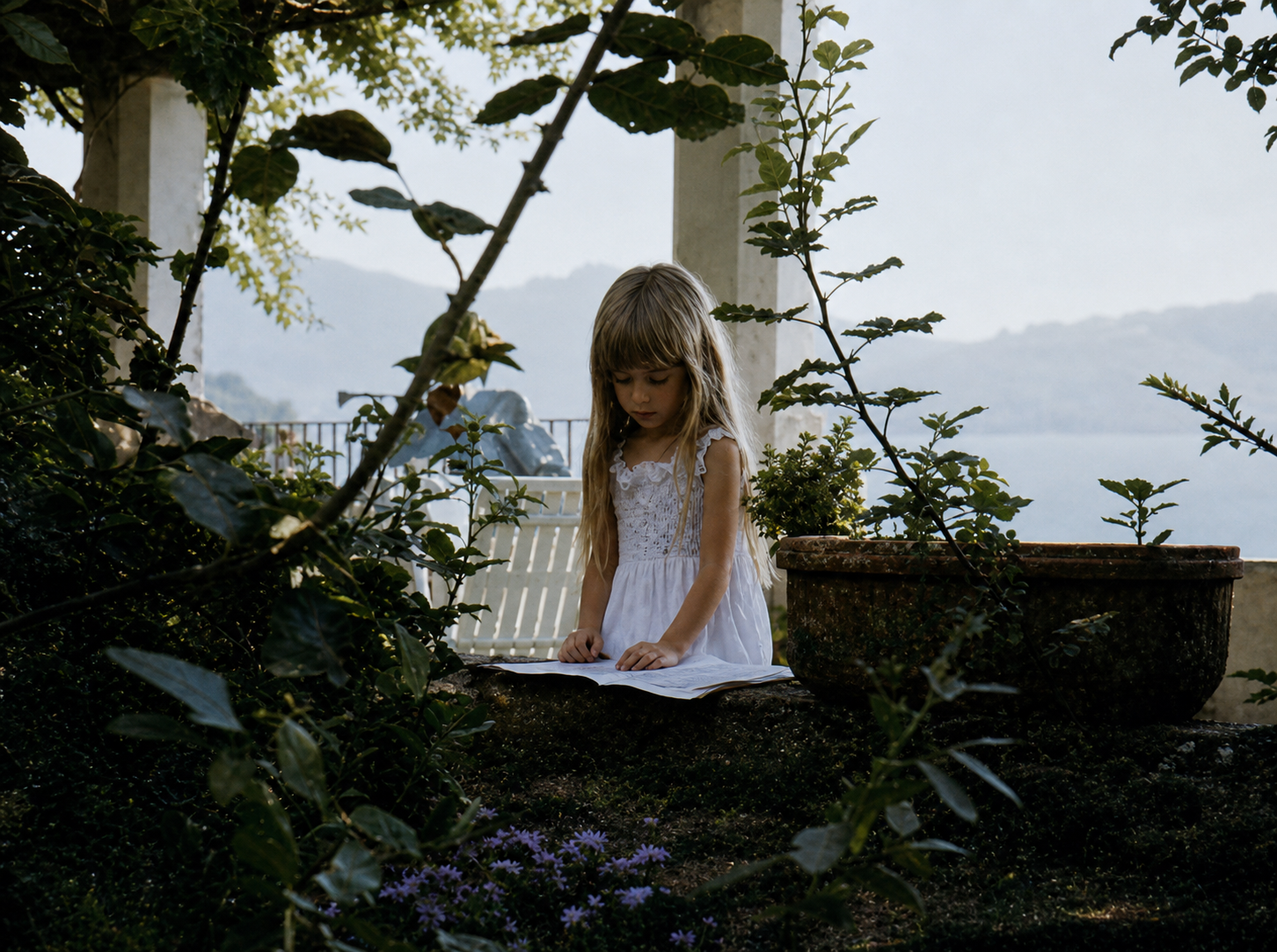
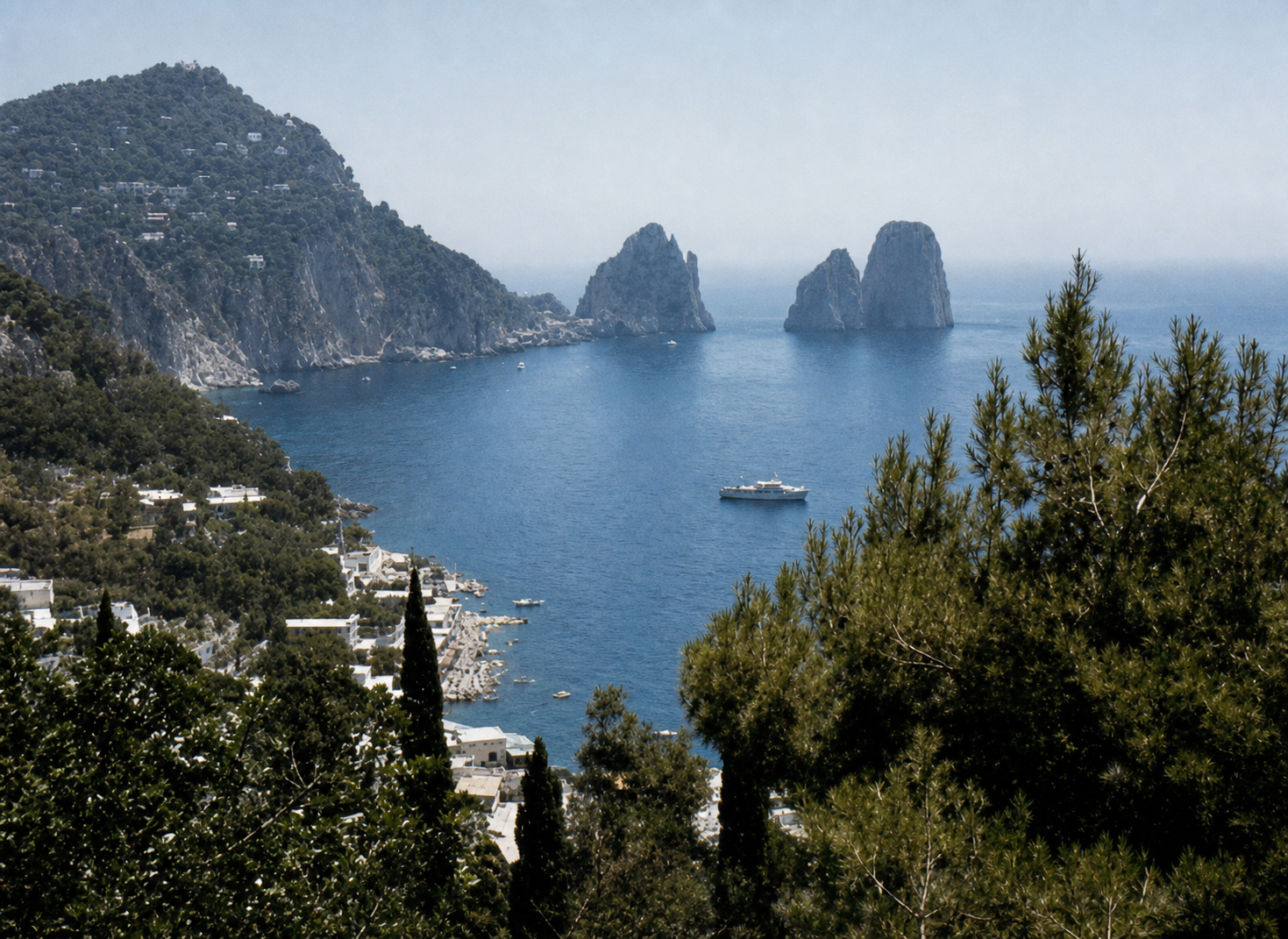
Looking out across the gulf of Salerno may imagine it as a cloud of space stretching from the terrace to the sea and over the sea. In a person's experience of that place, there is no doubt this center appears as a major entity, and no doubt that the existence of this large center brings life to the smaller center of the terrace itself.
What makes us so definite about recognizing the merging of the blue of the sea and the sky as a center in the place? It is something we are transfixed by, we stare at it, we are drunk in
The blue of the sea it, and the far-off blue haze helps the green vines of the terrace come to life. And the bays of the terrace themselves, as individual centers, gain greater life from this larger center which is stretched between these bays and the world beyond towards the Gulf of Salerno.
The system of centers, the ways these centers help each other, and the continuity of the thing with the whole world -- these together form the structure which establishes the life of the thing.'
4 / Recursive Definition
We need to go back to the key question in the puzzle of wholeness: What exactly is a center? This question holds the key to the problem of order, and to the entire problem of living structure.
The crux of the matter is this: a center is a kind of entity which can only be defined in terms of other centers. The idea of a center cannot be defined in terms of any other primitive entities except centers.
We are used to a view where we try to explain one kind of entity by showing it to be constructed of other different kinds of entities. An organism is made of cells, an atom is made of electrons, and so on. All of these are centers. If we ask what the centers are made of, we come up against a brick wall. Here we have a question
OF A CENTER so fundamental that it cannot be explained or understood, as a composite of any other more fundamental kind of entity. Instead, we shall see centers are only made of ofher centers. This is the most fundamental concept. The nature of these centers can therefore be understood only reflexively, or recursively. This is one reason wholeness looks so mysterious to those who are wedded to mechanistic thought.
Consider, for example, the apple tree shown on the next pages. I see the tree as a center, I see its branches as centers, the blossoms as centers, and the petals of the bloom as centers. The fact that I can see the tree as a center comes about because I see it as a whole: seeing it as a
HOW
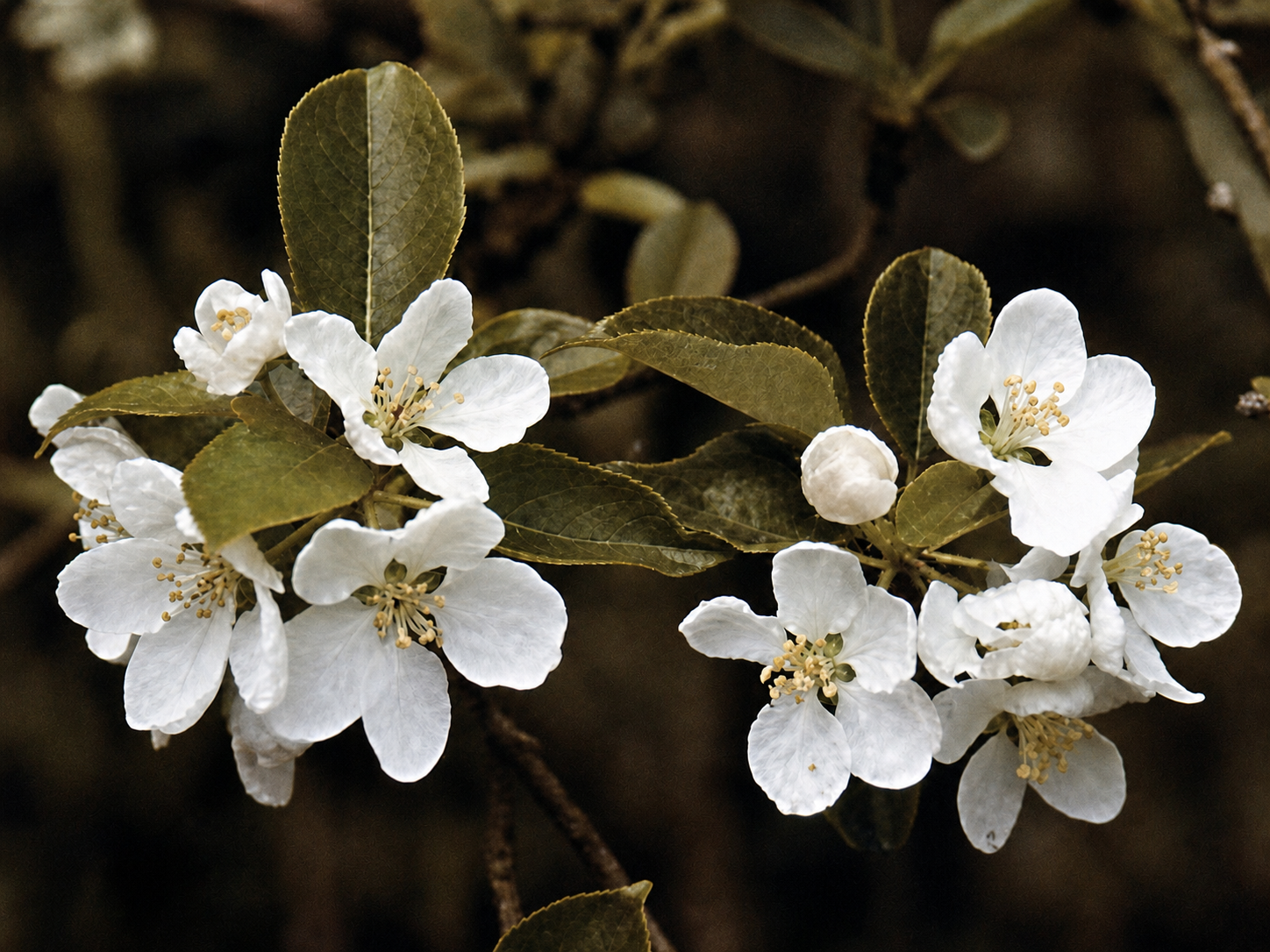
The wholeness of the tree, as I see it, comes from the way that I understand the interpretation of these many centers: by recognizing that the tree is made of branches. My ability to perceive that a branch is a center is necessary part of my ability to see the tree as a center. I cannot find some way of explaining the centeredness of the
tree which does not rely on my ability to see the centeredness of the branches.
This interconnection of my perceptions goes all the way to the very bottom of the foundation that my perceptions stand upon. Consider, for instance, one of the apple leaves shown below. We feel it to be a center, of course. Now, suppose I ask what it is about the leaf which makes it seem like a center. To answer this question, I have to point to the tip of the leaf, the uniform double curvature which makes it a single thing, its spine, its minor ribs, all parallel to one another, the zone of flesh roughly a parallelogram between two ribs, the stem of the leaf, and the indentation where the leaf is joined by its stem, and the very tiny serrations, almost smooth, which form the outer boundary of the leaf. All these are centers.
It is the organization of these centers which makes the whole leaf a center. Yet all these things are themselves centers. That is why we notice them. It is their centeredness which we notice,
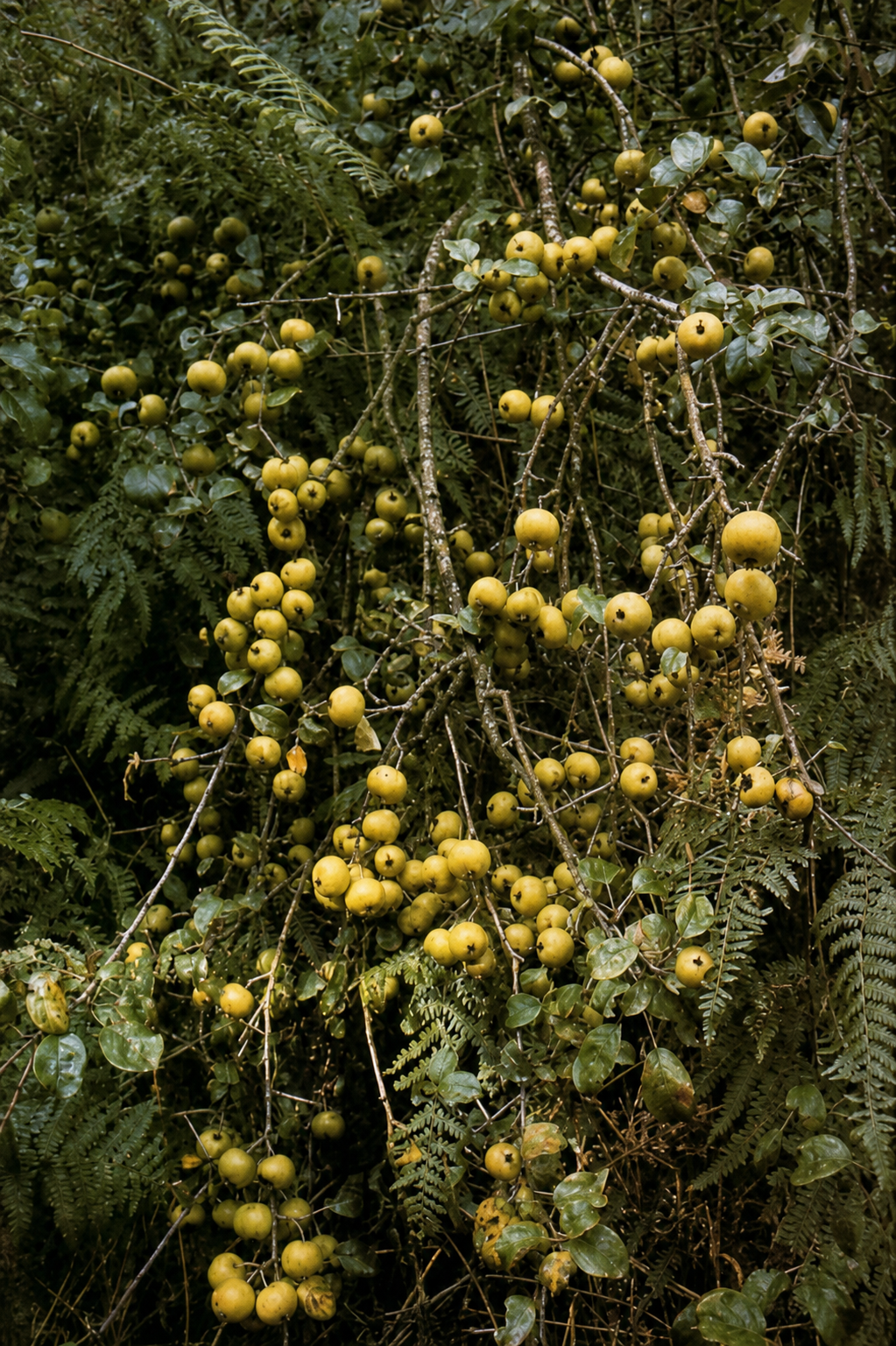
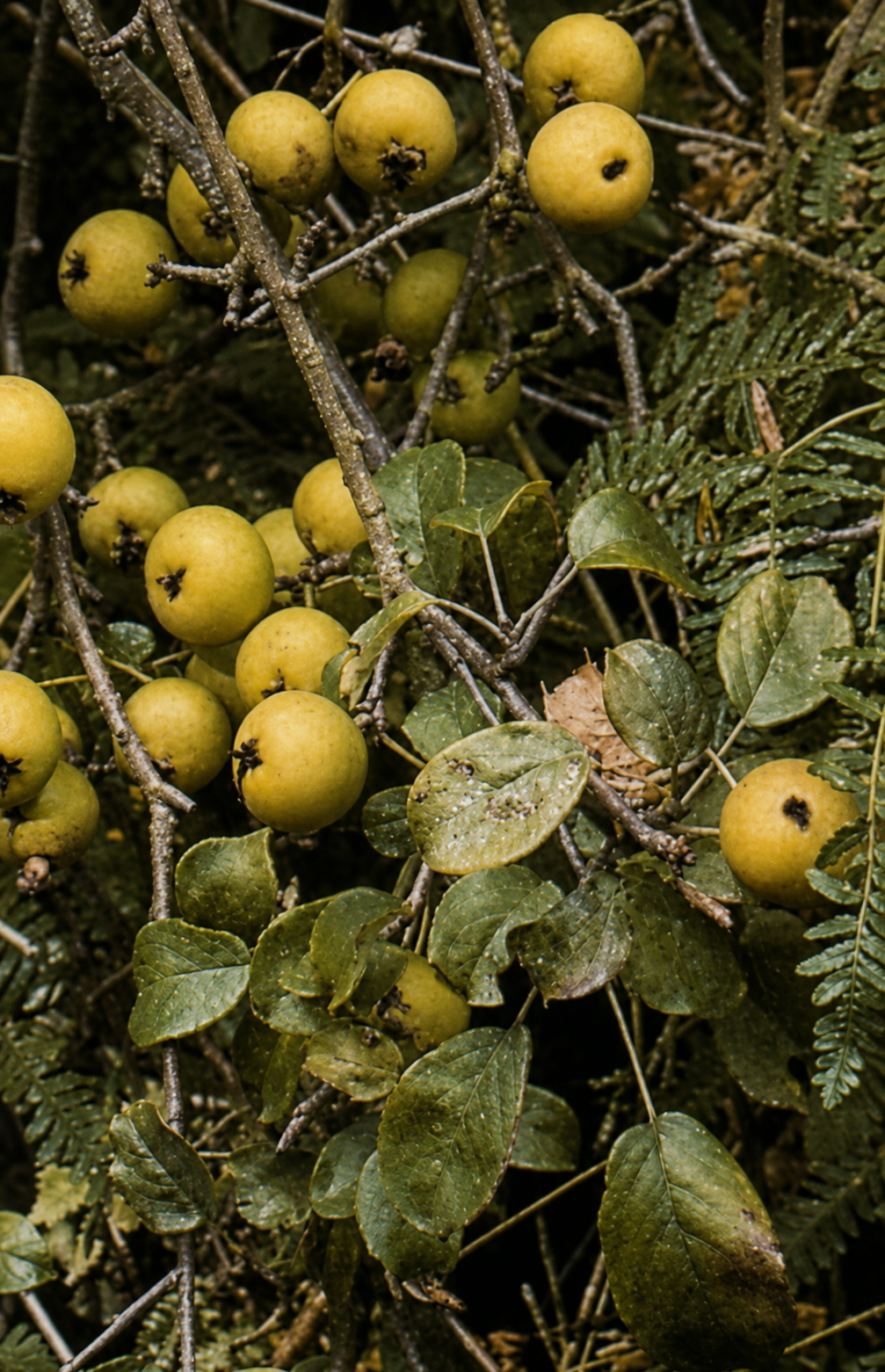
The branch of the tree, its leaves and apples and twigs
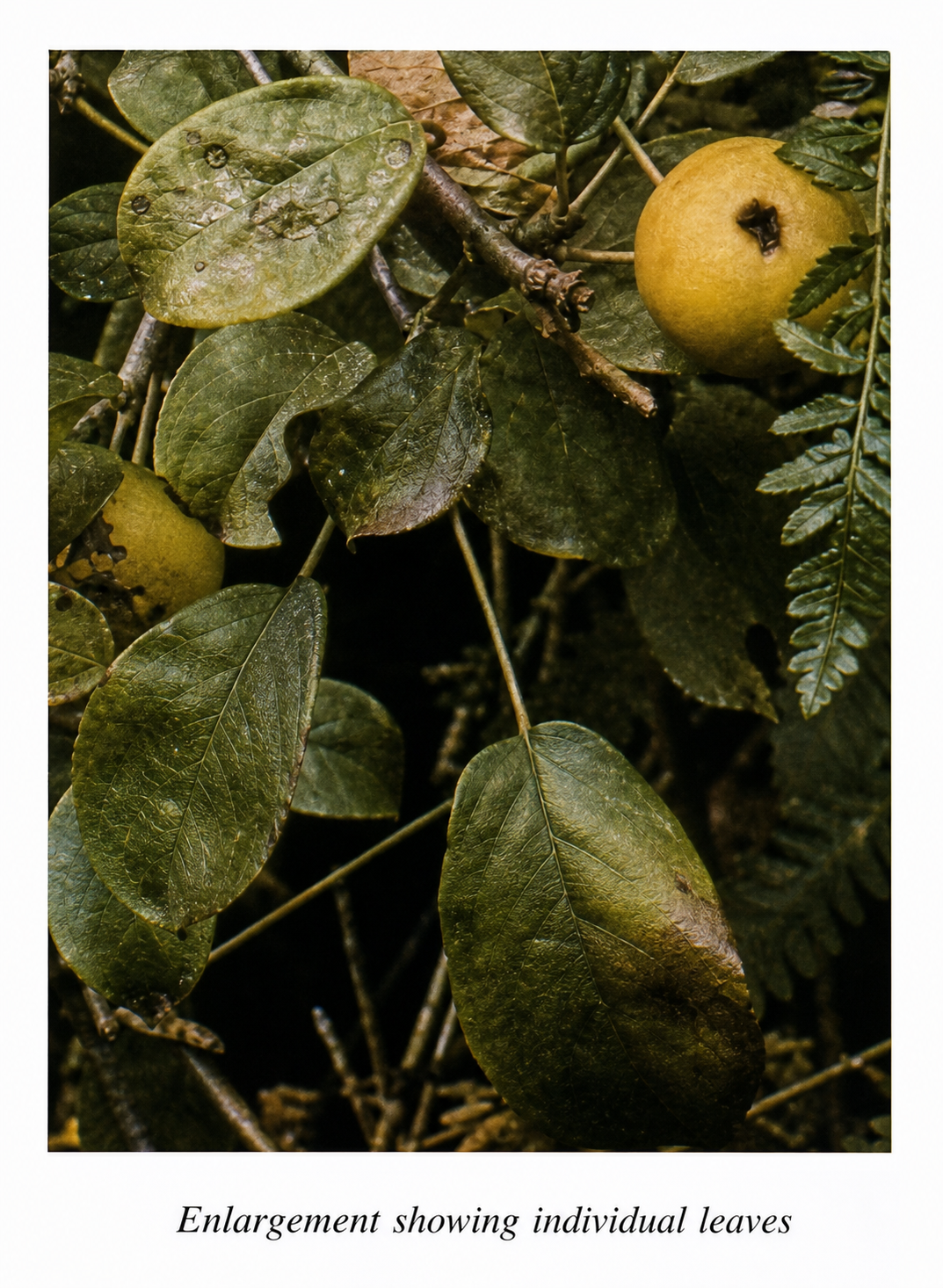
and which makes us pick them as the elements with which to see and explain the centeredness of the leaf as a whole. Thus it is the organization, the "centered" organization of these other centers, which makes the leaf a center in our experience. As soon as we try to describe, precisely, why this particular thing is a center, we find that we have to invoke some kind of description in terms of ofher centers.
In mathematics, such a concept is called recursive.* Grasping this idea, and grasping the fact that this bit of understanding is a positive step forward, and not problematic, is the key to understanding wholeness. The apparent circularity here is -- I believe -- the crux of the problem of wholeness. The reason that deep wholeness (or life) is so mysterious, is that centers are built from centers, wholeness is built from wholeness.'
This is not a peculiarity of the leaf. It is typical of every single thing in the world that we can examine. In fact, it is precisely this which I believe to be unavoidable. What then is a center? A center is not a primitive element. Centers are already composite. Yet they are the most primitive elements available. They are bits of wholeness which appear as structures within the wholeness. But where do they come from, and what are they made of? The answer to this question is essential to all that follows.
Centers are always made of other centers. A center is nota point, nota perceived center of gravity. It is rather a field of organized force in an object or part of an object which makes that object or part exhibit centrality. This field-like centrality is fundamental to the idea of wholeness.°
The relative wholeness or centeredness of any given center can only be understood in terms of the relative centeredness of its component centers and their organization. There is no way of describing the centeredness of a leaf -- or anything else -- which does not invoke the centeredness of its various component parts, and of those around it. If I try to explain why a given thing feels like a center -- why a center occurs at a particular point in the organization of the leaf -- I cannot avoid talking about the other centers which occur at other levels. The centeredness or centrality in the leaf comes from the organization and interplay of its centers, and they are only centers because of their organization and their relatively greater centeredness.
So there is a fundamental circularity which we cannot escape. This circularity is not a mistake, or an indication of something logically vicious in the argument. On the contrary, it is the essential feature of the situation. Our understanding of both wholeness and life will come into focus just at that moment when we thoroughly grasp this circularity and what it means.
5 / THE DIAGRAM OF
EACH
To understand the idea of a center and its recursion deeply, it is necessary to learn to see each center as a field.' What makes a center "centered" is that it somehow functions as an organized field of force in space. It has a structure of centrality, it communicates centrality, it creates a spatial feeling of centrality.
To see how this comes about, I should like to ask that you examine the ornament shown below. It is a fragment from a 15th-century Turkish carpet (shown on the next page) whose beautiful design is made of centers, perhaps more visibly than other examples I have asked you to consider. I have picked out just one of the centers in this carpet and show it, below, in black and white. Next to it, I have drawn a diagram of the fieldlike living structure which creates this center. This field-like structure may be visualized something /ike a vector field (see note 7). Each part of the field points in some direction, towards some other center (see the diagram). Here we see wholeness, not merely as a nested system of centers (as in chapter 3), but as an ordered system in which the way that different centers and subcenters help each other creates the field effect. What do the arrows in this drawing represent?
They are orientations created by the contribution
ooh Se
STRUCTURE: FIELD which centers make to one another. These orientations are also centers. Thus the elements of the field are both centers of different strengths, and helping relationships among centers. Together they create a structure, not unlike a vector field, but with many layers hierarchically ordered. The diagram shown is a map, if you like, of a typical center within a living structure. It shows how the whole ornament, as a field, creates a feeling of centrality. In the ornament there is an organized field of force which organizes space and creates an overall impression of something centered. As such a structure becomes more dense and more complex, it approaches the thing I call living structure.
-- 4% _pin
Diagram of the force-field of the dominant center that appears in the carpet border
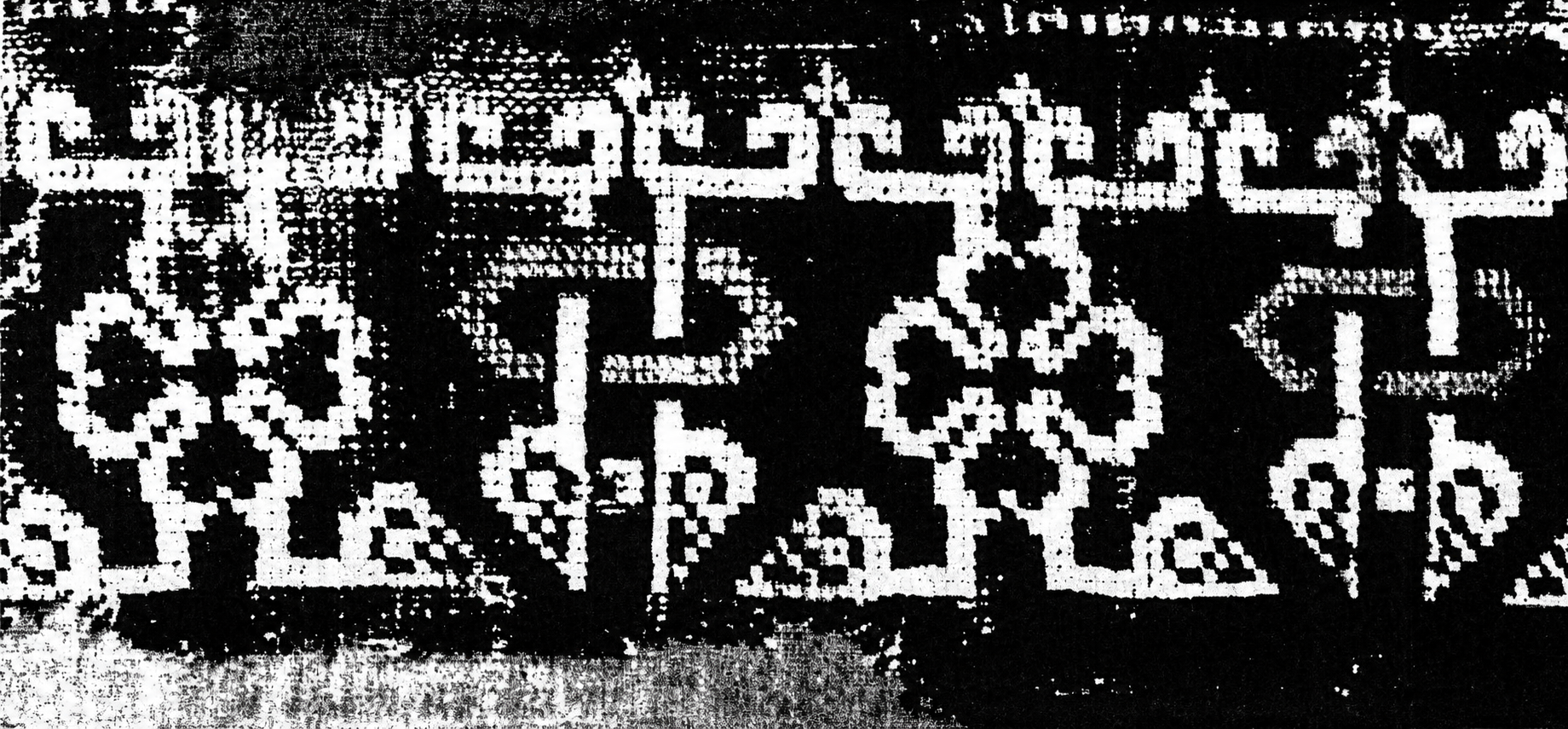
Anatolian carpet

Let us go back to the definition of wholeness. Let us imagine a space as filled with centers. As part of the definition of wholeness in chapter 3, I suggested that centers arise from certain sets in space -- often bounded, connected, convex, often symmetric, differentiated from the space next to them -- and radiating outward and creating coherence through a centered quality in space. But this is a convenient simplification.
To be more realistic, we need to imagine space as filled with such centers, all helping each other, all created by other centers, but all fieldlike, all radiating centeredness. How might we imagine this structure? We may imagine, in this space, an overall field in which, at each point there is an intensity -- the life of that field at that point -- together with vectors describing the impact of these centers on one another.
How can we describe it? Well, each of the new structures we observe is "induced" within the field as a new center of some kind. There are the centers between other centers, centers along the arrows, the arrows themselves, which themselves exist as centers, and so on. The ornament creates a structure which is, in some fashion, a continuous distribution of centers.
We may summarize the action of this field by means of a definition which is explicitly recursive: Each center is a field of other centers. By this definition, each of these other centers must then also be a field of centers. Thus a center is a field of centers, and within that field each center
is a field of yet other centers. There are no ultimate elementary components of the field, except the centers themselves.®
This is the foundation of what I mean by living structure. It would be very helpful to have a general mathematical description of this kind of field. But in its hierarchical ordering and in its great complexity, it is so unlike the structures conventionally used in present-day physics and mathematics, that it is not easy to grasp the nature of such a structure, let alone to represent it formally as a well-defined field of a new kind.'
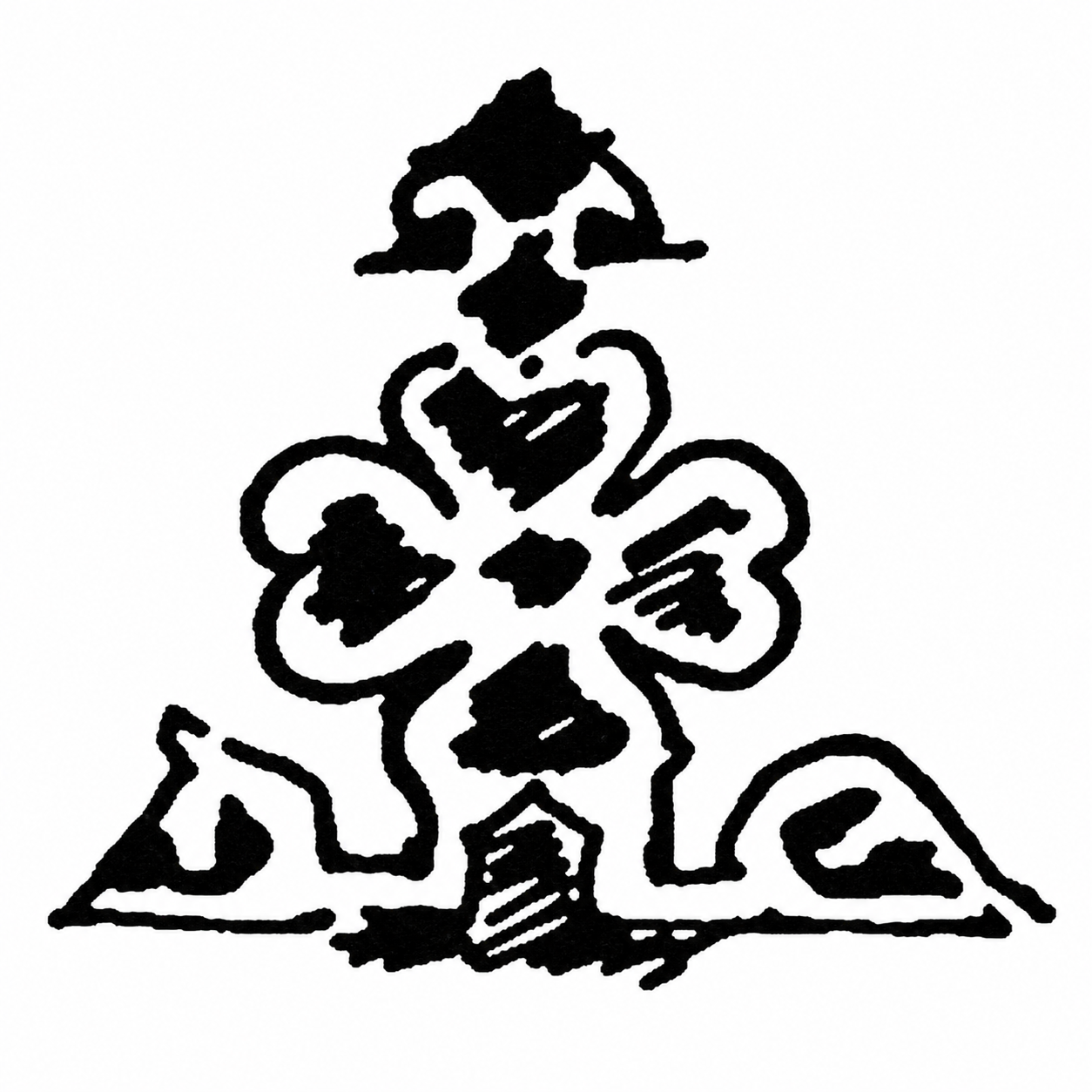
However, we may say this: in many of the examples shown, the key centers are symmetrical. Indeed, to a first approximation, one may identify the centers in a field as emanating from those entities which are convex, bounded, and roughly symmetrical, and differentiated from their surroundings." Some centers roughly follow these rules. But the rules are only approximate. A few of the centers and subcenters which appear in the carpet ornament are shown on the right. Some are imperfectly symmetrical. Some are not convex. Some are mainly defined by the degree to which they are differentiated from their surroundings, not by symmetry or boundedness at all. Nevertheless, as a rough rule of thumb, we may keep hold of the idea that centers are coherent entities, often marked by local symmetry, by differentiation, by the presence of a boundary, and by convexity, which cooperate to cause a field effect."
The mathematical definition of such a field awaits the work of other investigators. But no matter what the mathematical results, I believe it is true to say this much: shere is no way of defining the field in terms of ultimate elements that are essentially different from centers. There are no elementary entities that every center can be made of except other centers. The apple leaf on the apple tree occurs as a field of centers. The terrace of the Palumbo Hotel occurs as a field of centers. Each is a recursive field effect in which centers are induced by other centers. This is the basis of the phenomenon I shall now go on to describe as living structure.
i
pr
Some of the many centers which occur in the one border ornament on page 120
6 / Each Center Has Its Life
Armed with the idea that each center is a multilevelled field-like phenomenon made of other centers, let us now come back to the idea that each center has its degree of life.'"
The idea of this life of an individual center is similar to the idea already expressed earlier, that any given part of space in the world has its degree of life. But I want now to extend this idea and apply it separately and individually to every distinct center in the wholeness of a thing.
I simply assert (without, for the time being, demonstrating it) that every center has a distinguishable degree of life. If we accept this assertion, we may see how the degree of life of each center in a given wholeness depends on the degree of life of all the other centers in the wholeness. To get this, I propose to use the following unusual way of thinking, even though it may seem different from our normal ways of thinking.
I make five assertions:
1. Centers arise in space.
2. Each center is created by a configuration of other centers.
3. Each center has a certain life or intensity.
For the time being we do not know what this
f
~ life "is." But we can see that the life of any one center depends on the life of other centers. This life or intensity is not inherent in the center by itself, but is a function of the whole configuration in which the center occurs.
4. The life or intensity of one center is increased or decreased according to the position and intensity of other nearby centers, Above all, centers become most intense when the centers which they are made of help each other. Exactly what "helping" means in this context remains to be defined.
5. The centers are the fundamental elements of the wholeness, and the degree of life of any given part of space depends entirely on the presence and structure of the centers there.
From these five assertions, it will follow that the life of a given part of the world depends on the structure of centers it contains -- and that these centers are given their life, in turn, by the way that each one is made of still other centers. The interactive effect lies in the fact that each center has the power to intensify the life of other centers, and that the life of any one center comes about as the result of the placing and relative degrees of life of other nearby centers."
7 / Each Center Gets Its Life From Other Centers
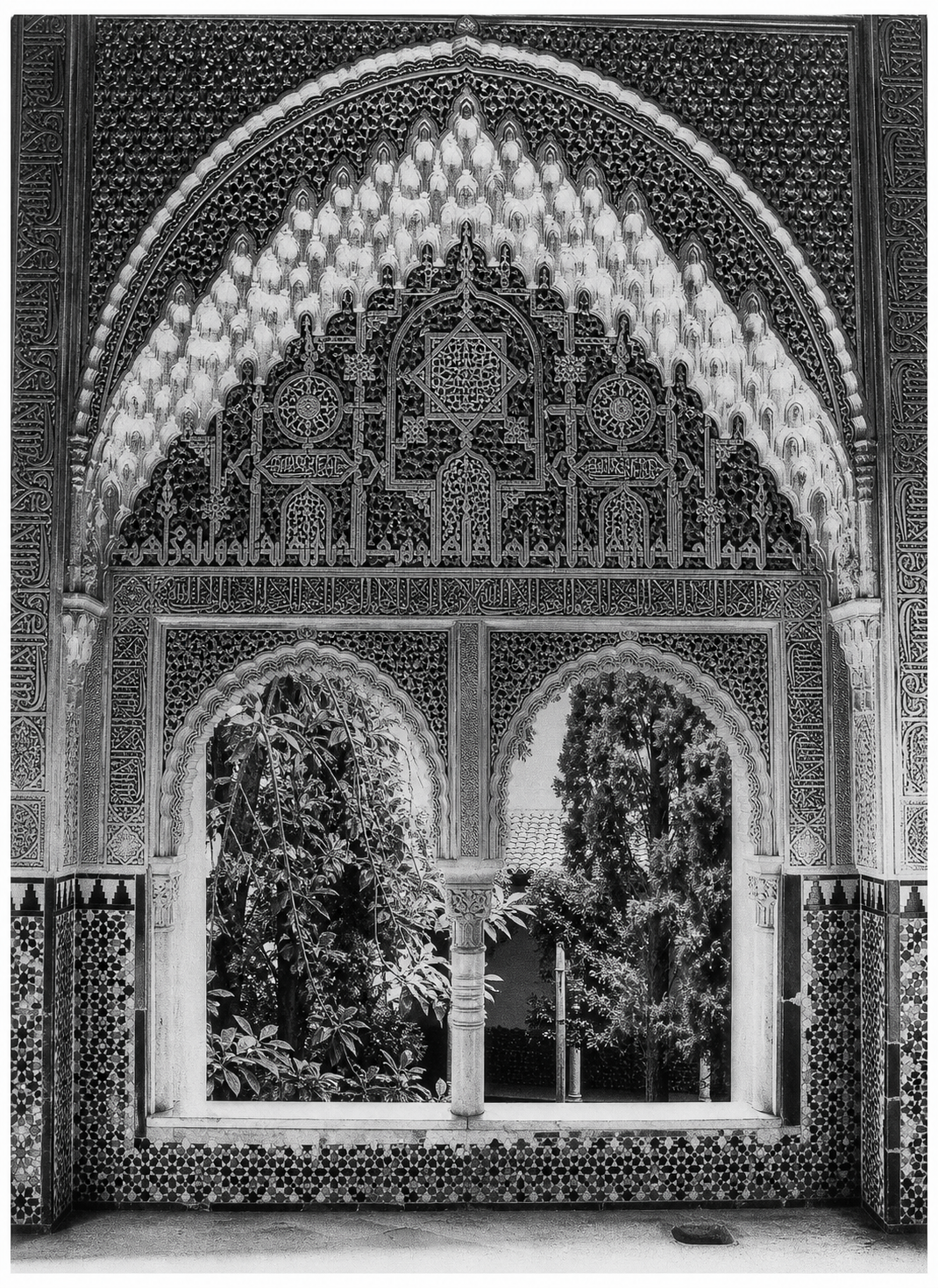
Consider the beautiful room from the Alhambra, illustrated here. In part, the beauty of the room depends on the life of the wall surface. Let us examine the life of the tilework forming wall surface. On the following page, there is a photograph of a tile fragment, which comes from one of these rooms in the Alhambra, where a whole wall was covered with this pattern.'*
When we look at the pattern on the tile fragment, we see many different centers. A black star, a black star-octagon, a green hexagon, the white space between the green hexagons, the very small white diamond between adjacent pairs of the black hand-shaped figures -- they are all centers. And they all help each other.
: PRI Ges HEwEES
To understand exactly how these different centers help each other, it is necessary to pay careful attention to the life of all the centers, each one in its own right, and then as they begin to work together. In looking at these examples, one must pay acute attention to one's inner feeling in order to judge the degree of -- top to bottom.
life in each example, to see how it is changing." Let us begin with the black eight-pointed star. Look at the five diagrams in the first sequence. In each case we see a center. But the centers, as drawn, become progressively more intense in their life as we go down the sequence from
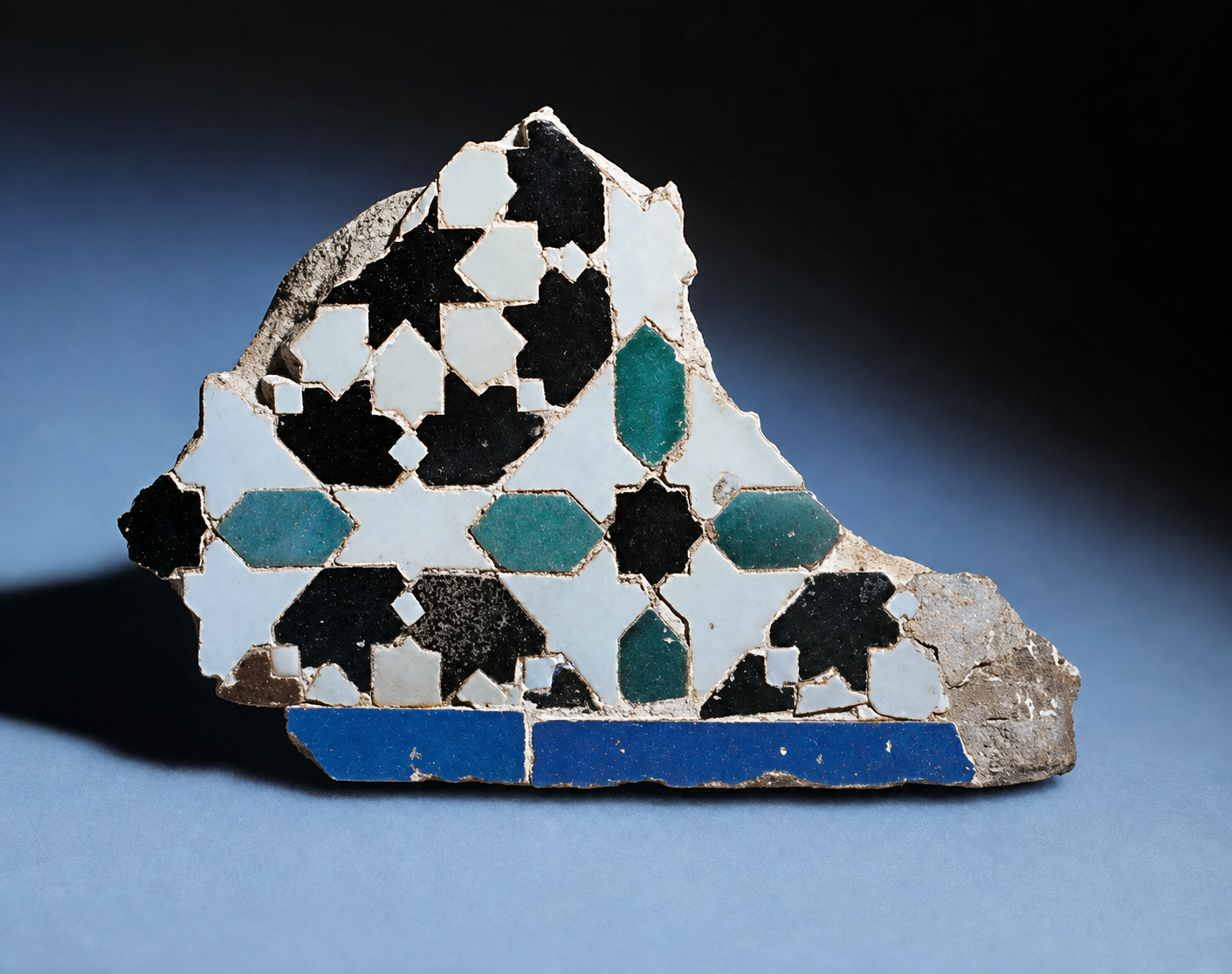
Step 1. Star shape, alone, without color. It has a certain life, but is limited.
Step 2. Star shape, colored black. When the star is colored black it is more intense than when it was white, because it is now more differentiated from its surroundings.
Step 3. Now we add tips at the points of the black star. This is more lively because it is supported by extra centers at the points of the star.
Step 4. Black star with partly formed white pentagons between the rays of the star. This figure is even more intense, because now the spaces between the arms of the star are working as centers, too; the whole thing takes on more life than before.
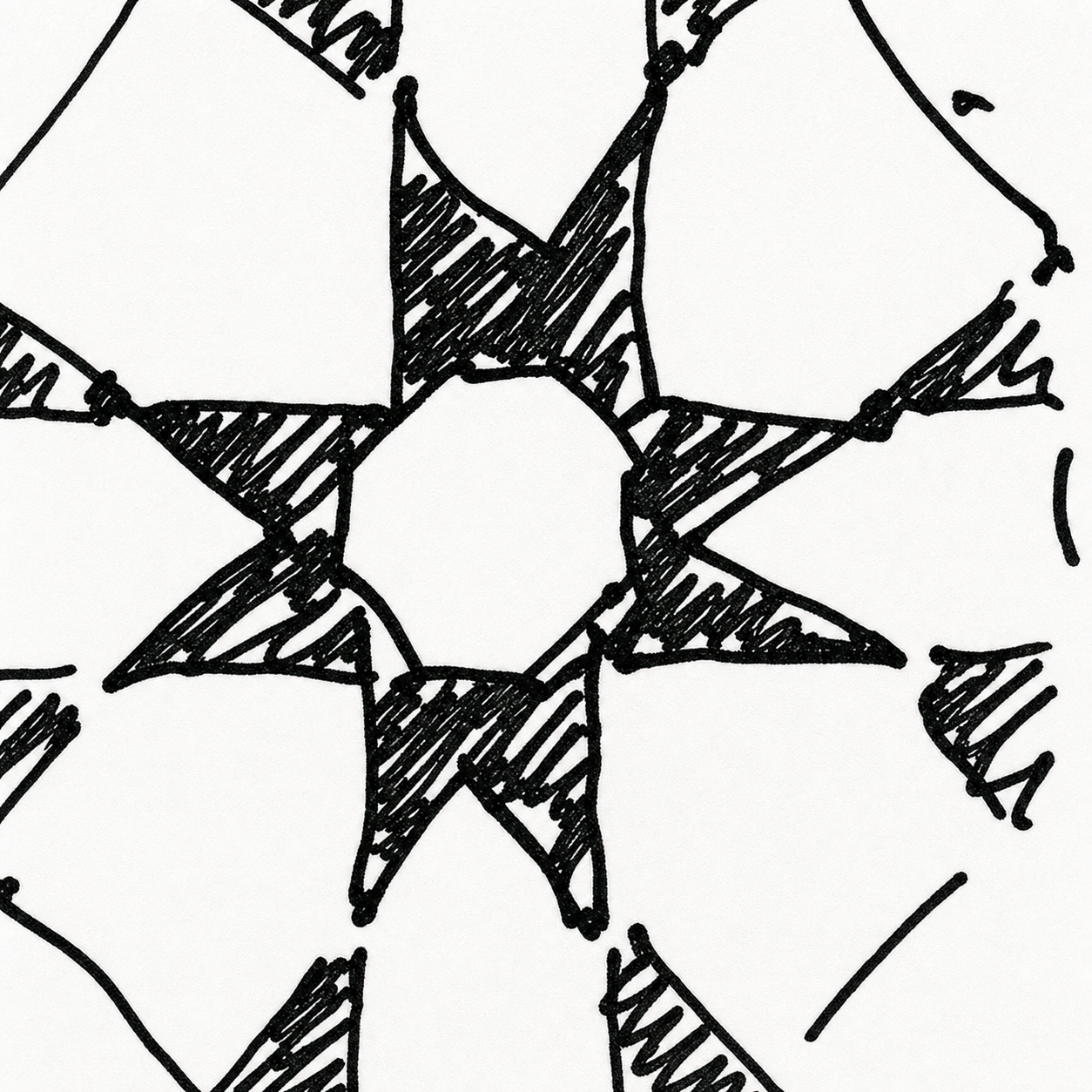
Step 5. Finally, a star which is still more intense, because the black hand-shaped figures have been added, together with the small white diamonds between them. The double system of more elaborate centers stretching out from the arms of the black star adds even more; the life of the figure is still further intensified.
In this progression, the star obtains progressively more and more life. Even if you are not sure why the stars in the five illustrations have progressively more and more life, I think you will agree that they do have it.
ML
VW!
Step 1: Star shape without color
Step 4: Black star with partly formed white pentagons between the tips
Step 5: Still more intense, because the octagon of black hand-shaped figures has been added there is a black star-octagon. It is shown first by itself. This black star-octagon has some life as a center, even with nothing around it. This staroctagon receives addition al life as a center from the other centers near it. For example, if I cover
Step 1: The black star-octagon, with nothing around it
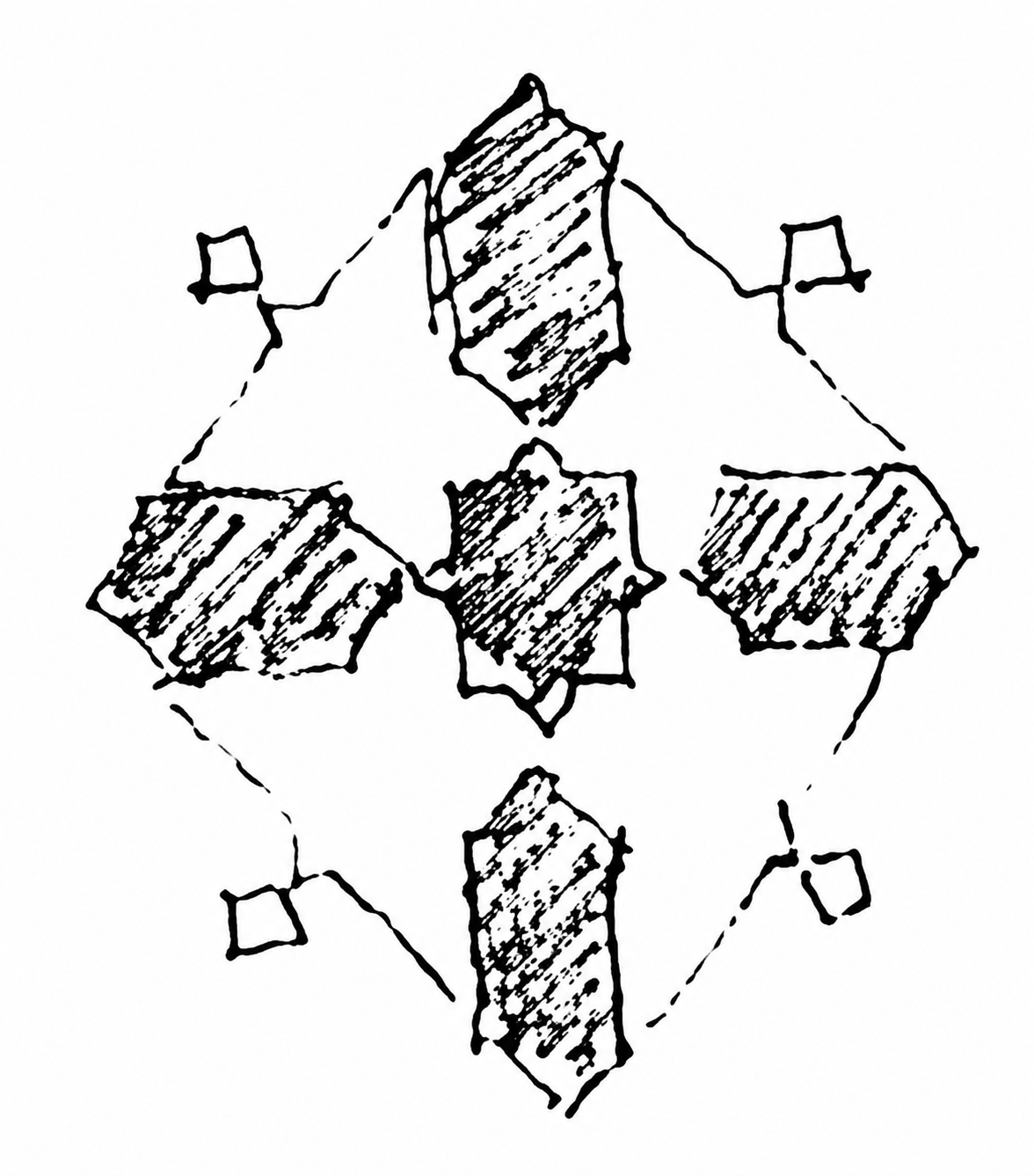
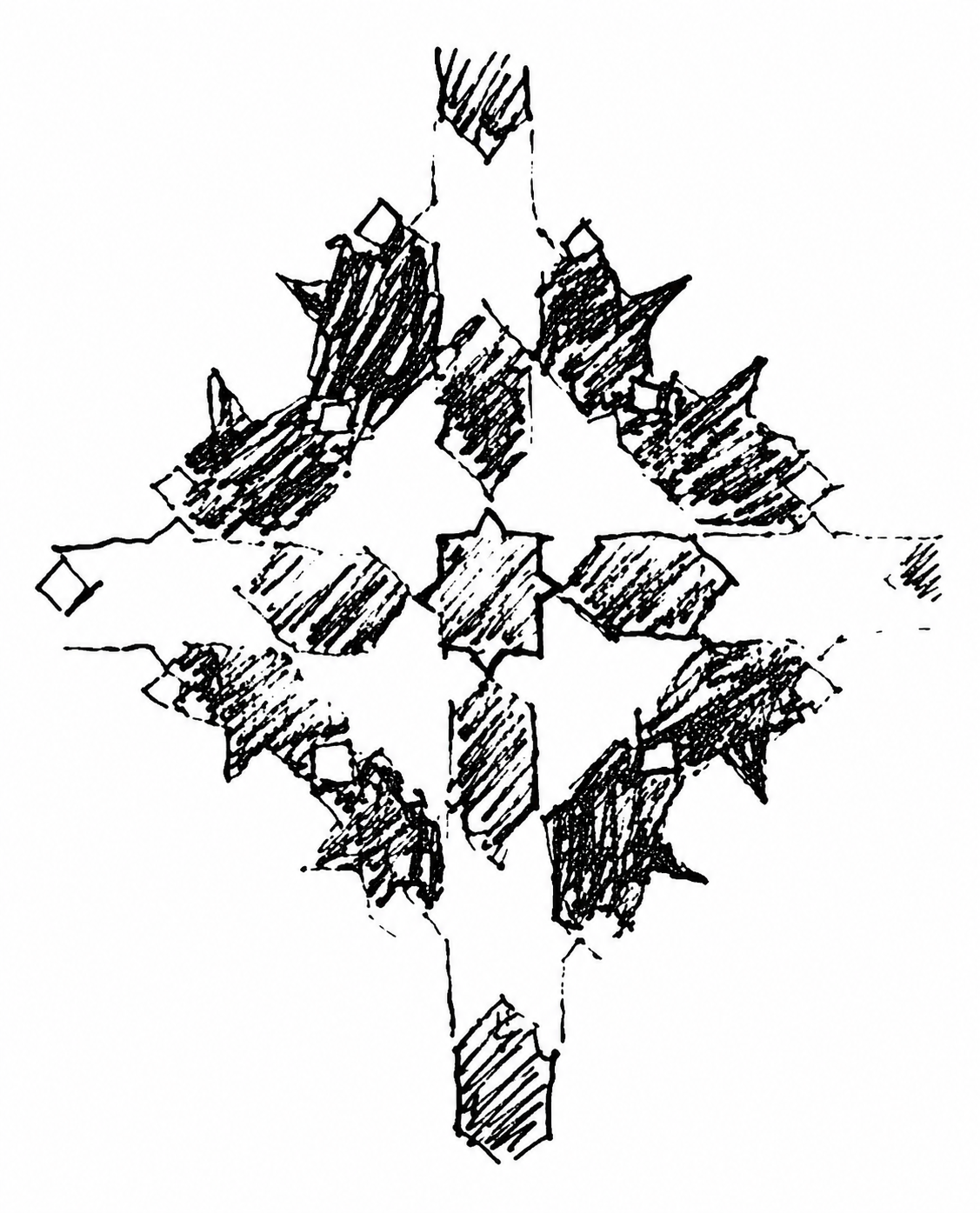
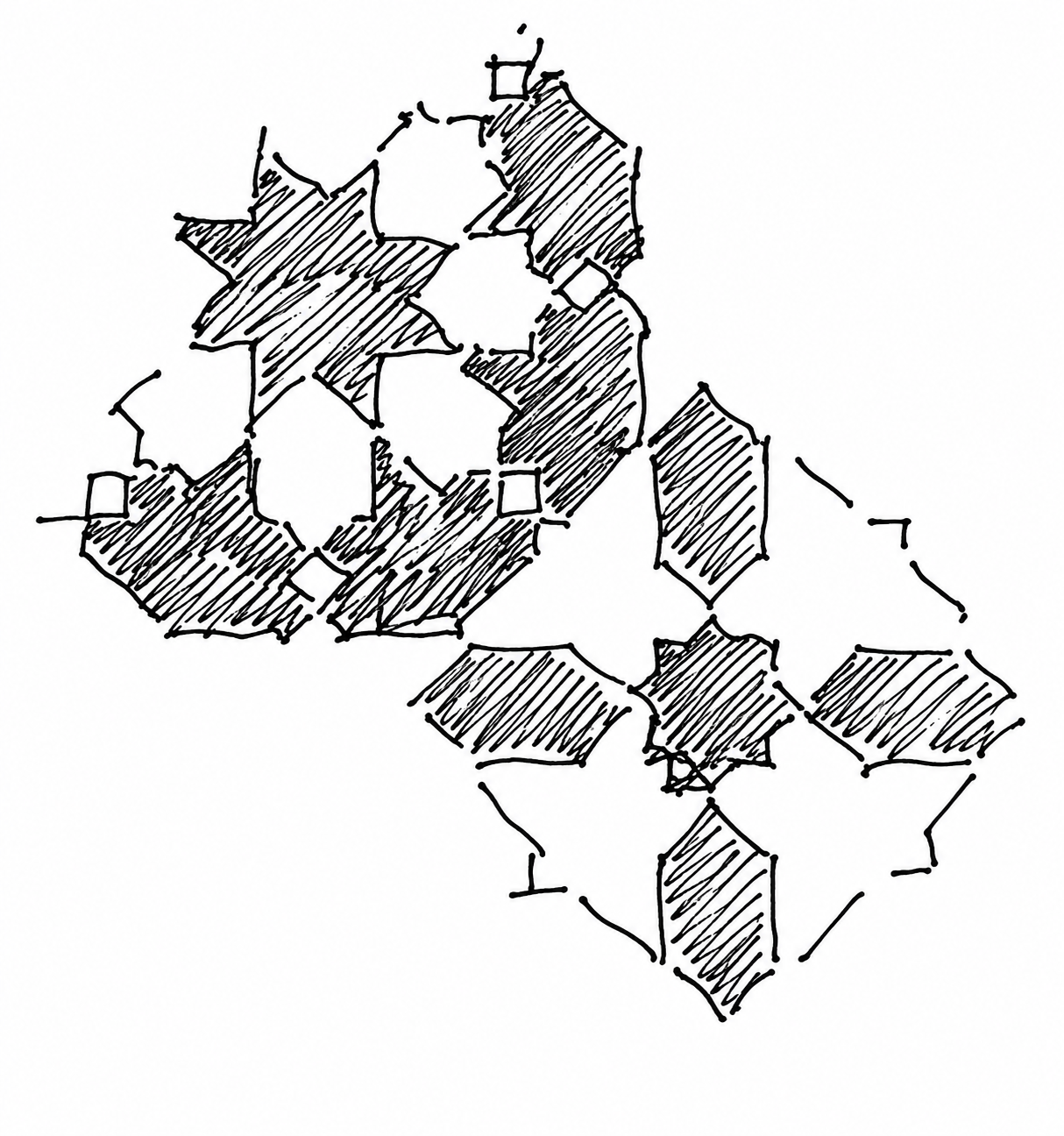
ings, the center formed by the black star-octagon regains more and more life.
Step 1. The black star-octagon by itself.
Step 2. Next, we see the four green hexagons around it, but without the white space between them. The center formed by the black staroctagon gains life when it is supplemented by the arrangement of the four green hexagons.
again,
Step 3. To the four green hexagons are added the four white "shirt" shapes between them, and, in addition, the four little white diamond-like lobes which extend out from the shirts. The center becomes stronger still, and its life increases
Step 4. Now we see the larger diamond which contains the black star-octagon plus the four green hexagons and four white shirts, with the four white fish-tail shapes and the large dark octagon edges beyond them. The center gains even more life.
Step 5. Finally I open my hand completely and let myself see all the structure which surrounds the star-octagon, and the complex structure which surrounds the more distant black eight-pointed star as well. The centers now acquire even more life.
We begin to realize how within the tile fragment the center which seems localized in the
Step 5: The complete pattern, as it appears on the original fragment. Here we see the addition al impact of the neighboring pattern of the black eight-pointed star, and the centers surrounding it, and what all this does to increase the life of the star-octagon yet further.
black star-octagon actually extends outward several inches, and how it grasps the space, even as far out as the black star, and interacts with it. When we understand this, we see the whole fragment as more remarkable. Our respect for the builders of the Alhambra increases greatly, and our understanding of the center formed around the star-octagon grows.
8 / How Life Occurs
What we have in general, in any configuration, is a state of affairs where each figure has the character of "being a center" to a certain level of intensity. The more intensely it has the character of "being a center" the more life it has. But this intensity is not a local phenomenon. It is determined by the way this one center sits in the system of other centers, the density of these other centers, and the degree of life these other centers have.
Thus we have a complex reciprocal relationship. Various zones in the pattern become centers because of their position and character within the pattern. This in turn depends on the relative position and intensity of other centers that spring
A BUILDING up all around. Yet that in turn may depend on the life of the original center, since if also helps to determine the life of these others, which support it, All in all we have a bootstrap relation, in which no one center is the origin of the structure or its life -- but the various different centers all support each other mutually. Their life arises mutually as a result of the way the centers prop each other up. No one of them comes first; each helps to support the others. Together they all raise themselves to life.'°
This conjuring trick is something akin to the trick of making Frankenstein. We take dead matter, rooted only in space endowed with the
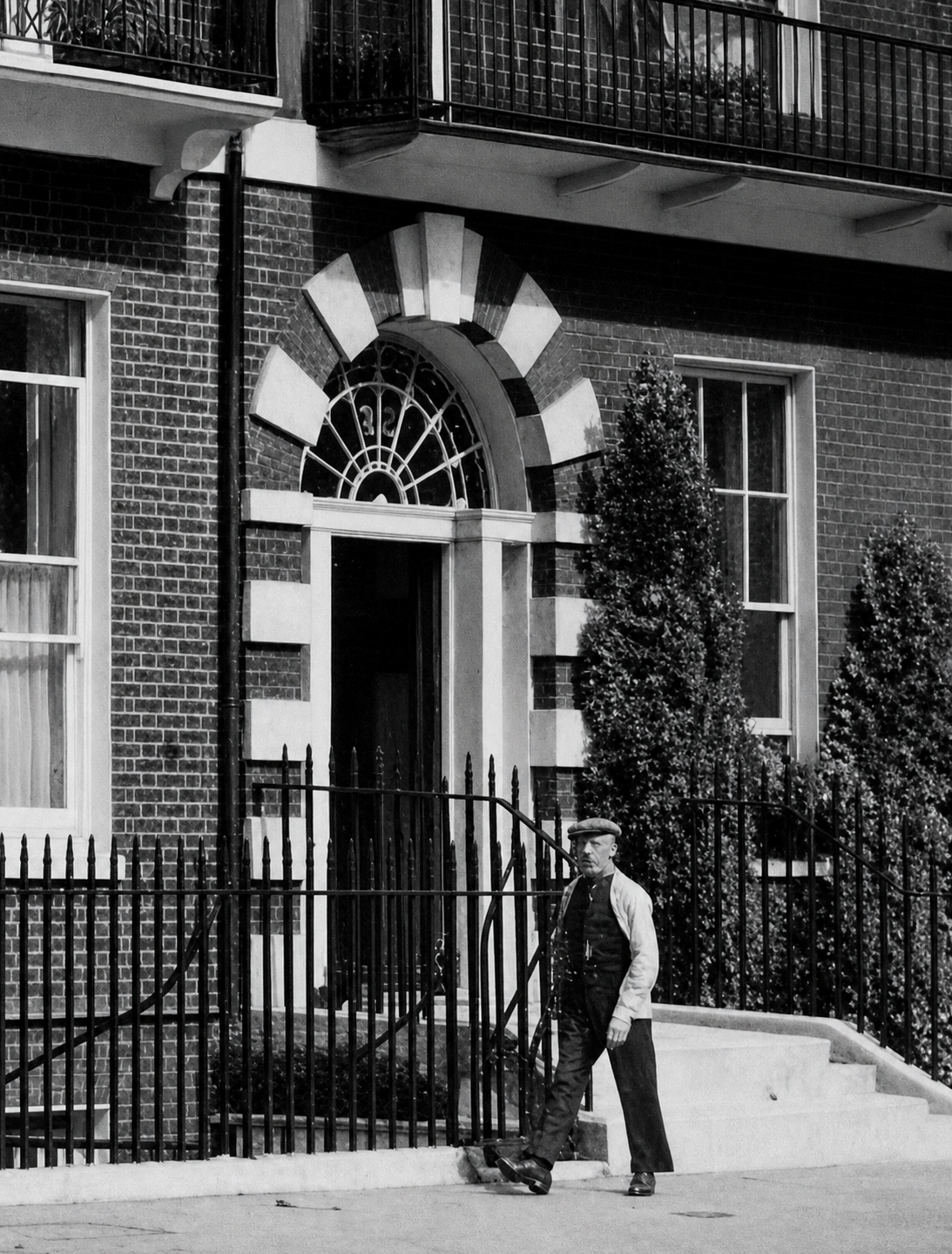
More subtle Georgian door, with a greater density of centers
HOW LIFE
rules governing the interaction of centers, and it can then raise itself to life."
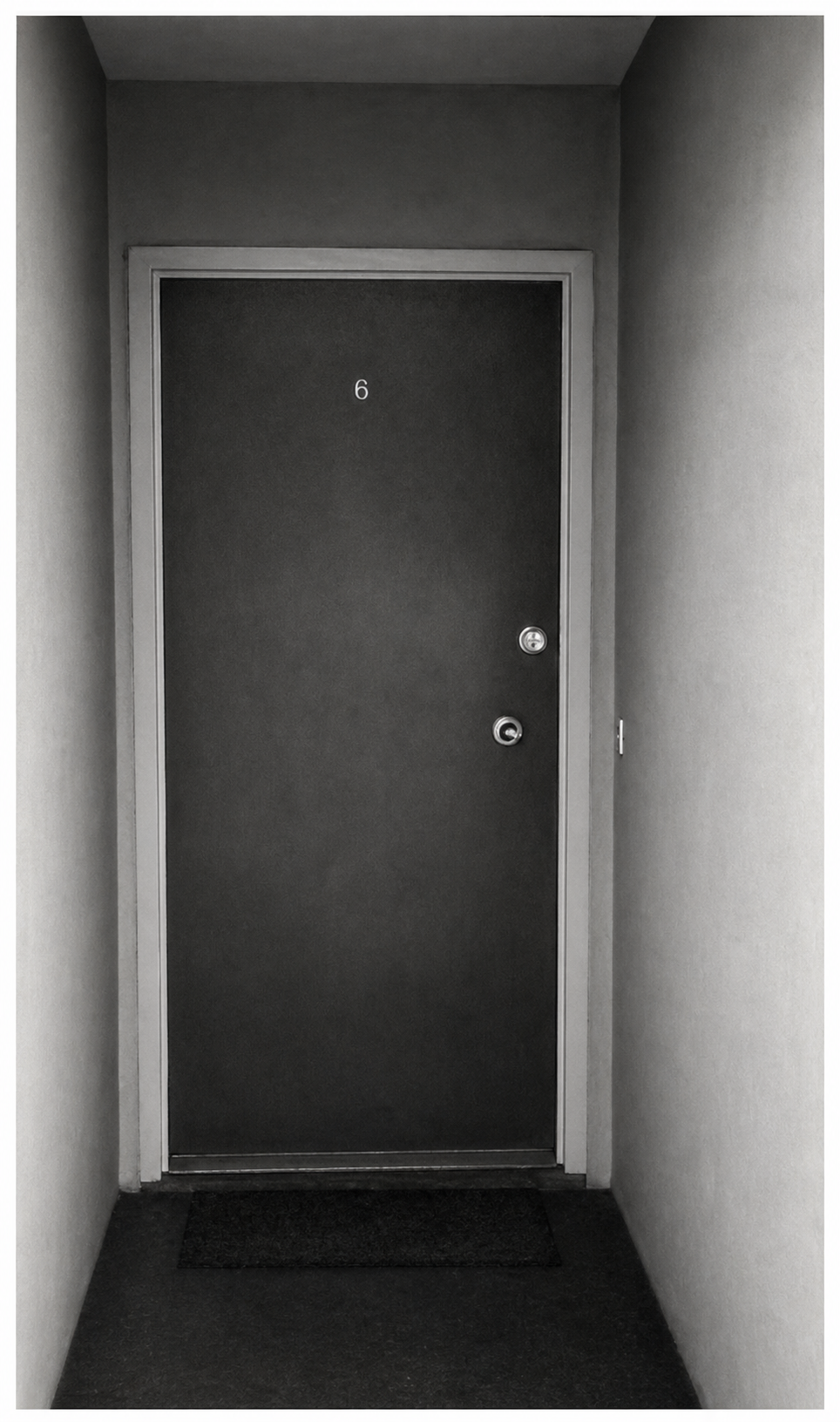
Let us apply this kind of thinking to a more ordinary part of a building. Compare the three doors on these facing pages. One is a typical hollow-core plywood motel door. The main center is the door itself. Its life is almost nonexistent. What little life it has comes, most of all, from its rectangular shape. Like any rectangle, it gets its centeredness from its edges and the corners. The edges also exist as centers -- they are formed by the straight cut along the edge -- and the centers that we recognize as edges are intensified by the centers which exist at the corners. The thin frame weakly helps the life of the door. It is made of centers (the trim pieces), and the placing of these trims make the main center alittle stronger as a center. The handle also helps. But the overall effect is extremely weak.
Next, we see a more elaborate Georgian door in London. Here the two centers formed by the wide panels on either side strongly intensify the main center. So does the half-circle of the window over the door. The half-circle is itself intensified as a center by the rays of which it is made. The subdivision into rays strengthens it as a center and gives it more life, and as a result it then passes on more life to the door below. The panels of the door intensify the main center of the door; these panels are again subsidiary centers, placed there for this reason. Each of these panels is itself intensified by the trim and molding along its edge. And of course, the larger centers, outside the plane of the door, also make a big difference in bringing it to life. The steps are centers which bring the stoop to life; the center which the stoop forms brings the door to life. The path leading to the stoop brings more life to the stoop and subsequently to the door. The balcony over the doorway completes the larger volumetric center of the door, and intensifies its life still more. It is clear that the Georgian door has more life than the motel door, and that this will be experienced as a more living environment by the people who live there. This is because the Georgian door receives more life from its component centers, partly because there are simply more of them, but mainly they are better arranged, and they also have more life as individual centers, and are placed to contribute more life to one another.
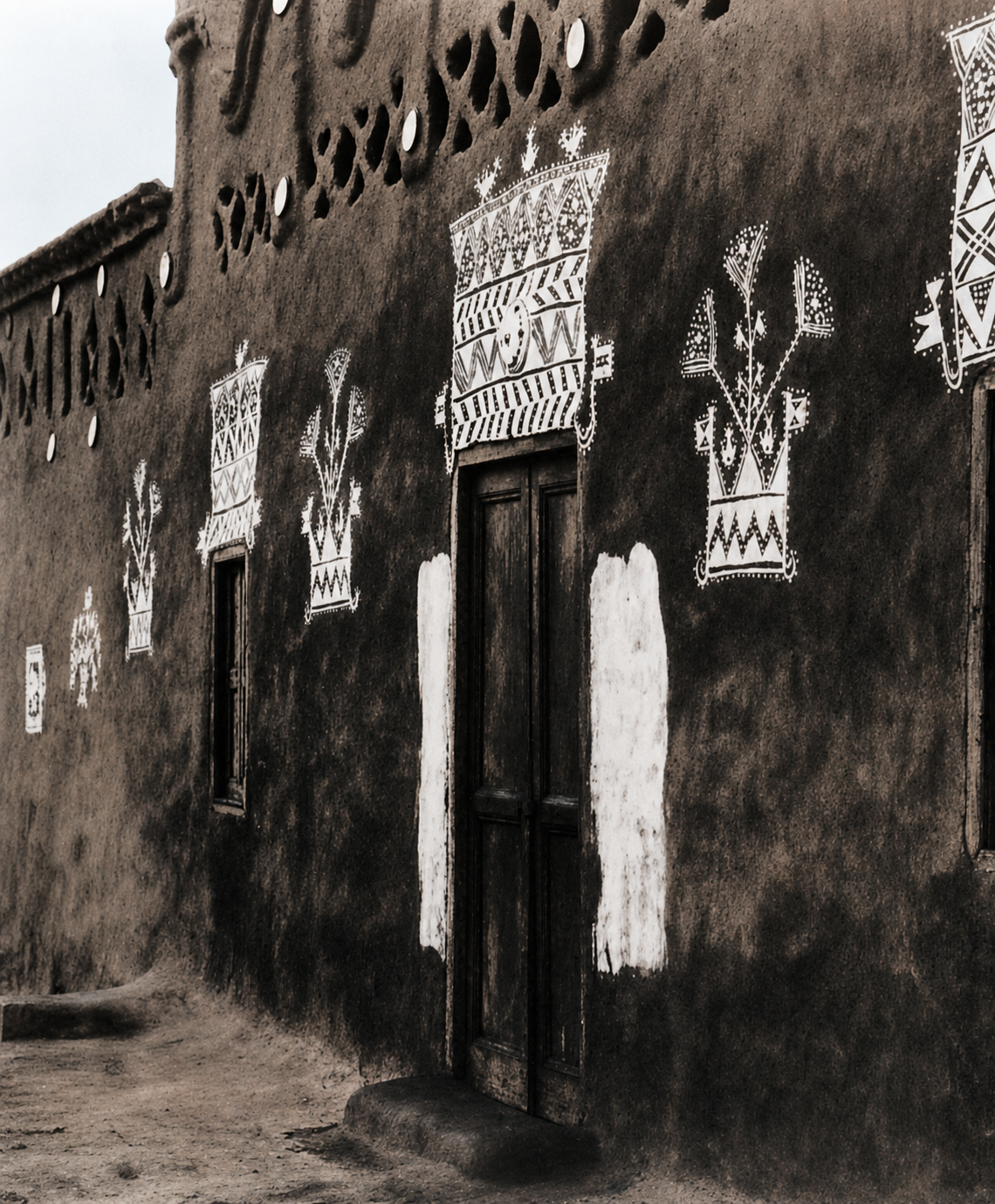
It must be stressed that a center does not get more life merely according to the number of its subsidiary centers. Such an idea would only lead to the fallacy of baroque architecture which piles on detail, but which never reaches a very intense kind of life. The Nubian door is an example of a very simple door which nevertheless gets enormous force as a center,
Ke
Nas
not from detail, but from very, very careful choice of shape, voids, and proportions, combined only with a tiny bit of detail. It is simple, not elaborate at all. Yet as a center it is more powerful than the Georgian door. This comes about because the centers are more carefully chosen for their intensity. Each center is in itself more intense, and the arrangement of the centers -- few as there are of them -- is calculated to make the larger centers as intense as possible. Though less worldly, it has more fire.
We see then, that the life of a center -- even in a simple door -- depends on the configuration of component centers, and to the wider system of centers which appears round about it. Life comes from the wholeness, from the system of centers. The degree of life attained comes from the degree of life of the component centers, and from their disposition.
9 / How Recursion, As a Process,
In six steps we will build up a center, step by step, recursively, gradually introducing other centers to intensify the field effect and create the center's life.
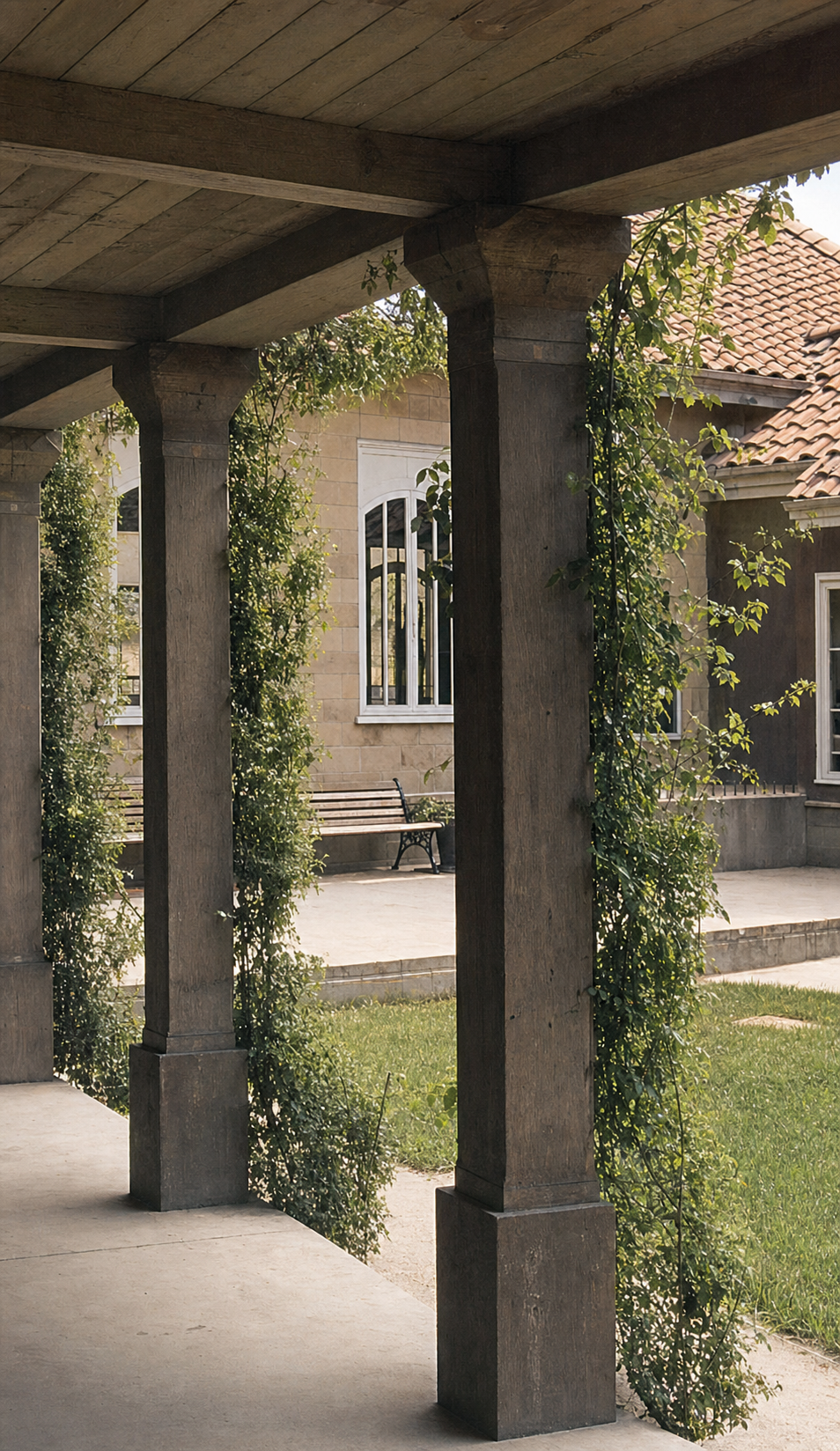
Step 1. The column as a center. Start, let's say, with a simple eight-foot column, 9 inches in diameter, supporting a porch roof. For simplicity's sake we start with a round column, unadorned, without either base or capital. The cylinder of this column forms a center in the crudest way. It has a compact shape, and is symmetrical, but that is all. There isn't much of a field there.
Step 2. The space next to the column as a center. We ask, now, how we can modify this center, by a system of centers which will intensify its field. First, let's try to create centers in the space next to the column. When the column is round, the space next to the column is shapeless, and doesn't work as a center. If we want to make a center in the space next to the column, we must shape it better. One way of doing this is to make it more compact and more convex, by making the column square, instead of circular. Already it is slightly better.
Step 3. Centers at the top and bottom of the column. Now let's make the base of the column into a center. To do this we bring the foundation up out of the ground to form a base. And let us imagine that the beam which will sit on top of the column joins the column in something which is also a center, perhaps a little platform on top of the column. We now have introduced some smaller centers.
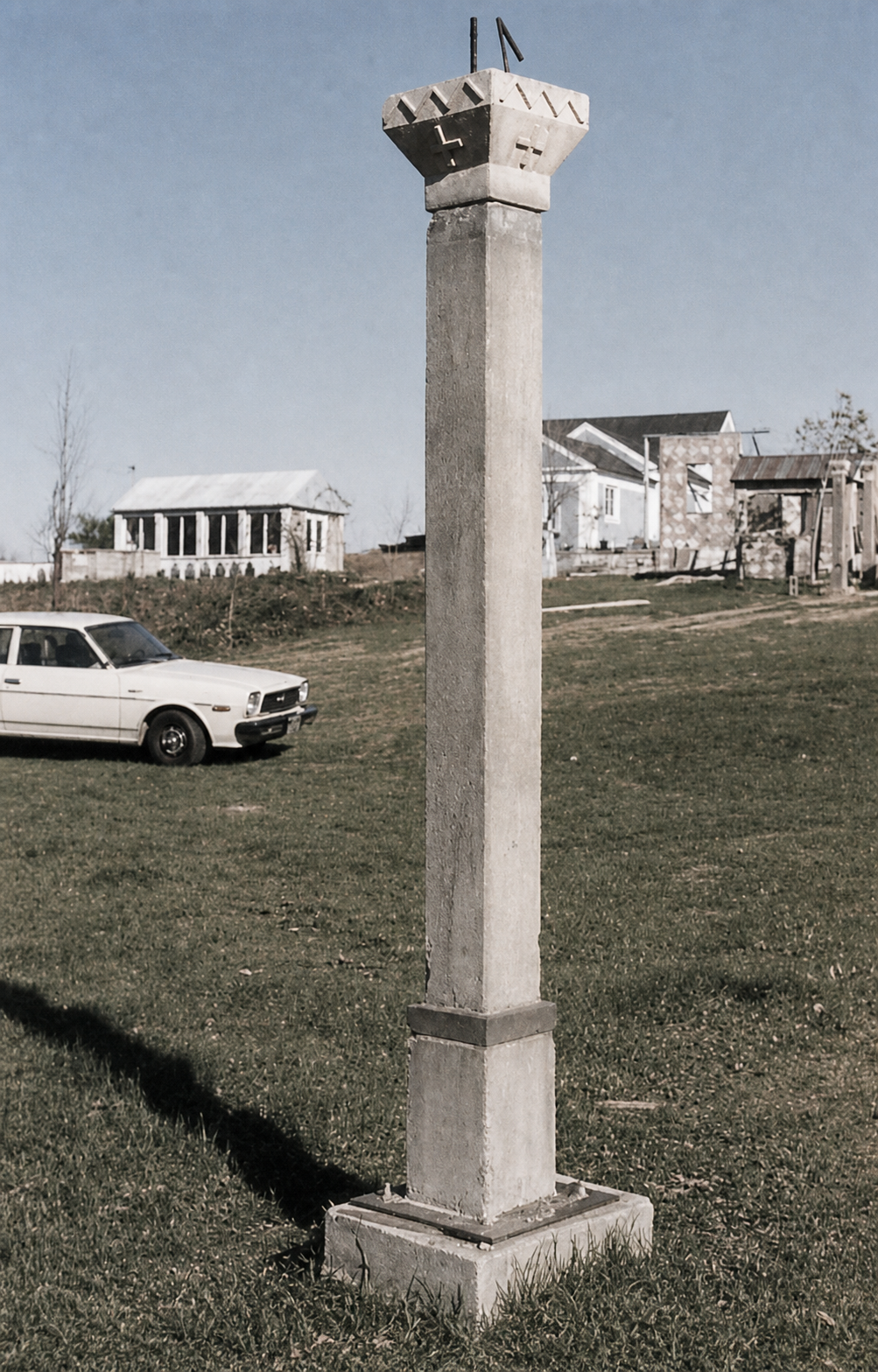
Step 4. Making top and bottom unequal. But now the whole has lost its quality as a center, so we must adjust what we have done to restore the feeling. If top and bottom are equal, the feeling of centeredness disappears. We make the top
smaller (lower) than the base. Then the feeling of centeredness comes back into the column we started with.
Step 5. Adding an ornament within the column, to intensify its life. Now we have created a complete system of centers that roughly corresponds to the kind of thing one can achieve within the confines of the recursive definition.
Let us try and extract, from the example of the column, the essentials of what is occurring in the field. Each center is created, and intensified, by the existence of other centers. So, we try to modify the column, by adding structure which will intensify the simple center which is the column. We do this by adding other centers. But we add the other centers very carefully to be sure that they work to intensify the center of the column.
Once we have done this, we have more centers than before. We have an emerging field of centers. The process is not additive: it is trans-
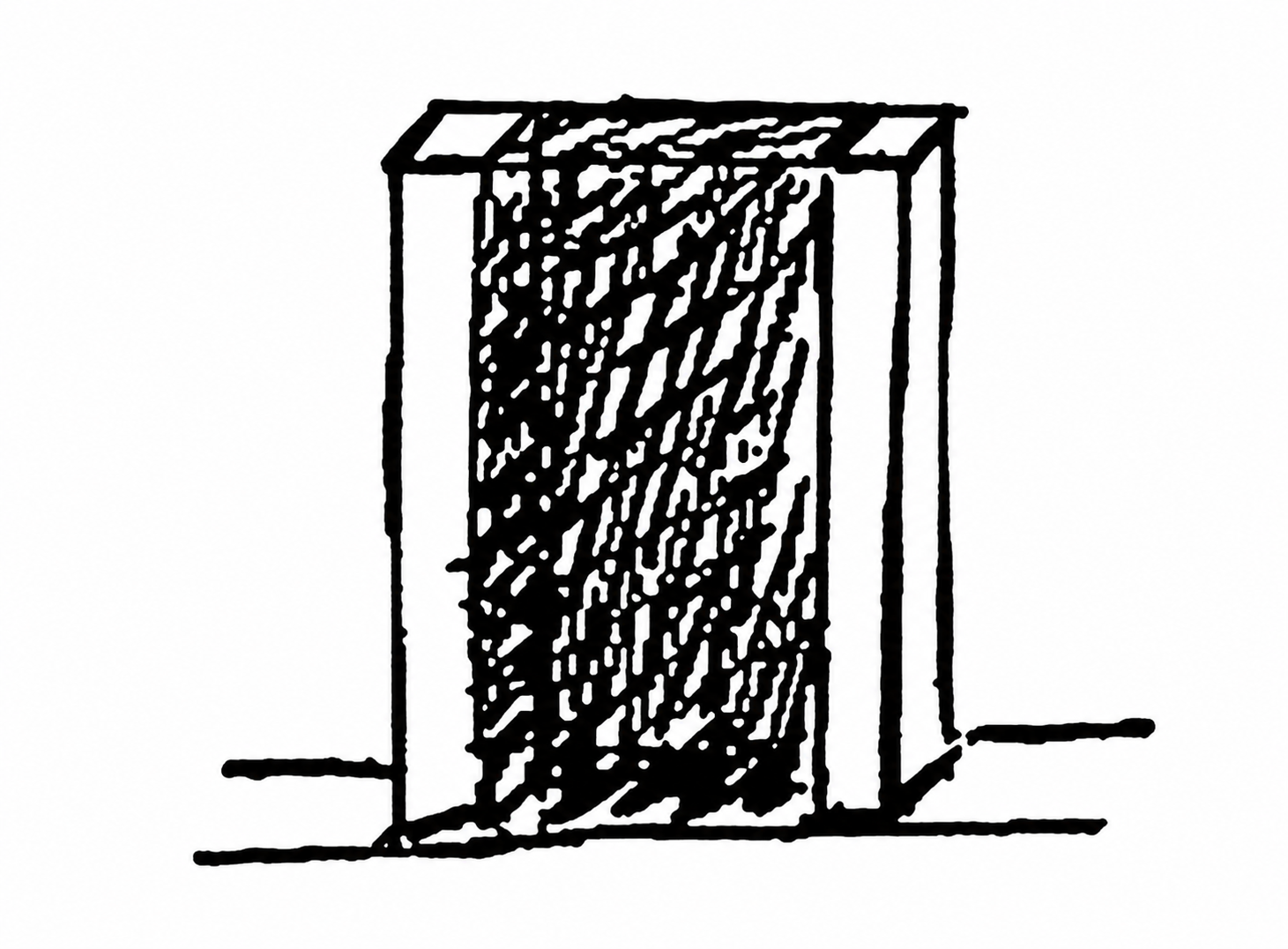
| Step 3: We make smaller centers at the ends of the column, a base and a capital. The column again becomes slightly stronger as a center.
already.
formative. At each step, we do not add things, but ¢ransform the previous version, as a whole, to give it more centeredness, as a whole, by inducing more centers to intensify those that exist
We apply the same thinking to each center in this field, recursively. We try to make each new center more definite, more truly centered, by adding yet other centers, which together increase centeredness. We do this without a very precise definition of wholeness or centers. There is nothing remarkably subtle about the capital, or the base, or the tiles we put on the ground. Yet each of these things intensifies the center which exists in the column, so that it becomes better and better.
During the recursion, it is not only the column which is getting better. Our understanding of what a center is, is also getting better. As we see the build-up of centers in the space, we gradually get a more developed idea of the kind of struc-
Step 2: We make the space between the columns into a center. To do it, in this instance, we make the columns square. The centers then become slightly stronger.
Step 4: We make the base bigger than the capital. As a result of the asymmetry, and the rhythm of the tiles on the ground, the column becomes even stronger as a center.
ture needed in order for something to be a center. So the impact of the recursion is not only on the emerging column, but on our understanding.
At a certain stage, we recognize that the beauty and wholeness of the column itself is deeply affected by the wholeness and beauty of the space between the columns. We realize that the space between the columns can be understood as a center with its own shape, and its own substance -- itself dependent upon all the subsidiary centers around it. And we find out that the nature of the column -- its wholeness, its centeredness -- actually changes qualitatively, as the space between the columns becomes more whole.
This is a great shift in understanding. An untutored person looking at a column will not understand that the column itself -- its life -- depends on the life of the space between the columns. These would be thought of as two separate things. It takes a big leap to realize that the shape of the space between the columns not only helps the columns, but actually changes them, and that the wholeness of each column depends on the wholeness of the centers in the space between. They are not merely next to each other. They are interdependent. This leap of understanding is similar to the change I get, as a painter, when I realize that a certain beautiful green, with red spots on it, is an entirely different green from the same green paint without the red spots. At first, one is inclined to say that the green is the same green, and that the red spots on it interact nicely with it, or make a beautiful composition. But this is naive. As I grow up as a painter, I learn that the green itself -- the actual substance of the green, is irrevocably altered when I
put the red spots on it -- and that if] want to get that green I cannot get it without these red spots that become part of it.
This is the kind of change which happens in the column. As more and more centers are added to the column, the center which the column "is
itself becomes intensified, and altered, and then intensified and altered again and again, as we develop the centers more and more. It is not the same column "with" some nice extra stuff around it. As a center, it is a different structure altogether.
10 / Profound Life the Deepest
IN
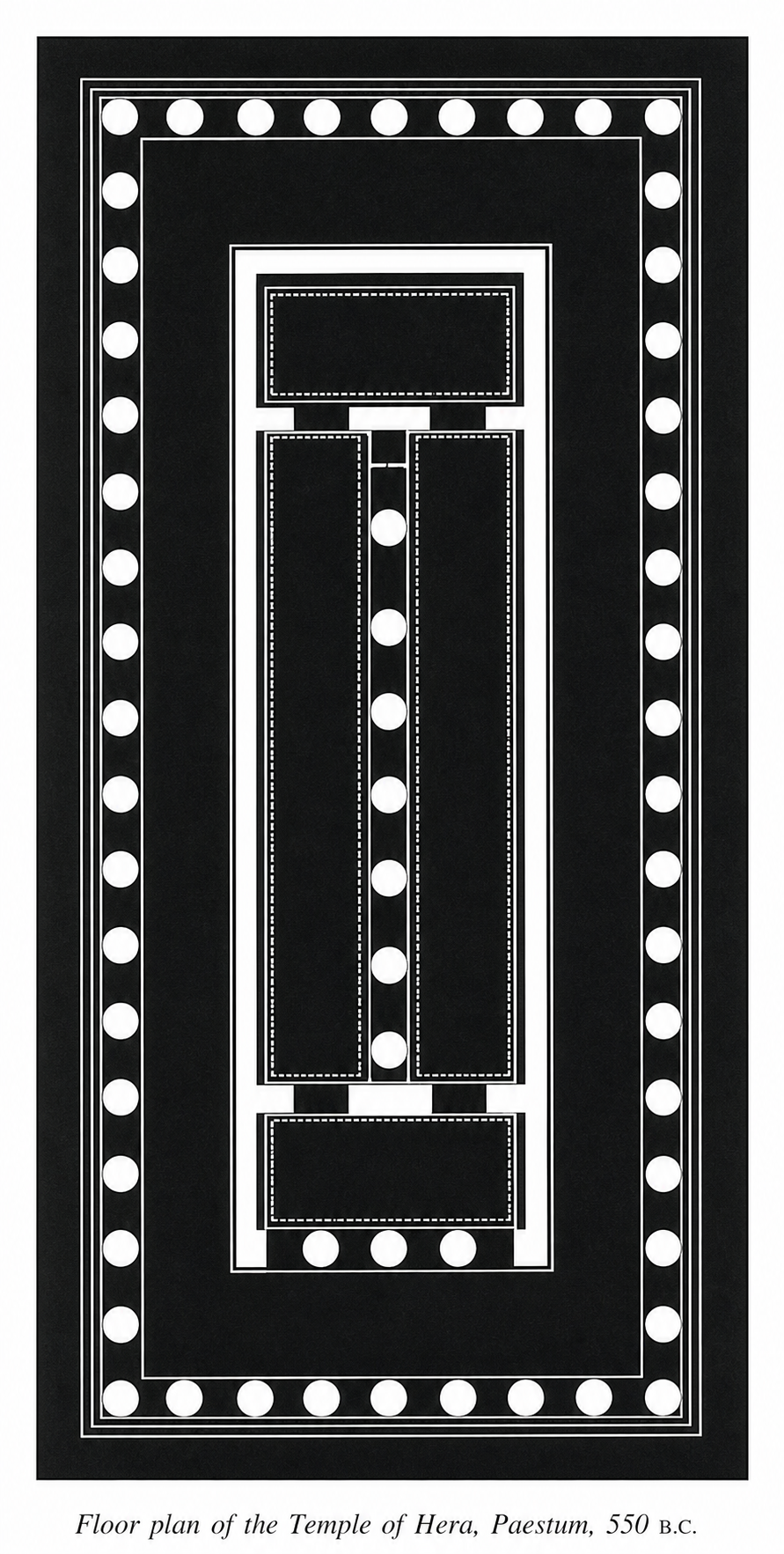
A mature artist will use much more powerful and subtle ways of making centers and intensifying them in a building. Consider, for example, the great columns in the Temple of Hera at Paestum (below and next page). Here, in
making the space between the columns strong, a far more subtle approach is used, in which these centers (the spaces between the columns) become almost like solid bodies, they are so powerfully shaped.
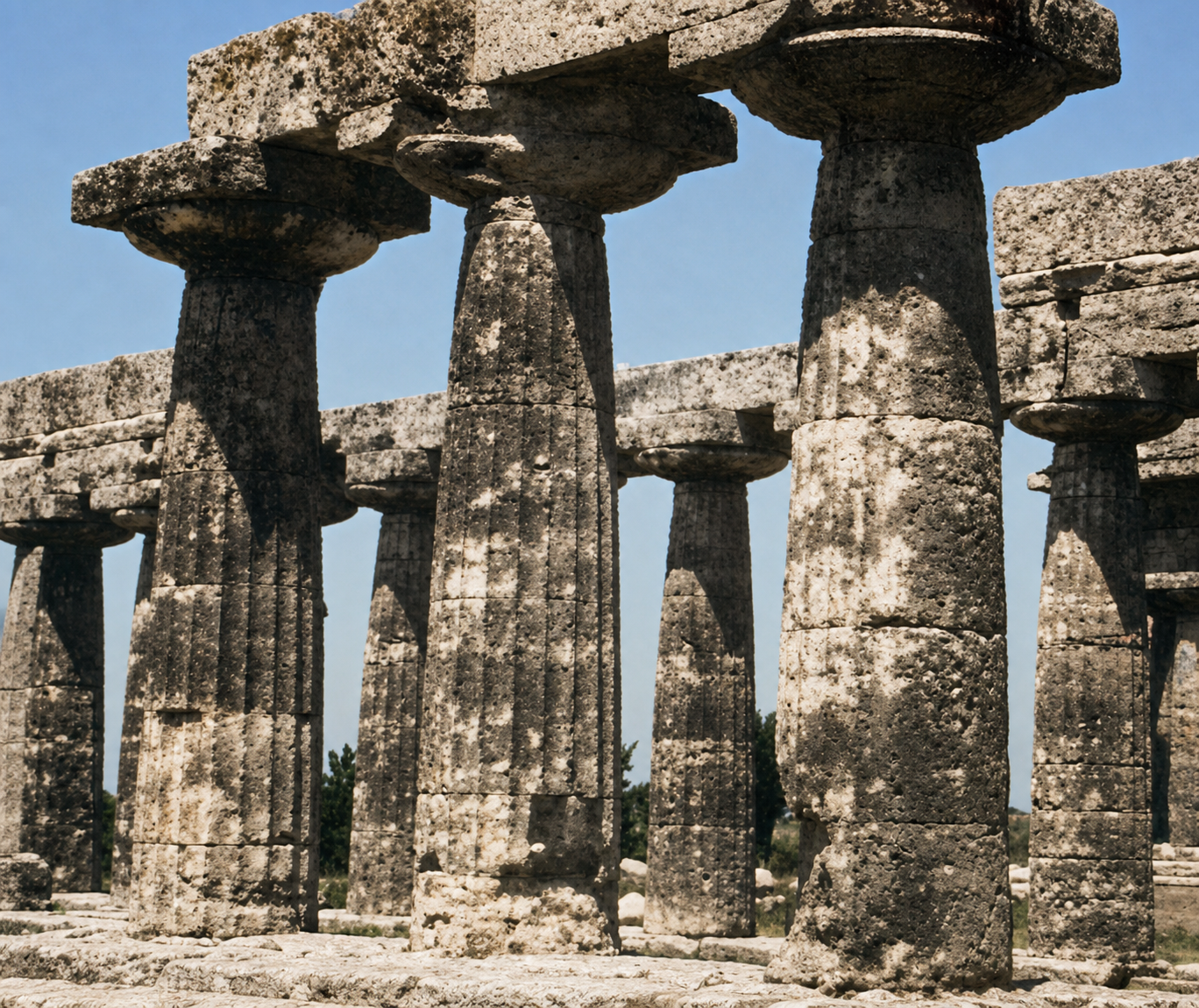
Spaces between the columns
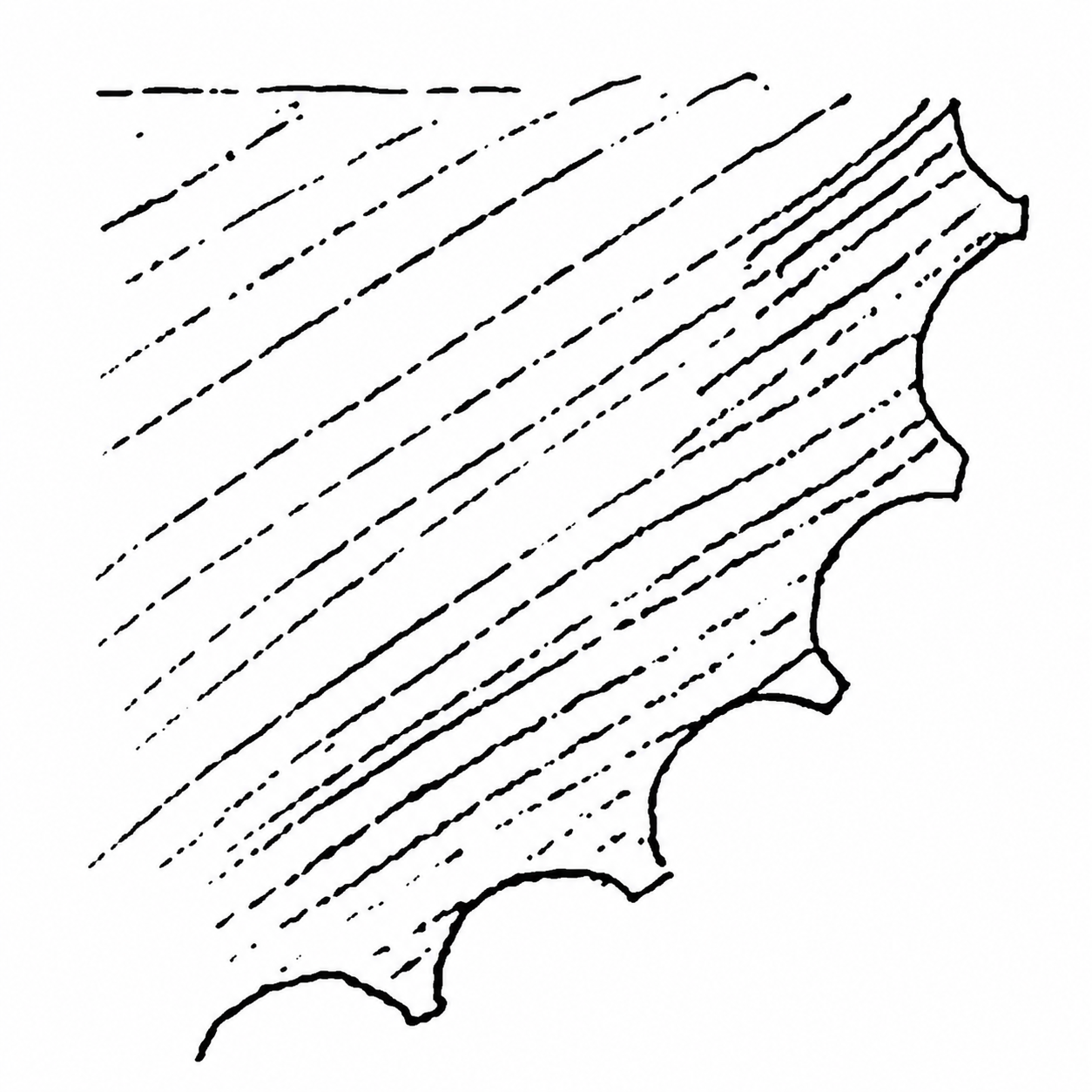
Second, the swelling of the column itself (its entasis) creates a shape which intensifies the body of the column itself as a center, and also creates a powerful second center, within the body of the column, at the point where the column is most pregnant. The next detail which helps to make the column more powerful is the system of flutes, which cut into the surface of the column, creating a ring of new centers round the column. The column base is more solid, and because of its own hierarchy of centers, even a more powerful center, thus intensifying the column further. The metopes in the beams between the columns, because of their own center-forming power, intensify the beams, which again intensify the columns even more.
We could go on and on. The main point is that a mature artist can use the recursion of living centers in a very powerful way, thus creating centers which have still more life, which extract far tougher and more profound life from one another, and which create, overall, an even greater intensity.
The field of centers is not just a nice way of talking about ordinary structures. In its intense forms, an extraordinary structure, comes to life because of its dazzling and intense structural density. The more the centers are packed and overlapped to fill the space -- the more an object is differentiated to produce center upon center, each one helping and intensifying the others, the more it comes to life.
HOW LIFE
11 / Objective Comparison of Degrees of Life
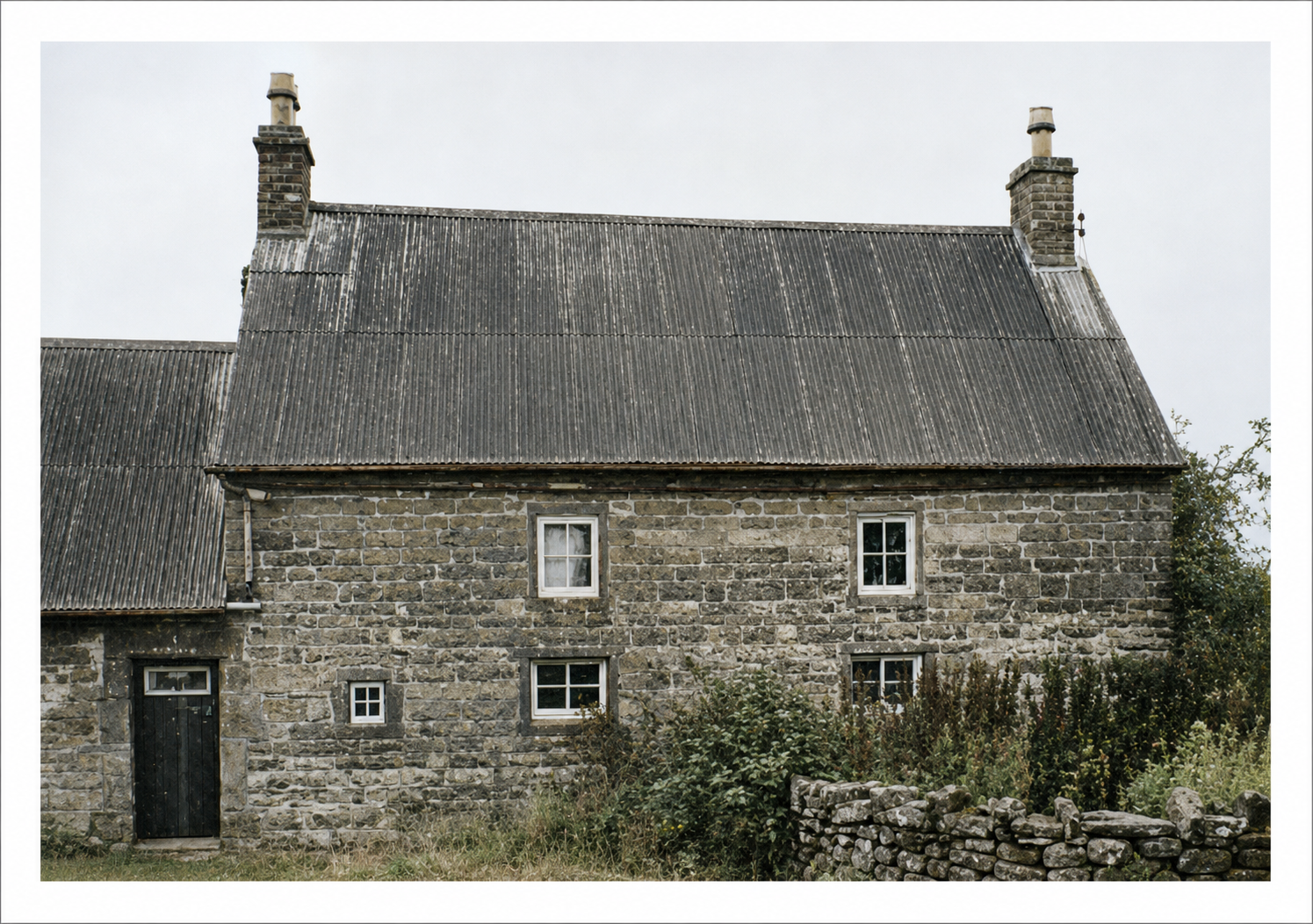
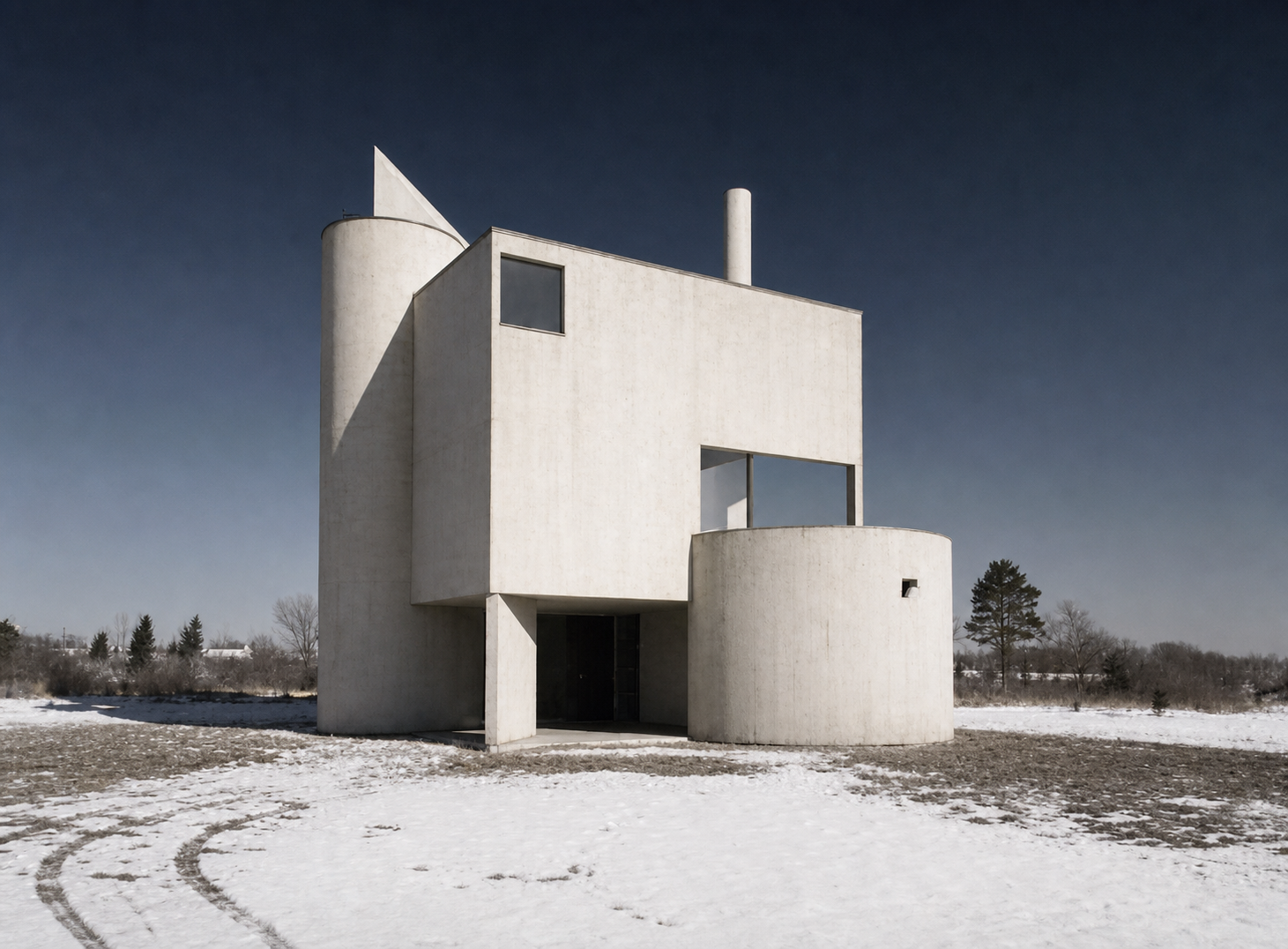
Ttis useful to bear in mind that the strong centers which occur in a living structure are not only "great," as at Paestum, but also down-to-earth and practical. Consider, for instance, a pair of houses. One isa traditional village house from Northumberlandin England. Simpleas itis, itis an inspired and profound center. The other is a postmodern house by the architect Charles Gwathmey from New York. It is rather weak in its life.
The Northumberland house is austere, perhaps not very warm inside when it was built. It even has corrugated iron on the roof. Yet every single part is a profound and living center im an ordinary and practical sense. The windows are profound centers. The chimneys are centers. The stones of the wall, individually, are centers. The door is a center. The roof is a center. The chimney pots are centers. The pieces of the wall between the windows, framed by the windows, are big centers. Even the rills in the corrugated iron function as centers. Even the wide piece of wood on the side of the window frame is a center. Each individual element, and every single part of the wall, is a strong center, with its own life. In this building we come close to an affair of the heart.
Compare the Gwathmey house -- a postmodern building from the 1970s. Hardly one center is visible, and those few that do qualify
life.
as centers would have to be called strained and very, very weak. The planks of the siding do not form centers. The arbitrarily shaped roof is hardly a center. The round thing coming towards you, though meant to be a center, is extremely weak because it is not sustained by any other centers. The column on the right is not a center. The entrance is not a center, just a big black hole. The space in front (driveway or lawn) is not a center, just empty space. The building is a series of abstract shapes, with almost no developed centers -- and as a result, has little
This is not a matter of style -- which it at first seems to be -- but a matter of substance. In the space around the postmodern building, very little can happen because there are very few centers. The absence of centers guarantees a kind of deadness in the exterior space around this building. As far as one can see here, the absence of centers continues to the inside. The strange roofs and windows reveal an organization of space which is probably dead inside too. Indeed there are few centers inside, and there are few centers outside. The building will not have ordinary life.
The Northumberland house is not some quaint, romantic village antique. It is a more
= rs
A postmodern house in New York: the centers are weak or non-existent. And the few vague centers which exist do not help each other, and therefore create no overall life in the house.
robust structure, by far, than the postmodern house. It has living structure, solidly and deeply built throughout its fabric. However one may judge it, and however one may judge what we
LIFE architects should do today, this fact must be respected. Sneering at its depth of structure as a possible goal, as some contemporary architects have done, is a profound mistake.
12 / BREADTH OF
The most basic aspect of the concept of living structure as I have described it is the great range it covers. (In chapter 7, I shall describe how functional problems in buildings are themselves solved, and supported by centers, so that the concept of life is deeply functional, not merely geometric.) However, it is useful to understand, from the beginning, that all systems in the world gain their life, in some fashion, from the cooperation and interaction of the living centers they contain, always in a bootstrap configuration, which allows one center to be propped up by another, so that each one ignites a spark in the one it helps, and that the mutual helping creates life in the whole.
Familiar examples abound in ecology: in the system of reeds, shallow water, insects, and water
LIVING STRUCTURE at the edge of a lake, as shown below. Another example, rather famous from agriculture, is the Jruit tree guild. Different species of trees mutually affect one another's health. Acacias help apple trees to be vigorous and healthy; mulberries also help apple trees. The presence of walnut trees, on the other hand, have a negative effect on the health and productivity of apple trees. Plants on the ground, including comfrey, clover, iris, and nasturtium, all have positive effects on apples trees. Thus when acacias and mulberries are planted together with apples, these centers have a positive effect on each other.
The concept of life or living structure -- as something caused by the density of living centers in any given wholeness -- explains life and function in a large variety of cases, cases so different
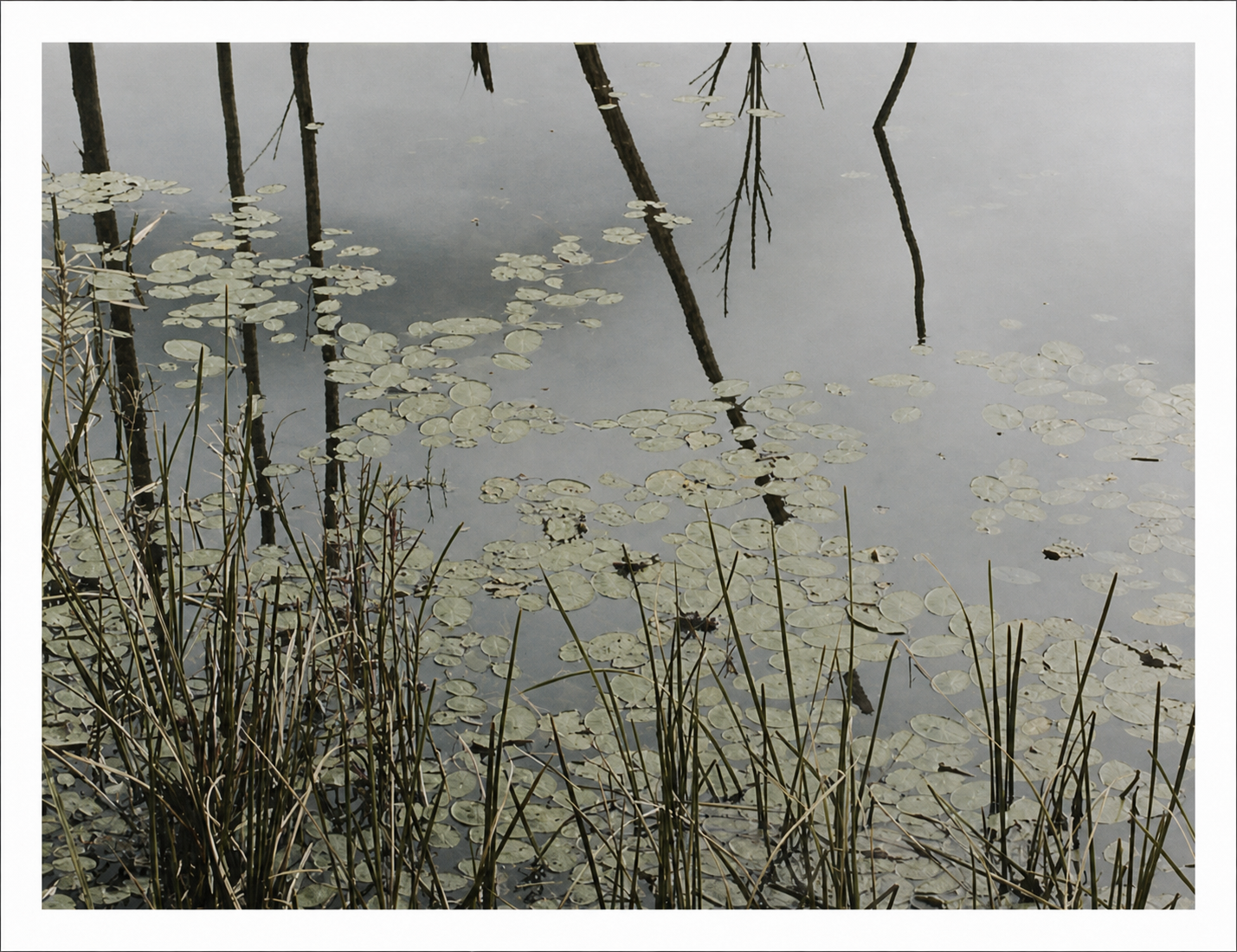
The reeds at the edge of a lake are given their intense ecological life by a system of coherent living centers, large and small: the open water, the lily pads, the reeds, the groups of reeds with common roots, the fallen branch.
HOW L
that, under other forms of analysis we currently know, they would appear unrelated."
In the remainder of this book, in chapter after chapter, I have assembled a very wide variety of unrelated examples to remind the reader of the truly enormous scope the concept of living structure has, and how remarkable it is that this living structure, in this wide variety of cases, is created again and again, by the recursion of centers which produces unity.
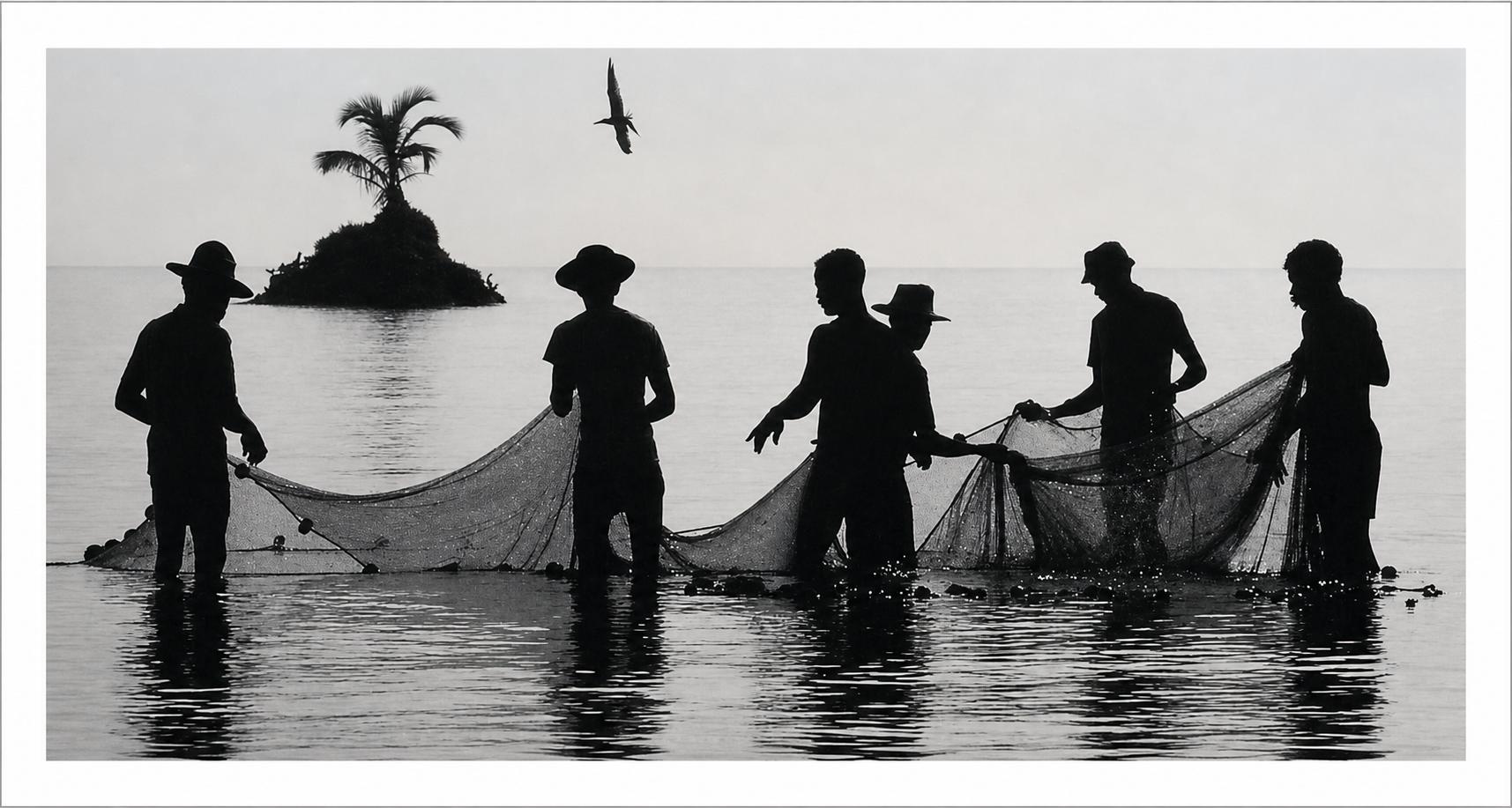
As a dramatic and beautiful archetypal example we may look at the group of fishermen washing and mending their net. Of course, the life in this group of men, at this one instant, might be described in many ways, for instance in their thoughts and feelings, matters that are not visible in this photograph. But the life they share and experience is deeply correlated with, and cannot be separated from, the geometry of the system they are part of, with the existence of
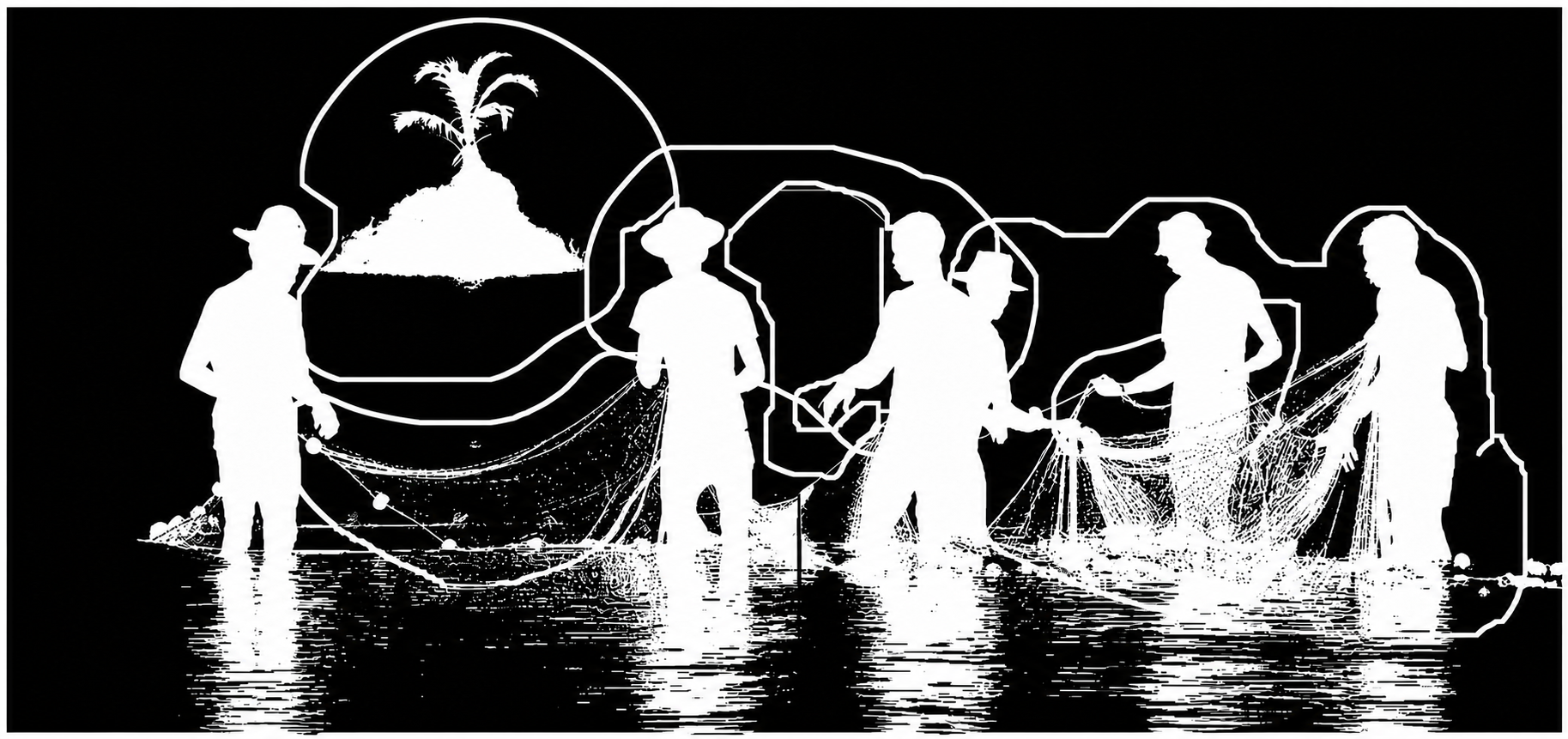
smaller and larger centers, pervading their bodies, the scene, the sea, the net, their hands. Each of these smaller and larger pieces of the whole is itself a whole, a living center which helps to intensify the life of the other centers, and which is helped in its own life, too, by their intensity. It is this cooperation among the living centers which makes the group of men alive as a whole, and alive in its parts (in their hands, and eyes, and fingers, too.)
Some of this helping and mutually supporting life is visible in the centers which appear within the system. In the diagram below the photo I have circled a handful of these centers: bits of space, corks on the nets, the distant palm trees in the sea, the space made by two men's arms in their adjacency. Altogether the life we feel in this photograph -- and the life which was, undoubtedly, felt by them, at that moment of their existence -- is caused by, in part created by, the interaction and mutual support among these many living centers, and by the fact that so many centers within the system are living ones.
I should like to complete my discussion of the way that centers help to create life from wholeness with a photograph of a single person in an acme of life: a girl throwing a ball, and her intense life. It is glowing, startling even, that this person, at that instant, had so much life in her, so much wonderful energy. I believe, even in this intense case, the life comes about because the centers have become vivid and intense at the moment captured. Her eyes, the position of her arm, the twist of her body -- it is hard to show exactly how these are all centers; but as I have become used to looking at centers, judging their life, I see even this case as dependent on the way that individual centers, and the whole, in that person, at that moment, become intensely alive.
I have not given enough detailed information in this chapter to explain exactly how a human activity like throwing a ball could be seen as a cooperation of many living centers. But -- Ido believe that this example, like the others, can be underhoping for the reader's indulgence stood as a cooperation in which each center has its intense life, and in which the life of each center is helping to sustain, enliven, intensify, the intense life of some other center in the system. Her hands, eyes, the set of her arm, the center formed by the planting of her foot on the
Notice the extraordinary beauty of the living centers which form in her body as she throws: the curl of her fingers around empty hole in her hand; the broad center formed by her dropped shoulder and the line of her lapel; by the center that is formed hovering in space between her left hand and forearm and her head, thrown back.
ground -- each of these centers, because of its intense life locally, cooperates with the whole, and creates the larger intense life which existed in her for that moment.
The wholeness -- the structure of centers which exists -- is animated or not according to the degree to which centers themselves have life, and this in turn depends on the degree to which

In the height of her lively existence, this young girl, with fire in her eyes, is throwing a ball in a street game. If we look carefully at her body, her posture, her fingers, the set of her jaw, each of the centers in her configuration has great life, each part is a living center to an undeniable degree. It is this cooperation of these living centers, at that moment, which makes her so fiery, and so alive.
centers help each other, and on the density of centers. I believe that this conception of living structure can be extended even to cover the intensity of life in a single human being, where it accounts, to some degree, for the fire in the eyes of a young woman throwing a ball. In the diagram, we see how a handful of the living centers small.
in this girl are visible in the large and in the
The life of the component centers ina living structure is intimately connected with the fact that they are coherent, beautiful. What is surprising is that such a relatively simple scheme is capable of generating life.
3)
I should like to end with something that is by way of being a footnote -- but a vitally important one. It concerns the minute subtlety and accuracy which is required, in order for centers to affect each other successfully.
Artists are aware, all too often, that a work can be made or broken by something that seems, to an outsider, a nearly trivial difference: a tiny spot of color, the shape of a curve. In buildings, too, the success of a room can depend on subtleties of placement where an inch this way or that makes all the difference, where a proportion changing by a few percent makes the difference between profound feeling and triviality. In natural living systems, too, a decimal point in a percentage of a chemical concentration can make the difference between life or death. In my experience this is not the exception, it is the rule.
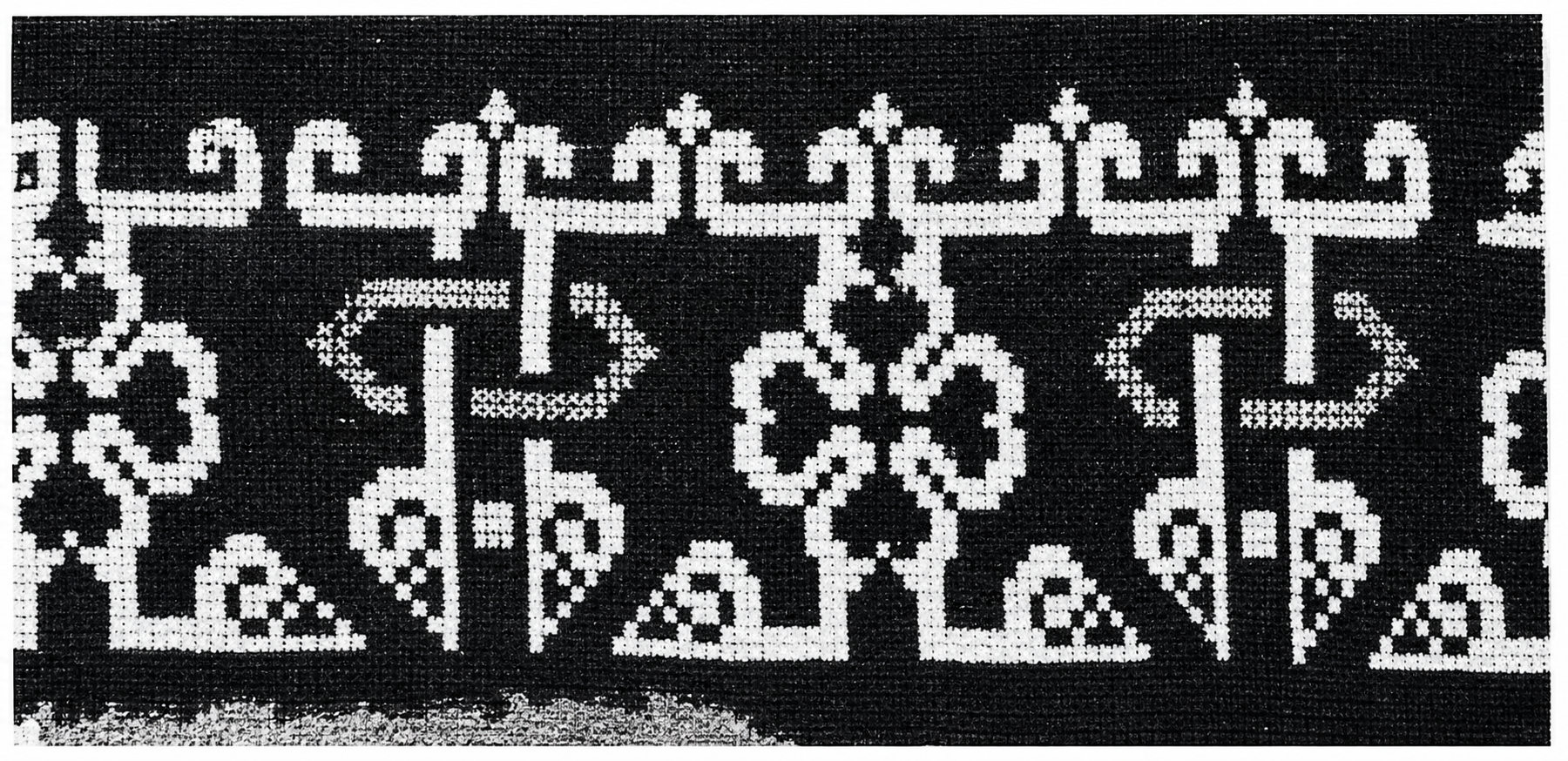
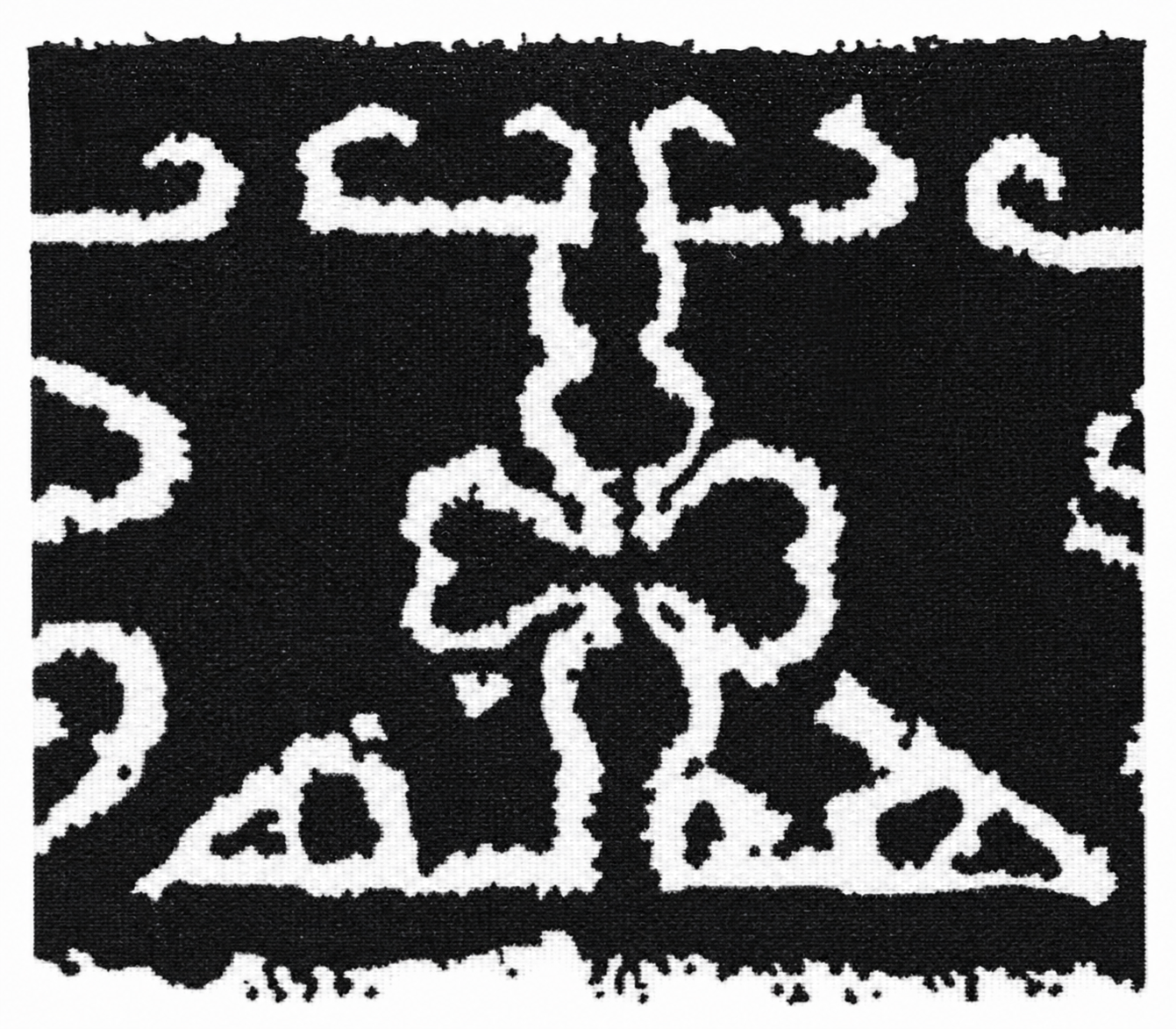
Living structure is enormously susceptible to minor changes, and accuracy of detail is necessary for success. To strengthen the reader's understanding of this point, I should like to illustrate this effect, with an example I used earlier in the chapter (page 120): the ornament of a 15th century carpet border."
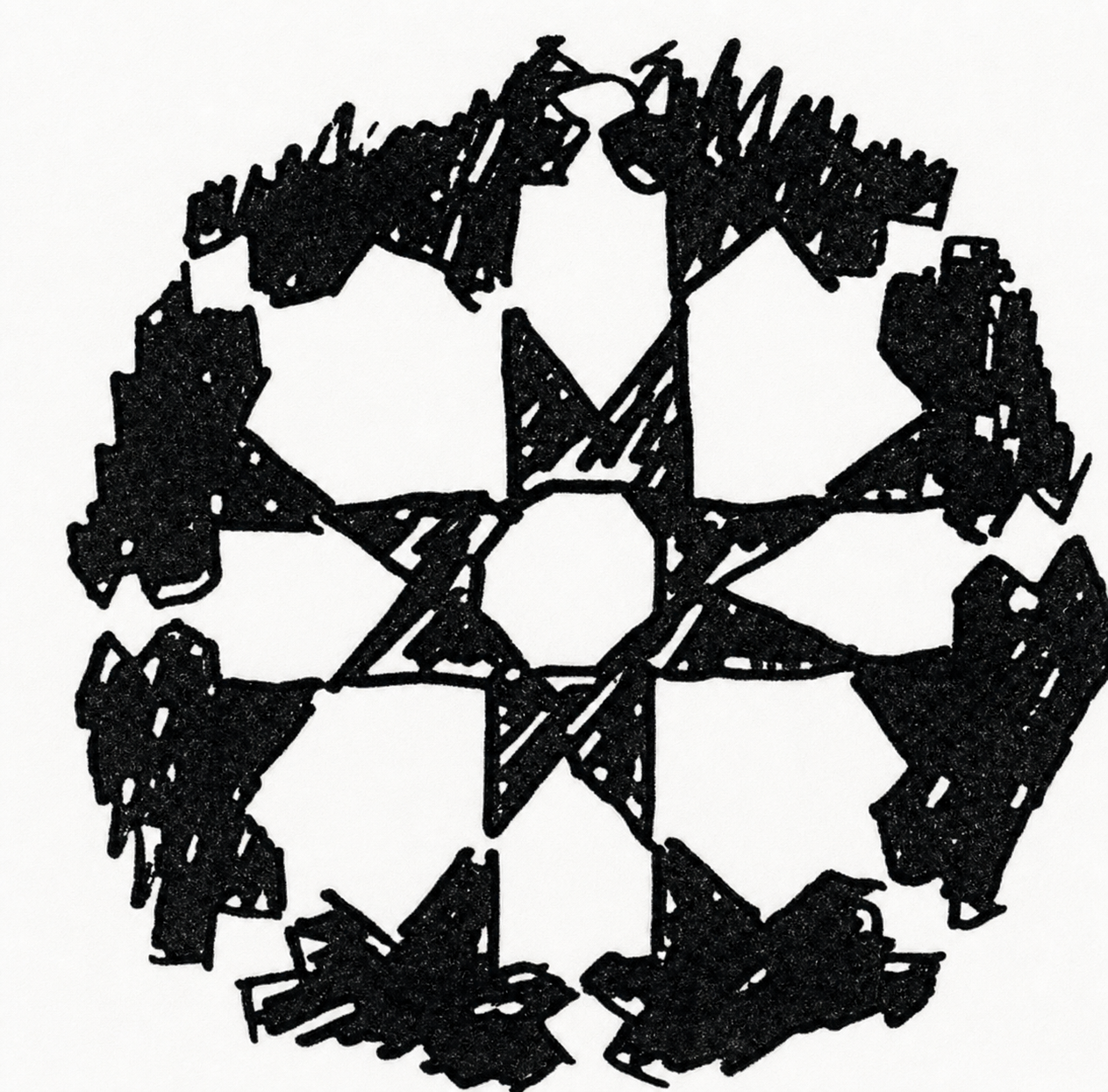
In 1988, I had an opportunity to study this carpet border, when working with students. I asked them,'as accurately as possible, to draw the ornament. I wanted to show them how deeply the success of the ornament depended on the presence of ai// the centers it contains. This means, that in order to communicate the profound feeling of harmony which it has, it is necessary that more than a hundred centers and sub-centers are all shaped, within a hair's breadth, in order to have their own good shape, life, and positive quality. The students discovered, soon enough, that this was difficult to achieve, and that even when copying the ornament directly from a photograph, they were, more often than not, unable to recreate all the living centers -- and they found out that insofar as they failed to capture them, the ornament they reproduced had less feeling and less harmony.
As drawn by the weaver, the design has a beautiful, limpid, and almost deceptive simplicity. But if you start to draw it, you may become amazed: it is much harder to draw than it seems. The reason is, that its beautiful simplicity -- in fact, its life -- really does come from a highly subtle and complex structure of centers. You find that out when you try to draw it, because the structure of centers which contributes to this ornament is so subtle, and so complex, it is extremely hard to draw.
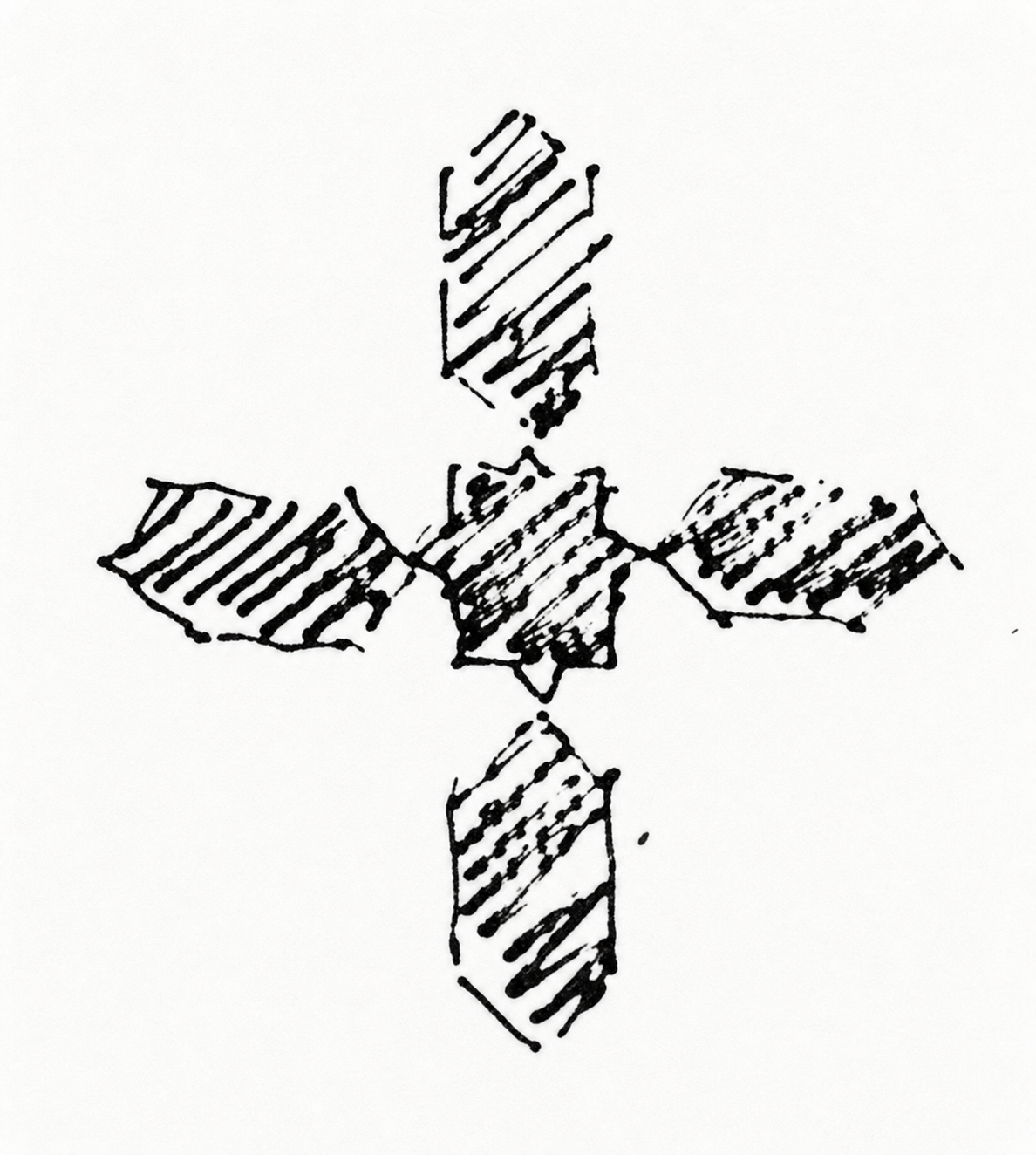
The centers which are present in the original design are shown in the diagram on page 121. If you look at that diagram, you can see that there are eighteen small drawings, each showing a center, with at least a hundred further and smaller centers appearing within these drawings. Some centers are small, some are almost as big as the whole pattern. To make the design work (i.e., to make it have the wonderful simple gracefulness of the original), all these centers must be present in the drawing and all must work as centers themselves.
When you try drawing it, a first attempt typically looks something like sketch 1, shown opposite. In this kind of sketch, which roughly catches the drawing of the quatrefoil, and not much else, there is very little feeling. You notice right away that your sketch does not have the same depth of feeling that the carpet ornament has, but you may not understand at once what has gone wrong.
Ina second attempt, trying harder to get the details right, you may achieve something like sketch 2. This sketch contains more of the missing centers -- but only about half of them. In this case, the sketch degins to have the subtlety and life of the original carpet, but the great
HOW
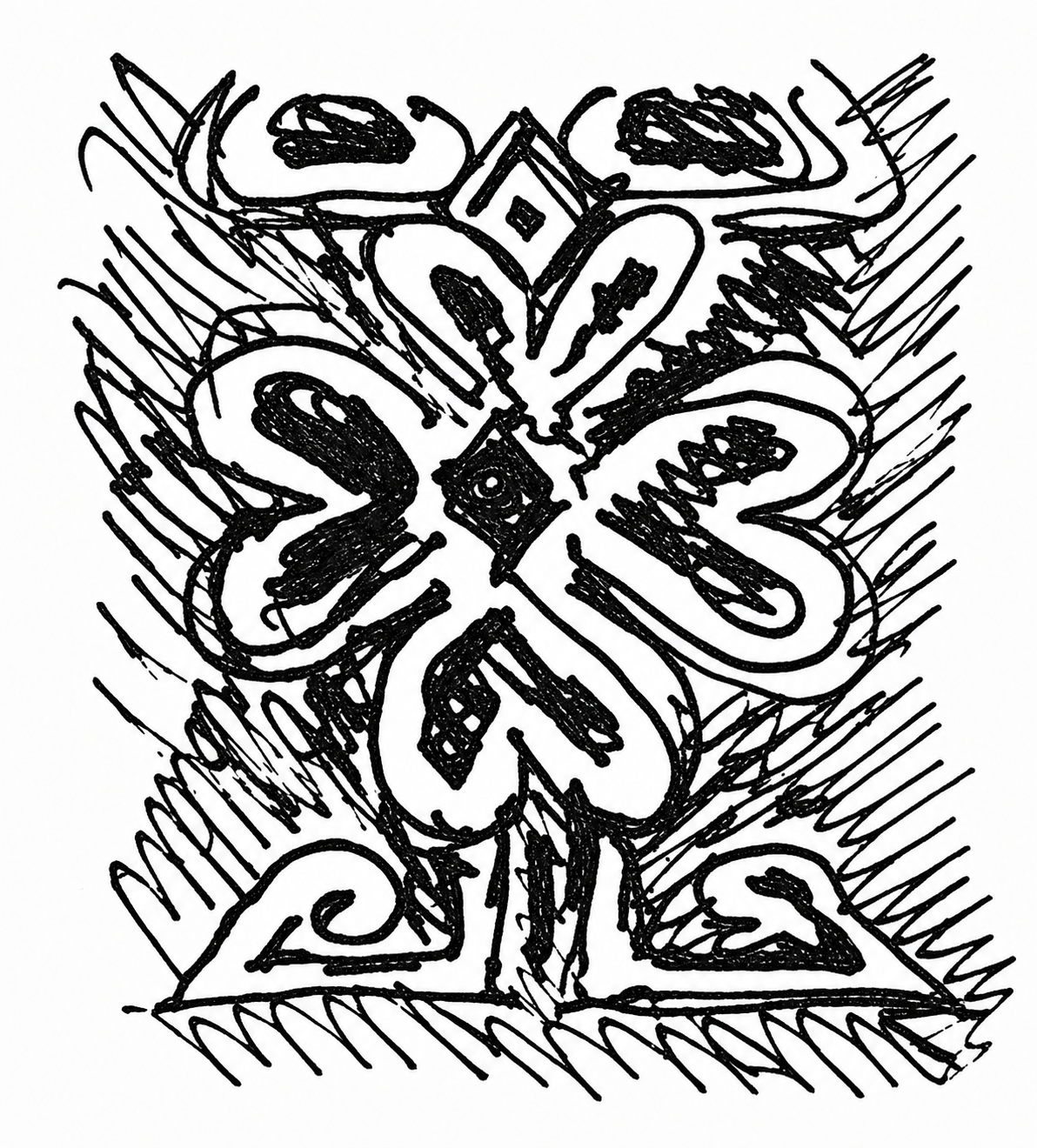
Student sketch 2: better, but still not very good
Sketch 1 is a highly inaccurate drawing of one part of the design. Most of the centers which should be there are ing from this drawing, or wrongly drawn: that is why it doesn't have much feeling. Sketch 2 is more accurate, but still wrong. In this drawing perhaps fifty percent of the centers are present, and the design is visible in something approaching its proper state: but the limpid and beautiful simplicity of the actual weaving is not present -- because half the centers are still missing, or distorted, or too weak.
depth of life that is in the actual weaving is still sing half the centers which need to be there. For exmissing. The reason is, the sketch is s¢i// n ample, the rosette in sketch 2 does not have a nice diamond-shaped center in its middle, neither in the white nor in the black, as the real ornament does. There are no shaped centers in the white shape between the petals of the rosette, as there should be. At the top of the figure the fleurs-de-lys figure is distorted and almost invisible. The bottom lobe of the four petals does not form a nice center with its "stem" as it should do. And so on. Sketch 2 was made after the draftsman was aware of the centers, but he still did not see enough, or know how to make these centers properly.
This experiment shows how vital the centers are to the life of the whole. Perhaps for the first time, in trying to copy such a design, and in fai/ing, we begin to see in real terms -- terms that are actually experienced -- how the life of the whole depends on the presence of the centers ina strong form, and on the way they help each other properly, and deeply.
That means it is not enough for the centers merely to be present in the drawing. To make the drawing work, each of these one hundred centers must be drawn in such a way that if is beautiful and has its own strength.
It is also instructive to find out how hard it is to draw all one hundred centers as strong, living centers even when you know what they are. The reason is that when you draw you do not necessarily draw the centers as beautiful centers. Even at a late stage you may still not fully realize that the life of the pattern, the life of the rosette shape, the life of the fluers-de-lys, all come from the beauty of their subsidiary centers. You may find yourself trying to copy lines, curves, shapes -- but do not concentrate sufficiently on copying centers because you do not understand that everything that is important and valuable about the pattern lies in the structure of its centers.
Also, drawing the centers so that all of them have life in them is geometrically and physically hard to do. Even after you have recognized how important the centers are, you will find that you cannot easily make all the centers work at the same time. You fix one, and another goes off. When you make that one, another becomes distorted. It takes enormous skill and concentration to draw the pattern so that all the centers at once have their full strength. To do it requires a mode of perception (unlike the one we are used to) in which every pencil stroke is creating centers, and more than one at a time. Suppose, for instance, that I make a dot to start my drawing. As I draw I have to be aware of half a dozen centers which this dot is part of; I must shape all six of them well, at the same time that I draw the dot. Then, in the next instant, as I place the next dot, I may have to look at eight other centers, different ones, which are involved in that second dot, and which must be created by shat dot.
To have the multiple parallel vision which is required to see and pay attention to all these centers at the same time while placing a single dot, requires blankness, flexibility of vision, and a relaxed and open state of mind. Above all, it requires the wide-open-eyes mode of perception which is described in appendix 3. It cannot be done without seeing the wholeness itself.
In conclusion then, we must be aware that a living structure comes to life only when the density of centers is present, and for it to be present, every center, at every scale (many of them large, but overlapping), must be shaped with the greatest care. It is this highly articulate and conscious structure, which must be -- for an artist or an architect -- the culmination of his art. Without this dense presence of living centers, life is unattainable.
Many of the centers that have to be protected, are centers in space; and it is often, above all, the positiveness of these centers in apparently unfocused space, which creates the life of a living structure. To accomplish this requires concentration at a level which is hardly ever taught in architecture schools today.!
The reader may wonder how, exactly, one is to get a grip on the making of living centers. If they are as subtle as the last passage suggests, how, as a practical matter, can one hope to get them right -- especially if making something new, in uncharted territory? The ways in which centers become living, and can be built from other centers, in such a way to make them living, depends on a certain limited number of practical rules. These rules, described in the next chapter, control the ways that living centers can be made from other centers. As far as I have been able to determine, there are only fifteen of these rules.
HOW LIFE
Notes
1. George Bernard Shaw's play, BACK TO METHU- SELAH (London: Oxford University Press, 1947), contains a poetic evocation of this idea that I like very much, where Lilith says: "I am Lilith: I brought Life in to the whirlpool of force, and compelled my enemy, Matter, to obey a living soul. But in enslaving Life's enemy I made Life's master; for that is the end of all slavery; and now I shall see the slave sct free and the enemy reconciled, the whirlpool become all life and no matter."
2. If any reader is not sure how this test can be performed, in chapters 8 and 9, I give various criteria which allow us to determine which of two centers has more life. In practice, this test is not hard to do, and by now I do it routinely in my work as an architect.
3. The use of centers as the fundamental building blocks of life or wholeness appears in an art-historical context in Rudolf Arnheim, THE POWER OF THE CENTER: A STUDY OF COMPOSITION IN THE VISUAL arts (Berkeley: University of California Press, 1982). It was also the foundation of Boscovich's theory of matter, presented approximately two hundred years ago. Boscovich had a conception of abstract point centers as the fundamental entities. Roger Joseph Boscovich, A THEORY OF NATURAL PHILOSOPHY (London, 1763; reprinted Cambridge, Mass.: MIT Press, 1966).
4. In mathematics it is common to have mathematical entities which are defined recursively, and such recursive definitions lead to well-defined and unproblematic mathematical theory. They arise most commonly when, for one reason or another, we have a system of functions, f(n), and cannot define them in terms of other concepts, but do have a set of defining relations which exist among the f(n) for different n. See, for instance, R. L. Goodstein, RECURSIVE NUMBER THEORY: A DEVELOPMENT OF RECURSIVE ARITHMETIC IN A LOGIC-FREE EQUATION CALCULUS (Amsterdam: North-Holland Publishing Company, 1957).
5. In the mechanistic world-view, a machine is built out of elements. We define the elements, and then assemble them to form some larger structure which gets its behavior from the interaction of the elements. However, wholeness does not come about in such a simple-minded way. It is my view that wholeness comes about precisely under those circumstances where centers are made, only, from other centers, and where more primitive elements do not exist.
We are used to a view where we try to explain one kind of entity by showing it to be constructed of other different kinds of entities. An organism is made of cells; an atom is made of electrons, and so on. But here we have a situation where we shall sce that centers are so fundamental that they cannot be explained, or understood, as composites of any other more fundamental kinds of entities. Instead, centers are only made of other centers. This is the most fundamental concept. The nature of these centers can therefore be understood only reflexively, or recursively. This is the reason that wholeness looks so mysterious to those who are wedded to mechanistic thought.
6. In an interesting passage, Alan Watts seems to anticipate the idea of a field-like center: "Theoretically, many scientists know that the individual is not a skinencapsulated ego but an organism-environment field. The organism itself is the point at which the field is focused, so that each individual is a unique expression of the behavior of the whole field, which is ultimately the universe itself. But to know this theoretically is not to feelit to be so." From Alan Watts, "The Individual as Man/World," reprinted in Paul Shepard and Daniel McKinley, THE SUBVERSIVE SCIENCE: ESSAYS TOWARDS AN ECOLOGY OF MAN (New York: Houghton Mifflin, 1969), 139-48.
7. In physics a field is a system of variables whose values vary in some systematic fashion throughout space. The simplest kind of field isa scalar field. This isa field in which there is a magnitude of a single one-dimension al variable associated with every pointin space. An example ofascalar field is the distribution of some hormone (a specific chemical) in the human body. For this chemical, each geometric point in the body has a definite and different concentration. In this case the field is the overall spatial pattern of concentrations which allows the chemical to produce differential growth in different parts of the body, and thus to control the growth of beautiful and complex structures. A vector field is more complicated. A classical vector field is a spatial system which associates not only a magnitude, but a direction and magnitude, with every point in space. For example, the flow of water ina basin may be considered as a vector field. At every point the water is flowing in one particular direction, with some particular velocity. Both speed of flowand direction of flow vary from point to point. The pattern made by the varying velocities and directions constitutes the vector field.
Advanced physics contains many more complex fields. But none of them, unfortunately, have the character of the field ] describe in this section.
8. This situation is mildly reminiscent of the bootstrap theory of particles, which was put forward in physics at one time by Geoffrey Chew. There, too, there were no ultimate entities, and every particle was to be defined in terms of other particles. Geoffrey Chew, LECTURES ON MODELLING THE BOOTSTRAP (Bombay: Tata Institute of Fundamental Research, 1970).
g. This topic, unresolved for the moment, is discussed more fully in appendix 4. In appendix 4, I have suggested some steps in the mathematical effort to define such a field. It is unlike other fields which have so far been defined in mathematics. Only my sense that it ought, in principle, to be possible to define a new kind of field that embodies these characteristics, is what makes me call it a field, and a field effect. In the field of centers, what varies throughout space is the overall orientation produced by the other centers. The great difficulty of making this field concept precise is discussed in the appendix. At present, mathematical theories known to me do not include a model which has the necessary behavior. Precise treatment of the field of centers concept, or the idea of a center as a field, must await formulation of a new type of mathematical structure that fits the situation.
10. Further discussion of local symmetries as approximations to centers can be found in chapter 5, and in appendices 2 and 6.
11. I apologize for the roundabout presentation, here referring to something which appears in chapter 5, later in the book. In any case it seems the best way to present the argument. The fifteen properties are fully defined and discussed in chapter 5.
12. The idea that every center has its life makes the "life" of the centers the ultimate primitive of this theory. This is perhaps comparable to Robert Pirsig's idea that Quality, not Substance, is the ultimate primitive. As Pirsig puts it, "Quality is supposed to be just a vague fringe word that tells what we think about objects.... The idea that quality can create objects seems very wrong... but the idea that values create objects gets less and less weird as you get used to it." Robert M. Pirsig, Lita (New York: Morrow, 1991), 98, and 97-106, and zEN AND THE ART OF MOTORCYCLE MAINTENANCE: AN INQUIRY inTO vatuEs (New York: William Morrow, 1974). I am saying something similar about that which animates the living centers.
13. The idea that life might come about as a recursion among undefined entities is touched on by Douglas Hofstadter, GOEDEL, ESCHER, BACH: AN ETERNAL GOLDEN BRAID (New York: Random House, 1979). It was also discussed extensively through the idea of holons, by Arthur Koestler, in Janus: A SUMMING UP (London: Hutchinson, 1978).
14. This fragment stood before me for years, in my study, while I was working. I bought it from an art-dealer in Chicago, who told me that it was stolen from the Alhambra a hundred years ago, long before people started taking preservation seriously.
15. Ifyou have trouble doing this, please read chapters 8 and 9, and use the techniques described there.
16. The use of the word "bootstrap" here again refers to the phrase "lift yourself by your own bootstraps," commonly applied to those theories of particle physics in which there are no elementary particles, but each particle is "made" of all the others. See Chew, LECTURES ON MODELLING THE BOOTSTRAP.
17. However, to make this work, we do need a conception of a kind of space in which these things can happen. In the end we shall be able to penetrate this apparent circularity only by modifying our idea of space to a form of space which explicitly includes provision for this feature. See appendix 4, and the last pages of chapter 11. I believe this recursive and apparently cyclical set of relationships will then be seen as the key to the phenomenon of life.
18. Bill Mollison, PERMacuLTuRE (Washington, D.C.: Island Press, 1990).
19. Please see, for example, the discussion throughout chapters 10 and 11, where I discuss, in some detail, the unity of function and geometry.
20. This beautiful design was drawn at the end of the 14th or beginning of the 15th century, and now remains with us in only two carpet fragments and one painting. The ensuing discussion follows Christopher Alexander, A FORESHADOWING OF TWENTY-FIRST CENTURY ART (New York: Oxford University Press, 1993), 176-79.
21. Please bear in mind that my view is that all life -- not only the life of abstract patterns or works of art -- can be characterized in this way. This means that the same intense multiplicity of structure, the same densely-packed pattern of coherent, positive centers that I have illustrated here, is to be seen in living structures in biology, through nature, in natural ecological systems.
I remember being astonished, a few years ago, by seeing a Magnetic Reson ance Imaging (MRI) cross section ofa human neck, What amazed me was the compactness of the tissues, the way they all fitted together. I had always had (previously) a rather naive and totally inaccurate view of human body as a kind of bag, loosely filled with organs, tissues, nerves, and so on. Old-fashioned illustrator's drawings of the body tended to reinforce this view. But seeing the MRI cross-section of a human neck makes it clear that it is, internally, a wondrous structure of carefully constructed coherent form, interlocking, overlapping, and richly woven, so complex and beautiful geometrically that every space, every nook and cranny has not one, but multiple functions, and participates in the form of several, multiple, coherent, geometric structures.
In this regard the human body has the same overall character as the ornament I have discussed -- and so must any living structure of any kind. That, at least, is my belief.