Chapter Nine
Beyond Descartes: A New Form of Scientific Observation
1 / the Appeal to Shared Experience
The factual character of modern science -- what we call its objective nature -- arises chiefly from the fact that its results can be shared. The method of Descartes -- the observation of limited events that are tied to a limited and machine-like view of some phenomenon -- creates a circumstance in which we all reach roughly the same results when we do the same experiments. It is this which allows us to reach a picture which is shared, and this in turn which then leads us to call the picture so created an "objective" picture.
What is vital, then, about any objective phenomenon is that the observation of its essential points lead to shared results. To reach an objective picture of a phenomenon of any kind, we must find a way of observing the phenomenon that gives sharable, and shared, results. Then we may say that the phenomenon is objective. Then we may gradually come to share the same picture.
But the methods described in this book -- methods which I believe to be necessary if we are to arrive at an adequate view of life in the world -- are not based on the Cartesian way of sharing results. To see the phenomenon of life as it really is, the methods used cannot be tied to the crutch of mechanism as the basis for the sharing of observations and results.
For example, when I was working out, and observing, issues of wholeness and life in a thing, as reported in chapters 1 and 5, I did not try to observe things as if I myself did not exist. Instead, again and again I tried to discern which of two objects was more like a mirror of my own self, which one had more feeling, which one seemed to have more life, which one made me experience greater wholeness in myself, and so on -- and then tried to find out what was correlated with the thing that I observed. This kind of observation would have been considered inadmissible in the canon of then-contemporary science. Yet, without it, the very subject matter which I have presented in this book would not even have come into view.
Thus it is not a question of opening the door to subjective fantasy. The matters in this book are as objective -- as dependent on experience and as likely to give sharable, repeatable, results -- as the experiments and observations that are permitted by Cartesian method. But they extend and supplement the arena of permissible scientific observations in such a way that the self of the observer is allowed to come into the picture in an objective way.
I have expressed the view that space must be considered an almost living entity -- a kind of stuff which, depending on the recursive structures that are built up in it, becomes progressively more and more alive. Of course, it is unlikely that this way of understanding space could be undertaken within the confines of a method of observation that insists that everything is a machine. Since the conception of space/matter I describe in this book has precisely the character that it is not machine-like, no method of observation which is obliged to pretend that everything is machine-like can possibly see it as it is, or acknowledge its properties.
Yet the facts of experience that I have shown, and used to build up my new picture of space/ matter, are available to anyone. I refer especially
to the fact that different parts of space are seen to have different degrees of life. But precisely because the observation al method of Descartes forbids us from seeing these facts -- or indeed these inds of facts -- these observations and these observed facts have dropped out of awareness in the modern era. That is essentially how our defective and anti-life view came into being in the modern era.
As I began to write this book, I started with a different kind of observation. I believed, intuitively, that observation of our inner feeling, and the fact that different works of art have greater or lesser impact on our inner wellbeing, have their origin in real phenomena. I concentrated, always, then,-on the depth of feeling which occurs in things -- especially buildings. The field of centers -- and its profound character of wholeness which makes it the basis of all architecture -- were available to my inspection because I used a method of observation that allowed me to check the relative life of any given work as an objective matter.
I want to emphasize that this method of observation, like the method of Descartes, still refers always to experience. It is empirical in nature. It dismisses fantasy and seeks constantly to avoid speculation. In this sense, it is as empirical as the method of Descartes. But where Descartes only allowed observation to focus on the outer reality of mechanisms in the world, my method requires that we focus on the inner reality of feeling as well.
So, the results I have reported are based on experience, they report experience, and they describe experience. The experience in question is experience of inner feeling. But the amalgamated results of this experience still ultimately refer to facts about the world -- the different degrees of life the world has in different places. Because of that, our knowledge of these facts can be shared.
2 / a More General Class of Tests for Life
T first discovered the mirror-of-the-self test in the late 1970s. At that time, I was surprised, and delighted, to have found a simple test which allows access to empirical investigation of quality and life in artifacts.
In the years which followed, I discovered that this particular test was only one of a whole family of similar tests, all of which laid emphasis on the wholeness experienced by the observer, as the underpinning of the empirical method.
Nowadays, since use of this empirical method has become the cornerstone of my method of practice, my colleagues and I do not exclusively use the mirror-of-the-self test. It is a little too exotic for daily use, a little too eyebrow-raising for everyday professional work. In recent years, when making comparisons between possible building designs, we are more likely to ask ourselves which fills us with the greatest feeling of our own life, which has the most life, which touches the soul most deeply, which one creates the greatest sensation of wholeness in us. It is this, above all, which is the cornerstone of the test, the observation that the systems with most life have the greatest impact 07 our own wholeness. It is the observation of this wholeness as we experience it in ourselves, which becomes the cornerstone of the method that allows us to use the distinction between greater and lesser wholeness as we feel it in ourselves to distinguish greater and lesser life in the system being observed.
The reader might wonder why I did not begin right away in chapter 8 describing a more general test based on the observer's feeling of wholeness. However, by the time all this became clear to me in the mid-1980s, I had already written chapter 8; and the cogency of the chapter as a piece of writing, together with the nearly archetypal aspect of the mirror-of-the-self test itself, made me decide to keep that chapter as it was. The mirror-of-the-self test remains fundamental as a method of observation. It stands as the base on which the other versions rest. But it is not the easiest to use in practice, nor is it the one we most often use as a matter of daily habit.
2)
Other, more general tests are more robust, and easier to use. I find that for dailv use, the one that works best is the question: "Comparing A and B, which one makes me feel the most wholeness in myself, which allows me to come closest to my own life, which makes me experience life most deeply?" It is not always easy to answer this question, but it is usually possible.
3 / Techniques of Measurement
The essence of the idea of measurement is the following. The degree of life of any given center, relative to others, is, as I have said, objective. But in order to measure this degree of life, it is difficult to use what, in present-day science, are conventionally regarded as "objective" methods, Instead, to get practical results, we must use ourselves as measuring instruments, in a new form of measuring process which relies (necessarily) on the human observer and that observer's observation of his or her own inner state. Nevertheless, the measurement that is to be made this way is objective in the normal scientific sense.
The essence of the idea behind this measurement process is that, in comparing two different centers, we ask which one induces, in us, a greater feeling of wholeness. The one which induces a greater feeling of wholeness is the one which has more life. According to conventional wisdom, such a measurement process would appear to be highly subjective, and would therefore appear likely to get different results for different observers. If so, it would be useless, since the whole idea of objective observation would then be vitiated. But the essence of the new method I am putting forward is that, on the contrary, we discover that different human observers report very similar results when they perform this experiment. Their observations converge. And the convergence of observations made by different observers thus gives us the key to the objective nature of the degree of life being observed.
I first began using and testing such a measurement process in about 1978. In the years since 1978, I began to see that the mirror-of-the-self test is only one ofa number of possible tests, all related and all similar in essential content. All of them invite the observer to inspect the subjective and interior feeling of wholeness induced in him or her by some system in the objective and exterior world, and to use the results of this inspection as a way of obtaining objective insight about the systems observed.
Versions of the test which I have tried in the years since 1978 include general tests in which I would directly ask a person to report on the relative degree to which he or she felt wholesome in the presence of the two systems being compared, and tests in which I asked a person to report on the relative depth of feeling experienced in the presence of the things being compared. Other tests I have used even include one in which I asked a person to report on the relative closeness to God the person experienced when in the presence of the things being compared. There were many others too. I have since heard of another, comparable test, in which exponents of Akido (one of the Japanese martial arts) are asked to compare the inner state they find themselves when comparing two actions; these Akido-trained individuals are quite used to discerning, and then using, their inner awareness of relative greater harmony in themselves as a measure of the goodness of the action contemplated.!
In all these tests, the observers use observation of their own inner state, when comparing two systems A and B, to decide which of A or B is the more alive.
Some of the possible questions are:
- Which of the two seems to generate a greater feeling of life in me?: Which of the two makes me more aware of my own life?
+ Which of the two induces (as asked in Akido) a greater harmony in me, in my body and in my mind?
- Which of the two makes me feel a greater wholesomeness in myself?
- Considering my self as a whole that embraces all my dimensions and many internal opposites, I then ask which of the two is more like my best self, or which of the two seems more like a picture of my eternal self?
- Which of the two makes me feel devotion, or inspires devotion in me?: Which of the two makes me more aware of God, or makes me feel closer to God? *: When I try to observe the expanding and contracting of my humanity, which of the two causes a greater expansion of my humanity?
- Which of the two has more feeling in it or, more accurately, which of the two makes me experience a deeper feeling of unity in myself?
All these tests have in common the fact that they ask observers to be very truthful indeed about the extent to which they are experiencing greater or lesser wholeness in themselves, while they are in the presence of the systems being measured or compared.' The observer is thus asked to report an interior experience while in the presence of the things being compared.
4 / the Expanding and Contracting of Our Humanity
To illustrate the different possible tests, I describe one more of them in detail: she extent to which the observer experiences his or her own humanity rising or falling, expanding or contracting.* This is yet another particular way of paying attention to the degree of inner wholeness I feel at different moments of the day, in different places, and another way of seeing which thing is most nearly a picture of my self.
If I pay careful attention to my own state, from instant to instant during the day, I can notice that at different times I am more humane, or less: at one instant lethargic, at another filled with loving kindness and appreciation of the world; at another, I am a son-of-a-bitch; at another loving, sometimes perhaps almost angelic; at another caring and concerned about others; at another harmful and hurtful again. In short, if I pay very careful attention to my experience throughout the day, from moment to moment, I can watch, in myself, the continuing expanding and contracting of my own humanity.
For example, some time ago, I was on Telegraph Avenue, in Berkeley, on my way to a record store. I stopped on the street to speak for a few moments with a homeless man who often sits there. I sat down on the sidewalk beside him. He was talking to me about the people he observes, how they are OK and not so OK. Something hard had happened to him just before -- I could feel it in him; we sat and talked about it. Then, all of a sudden, he put his hand on mine, pressed three fingers into the back of my hand. He left them there for a few seconds, without speaking. Then, slowly, he took his hand away. During those moments, I felt in me a great expanding of my humanity. My existence as a person, my humanity, was larger at that moment when his
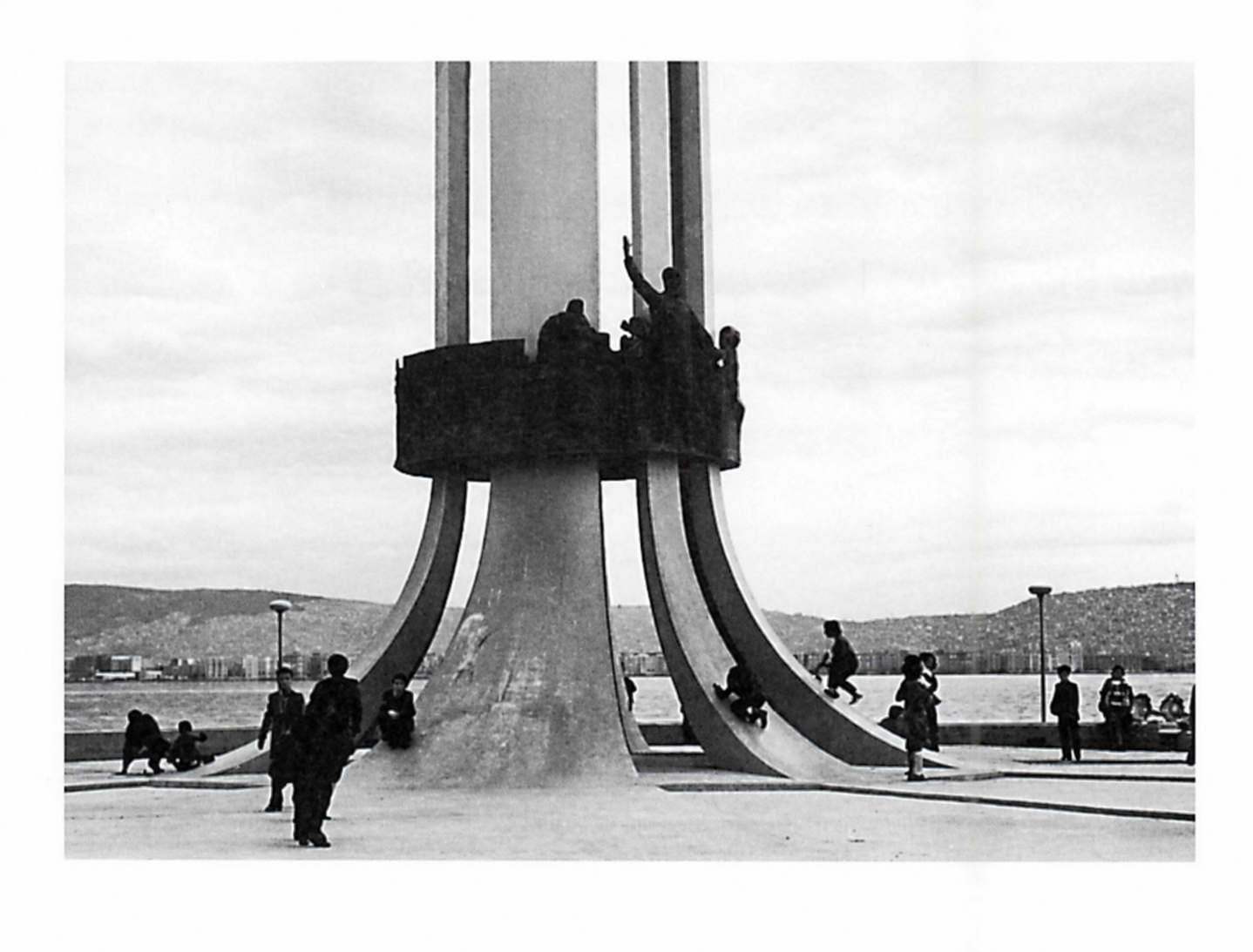
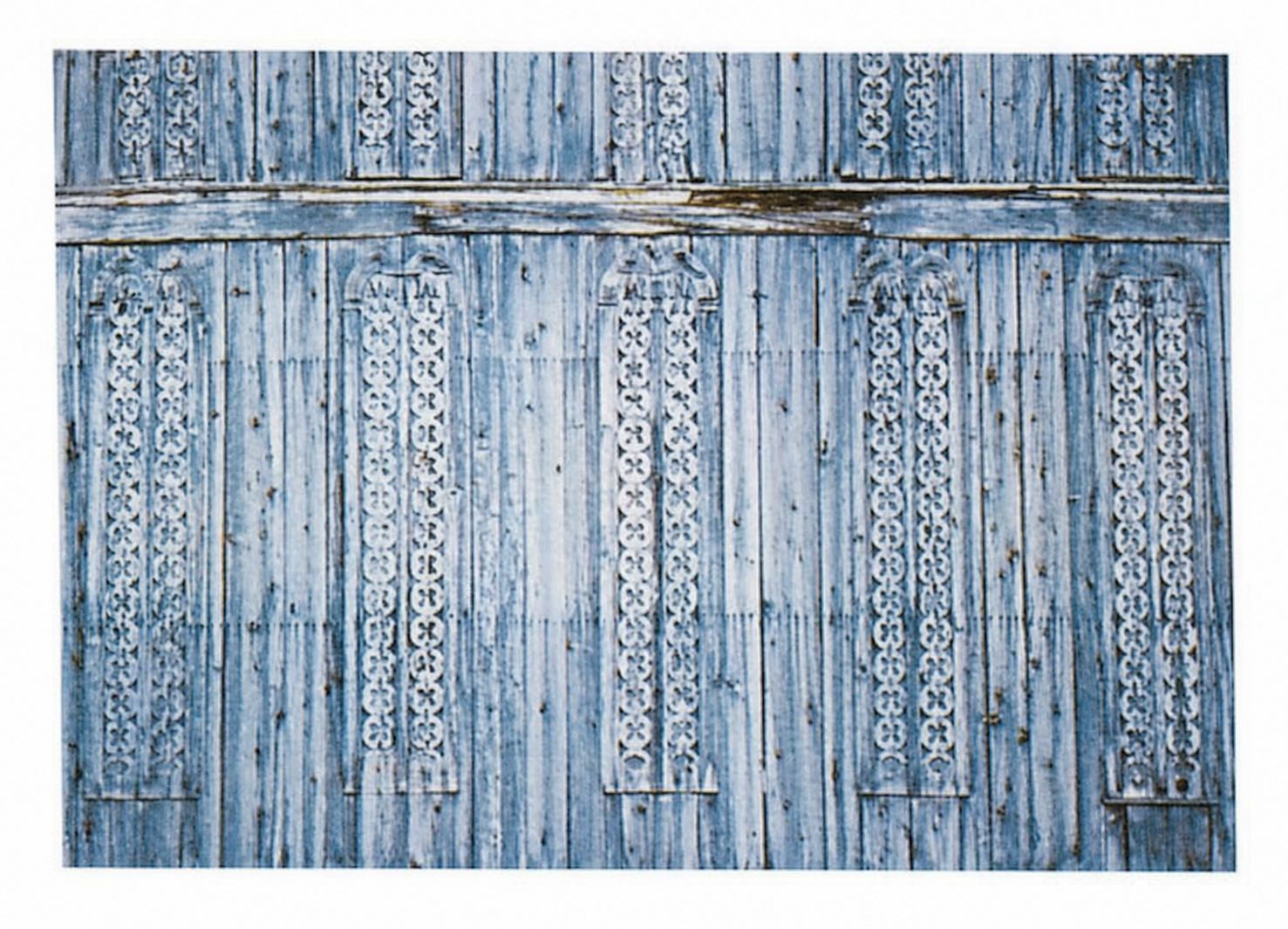
Symbolic ornament from Brasilia
Am I more wholesome -- in my soul -- when in front of this left hand ornament from a Pennsylvania barn, or when standing in front of this symbolic ornament from Brasilia? Facing the left-hand panel, I feel my humanity expanding; facing the right-hand picture, I feel my humanity diminishing.
three fingers dug into my hand. For a few moments of silent communication, I was more than I usually am: more of a person.
Of course, it didn't last. When I left him, as I walked away, my humanity started dropping down again. I went into the store. A few minutes later, I bought a record and went to the front desk to pay for it. I had a few words with the clerk. He took my credit card. Chit chat. Nice guy. Nothing out of the ordinary. But it was a mechanical transaction. The credit card. It was OK. But, very slightly, my own humanity was diminishing, just a little bit, while I went through the motions of paying with that card.
These things are happening in each of us all the time. At each instant, as I go through the world, because of what happens to me, and because of what I do, my humanity is expanding and diminishing all the time; sometimes for an instant it is a little greater, sometimes for an instant it is a little smaller.
It is not only Auman situations which cause the expanding and contracting of my humanity. It is everything in my surroundings, my experience, the physical world I pass through, the activities and actions I encounter. Even architectural details are like this. They support me, or they deny me, in varying degrees. An ordinary iron railing may be very positive. It is no big thing, but as T look at it, as I am aware of being with it, very, very slightly I feel more of a person, a little bit more valuable. Or, on another occasion, I may be looking at a thermostat on the wall, I may feel the opposite. The thermostat itself -- the box -- is not ugly. It is just ordinary. But when I contemplate it, and contemplate the state am in as a result of being with that thing in that box, very, very slightly I feel less of a person, and my humanity is falling off again.
Consider the two examples on this page. In the ornament from the surface of a Pennsylvania barn -- when I stand in front of it, consider it, and bury myself in it -- I feel, to some degree, that my humanity is rising, expanding. But with the ornament from Brazilia, I feel something different. Itis true that this ornament is supposed to be symbolic, and is supposed, in some fashion, to represent or suggest a new spirit, an uplifting spirit. But, in fact, when I stand before it, walk into it, consider it, and bury myself in it, what T actually feel is my humanity diminishing.
So, the life in things that I have been writing about has a direct effect on me. A thing with more living structure makes me more of a person, another thing with less living structure makes me less of a person. All the time, as I go through the world, I feel the expanding and diminishing of my humanity. Of course it comes from me and it is caused by me, but it is caused, too, by my interaction with the world; and it is different for the different things which I encounter.
This kind of experience happens every day.
When I visited Dallas in 1992, my hosts took me around and showed me various places. We started with the Dallas Art Museum. There is a plaza in front of the museum. It has a huge iron sculpture standing in it. In that place, harsh, austere, hot under the Dallas sun, I feel my humanity less, I am less of a person. My humanity is dropping down. But just outside the museum, to the right, there is a short stretch of sidewalk, perhaps three hundred feet long. Along the sidewalk, there are small light green trees, leafy and breezy; they are small in scale, and the avenue they make along the sidewalk is pleasant, cool, shady, and even intimate. When I stand in there, and walk along the sidewalk, my humanity is lifting again, it is rising. I am, during those moments, more of a person.
Then we went to the Texas Bank of Commerce building. In front of the building, there are seats and bushes. Someone tried to make something pleasant and useful. But there are details which make it funny, not quite right. The seats aren't really seats. They are too narrow, you can't sit on them. They are like images of seats, rather than real seats. But even so, funny as it is, the places on the right and on the left are slightly different. On the right, the seats are interspersed with bushes; this is meaningless. No one sits there. No one likes to be there. There I feel my humanity dropping away again. But on the left, it is slightly different. There are a few bushes which have grown up, creating an intimacy underneath. Even though the seats aren't quite right, this intimacy makes it pleasant to be there; slightly, I feel my humanity rising up again.'
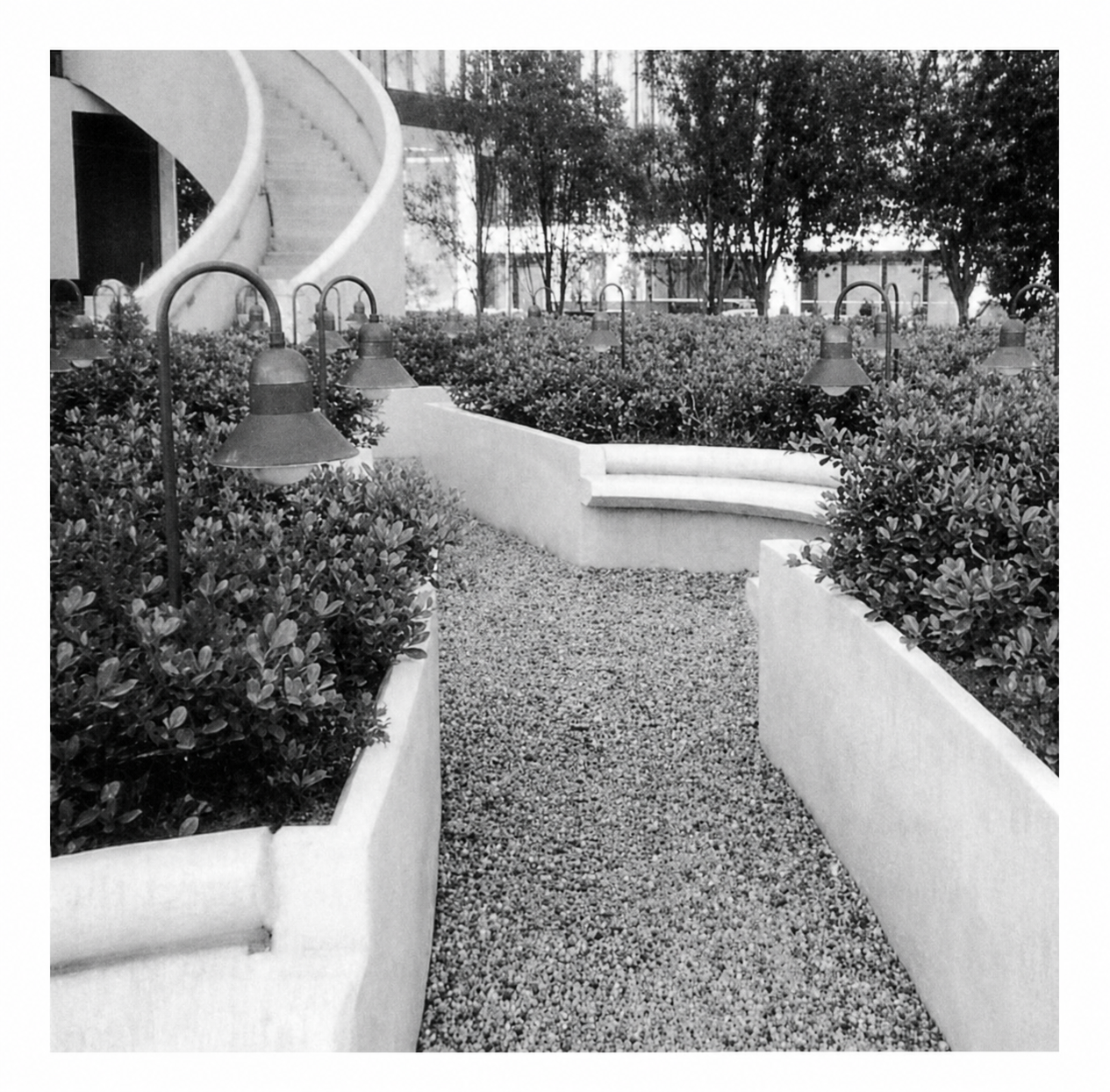
One might ask why such an esoteric litmus test as the expanding or diminishing of my humanity is needed, when the examples from Texas (the fountain, the art museum, the little avenue of trees and benches) are so obvious in their quality or lack of it, and all one really needs to
My humanity expanding: Avenue to one side of the Dallas Art Museum
My humanity diminishing: Seats outside the Texas Bank of Commerce say is that the trees and benches are nice, while the art museum plaza is not very nice.
Indeed, this is true. But it must be remembered that in the late 20th century, judgement of architectural matters had been turned on its head by then-prevailing dogma. Many architects
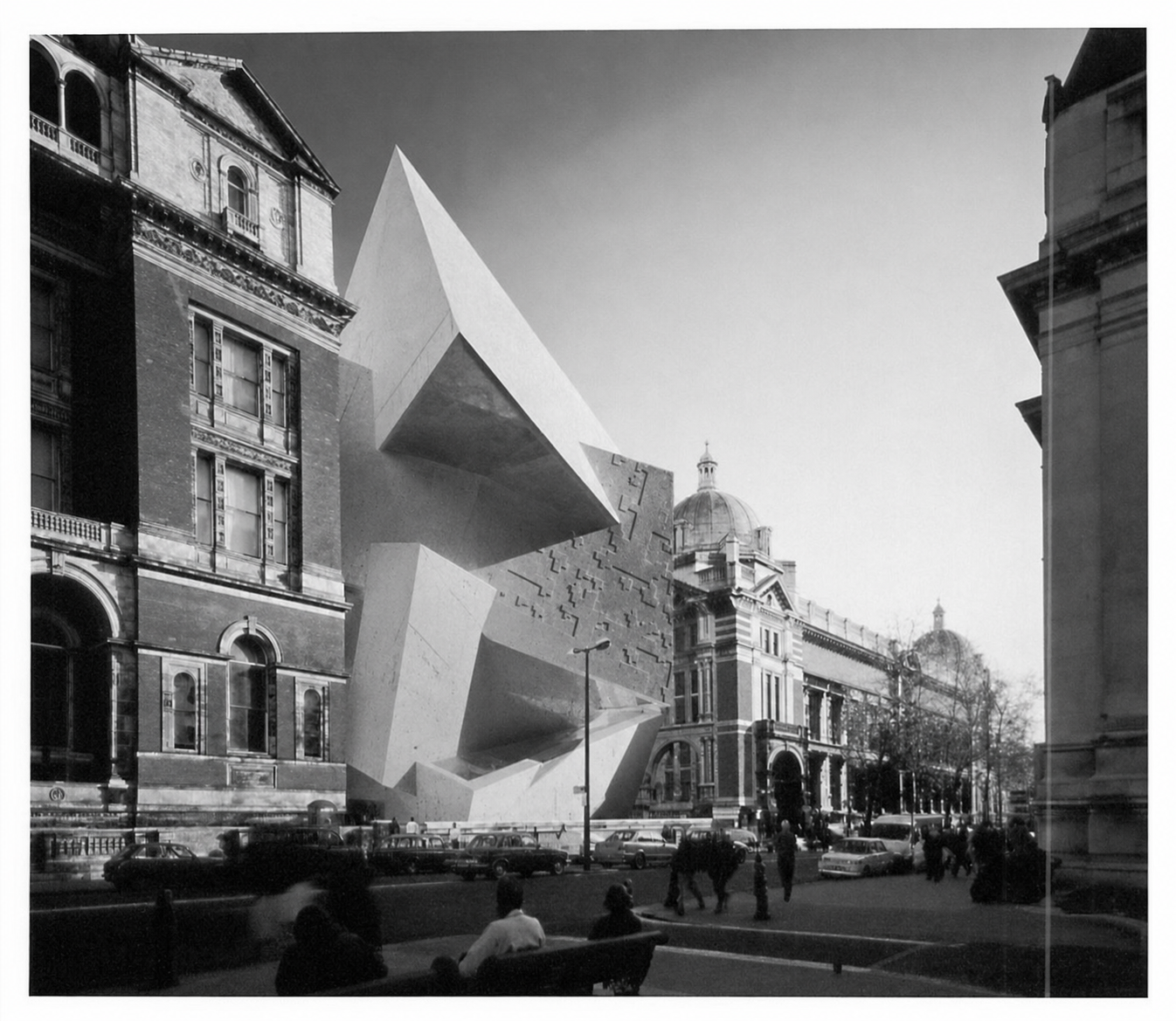
"'A."" Architect's rendering of a proposed addition to the Victoria and Albert Museum, London were intentionally designing things like the art museum plaza, and were intentionally avoiding simple nice places (like the small benches and trees) (for example, by sneering at students in architecture school, especially women students, who did projects of this kind).
The same architects, in order to protect the then-prevailing view of architecture, had gone to a great deal of trouble to erect a false system of values in which living and not-living no longer had any meaning. This had been accomplished by an architectural culture in which some architects openly sneered at the idea of deeper meaning, and did their best to pervert commonsense understanding of these issues in order to shore up the artificial values then current.
The need for a formal way of creating welldefined methods, as I have tried to do here, must be viewed as an antidote to an extremely difficult (and virulent) situation in which people's common sense had been turned on its head, and many people no longer knew how to respond to life in buildings, in an authentic fashion.
Even to this day it is continuing. The director of the Victoria and Albert Museum has very recently been quoted as giving a glowing justification for his decision to build a monstrosity in London, in contradistinction to the ordinary values and opinions held by people in everyday walks of life. It is shown in the accompanying photograph of a proposed extension for the Victoria and Albert Museum in London.° In this case the "A" might be the photograph zs depicted here, and "B," the photograph with some other (to be imagined) alternative, in the position shown. The building shape of A intentionally
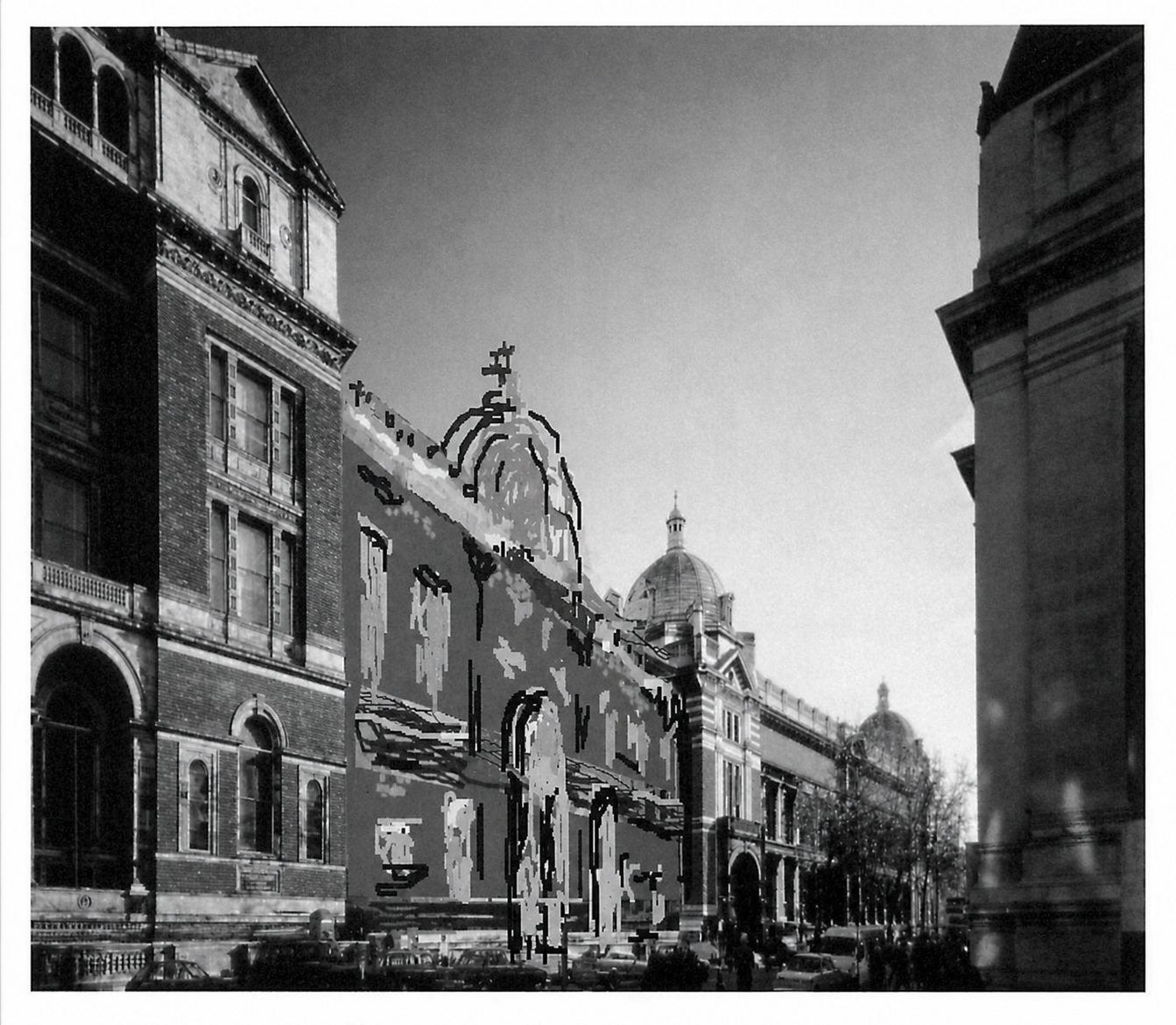
"B."' The same street with a different possible new addition violates most of the characteristics of living structure (I assume it is intention al, in an effort to be artistic, since the diversion from these structural features is too extreme to have happened by accident).
If we ask ourselves whether the addition of this structure to the museum and to the street helps our sense of our own wholeness, I believe the answer is almost obvious, that it does not. Of course, one can apply the other versions of the criterion too. Does the street become a better picture of the deepest self? Does it (in any interpretation) bring a passer-by closer to his own true self? Does it feel alive?
Naturally, there are many significant issues in the construction of such a museum addition. The arrival to the building, the importance of a well marked entrance; the impact of traffic, the possibility that significant things are visible, or sensed, from the moment of arrival. The connection with the objects to be displayed in the museum. This design might be faulted on any or all of these criteria. But what I want to say is that the criterion of its impact on our own wholeness includes all these. The test concerning the wholeness experienced by an observer is not naive. It goes to the root of the life in that part of the environment.
Thus, with a very simple tool, one is able to determine, with reasonable certainty, and with simplicity of means, the extent to which this building does contribute life to the environment of London.
It is true that sophisticated people might feel almost embarrassed to use such a simple standard, to discuss a topic which, for at least a
hundred years, has been so wrapped in complication (the judgment of a building's quality). But nevertheless that is, in part, the point of what I have to say in this book, and also the point of my post-Cartesian method of observation. It is fairly unambiguous, easy to perform, and gets results very quickly.
Whether we are comfortable po/itically with the results of this observation al method is another matter. The method does not allow foolishness. It is not consistent with foolish star-struck adherence to obscure and impenetrable notions of art. For that reason, some may jokingly dismiss the method, because they see that it cuts to the core of the intellectual game which they are playing. The director of the V&A, perhaps in love with the avant-garde character of his brainchild, might do so. But the test is true, and effective and empirical, nonetheless.'
Of course, this method of judging does not only allow us to make global judgments, after the fact, when comparing two designs in their totality. What is even more important is that it provides us with a tool for creating plans and designs. It allows us to examine each step in a design process, making judgments about the life and wholesomeness of different possible next steps, and allows us, at each step, to choose the most wholesome, then to move on to the next decision. It may be helpful, I think, to see this use of an empirical method not merely supporting a judgment but contributing to the evolution of a design, in action.
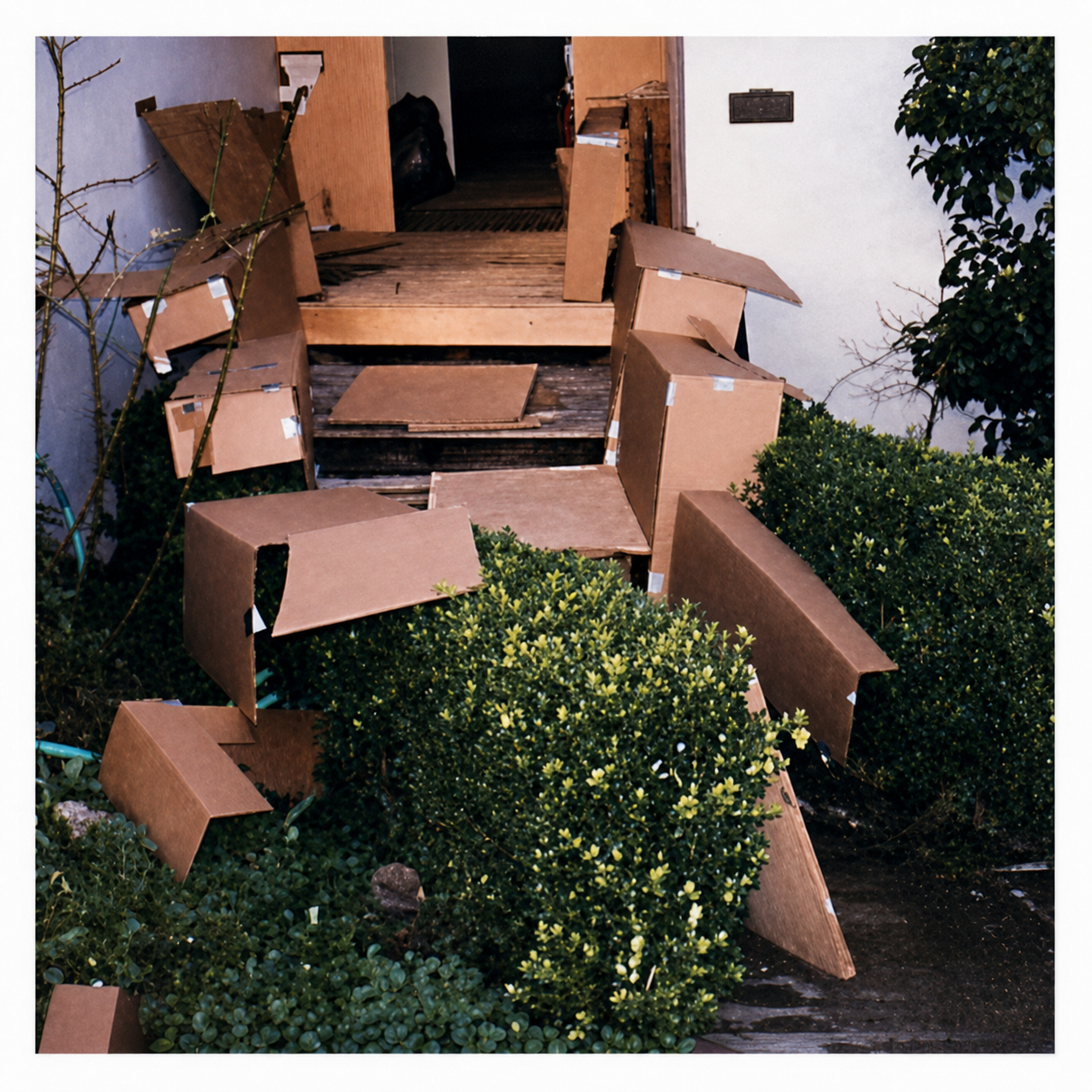
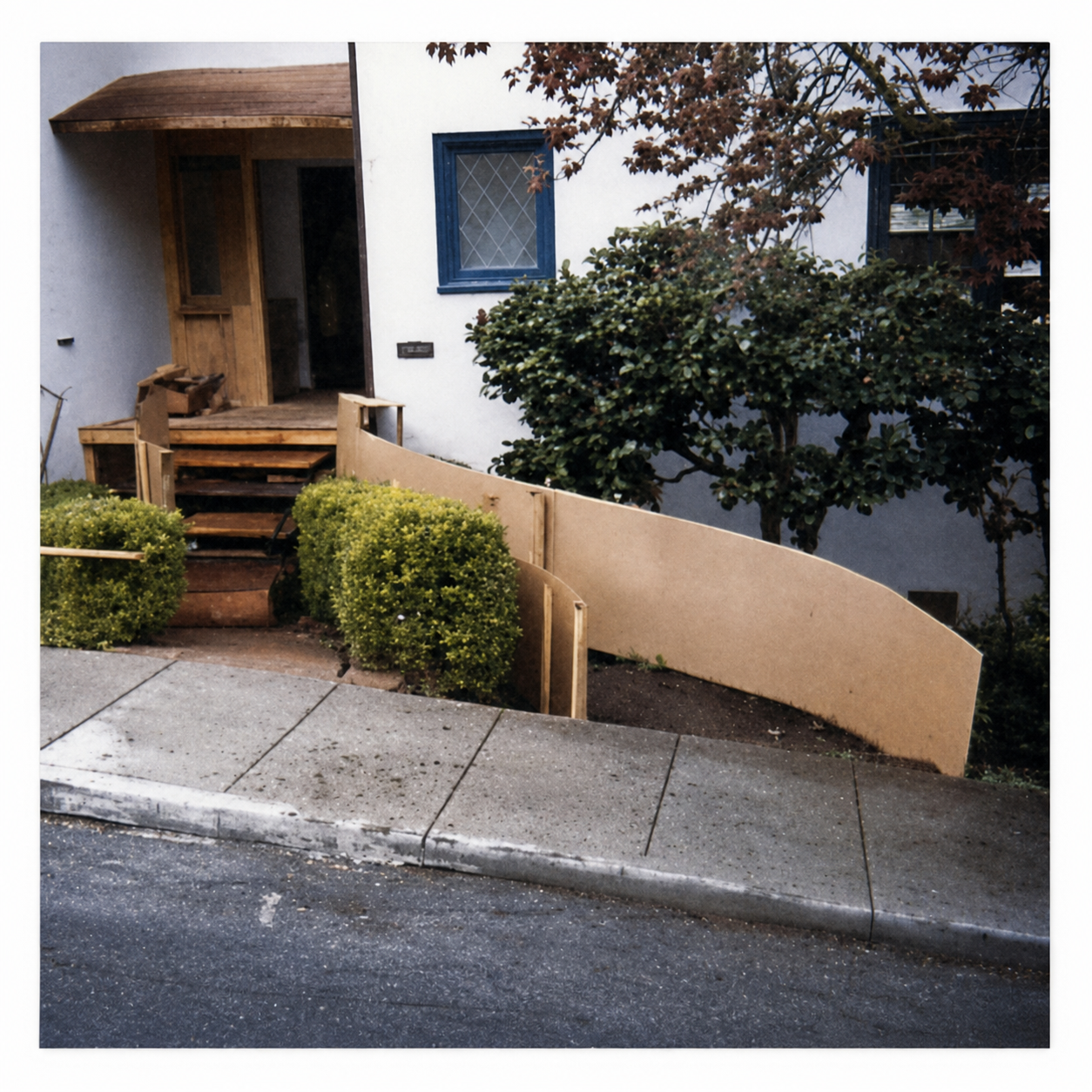
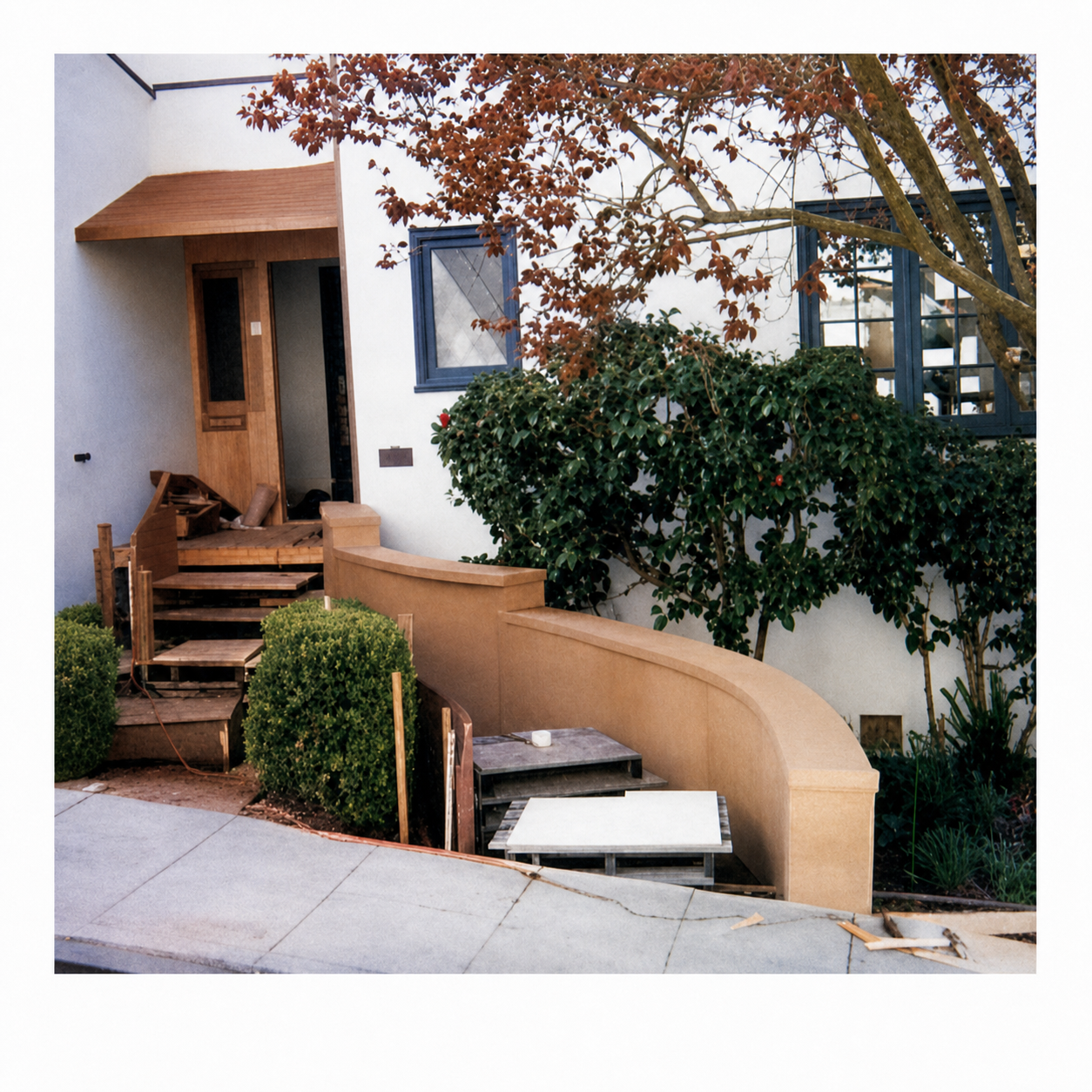
In the next example I illustrate the entrance to a house in Berkeley, California. The house, which my staff transformed and redesigned, started with the front door and the entrance. The then-existing entrance was gloomy and unfavorable, and the owners wanted to change it. It was not easy to do. So we assembled very rough bits of cardboard, and arranged them, trying to get some kind of glimpse of what would be a good thing to do. As you see in the first picture, we started with a fairly straight approach, indicated here by roughly placed bits of cardboard. This had very little feeling or potential for feel-
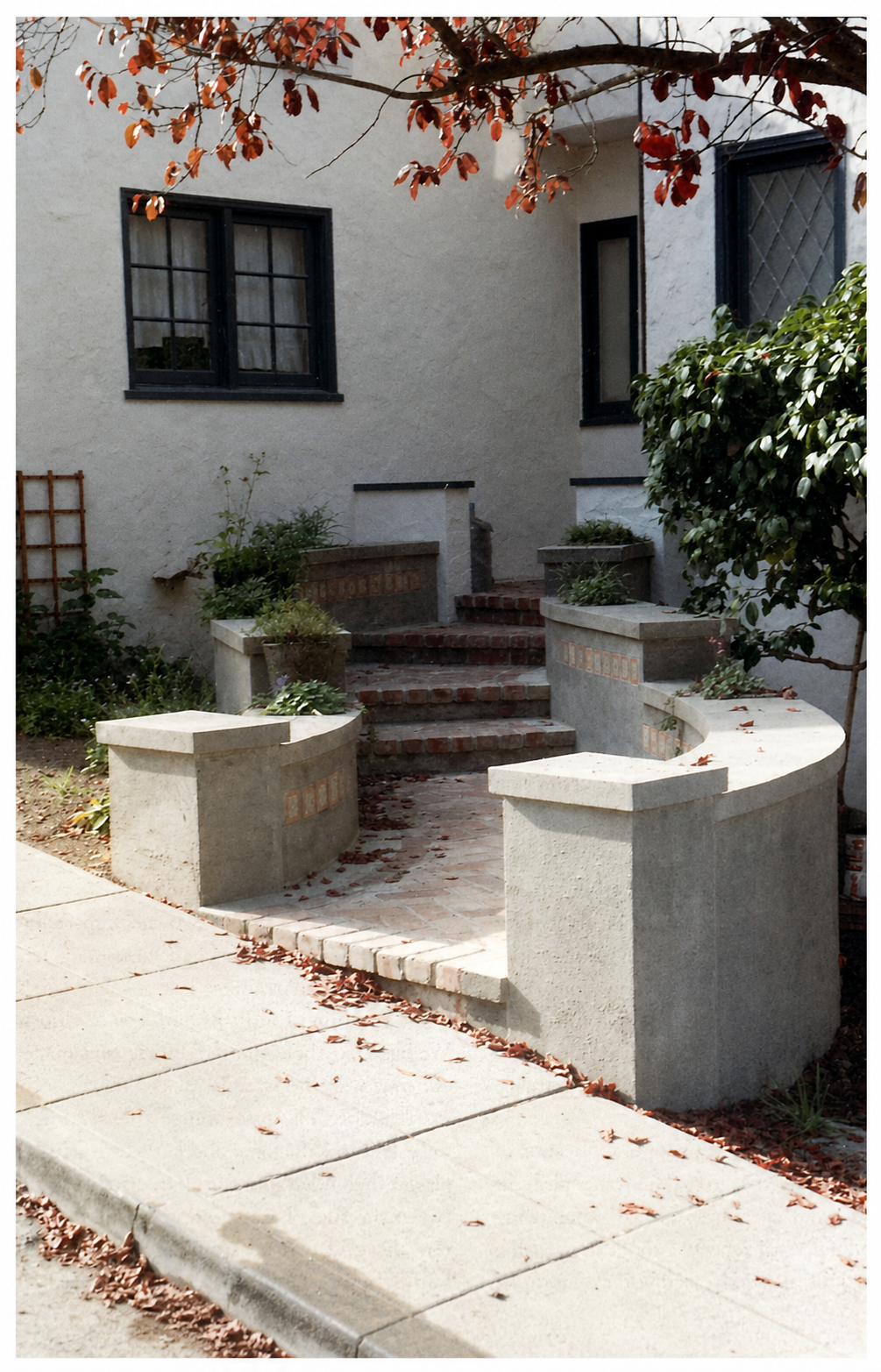
ing. Certainly, as something which indicated a sense of life or made one feel one's own soul, it was virtually useless. In trying to see what might do better, at some moment a long sheet of cardboard was bent and placed in the S-curve you see in the second photograph. This was more promising. One felt the beginning of a situation where indeed one's own life, or soul was elevated
Two versions of the way the tile repeat might meet the window, before the final tile work we set. Though unusually hard to decide, it slowly became clear that the right-hand version created an atmosphere of greater wholeness in an observer, and that was the one we chose. The extra gray space around the window, though at first sight less complete and less perfectly made, induced a greater feeling of relatedness than the left-hand example which was more conventional, and more by its presence. We then built on, trying to see, again in cardboard, what might be done with such a curve, to make it in actual dimensions of masonry materials. This did become more substantial. Finally, the wall was formed and poured in concrete, more or less in the line shown in the third photograph. The finished entrance is shown on the right.
We see here how a very simple application of the criterion enabled us to make a rather pleasant garden wall and entrance, simply by following the consequences of repeated application of the criterion. This method, used for evolution of all aspects of building design, large and small aspects -- plans, conception, structure, volume, layout, details -- is the backbone of the living processes described in Book 2.
The example on these two pages, shows some of the deeper and more subtle distinctions which can be made by using the criterion of
perfect."
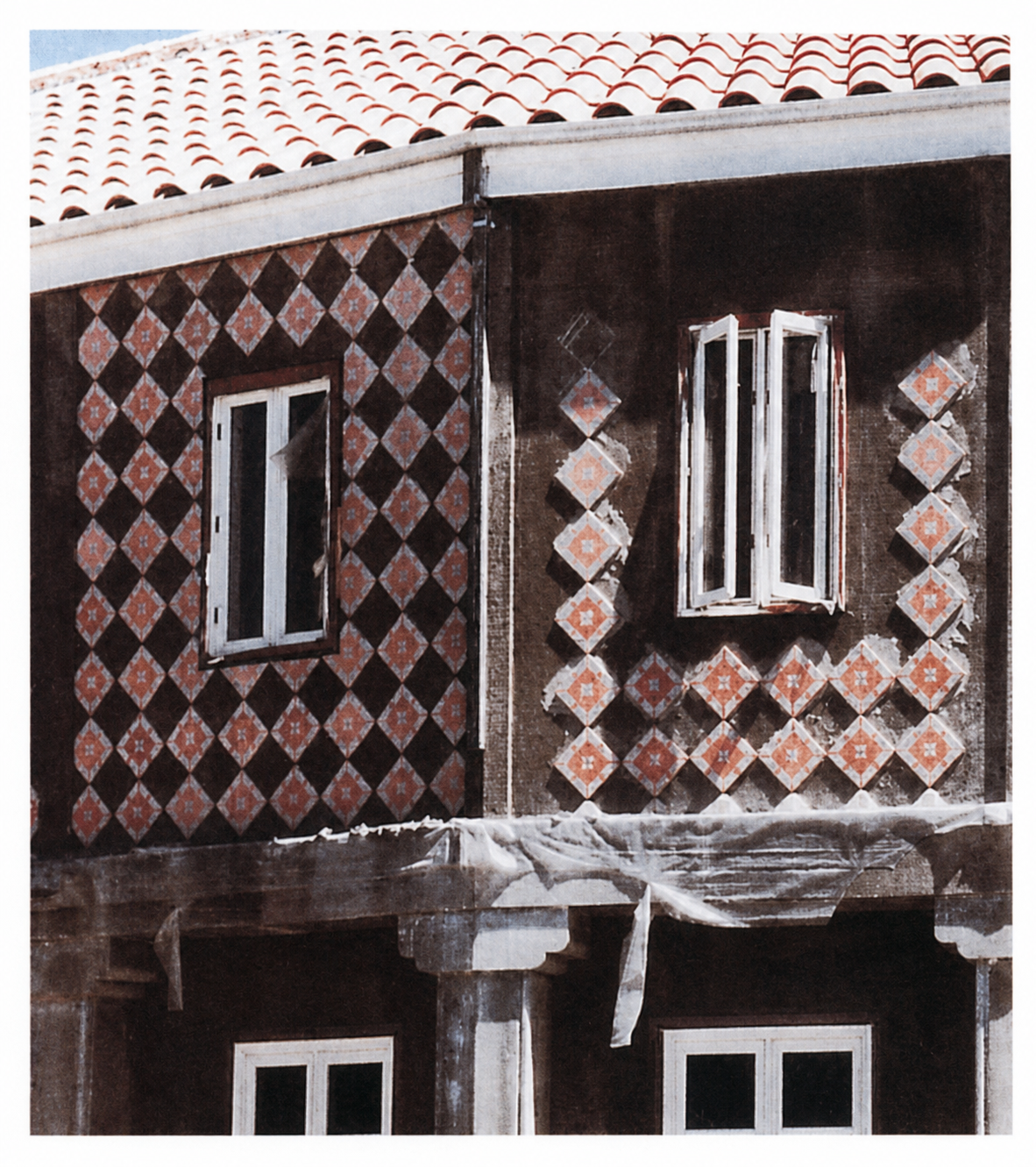
the observer's experienced wholesomeness. In the first photograph one sees two mockups, side by side, in adjacent panels. I had these made while building the Julian Street Inn, a shelter for the homeless which I built in San Jose, California. We had four thousand handmade tiles made in our own workshops, to be placed on the second story facade. The rose-orange tiles were going to be laid in a diagon al checkerboard, with gray plaster then filled into the alternating spaces between the tiles. I was now struggling with the way the grid of tiles would meet the window frame. In case A, the tiles would be brought all the way to the frame, and the edge-tiles cut, as necessary, to complete the pattern. In case B, the tiles were held back from the window frame, with the idea that the gray plaster would be made solid in the zone next to the frame.
As the reader can see from the second photograph, I finally decided to use B, rather
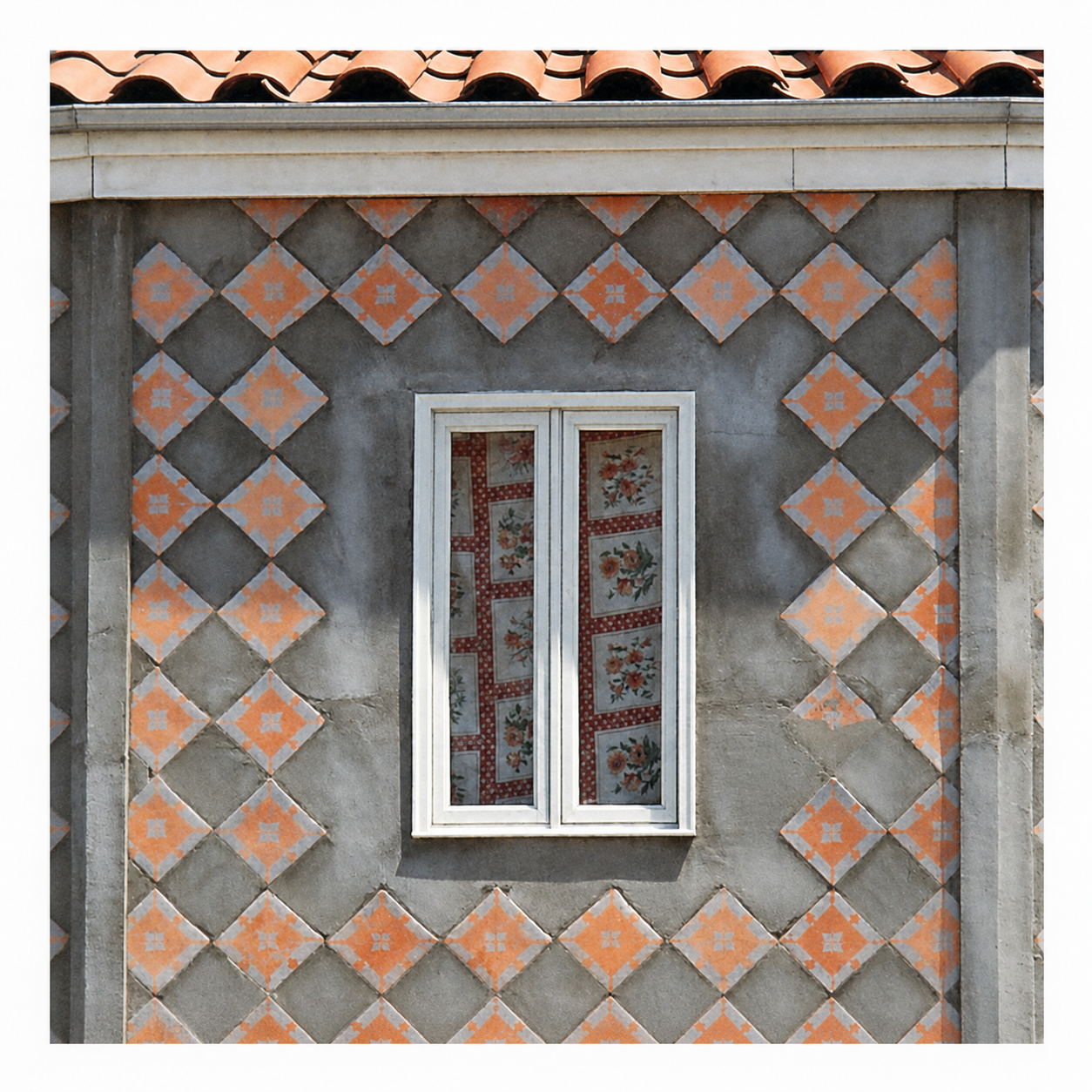
than A. This choice was not easy. When one first looks at the two mockups, side by side, one is inclined to choose A. A is more conventional, it seems more tidy; it even seems that somehow may do more justice to "the whole." On the site itself we had the same sensation, at the time we made these mockups. I noticed however, that B, though a little strange, was worth examining closely. I then did the mirrorof-the-self test, in that instance, together with a careful check of my own feeling. I found that when this criterion is used it is B, though unusual, which has a slightly better impact on the increase of my own wholeness. 1 must emphasize, here, that this was not easy to see. The judgment was elusive, not obvious at all, and only stood out clearly after my colleagues and I repeatedly asked ourselves this question, comparing A with B, then going back to A, then back to B again. This is an example where simple-minded adherence to "Which one is nice?" or even to "Which one has more life?" might easily push toward A. Only the very subtle and careful examination of one's inner feeling, reveals that B, not A, creates a greater sense of wholesomeness or humanity in the observer, and is therefore more truly alive in the deep sense.
6 / Judgment and the Pursuit of Architecture
The whole problem of architecture, especially the problem in our time, has as its underpinning the fundamental question of architectural judgment. What is good and what is bad? What is better and what is worse?
For us as a society, these question are paramount, since if we can attain a shared basis for deciding these questions, and it is reliable, wellfounded, and indeed shared, so that everyone agrees on it, then gradually, our cities and our environment will get better, simply because the human judgment will gradually push them and nudge them, to get better. But of course, that has not been happening much in recent decades, because there is so much ambiguity about these questions. Anything goes. Everyone has a different opinion. Almost everyone has a different philosophy.
The same is true for every architect, and every builder. If we have a sound, and clear basis for making decisions about what is good and what is bad, what is better and what worse, we can then move through the days of decision making successfully, and we shall have good results. But at present, we have no such tool. We have opinions, certainly. But no reliable source of judgment, that we can truly stand upon. And as a result, each architect, each designer, is a little lost, mentally flailing around trying to doa good job without being sure what that means -- all because we have a foundation of quicksand for the judgments he/she/we are called upon to make every moment of the working day.
What is ecologically appropriate, what is socially and psychologically valuable, what is beautiful to the eye, what is comforting to the soul -- these are all wrapped up together in the global judgment of wholeness. Using the degree of wholeness the observer experiences in herself or himself as a measure of the wholeness in the system being observed, in similar fashion all of these tests help the observer reach understanding of the objective degree of life that is present in a system. All of them, used by different observers, will create broad agreement about comparisons.
It is vital to understand that the ultimate goal in these observations is observation of the system in the world, not observation of the observer's reaction. If we compare two mountain streams by checking the degree of wholeness which the observers experience in themselves when in the presence of these streams, it is the degree of life, wholeness, and ecological health of the systems -- that is, of the living streams themselves -- which is being measured, not the satisfaction of the observers. If we compare several designs for a great bridge, as people were asked to do in the recent debate about designs for the Oakland Bay Bridge in San Francisco, we may see, and feel some to be more alive than others -- because they make us feel more whole in ourselves -- and ¢hose are the ones which have more life.
All these methods are special cases of a very general type of observation that relies on the observer's study of his or her own state of wholeness as it exists in front of different things or systems being observed and that then uses the observer's experience as a measurement on the system being observed to determine that system's objective degree of life.
All this can arise only from our willingness to accept a non Cartesian, or post-Cartesian, form of criterion for objectivity.
8 / Emergence of This New Form of Observation
Since this form of observation is so new, I believe it may be helpful to show that, even though new, it has continuity with other methods of observation from modern science.
Measuring the life of very simple centers is something which occurs, as a matter of norm, even in contemporary thought. Let us go back to the original definition of wholeness. The wholeness is a system of centers which, working together, create the gestalt of a given part of space. Now, the task of distinguishing some of the elementary centers which occur, and setting them apart from other fragments of space which are less centered, happens without difficulty in sim-
ple cases. In seeing an apple as an entity, or the core of the apple, or the apple pits, something we do every day without thinking, again we calculate and notice that this center is more salient, more coherent, than many other nearby overlapping portions of space. Or, for example, if I look at a black line on a white ground, the black line may be identified as a center. It is distinct, bounded, symmetrical, contrasting in color; its appearance as a center comes about because of these features which cause its differentiation. The objective character of this circle as an entity is well known as a fact of cognitive psychology.
In a similar fashion, I have suggested that the wholeness created by a single dot sitting on a sheet of paper consists of a series of convex segments of space. The wholeness is not defined until we can identify these sets as being more coherent, or more centered, than other possible subsets of space. These judgments, too, are usually not controversial. In fact, the point of the gestalt psychologists' experiments in the 1930s was precisely to show that we all make these judgments in more or less the same way.' They identified something they called "praegnanz" as the character which created saliency in figures and made them stand out as wholes -- what I call the "strength" of centers. By about 1930, there was already a well-documented literature on the problem of defining greater and lesser strength in centers (then referred to in simple cases as "goodness of figure"). By about 1940, this goodness of figure had been pinned down as being dependent on characteristics like convexity, differentiation, boundaries, and so on, "precursors of the fifteen properties I have identified.' This goodness of figure was a weak form of the quality which I call "life."
Let us now consider some more complex and more interesting cases: for example, the way the centers work in the garden of the Hotel Palumbo. If you look at the centers listed on page 111 for the Palumbo terrace, it is unlikely that this list will be strongly questioned by anyone. To that extent, we may say that the relative strength, or life, of the centers is so straightforward that most people will agree with it. However, in this case, the judgment that certain centers are more salient, and others less, reaches a level of complexity that would challenge a purely mathematical analysis aimed at measuring these centers. It is possible that one day computer programs designed for cognition might be able to pick out these centers and rank order them by their degree of life, but in this case we are moving to a level of complexity where human cognition is a more reliable measuring instrument than any presently available mathematical theory.
Suppose I now consider the Palumbo terrace as a whole and try to measure its degree of life. Here again we have a center -- but now a very complex center. Consider the problem of judging its degree of life, compared with the degree of life of some chic restaurant. We now enter the realm of architectural judgment. A person who likes postmodernism may choose the chic restaurant over the Palumbo terrace. The degree of life in the Palumbo terrace is not unequivocally visible. It can be questioned. It is not until I point out how many centers it contains and invite examination of the density of these centers that we begin to see how strong its life is.'' In a case like this, we do still have the number of centers, or density of centers, as something that can help to settle the argument. But this is an analytical evaluation based on a particular method of counting. It can be used to bolster a doubtful judgment. But the judgment itself as a pure judgment, the measurement itself, needs a direct method.
At the end of chapter 8, I showed examples of comparisons which are still more difficult. In these very difficult cases, like the pair of Chinese bronzes or the pair of Matisse paintings, accurate judgment of which one has more life requires a level of self-knowledge on the part of the observer. This may take a long time to develop, and often does not exist until a person has spent years looking at things, sharpening his or her power of discrimination. In this case, even the rule "Choose the one which generates greater wholesomeness in me"
is hard to follow, because the sensation is so deep, and the self-knowledge required to feel, or know, which one creates greater wholesomeness is not readily accessible.
In recent years, experiments done with such highly complex and controversial cases have begun to show that even they are ultimately objective. Ken Pirsig described similar experiments in his novel ZEN AND THE ART OF MOTORCYCLE MAINTENANCE." One of my students, Cristina Piza de Toledo, established that when we make paired comparisons of things, asking people which has more life, there is a surprising and profound degree of agreement about this quality.° The studies of Professor Hajo Neis, in the Department of Architecture of the University of California at Berkeley, have reached similar conclusions.'*
One might say that these studies are still merely sophisticated judgments of preference. But other experiments have begun to establish that these phenomena, which can be measured by techniques similar to those I mention here, have practical consequences in the world that go far beyond mere pleasure or delight. In 1967, Robert Sommer and Ken Craik made a comparison of rooms with and without windows. This was done at a time when architects were advocating windowless classrooms in schools on the grounds that windows were distracting to children and prevented them from learning. In the study, people were asked to sit in a room and write a story. The stories written by people who had been in rooms without windows, and by those who had been in rooms with windows were mixed up and then scored by an independent person, not part of the experiment, for the quality of being "depressed." A variety of indicators was used. All in all, it was possible to establish, objectively, that people were more depressed, and less creative, while they were in the windowless room than in the room with windows. Of course, this method was still carried out within the Cartesian canon. However, there was a hint here of a method in which the wholeness of the observer's state was the crucial instrument.
Other similar observations, where people are asked to report directly about their surroundings and to judge the condition of their surroundings as nurturing, wholesome, comfortable, and so on, have also been introduced by anthropologists, psychiatrists, and sociologists, including Len Duhl, Randy Hester, and Clare Cooper Marcus." In all these cases, what is presented is the idea that subjective reports of human experience have an important bearing on the evaluation of architecture. However, the jump to the idea that these subjective reports are describing the objective state of an objective system was not made by these authors.
A further step was made by Alice Coleman, in her massive 1985 study of high-rise public housing in England. She used indirect indicators of well-being and wellness to show that many government housing projects were objectively damaging to their inhabitants.!7 However, Coleman's study underlines the difficulty of using the type of observation which I am describing here. The fact that the housing estates she studied are for the large part abysmal as environments for growing families is obvious to most observers. Whether measured by "life," by "wholeness experienced in an observer," or just by plain common sense, it is obvious that they are not nurturing for their inhabitants. In the intellectual climate of 1985, these feelings would not have been considered legitimate or reliable indicators of any objective reality. Indicators such as urine in the passages, on the other hand, were considered reliable, and their measurement consistent with the Cartesian method of observation. Thus, although the observations of Coleman are precursors of the type of observation I am proposing here, her work only illustrates the extent to which, by the 1980s, we had not yet learned to accept such observations as legitimate.
In 1985, reports of people's feeling would not have been accepted as proof of anything except subjective feelings. To make the point that these were objective judgments about something real in the world, the urine in the passages, and other mechanical indicators, were used as a way of
proving that it was hard, legitimate, social science. But this was really a conjuring trick. It was really a roundabout way of addressing the underlying fact that there was something objectively wrong with many housing projects, and a way of trying to get by the fact that the science of that time, had no way of making this a legitimate object of inquiry.
Another similar example is instructive. In Berkeley from 1989 to 1992 there was controversy about an apartment building that was proposed for the intersection at Rose and Shattuck Streets. More than a hundred people came to the hearings when the developer presented his project. They objected, in a variety of ways, and said that the project was unsuitable. However, once again, they felt obliged to express their reasoning in mechanistic terms: "it will create a parking problem," " there will be pollution," and so on. What they actually wanted
n « congestion will increase, to say, I believe, yet what was only occasionally voiced was that the new proposed building was simply not harmonious with the neighborhood, or fitting for it. It was too big, too high, uncomfortably different in construction character. This observation -- clear, legitimate, and shared by a hundred people who turned up (and probably by thousands more who did not) -- did not have the scientific or social legitimacy that was required to turn the project down. If they had simply said, "The project feels wrong," this would have appeared to be an inadequate legal reason for stopping the project -- because it would have appeared subjective, not objective. Referring to transportation, parking, and pollution, was intended to give legitimacy to these clear feelings by linking them to mechanistic counterparts. But the essence of the matter rested on the clarity and objectivity of the feeling that the project had to be made smaller in order to be harmonious with the neighborhood.
In all these cases, we see, in one form or another, the raw beginnings of the idea that observation of a person's internal state can give us information which is reliable and objective about the objective living or non-living character of some system in the world outside the person.
So far, the studies I have cited have still been viewed mainly as studies within the realm of social science, showing that psychological considerations should have a bearing on the evaluation of architecture. Their validity has been viewed as a validity within psychology, not within physics. The method which I propose, on the other hand, though continuous with these studies, takes a very important further step. I suggest that these apparently "psychological" methods give objective insight about the objective state of a system in the world and should be considered as measurements of this state -- and hence as part of physics.
What I am proposing is that these observations of an observer's inner state are not merely a reflection of a person's attitude or psychology, but can actually can be used to measure something real about the external world itself-
9 / the Core of the New Method of Observation
The method which I propose is therefore different from currently accepted forms of observation. It goes directly to the intuitions which are widely shared and raises them to a formal level as techniques of observation. You are asked to record your own inner feeling, your own inner wholeness -- and this is used then as the measure of the degree of life in some system of the outer world you are observing. Although this technique is new to modern science, it was not unfamiliar to the ancients. Confucius advised that a ruler will only be effective to the degree that he is able to listen to his own heart."* It is said that Socrates gave the same advice.
This kind of technique is also the basis of one of the most sophisticated Buddhist canons, the visuDDHIMAGGA, in which the Buddhist student is taught to recognize, feel, and experience the precise inner state which he or she is in at each instant." The key to this method, as practiced by Buddhists, is to recognize the inner states which are wholesome, and then to move toward those phenomena in the inner and outer world which cause or tend to create this state of wholesomeness in the observer and in which wholesomeness is considered to be the most important and most fundamental internal condition. The visupDHIMaGGaA teaching recognizes a picture in which our consciousness is made of instants of consciousness, eighty-nine different ones, called "cittas" in Pali. One of the main processes taught by Buddhism is discovering the fact that some of these cittas are wholesome ("kusala" in Pali) and some are unwholesome ("akusala" in Pali). It is interesting that in the visuDDHImacca there are clear explanations of the enormous difficulty of concentrating accurately on the distinction between wholesome and unwholesome internal states. The task of learning to distinguish these states in oneself is the main method by which a person can make progress.
The idea that a person will, in general, have difficulty reporting his own internal states accurately, and the training techniques which focus on this problem and allow a person to grow more accurate and more familiar with the internal states arising in him, are also the main focus of an entire literature in contemporary psychology, including the gestalt psychology of Frederick Perls and hundreds of others."
What is new in the method I have advocated is that this time-honored and essential part of human experience, the fact that it is possible to focus accurately on the experience one has internally, is not categorized as a subjective and personal matter. Instead, it is used, and recognized, as a fundamental measuring instrument about the structure of the real world outside the observer.
All this hinges on the fact that, when we pay attention to our own wholeness, we find that the degree to which conditions in the external world do increase our wholeness, is predictable. We find, too, that the effect of these conditions on the human observer is reliable and replicable. The idea is that our feeling is not merely a subjective and changing thing, but that it itself is a reliable instrument -- and that the condition, or state of this feeling, is a source of objective truth.
It is, in the end, this measuring technique that provides one mainstay of the claim that degree of life is an empirically observable quality in the world.
10 / the Relation to Descartes
T revere Descartes. Years ago I remember reading a passage in THE MEDITATIONS, where he said something like this: "If you keep on using this idea of making little thought machines, then observe, do experiments, you will find out if this machine is like the world or not. If thousands of people all over the world start doing these experiments, then after two or three hundred years, we shall know almost everything about the way the world really works."""
That is my paraphrase. It is what] remember, and I can no longer find the passage, so I may have embellished it. But when I read this, I was astonished to see that Descartes not only invented the method of observation which in effect we have continued to use unchanged for several hundred years, but that in addition he saw clearly what it would bring. Back in 1641 he effectively foretold the modern history of science.
I should like to call the Cartesian method the first method of observation that allows us to find agreement about the world. Nowadays, this first method of observation -- the process of obtaining truthful insights about the world, by
standing outside the world as an observer -- dominates modern science. It has become, in effect, the on/y way in which we obtain objective information about the world.
I believe that what I have described in this chapter may be thought of as a second method of observation. If I am right about its power, it might one day seem comparable in value to the first method -- and complementary to it.
The first method has helped us to find out how the world works in the machine-like sense. With it we have accomplished miracles, nearly, in the breadth of our scientific understanding. The second method of observation may bring us further miracles. It may perhaps bring us to the doorstep of another kind of world, in which we see, feel, become aware of a second layer of existence, beyond the mechanistic view of science and technology: a layer which is the underpinning of architecture and which is, also, the basis of ouremotion al and spiritual relation to the world.
The fact that, like the first method of observation, the second method gives insights about objective truth, in the real structure of the world, is highly significant. It means that aspects of beauty, the nature of life, the deeper aspects of our existence, even perhaps the nature of God, may also become visible truths. And it may also come about that their landscape -- like the landscape of modern science -- is one that is seen to exist, objectively, and is ultimately available to our inspection. That could be, I believe, the longterm result of the method of observation which I have sketched out here.
It is necessary to understand that there is no choice required between the method of Descartes and the method which I have defined here. The two methods are consistent with one another. In any situation where the relevant facts have to do with things that can be viewed in a machine-like fashion, the method of Descartes is best. Pretend the unknown thing is a machine, and find a model which represents its behavior. But in any situation where the relative wholeness of different systems is the most relevant issue, then the method of Descartes, by itself, will not work. We then need a method which can explicitly, and objectively, recognize the relative degree of wholeness in different systems. In such a case, the method which I have described must be used as well. If we follow both methods -- the method of Descartes for things that are outside ourselves and can be represented as machines; and the method I have explained, where we have to study or judge wholeness -- we shall then arrive at a picture of the world which includes the self and which is able to recognize the personal nature of the universe."
Notes
1. This example from Akido was given to me by Scott Hunter. I am very grateful to him. There are no doubt many other versions of this test too.
2. This question is, of course, only likely to be successful for an observer who feels that it has a clear meaning.
3. One nicely unassuming and straightforward version, still essentially of the same test, was described by Michael N. Corbett in A BETTER PLACE TO LIVE (Emmaus, Pennsylvania: Rodale Press, 1981): "I became keenly aware of a pleasant feeling and, at that time, realized that architecture should be judged by how people feel when they are using the space for what it is designed for..." (p. 113).
4. The following discussion is based on a speech I gave in 1992 in the Dallas City Hall Council Chamber.
5. Later in my visit, I gave this and many other similar examples in the City Council Chamber of Dallas, where there were about a hundred people listening to my speech. Each of these examples was something familiar to them. As I gave each example, I could see people nodding their heads and agreeing. The experiences I described from the streets of Dallas were not unique to me: I picked examples which I knew would be shared by many. I think they were shared by almost everyone listening to me that day. Most people feel their own humanity dimishing when they are in the forecourt of the Dallas Art Museum. Most people feel their humanity rising in the little avenue alongside the art museum.
What we witness here is something, this expanding and diminishing of our humanity, which happens in each one of us. To a large extent, it happens in the same way, and to the same degree in each of us. Of course, there are still individual differences. Of course, we shall not find perfect agreement about these judgments. But in broad terms, if we observe carefully, with microscopic attention to our own interior feeling, the rising and falling of our humanity from moment to moment, from place to place, we find that we experience this in the same way and largely to the same degree.
6. Taken from the new york TIMES, February 2, 1999.
7. Thus, what could appear to some readers as a nearly contrived and over-complex definition of value and quality, together with an almost rarified way of deciding its presence or absence, is required by the upsidedown character of the present social situation, and the need for us to reestablish a solid foundation for the art of building. It is very practical, very useful, this feeling. It tells me what to do. Those things which make me feel more whole are things to work toward, things to do. The things which make me less wholesome are things to stay away from.
8. These convex segments are the centers that I have identified in chapter 3.
9. Wolfgang Koehler, cestatt psycHoLocy (New York: Liveright, 1929), and THE PLACE OF VALUE IN A worLD oF FACTS (New York: Liveright, 1938); Kurt Koffka, PRINCIPLES OF GESTALT PSYCHOLOGY (London: Routledge & Kegan Paul, 1955).
to. This has been very thoroughly explored -- as, for instance, in Marian Hubbell Mowatt, "Configuration al Properties Considered Good by Naive Subjects," AMERI- CAN JOURNAL OF PSYCHOLOGY 53 (1940): 46-69, reprinted in David Beardslee and Michael Wertheimer, eds., READINGS IN PERCEPTION (New York: Van Nostrand, 1958), pp. 171-87.
u. And even this, of course, is susceptible to change. In 1985 the terrace (as shown in chapter 4) was beautiful beyond imagining. In 1997 it was merely nice, with very much less life remaining in it. The son of the previous owner had rebuilt it, and what had once been magical was now merely pleasant because he had altered the centers by remodeling.
12. Experiments of this kind have also been described by Ken Pirsig, in his book EN AND THE ART OF MOTOR- CYCLE MAINTENANCE (New York: Morrow, 1974) where he describes an imaginary (but in part autobiographical) professor of English literature who achieves a drastic change in our way of looking at the world, by establishing empirically that the relative quality of different student essays is a matter of fact, not a matter of opinion.
13. Cristina Piza de Toledo, opjecTIVE JUDGMENTS OF LIFE IN BUILDINGS (unpublished master's thesis, University of California, Berkeley, 1974).
14. Hajo Neis has undertaken a wide variety of such experiments, asking subjects to make comparisons of the degree of life or degree of quality in different objects, situations, and artifacts. The results of the experiments, so far unpublished, are available from Professor Hajo Neis, Department of Architecture, University of California, Berkeley.
15. See various studies by Robert Sommer for the effects of windowless rooms on creativity; also bibliography by Education al Facilities Research on the Internet.
16. At the University of California, Berkeley.
17. Alice Coleman, uTOPIA ON TRIAL: VISION AND REALITY IN PLANNED HOUSING (London: Hilary Shipman Ltd., 1985). Coleman used indicators like urine smell in passages and swear words written on walls as negative indicators of wholesome feelings experienced by the inhabitants in these places. The studies had a high degree of statistical reliability, for different features of the environment, which correlated with the presence of these negative indicators.
18. Confucius, THE UNWOBBLING PIVOT, trans. Ezra Pound (London: Peter Owen, 1968).
19. See, for instance, Nina van Gorkom, ABHI- DHAMMA IN DAILY LIFE (Bangkok: Dhamma Study Group, 1975), and BUDDHISM IN DAILY LIFE (Bangkok: Dhamma Study Group, 1977), which summarize the main teachings of the Buddhist canon.
20. Frederick S. Perls, GesTALT PSYCHOLOGY VERBA- TIM (Lafayette, California: Real People Press, 1969). For example, the huge effort which appeared in the years 1960 to 1980 as the human potential movement, included the wisdom that a person will be healthy to the extent that he or she is aware of his or her own inner feeling and can experience and record it accurately.
21. Descartes, MEDITATIONS.
22. This is the subject of Book 4.