Chapter Eleven
The Awakening of Space
1 / Introduction
No building (and no part of any building) has real life unless it is deeply and robustly functional.' What I mean by this, is that the beauty and force of any building arises always, and in its entirety, from the deep functional nature of the centers that have been created."
In nature there is essentially nothing that can be identified as a pure ornament without function. Conversely, in nature there is essentially no system that can be identified as functional which is not also beautiful in an ornamental sense. In nature there simply is no division between ornament and function. Tradition al buildings, too, often had a unity of ornament and function similar to that which occurs in nature. But within contemporary ideas about buildings, on the other hand, the division has existed. The more conscious architecture of our own time has largely failed in this respect. We have had function as a mechanistic concept, and ornament as a superficial and stylistic concept. Neither has been satisfactory. Indeed, in our time, the separation of ornament and function has been one of the symptoms of the breakdown of architecture. In this chapter, I shall present a vision of building in which there is a single idea that embraces everything that we have learned to speak of as ornament and function -- without dividing them.
2 / Ornament and Function
I shall try to show that the functional behavior of buildings, the human life present in them, like its geometry, can all also be understood in terms of wholeness. That means that emotion, movement, light, comfort, climate, balance of functions, the ability of a room to accommodate the behavior in the room, the engineering structure, the manufacturing -- all these practical matters can be understood in terms of centers. I shall argue that the full harmony ofa functioning building, in the deepest functional sense, is itself something which can best be understood as a product of the wholeness and the field of centers. This means that practical everyday life in and around buildings is more geometric in its nature than we commonly believe, and that all of it can and must be understood as something geometric happening in space.
What, then, is the relationship between order and function? Given the insights of the last chapters, how shall we now understand the idea of a building "working?"
During the early and middle 20th century, the idea of function was for the most part understood in a mechanistic spirit. In trying to work out what a building ought to do, how to analyze its way of working, one had the approach that the building's functions were to be described by a kind of shopping list of "goals." These goals were defined by the architect or engineer, then achieved. It coincided with an idea, due to Bronislaw Malinowski, current in anthropology, that function in anthropology was to be understood also by a kind of shopping list of needs which were met or not met in various ways by the institutions of culture.
However, there were unsolved puzzles inherent in this idea of needs or goals. Those of us who made lists of functions were aware that these lists were inherently arbitrary (dependent on the architect or client who made them, their forgetfulness, lack of insight, etc). Where was the rea/ list of needs? Where was it to be found?
I remember making a long list of some 390 requirements which were to describe the ways in which the rapid transit stations could malfunction. But still, there was an intuitive sense that such a list might be wrong, might be missing items, might be profound or shallow. What these terms meant, or where they might come from, was never answered. The goal analysis of such writers as Churchman, Rittel and others did little to bring insight to this intellectual puzzle. Goals were always arbitrary in some essential way, which could not be mended.
There were further difficulties. The list of needs or goals, no matter how carefully stated, could only with difficulty be connected to the physical form of a building. And the beauty or form itself was even more elusive. When it came to the physical beauty, ornament, gracefulness of appearance, these matters, obviously important, were in a different category.
So one had a split view of architecture, in which two separated and warring categories of content existed, could not easily be fused: function and beauty, ornament and function. Some architects turned toward formalism (were occupied with the geometric aspects of the beauty of a building). Other architects became socially aware, and became occupied with the functional aspects of social process, social need, ecology.
This rift between ornament and function characterized an era in architecture that lasted almost a century. The two were not easily unified. During the 20th century, the possibility of finding ways of designing or thinking about beauty and function in one breath seemed remote and unattainable. It was not possible, intellectually, because we did not have the right intellectual tools. It was not possible, artistically, because we could not think our way into a unitary frame of mind where the two could be fused, unified, in works of beauty which worked profoundly well. That was the state of architecture, almost without change, throughout the 20th century.
But within the view of order which I have put forward in this book it is possible, in princi-
whole.
ple, to unify these two broken halves. It is possible to think of architecture in a single way where beauty and function -- both contributing to life -- can be understood as a single unbroken
Function, like wholeness itself, is all based on centers. Function is simply the dynamic aspect of wholeness. A structure, viewed in a static sense, has to do with the system of centers' that appear in it. As something lives, acts in the world, interacts with the world, different centers appear and disappear. Some are moving, some are temporary. The flux of these moving, transitory centers, and their appearing and disappearing, is the process we call life.
The process we call "function" is the process by which the static system is -- or is not -- in harmony with this moving system of centers that we call life. Water flowing in a stream, nutrients growing in a biosphere, forces in a girder, cars moving on a street, rain falling, people sitting and talking -- these are all centers rising and falling in the world. Thus, as cars cross a bridge, they form centers. Each car in itself is a center; the stream of cars forms centers; a traffic blockage is a center. The road system, which has its own geometric centers, is then either harmonious, or not harmonious, with the system of cars that are parked, moving, standing, and so on.
When they are harmonious and co-adapted, we call the system functional.
Essentially, the insight comes from the fact that the goals are not external to the form. We cannot successfully describe a building with goals, because there remains, always, an infinite regress. Instead, we take the idea of life as a primitive notion, and recognize that everything about the life of the building encompasses both form (geometric structure) and function (its behavior).
There is nothing except the living structure of the world, and this living structure is all we need to reason with. We can fully describe all function, through living structure, and the living structure exists recursively, within the idea of living centers.
3 / How a Chisel Works
Consider a simple Japanese chisel. It has a handle, shaft, blade, tip, and so on. It works because of its centers. Each kind of working that exists in the chisel inheres in one of the centers which we see in the chisel. The tip of the blade is the cutting edge -- this is a center that does the cutting. The handle is the right size and shape for the hand.
The tip of the handle is bound with a steel ring, so that if you hit it with a hammer it doesn't split. The steel binding at the lower end is another center, which stops the wood from splitting. The shaft of the blade, where the blade meets the handle, allows a handle to be put on the piece of steel, and makes a firm connection. This shaft is another center, and it does the work of making a firm connection between handle and blade. The pieces of wood in this part of the handle, alongside the shaft, are centers too -- they have the job of making the connection capable of withstanding bending. In a well-made chisel, the geometric centers correspond exactly
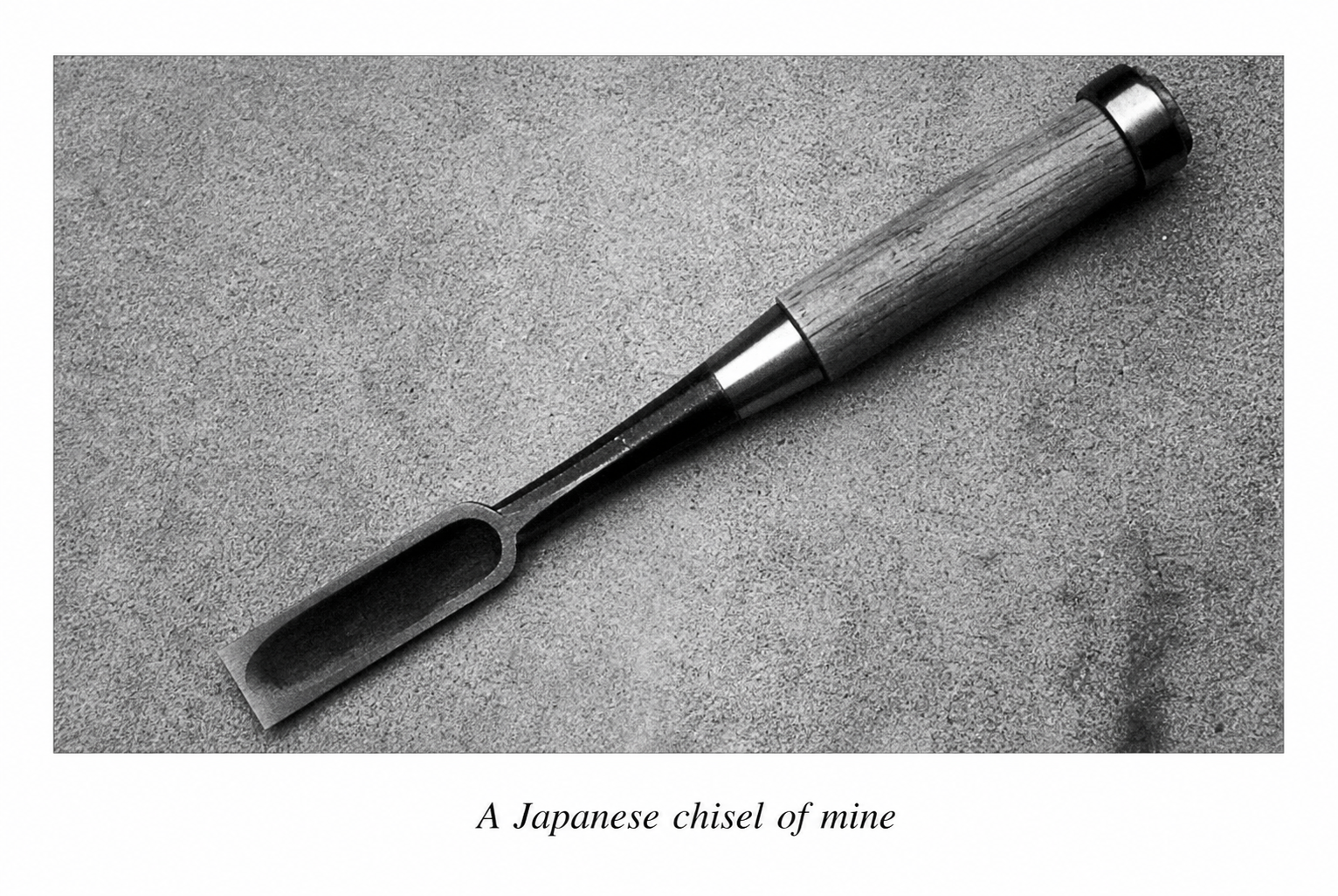
(Kuchi-gane) middle ring single hollow blade (back Ho) to the centers of action (i.e., the way the chisel interacts with the world when we use it) how it cuts the wood, holds in the hand, gets hit by the mallet, and so on.
The functional life of the chisel, the excellence of a good chisel, does not core merely from the fact that these centers exist. It also comes, as in the case of the little stars on the tiled wall in the Alhambra, from the way these centers help each other. For example, the shaft is tapered one way and the wood alongside the shaft is tapered the other way. The shaft makes the wood more of a center: the wood alongside makes the shaft more of a center. The binding strengthens the existence of the blade by being at the other end of the blade. The blade strengthens the existence of the binding as a center.
This idea of helping between centers -- especially in this functional sense -- may seem mysterious at first. Before trying to understand it in functional terms, I merely draw attention to the following observations. If I take the binding away from the handle end, the tip seems weaker as a center. When the binding on the handle is there, the blade seems to become stronger as a center. Because the handle swells at the hitting end, the steel shaft seems to become stronger as a center.
These are observations about our perception. We shall see later that this phenomenon of one center helping another is not only a perception, but a reality in the world, which is actually responsible for the way the chisel works. The chisel is made of centers, and in a well-made chisel, these centers help one another and mutually intensify their life.
(Tsuka) (Katsura) handle ring blade(front Ho)
The centers in the chisel
4/HOW A Alllife -- even in the ordinary sense of practical everyday comfort in a building -- is a product of the centers interacting. The idea of wholeness as something which may be sustained or not by its own internal wholenesses goes far beyond the beauty of an ornament. It is the core of the functional life which occurs in things.
To illustrate the idea, let us draw a picture of the way the intensity of centers works function-
ally in a building. Consider the practical problem of making a comfortable and beautiful living room, which is one of an architect's most difficult tasks.' The following issues arise, all involiving centers: these centers may be strong centers or not, according to the geometry of the room where they occur. The living room will work well, only when it is so shaped that these centers are really strong, and have life in themselves.
At the core of a successful living room there must be at least one place which is quiet, a s¢i// spot in the room, a place where people are protected, where chairs together have a focus, and are not touched by through traffic. This is the place which everyone naturally goes to when they come into the room. If the room does not have such a place, it will only rarely work: by that I mean that people will have less inclination to be there, to use it, or to be happy using it.
The living room will usually be tranquil if it sits at the end of a sequence of movement. This, too, helps make it quiet, settled. This functional problem will be embodied in the system of centers, which, to solve the problem, must go from the entrance to the house to the living room to form a
GRADIENT of nested centers. Then, like the setting of a jewel, the gradient reaches the living room finally as the jewel encrusted and intensified by the previous centers. Itworks best ofall ifthe room is the end place, a spot of calm where one comes to rest after moving through the house.'
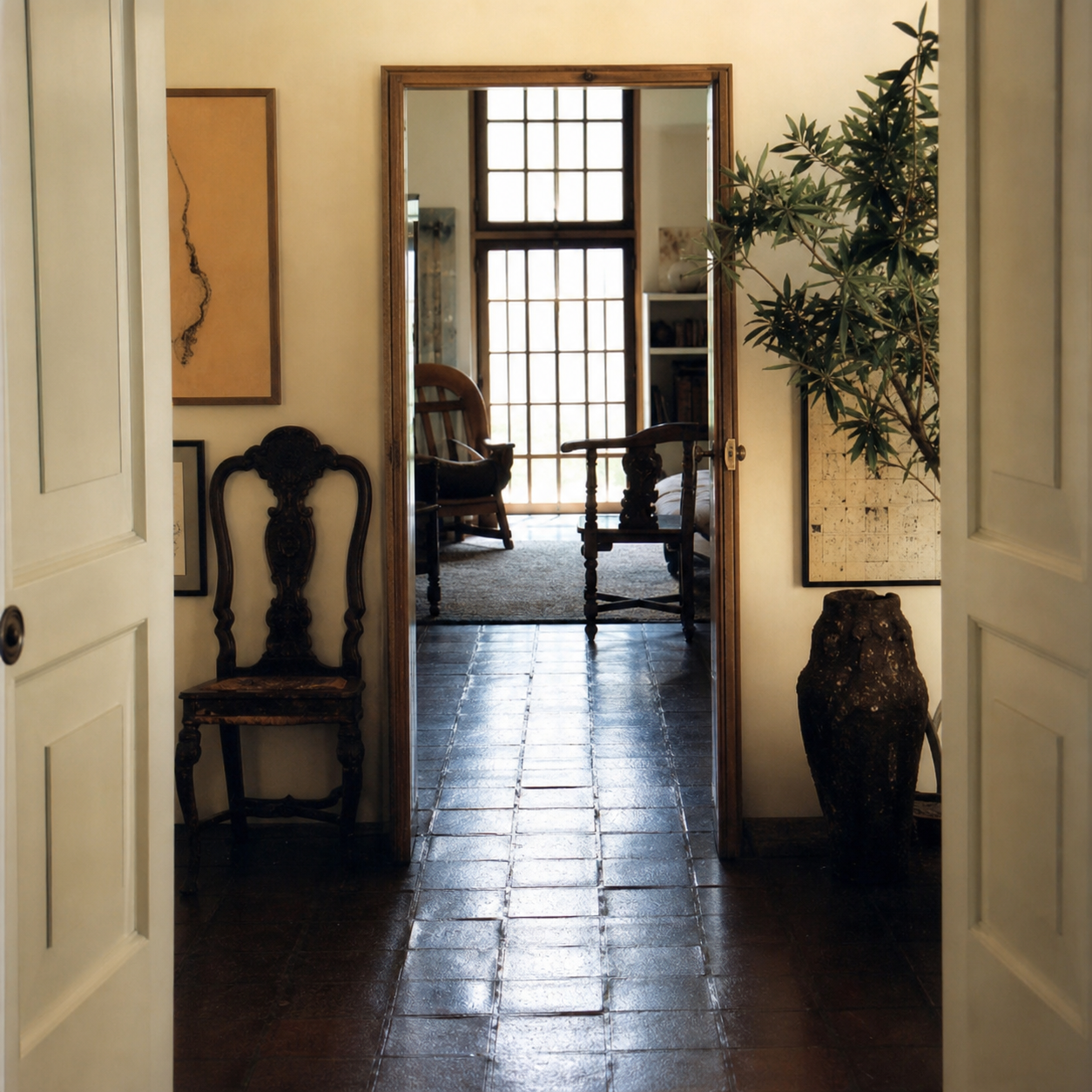
Many living rooms are uncomfortable because their key areas are destroyed by a bad pattern of circulation. The movement cuts up the room, and mostimportant, cuts up the possibility ofa resting place. To get it right, we have to make the most important center of the room -- the still resting place where there is no movement -- like the quiet spot in the bend of a river, where the water slows down, and the fish all gather. This means arranging the entrances so that the room -- and especially its still, focused, main center -- is not interrupted by movement. In short, we want to place those natural paths in such a way that they help the main sitting center of the room, instead of weakening it. They may lead to it, or be tangent to its core, but must not cross it.?
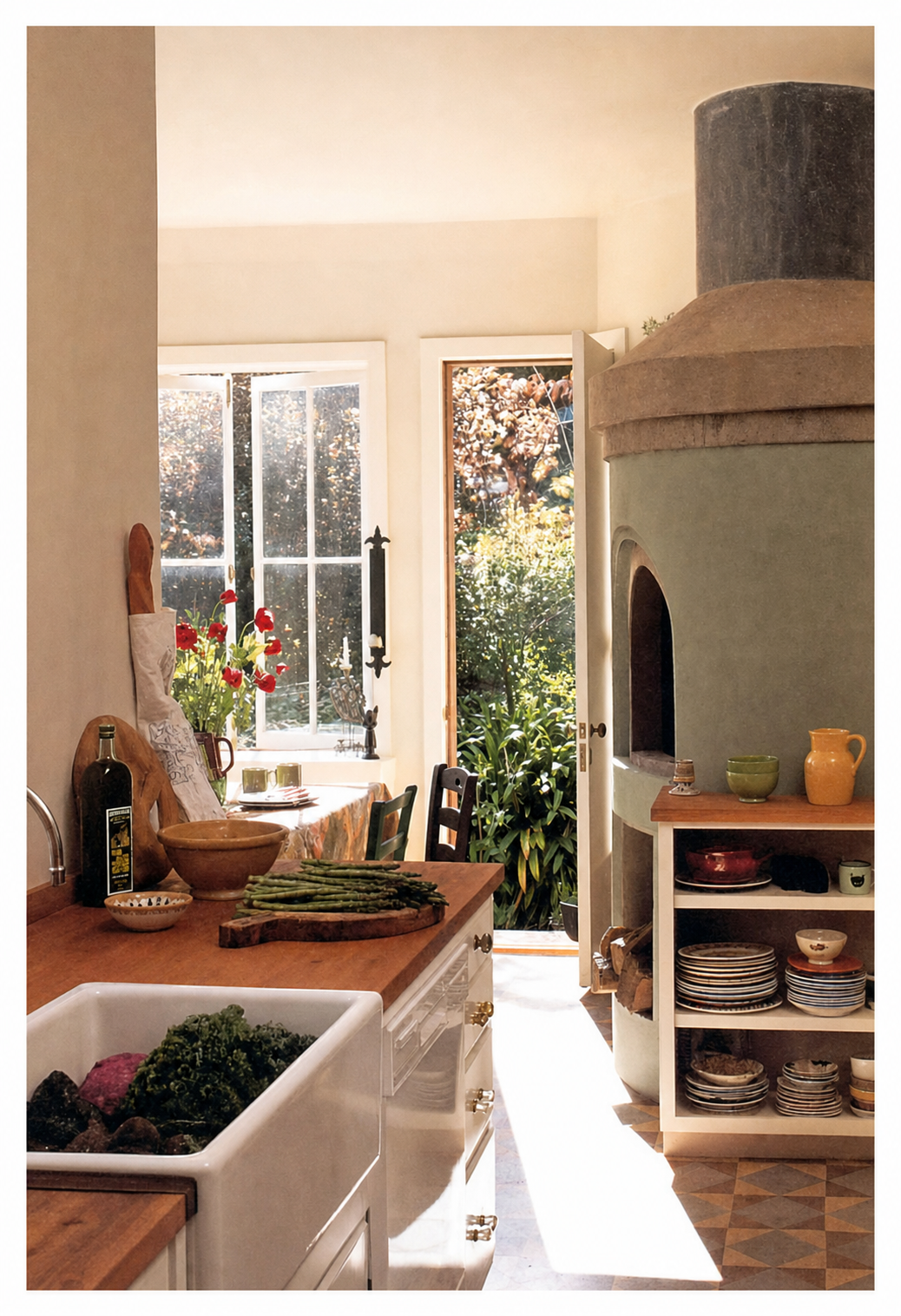
Any room -- especially a living room -- becomes comfortable in overall feeling only when the shape of the room (its volume) works as a center itself: I do not know of any generally valid rule of proportion -- but there is no getting away from the important idea that the proportion must be right for the particular case. In one case, the ceiling may be rather high. In another case, unusually low. In each case, in some different way the comfort of the room comes from the fact that the interior three-dimensional shape, conceived as a volume of solid stuff, is positive. It will usually turn out to be composed of definite spherical shapes. A tall, long, beautiful room might be made of two spheres. Another might be made of many smaller spheres. I remember once seeing a cottage near Shakespeare's birthplace, with a very large room, perhaps 28 feet wide and 18 feet deep -- but with a very low ceiling, only one or two inches above 7 feet. It was beautiful because one felt the space as a luminous flat thing; the ceiling was white and softly glowing plaster. In this case, the big, very low room was made of many smaller spheres: but again it was a beautiful shape in the volume (GOOD SHAPE). So, even the elusive question of the space in the room turns out to be defined by the way that the volume is composed of centers.°
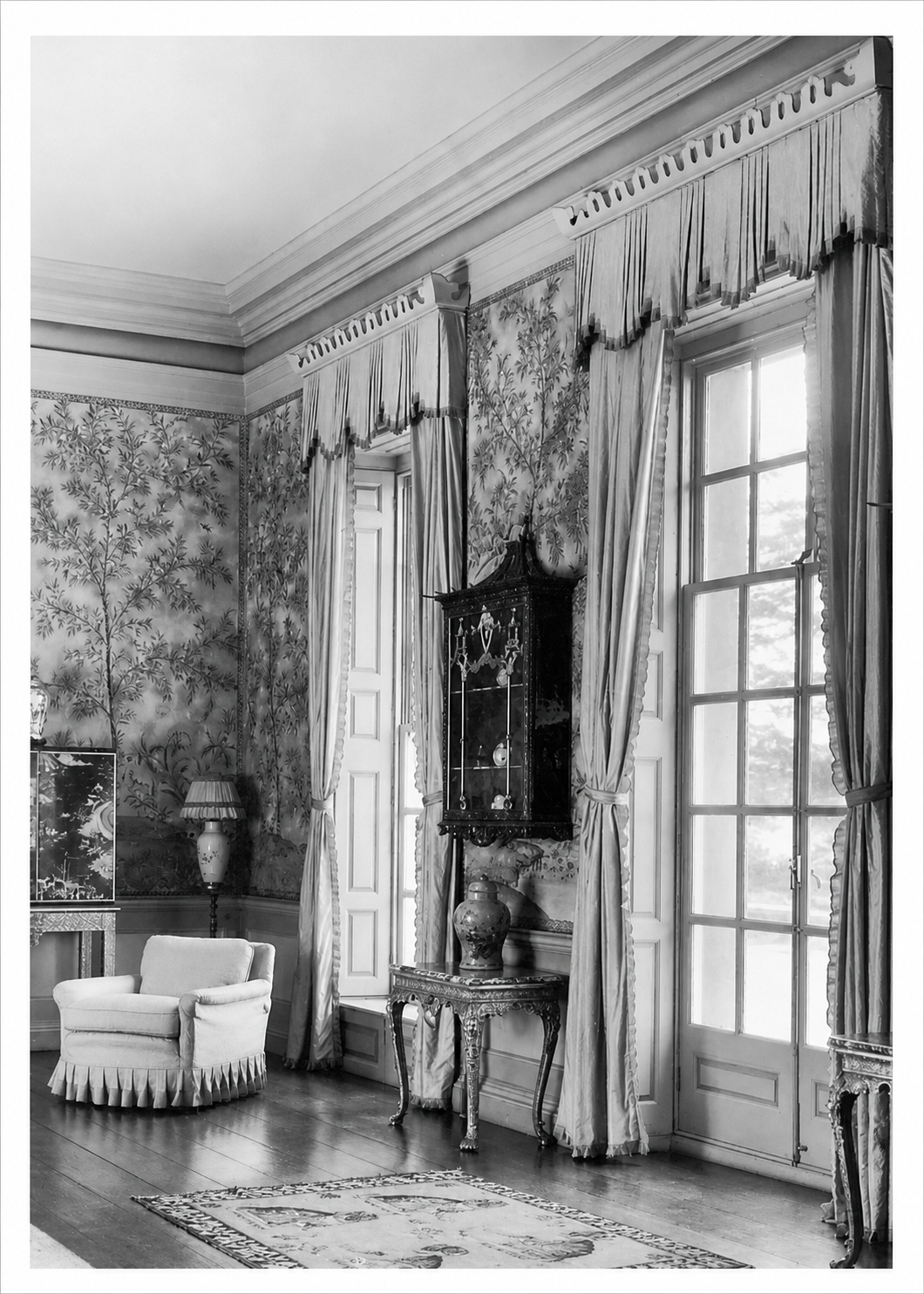
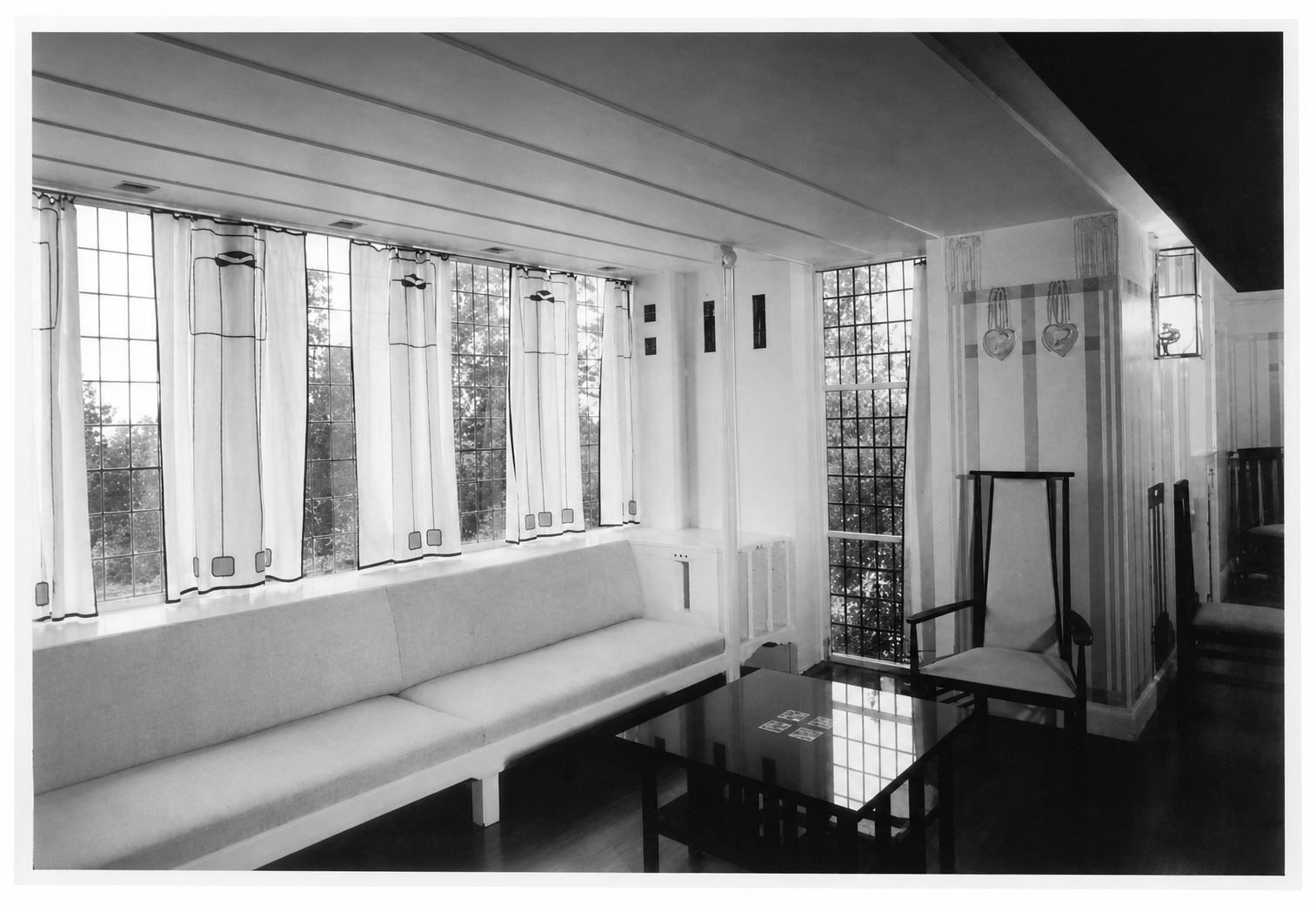
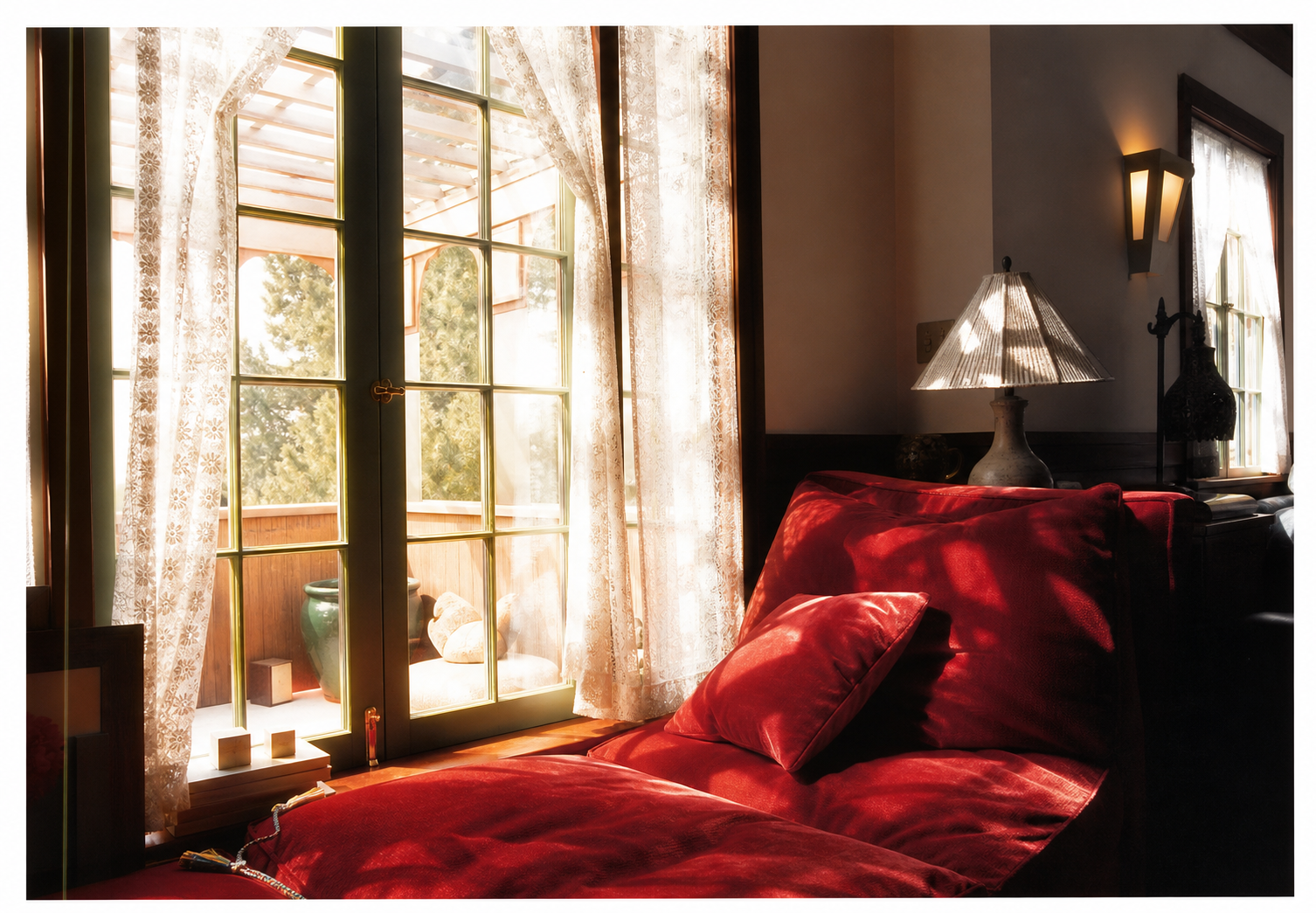
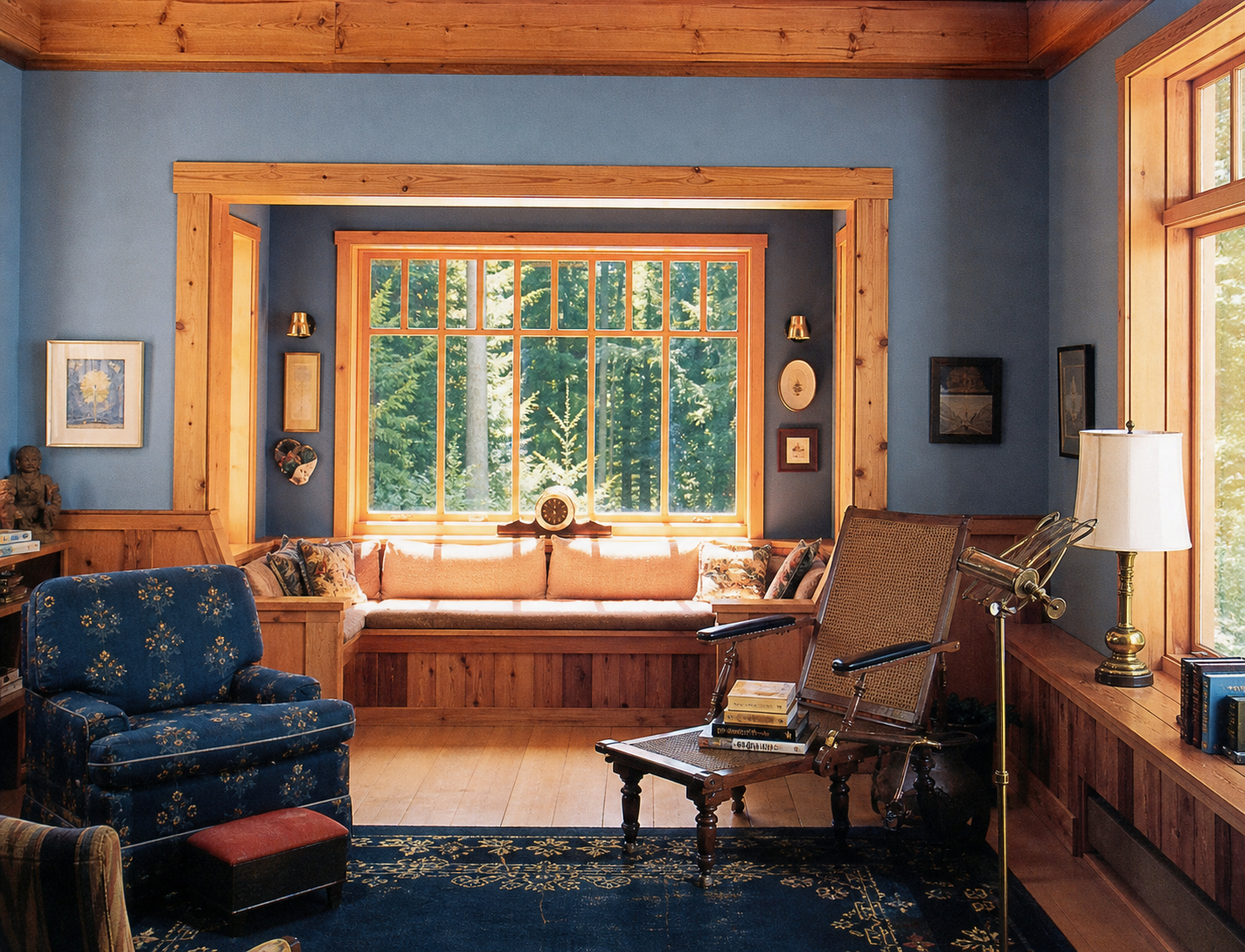
Living rooms are often made, or broken, by the beauty of the windows. To be beautiful, the windows themselves must be "places." This means not only that any important window forms a center in two dimensions within the wall (through shape, position, glazing subdivision, and so on), but also that it works in three dimensions: the actual space next to the window must, volumetrically, itself be a center; it must be a definite place. This is the kind of window which draws you to it, and which allows you to make yourself comfortable when you choose to orient yourself to the light.
And the window must not only accomplish all this by its own beauty and by its view, but it must also do all this in a way that contributes to the life of the major sitting area of the room. To do that the window as a center itself (size, opening, sill, view) must cooperate to intensify some other center in the room."
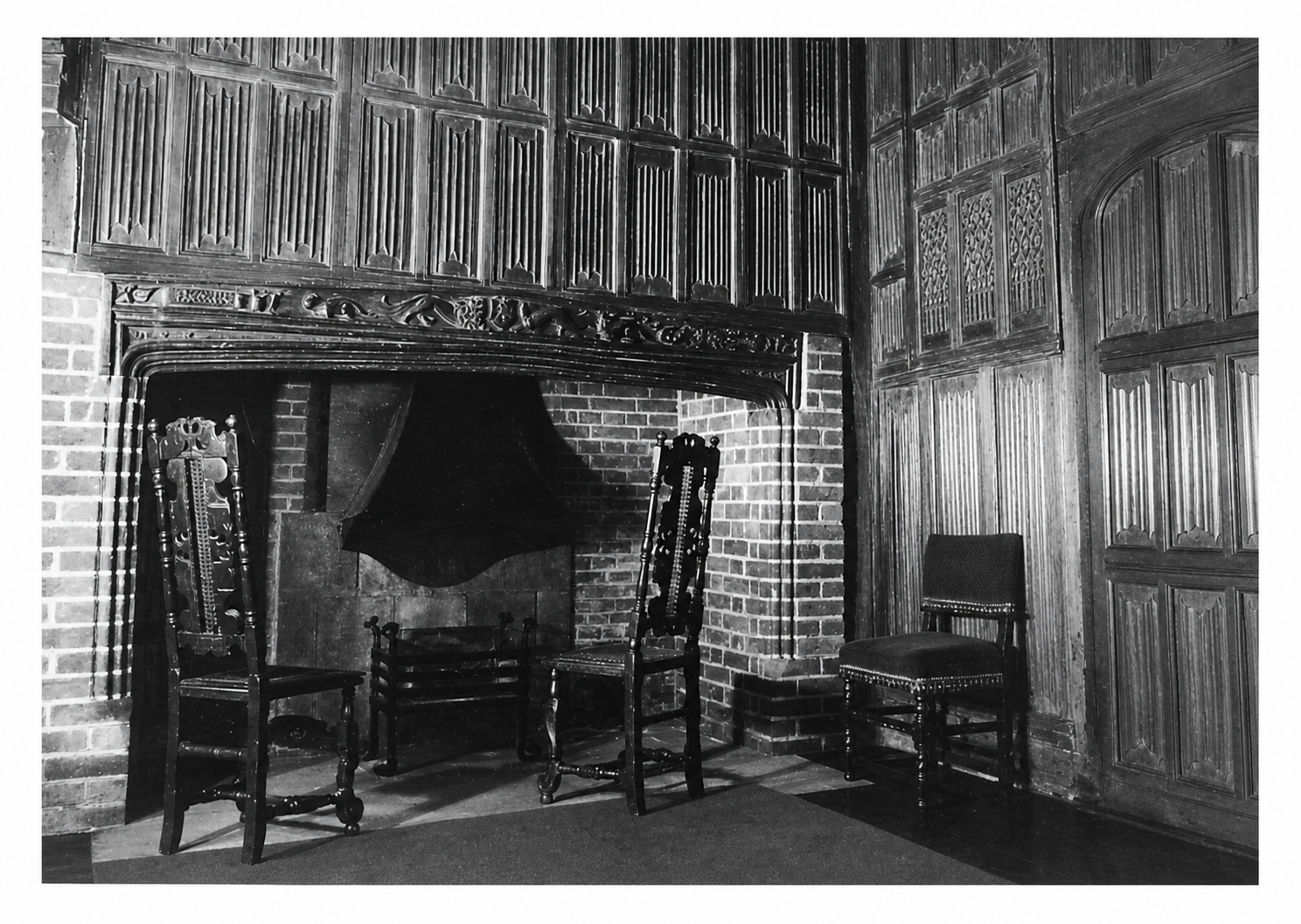
People feel a need for a smaller focus of some sort in the living room. In the Western world this smaller focus is often a fireplace. In Japan, it might be an altar or a tokonoma.' A TV set has the potential for it, but rarely works this way in contmporary rooms, because the "precious" feeling is not present. The focus provides something to gather round, something to orient oneself toward. Placing it may be hard because people also like to orient themselves toward the main window where the daylight comes in. Then the room must be constructed in such a way that the one center created by the fire and the other center created by the major daylight together help to intensify the main center of the room and do not clash with one another.'
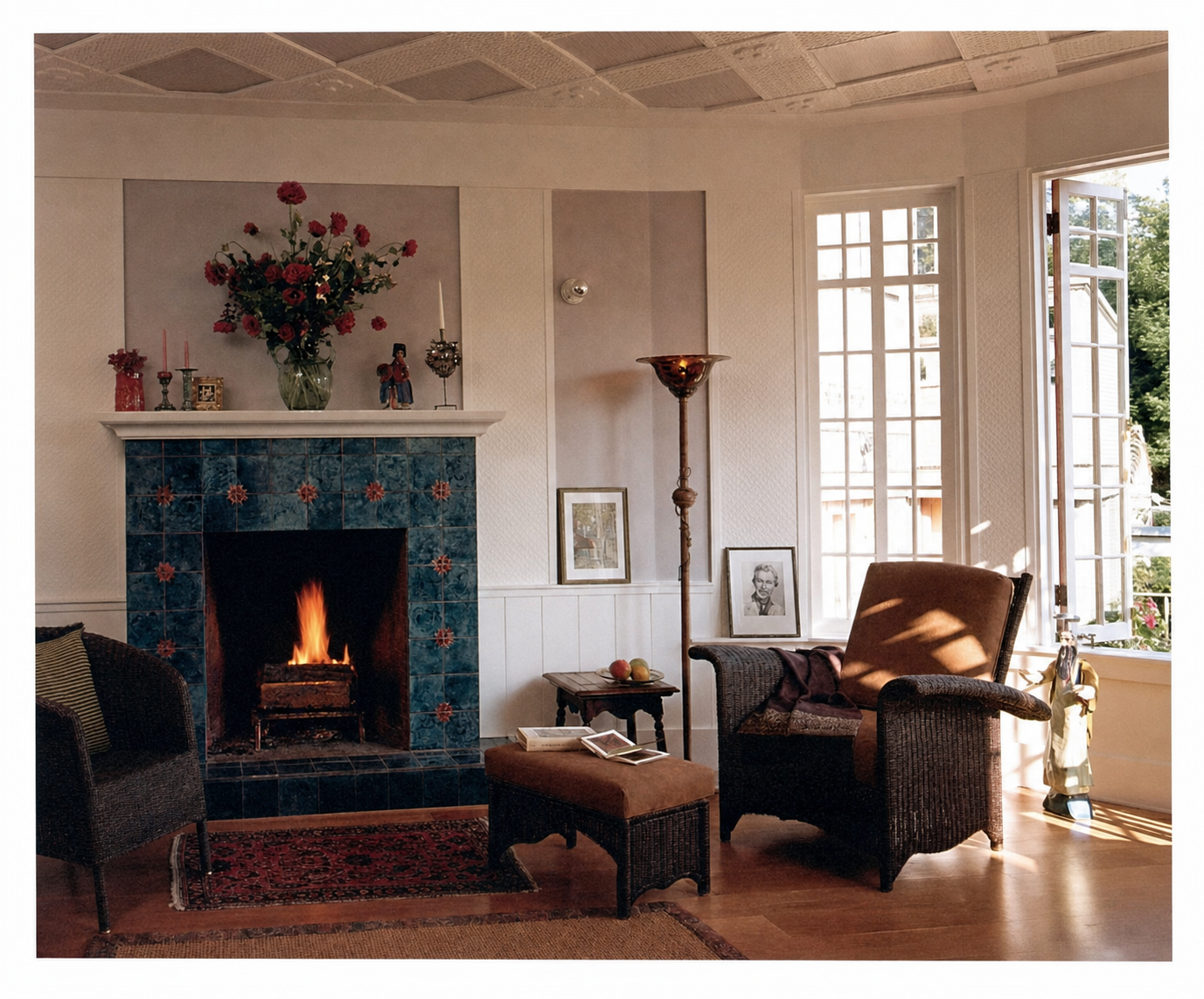
Most nice rooms have a good relation to a definite and beautiful outdoors. This requires that some outdoor area works as a center (a flowering bush, a view of a distant lake or mountain peak, the light coming through the leaves of a birch tree). Then the interior center in the room, which is likely to be an important place in the room, must be placed to have an easy and natural axis toward a vital outdoor center (near or far) as a focus, thus forming a new center (the axis joining the two) which
carries weight."
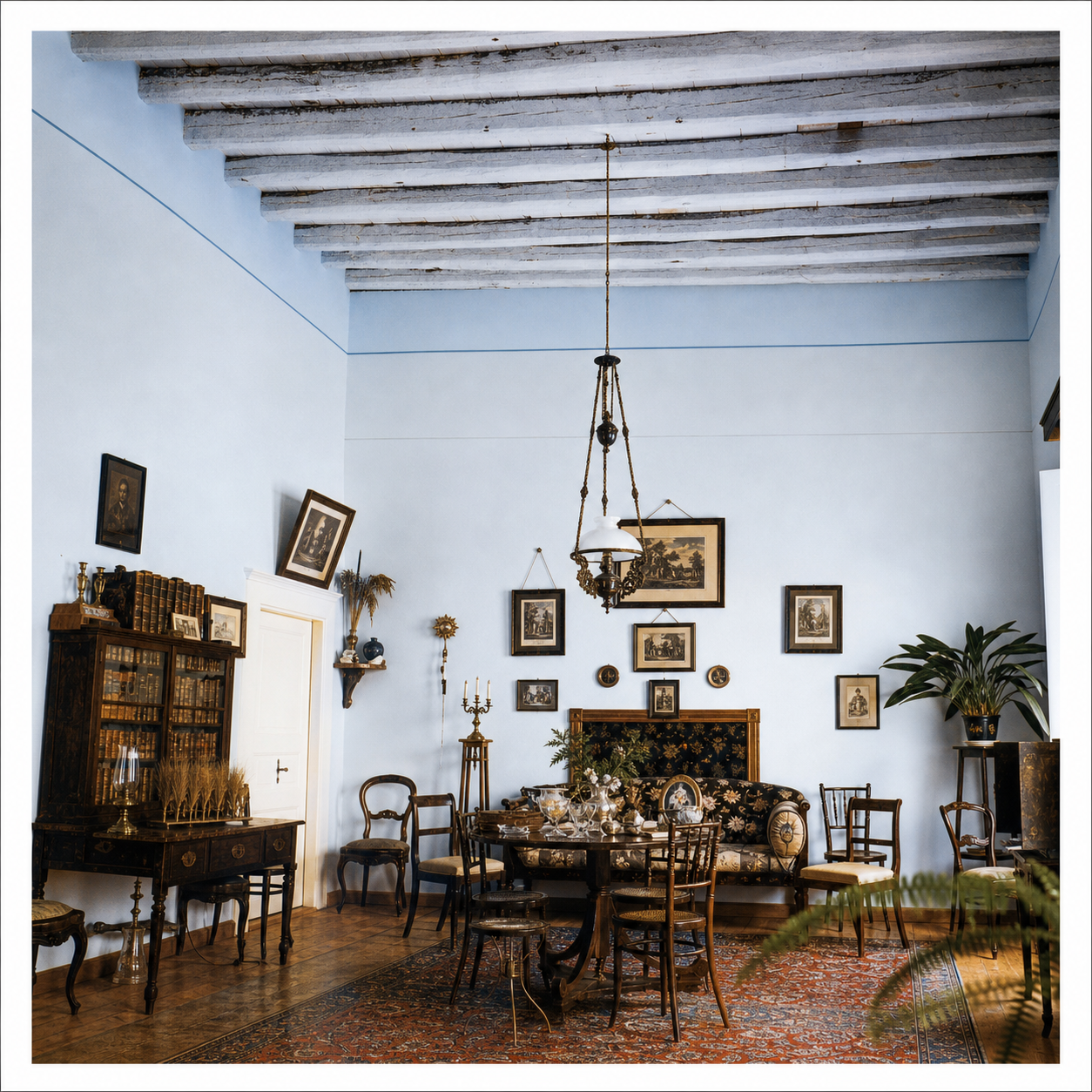
We want to place lights in the room in such a way that they create a pleasant atmosphere in the room, not too dim, not too bright, something which maintains the life of the room at night. When you think about this, it means that we want to place lights in such a way that the spheres of light formed around the fixtures induce centers which support the system of centers which makes life in the room. (My experience is that you can best do this with real mockups made with lights, at night, while the room is being built.) Ifa fixture is correctly placed, but garish in shape or color, it will draw attention to itself as a center, instead of helping to intensify the other centers in the room. The best lights are those which reinforce the structure of the room, without creating other new and irrelevant centers in themselves."
5 / How Centers Work Together
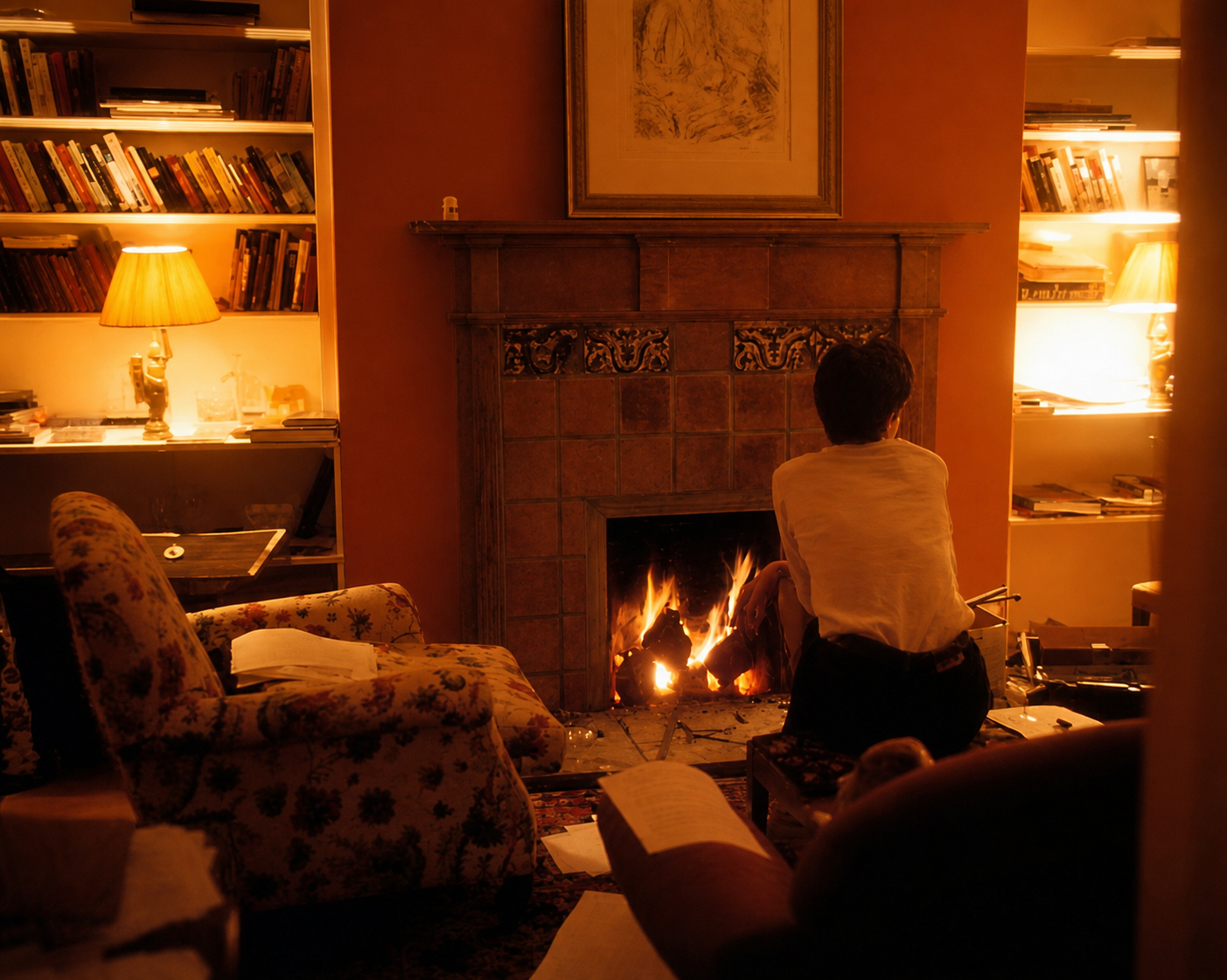
The centers described in the last few pages are some of the most important structures in a living room. Of course, these centers are important individually. But what is more important is the way these centers interlock and depend on one another for their success.
The quiet core of the room is a tranquil center; its tranquility depends on the paths going tangent to it -- other important centers. The window place works when it forms a focus, because then it can intensify, not destroy, other, still larger centers of the room. The volume swelling toward the ceiling, when it is supplemented by the lights, can form a composite center that supports and forms a matrix for the whole. And so on.
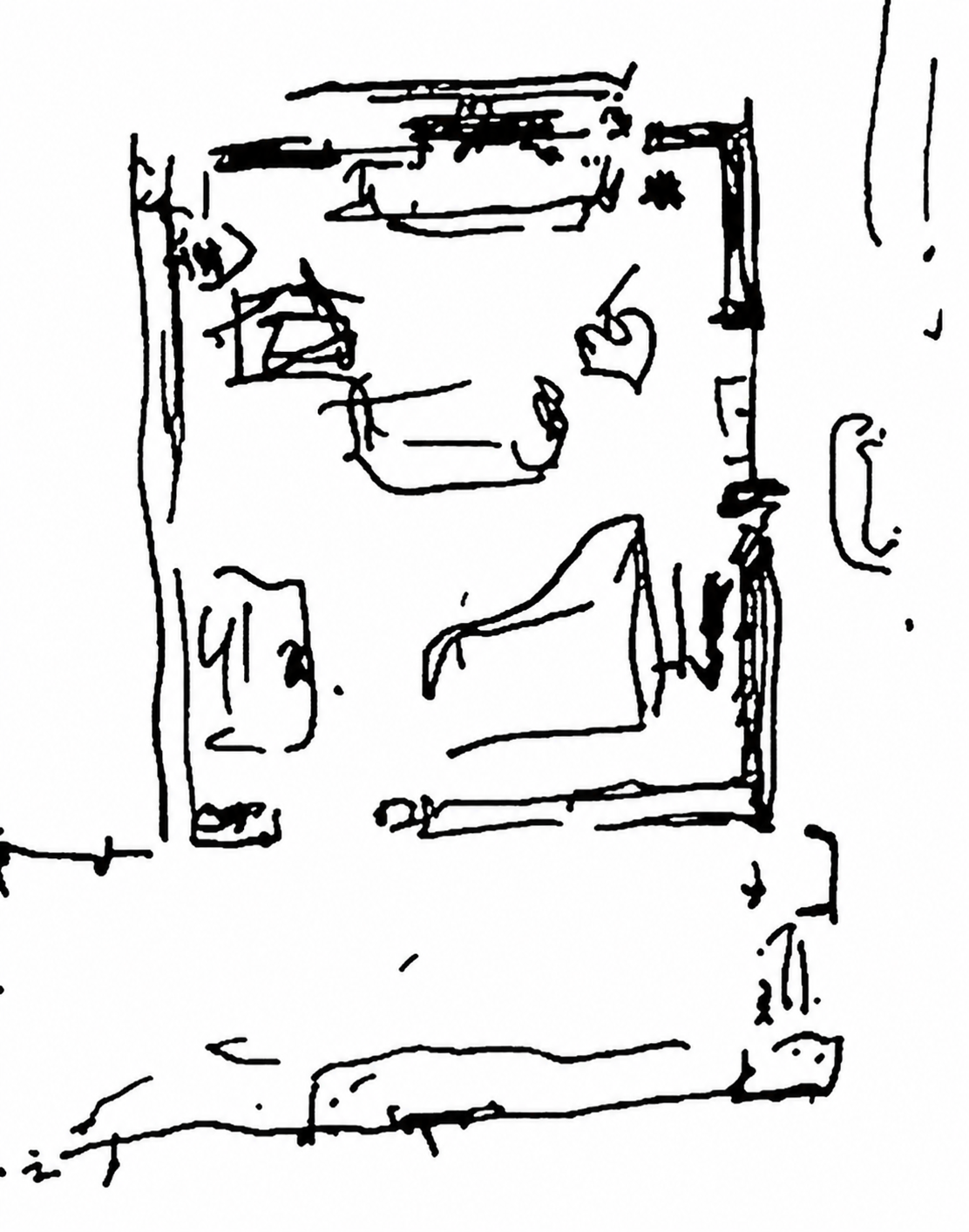
Ina successful room, these many centers are not merely aggregated. Rather, they fit smoothly together ina single form, so that one is barely conscious of the individual centers, but rather conscious only of the smoothly flowing whole which forms the largest center of all: the room itself. To see this, concretely, it may be helpful to see how these several centers were incorporated in a new living room. Here isasketch-plan ofa living room I built at Meadow Lodge in England. It incorporates the centers I have defined in a strong form, yet in a rather simple, modest, room.
The core resting place is formed as a dead end, in front of the fire. The window has a tree outside, and connects the inside of the room to the tree. The single door is placed in one corner to minimize circulation through the room. The piano makes positive space in the room, and fits together with the "resting place" center and the "window place" center. The easy chairs just fit, perhaps asymmetrically, but in such a way as to make space positive throughout the room. The lights are placed to complement and ring the other centers, especially reinforcing the resting place at the core of the room. All the centers supplement and support each other.
These functional matters are simple, even obvious. Nevertheless they are surprisingly difficult to accomplish in a newly built room. They are easy to think about, but not easy to embed in a realistic physical structure which actually creates all these forms of comfort at the same time in one room. The structure that has to be created is modest, subtle, and tough.
What is most important here: all the functions of the room -- things which appear at first sight as functional problems -- are in reality problems of centers. To provide for life, and to solve the possible problems you have to get the centers right. In short, to make the room work, you must make a dense, living structure. The practical matter is a matter of placing and arranging all these centers so that they work harmoni-
ously together. The hard part, the key part, lies in the way these centers are shaped, and strengthened, and arranged.
6 / the Unity of Ornament and Function
In the living-room examples, we see that key functions depend on various component centers and on the ways these centers cooperate to intensify each other. The functional behavior of each living room is almost geometrical in nature. What makes the room work is the geometrical intensity, vibrancy, of its living centers, their degree of life. The fifteen properties, the field of centers, and the wholeness not only control the way that beautiful buildings look. They thoroughly and completely determine the way that buildings work.
Altogether I believe the functional life of buildings is created by the same field effect among centers which creates the field of centers in an ornament. Each functional "problem" is solved by the cooperation or integration of centers which arise within the building dynamically, while it is working. The field of centers supports not only everything we commonly call ornament in a building but also everything we commonly call function.
Within a Cartesian analysis, the things that are considered real are those things which can be understood as mechanisms. This means that the functions which can be understood as "real" are only the "mechanically functional" aspects of a building like structural efficiency, thermal behavior, or acoustics.
In the holistic picture which I have been describing here, we see that each center -- as a bit of geometry in the space -- affects and changes the other centers in its life. The wholeness is a physical system in which different centers modify each other through the geometric field effect. In this picture, centers may affect each other both geometrically and functionally, since all the effects among centers take place within the same domain. Ornament is just as important as function. Indeed, we cannot separate the two from one another. What we call ornament and what we call function are simply two versions of one more general phenomenon."
SOCIAL COHESION
rn
(roe)
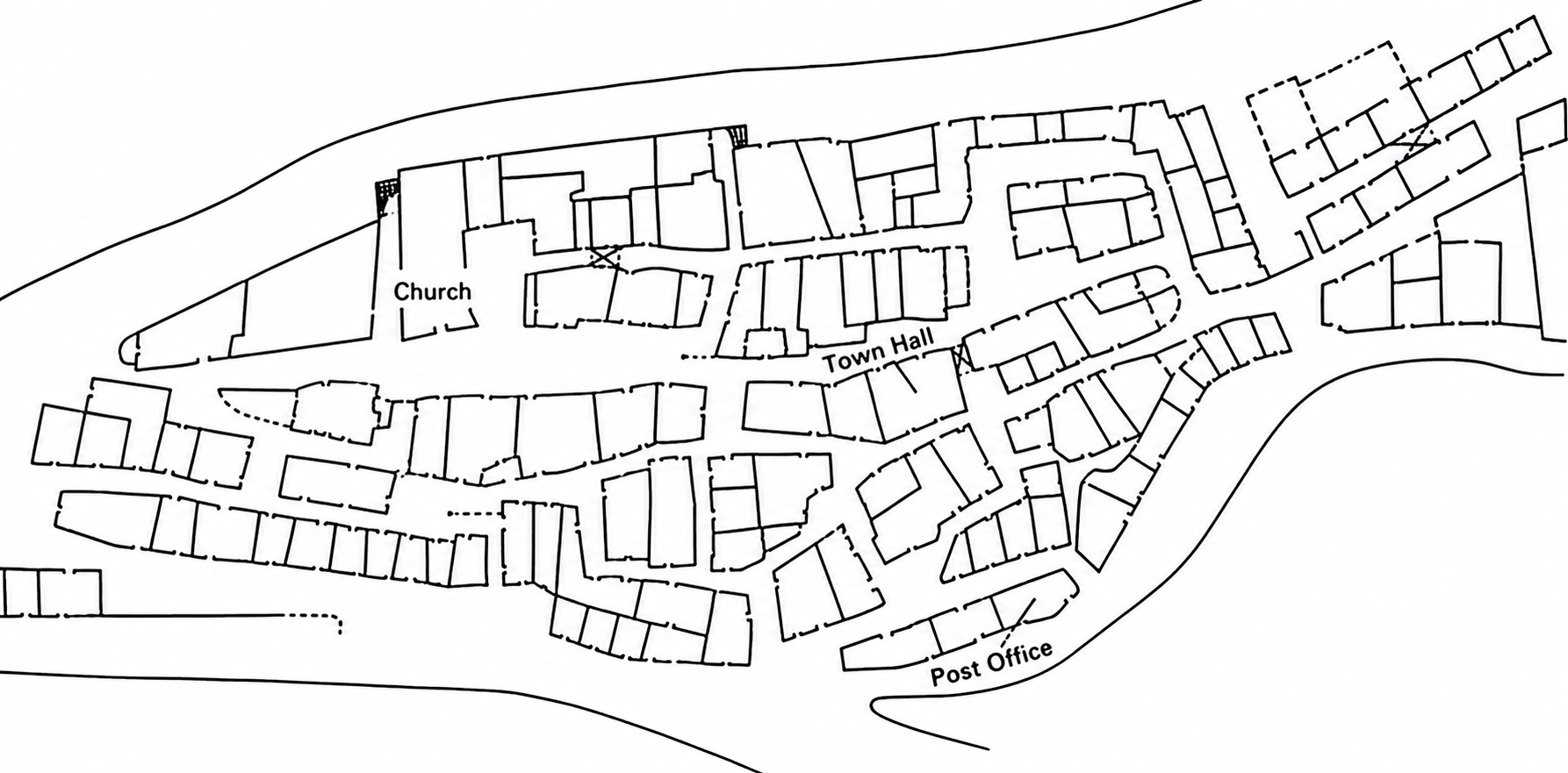
For the sake of further illustration, let us consider a study by Bill Hillier and Julienne Hanson, who explored, with extraordinary thoroughness, the question of communication in a human community, and the way this is supported by social and spatial structure as they act together."
Their study included field observations in communities throughout Europe, together with data collected widely from the anthropological literature. In the course of a 270-page book of careful empirical field-work and many computer simulations, they seek to correlate the ground plan of a village or neighborhood with the level and nature of human communication that takes place in that community. Above all, Hillier and Hanson looked for key structural variables which play a controlling role in the quality of this human communication.
One of the key functional issues they have identified, is that the human communication will be good, or not, according to the degree that the village or neighborhood contains instances of a structure they call a beady-ring structure. A beady-ring structure, illustrated in the drawings of the traditional French village "G," which they cite extensively in their study, is a closed loop of small convex positive spaces, connected by paths. The plan of G, its public space, the positive or convex spaces which the village contains along this path structure, and the resulting beady-ring structure are shown in the accompanying drawings.
One of their strong conclusions is that the quality of human communication in a village or neighborhood is largely dependent on the presence, and density, of these global beady-ring structures.
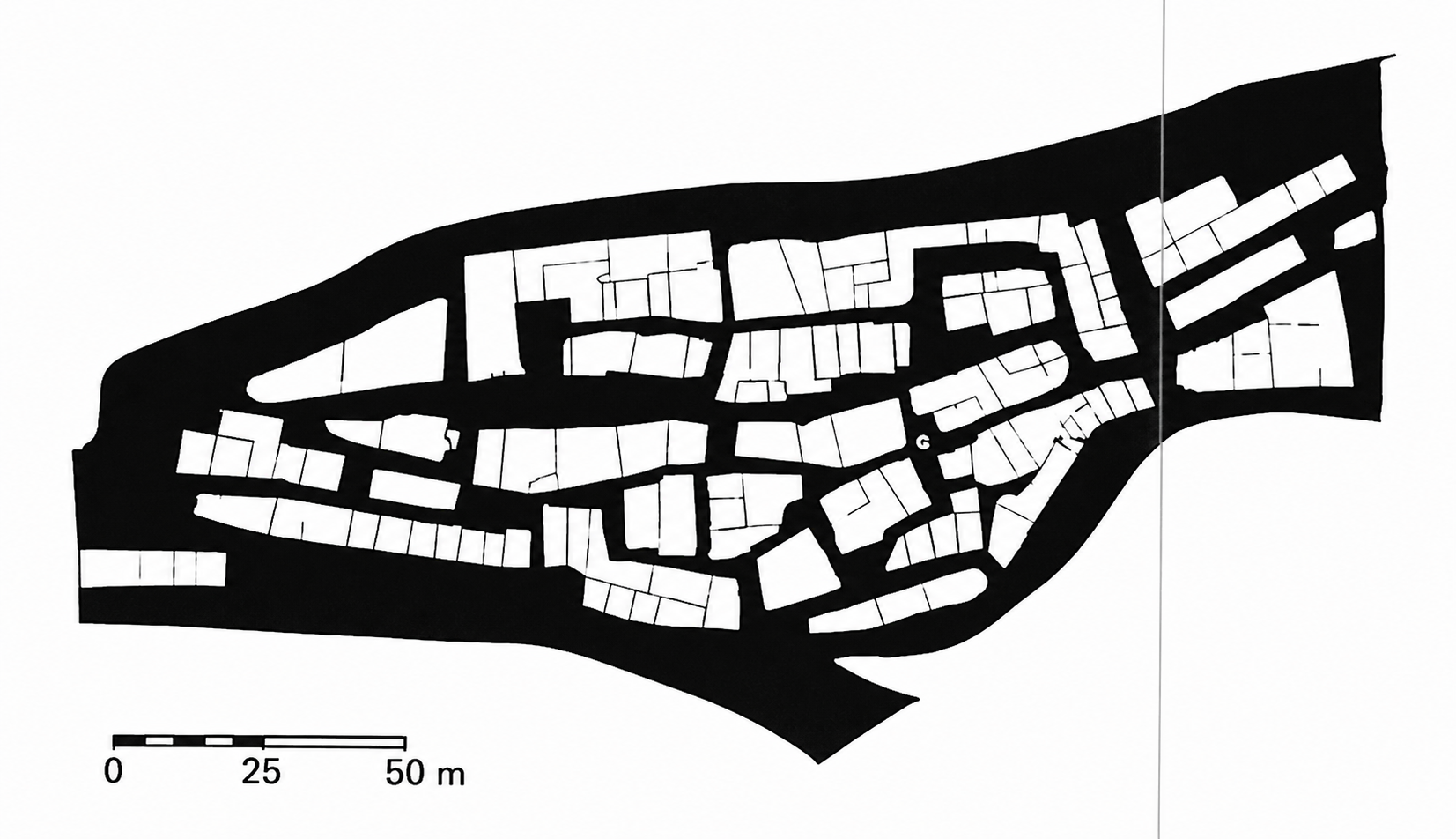
I bring this example forward in some detail, because what turns out, after the careful, and beautiful, and lengthy analysis, is that the characteristic which most makes the community work, in human terms, is the presence of a par-
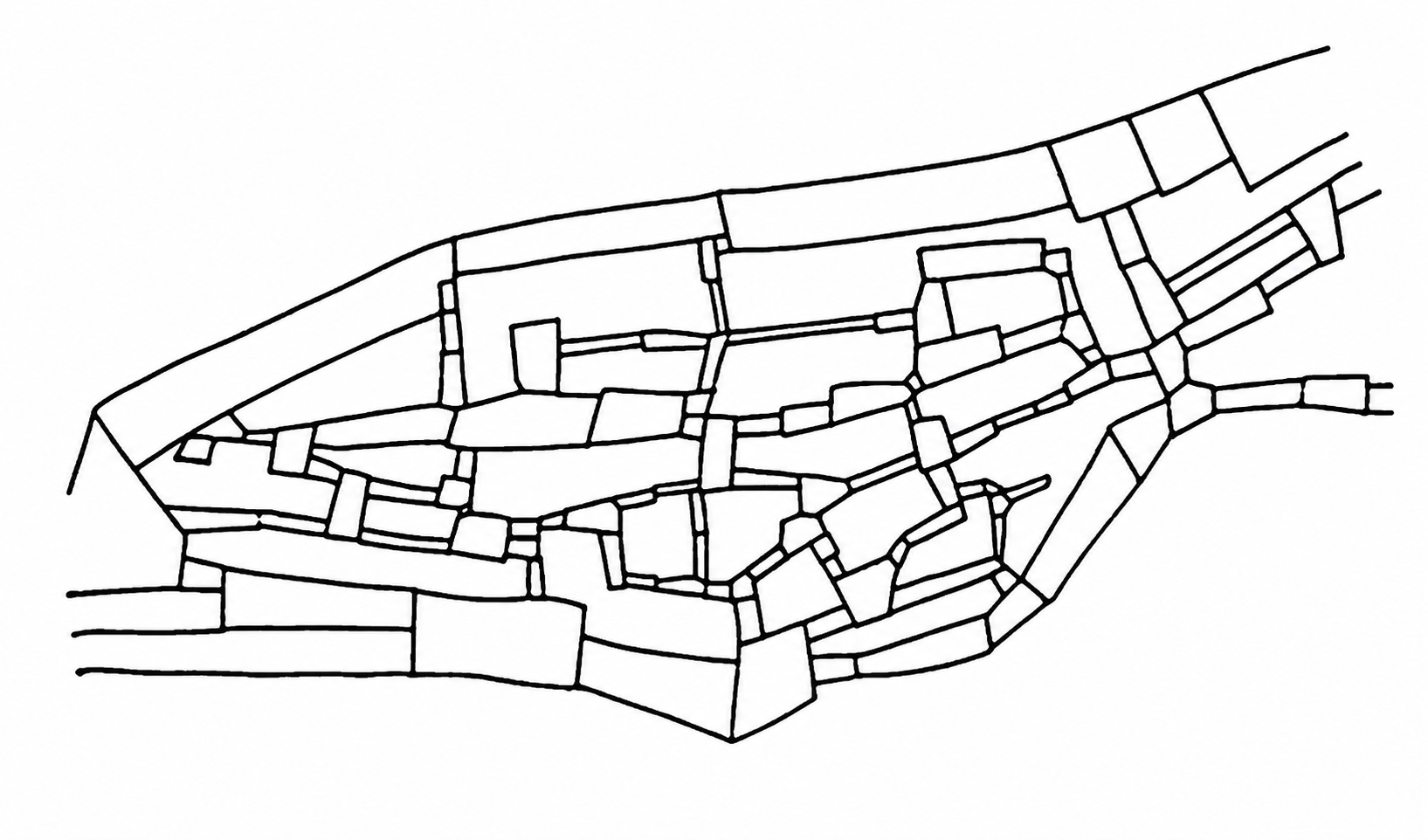
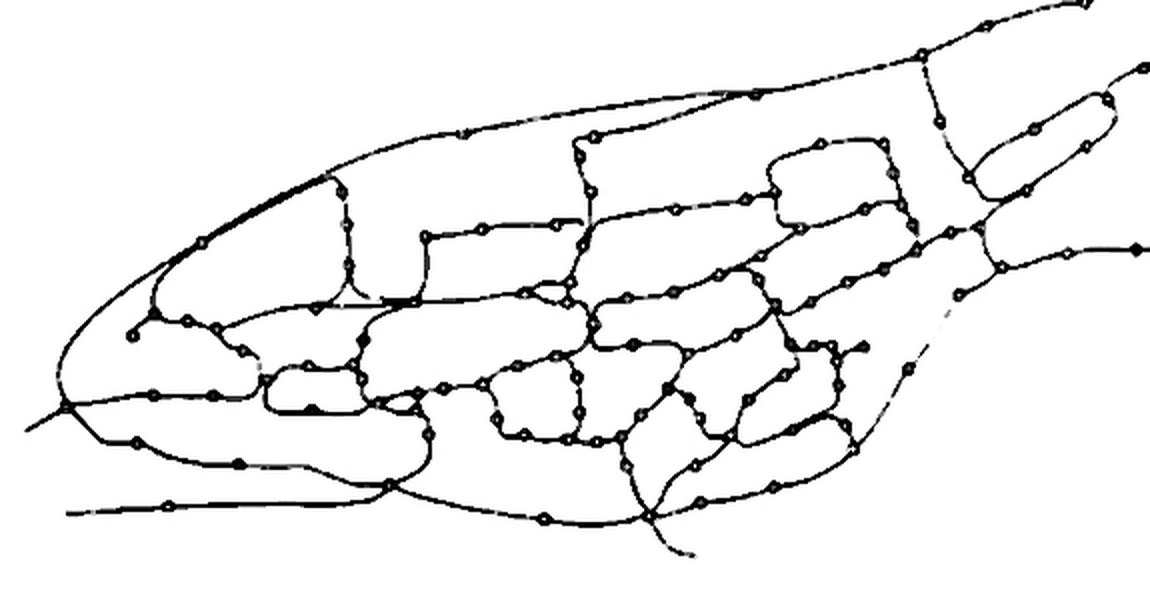
Here the circles (beads) stand for the convex spaces, while lines stand for adjacencnies and path connections. This diagram shows twenty nine beady-ring structures in the village -- the primary source, as Hillier and Hanson show, of the social cohesion and social interaction forms that occur in the village.
STRUCTURAL BEHAVIOR
Consider the following "functional" problem involved in designing a column base. In today's architecture and engineering it is common to design on the basis of purely considerations. Let us assume, for the sake of argument, that such a structural analysis of a column base shows that what is needed is a pinstructural connection: one which can take tension and compression and horizontal shear -- but no bending moments. This is one common design approach to a conventionally analyzed column base.
loop.
ticular type of center -- the thing they call the beady-ring structure -- and the density of these beady-ring structures in the community; also people's access to such structures, from their houses and shops. It is also worth noting that they explicitly show how the beady-ring structure is a global configuration composed of local centers -- it is a ring, formed from small positive spaces, connected along a path that forms the
These beady rings are living centers (not always present in a neighborhood) which, when present, enhance the centers formed by houses and gardens and streets. It is the presence of these supporting centers, and the resultant increased density of living structure, that makes the community work."
whole.
It is highly significant, in my eyes, that throughout their careful analysis, Hillier and Hanson reach conclusions similar to those I am presenting in this chapter about the unity of space and function. As they say: "Society must be described in terms of its intrinsic spatiality. Space must be described in terms of its intrinsic sociality."' In my language, they are saying -- as lam also saying -- that it is not really possible to keep function and space separate. Rather, what is needed is an integrated view of function and structure, in which the living character of space is visible as a characteristic of the integrated
Following this approach, and looking at the design of the column base in limited functional terms, we can get a design for a base which consists of a triangular piece of steel at the bottom of the column, meeting another triangular piece of steel that is welded to the base, and the two are connected by a bolt. The bolt itself and the distance from the bolt-hole to the edge of the steel are designed to be the minimum required for the necessary shears and compression. The base then looks like A (the upper picture).
Li}
aawaa awww Tih hy
=
Anchorage
A, A pure pin-jointed column base. Pin-jointed column base made for efficiency, and emphasizing the structural behavior according to item #5 in the list of eight functional items shown in the text, but ignoring the other seven items almost altogether
Intuitively, this is a pretty funny-looking column base. It certainly doesn't resemble the kind of base which I would show you as a good example of life in a column. A column with life
would typically look more like B (the lower picture).
Where does the discrepancy between these two views, or between the two designs A and B, actually come from. I believe it comes from the narrow limitations introduced by conventional functionalist design. If we are more truthful about column behavior a column base can be said to have many functions, including at least the following eight:
1. It is larger than the column so it becomes something to lean against.
2. It has a function in defining positive space next to it.
3. It may be a place to sit.
4. Structurally it spreads the vertical load onto the foundation.
5. The base may also have to provide horizontal resistance, to stop the column from moving out of position.
6. From a structural point of view, there may also be redundancy which comes into play if the pin connection fails in an earthquake.
7. In addition, moment design at the base may play a role.
8. The base may also play an important role in the erection of the column, by marking the spot where the column is to be and providing an attachment for this column.
These eight functions are allrelevant to the design of a column base. The important question is not, Which of them should we choose? but, How are all eight different functions to be balanced?
The pure functionalist analysis which argues for the highly efficient pin-jointed base comes about, really, because one particular function that we can identify (#5) is made very important, while others are ignored. The pinjointed base mainly deals with function #5 and gives it great importance. It more or less ignores the other seven functions. If we take the view that the balance among them is arbitrary, and a matter of choice for the designer, the pin-jointed base can then be a reasonable, and perfectly plausible solution -- along with fifty other possible
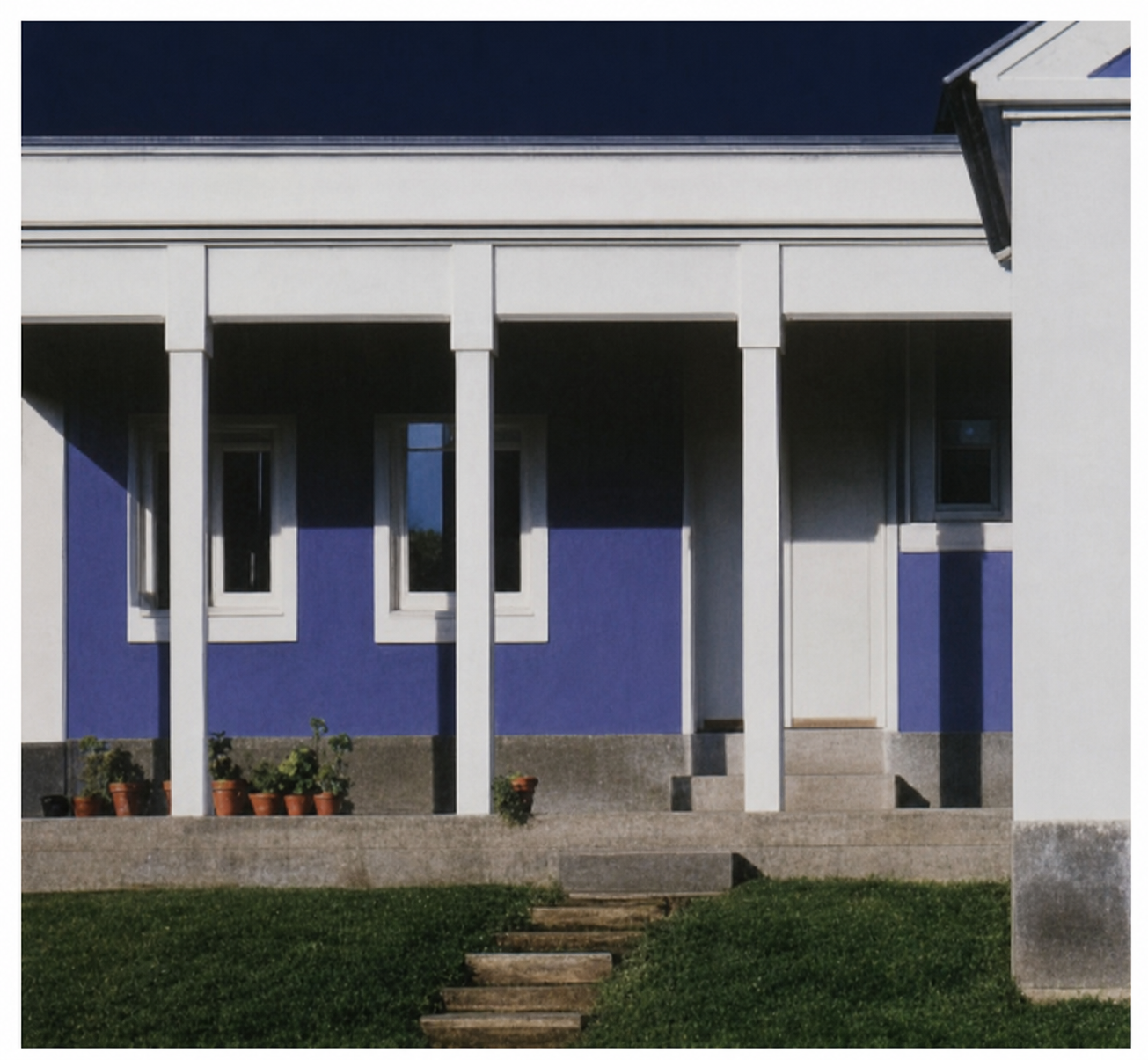
bases, which might all be calculated to meet different combinations, or different weightings of these eight functions. The pin-jointed base gives 100 percent weight to the restraint of horizontal forces, zero percent weight to /eaning against the column, forming a place next to the column, and zero percent to all the others too.
However, if we look at the base as a center whose life we are trying to intensify -- and we accept the idea that this "life" can be understood, measured, by direct observation -- then we get something much more like the second picture, where the eight functions are more in balance. On this page I show some cast-concrete porch columns which arose from a modern effort to balance all eight functions more equally. But what it also does, is to pay more attention to the centers: The base, the shaft, the flutes, the space Ss between the bases, and so on.
We see here how asking for the /ife of that center which forms the bottom of the column sues. And, helps us to balance allthe functional i more important, it argues against the one-sided choice of any one or two functions.
What is involved in this approach is that we pay attention not only to the functions themselves, but also (and rather) to the overall life of the system as a whole. The approach treats the space as a whole, and tries to make it more harmonious, more alive, more unified as a whole."
The issue of functionalism comes clearly into focus in the works of the 19th-century Shakers. Many people would say that the Shakers are famous for their practical ingenuity, and that what they did arose out of utter, pure practical considerations. In their work we may therefore see the issue of functionalism at its clearest.
Here is one example of their work in action: they made pegs, put the pegs on the wall, and hung chairs on these pegs. This is amazing practicality, taken to a spiritual extreme. They wanted to keep the floor clear for their celebrations, as well as clean and uncluttered, so they had the amazing (or inspired) idea of hanging ladder-back chairs on pegs around the wall, which were already being used to hang clothing, baskets, and other things. The form followed directly from the function. What seems remarkable and beautiful is that the function was taken to such an extreme.
But I believe that this analysis is wrong. Consider for a moment the configuration of such a Shaker room. It has a clear, uncluttered floor,
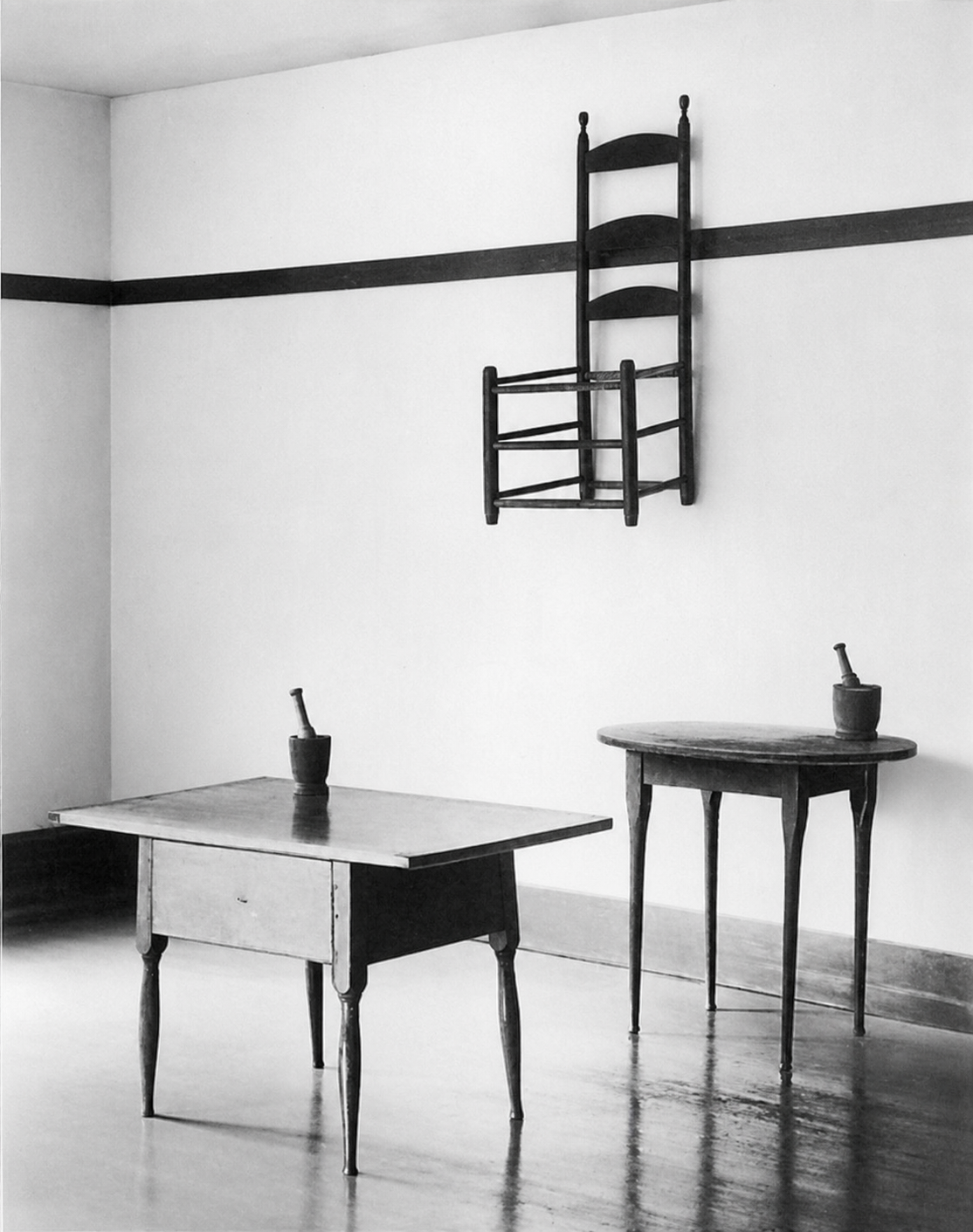
and around the walls of the room is a pine board at about head height. Along the board, regularly spaced, are beautifully shaped pegs. And hanging from these pegs are ladder-back chairs.
Think of this as a system of centers. The room as a whole is extraordinarily beautiful and pure. The clear space below the chairs is THE voip. The ring of the board with its pegs and hanging chairs is like a crown, forming the space, surrounding it, embellishing and creating and intensifying that void. It is a deeply spiritual form. To summarize it, we may think of the space as a crown, a void center, ringed about with centers, each leading to smaller centers, just as in a medieval crown.
In my view, the compelling and driving force behind the Shakers' idea of the hanging chairs was the creation of this "crown." I believe that a purely mechanistic view -- the Shakers did it to clear the floor or to find a use for their marvelous and highly practical pegs -- is a misunderstanding, caused only because our understanding of what it means to be "practical" is so limited, so narrow, and so mechanistic.
I suggest that being practical, for the Shakers, included finding a system of centers which had a pure spiritual light revealed in it. It is the invention, creation and propagation of the crown structure of centers which meant everything because it was this which instilled in them, and allowed them to preserve, a spiritual state. And we do feel this in the rooms they made. If the Shaker room was a machine at all, it was a machine for inducing and intensifying this spiritual state in a person who is in the room.
Our difficulty, though, is twofold. First, we fail to understand the way in which this system of centers, when properly created, does induce a spiritual state in anyone who comes in contact with it. Second, we cannot easily find our way to a conception in which we understand that the creation of this crown -- this system of centers -- is not formal, but both formal and practical. Of course, clearing the floor is part of it,
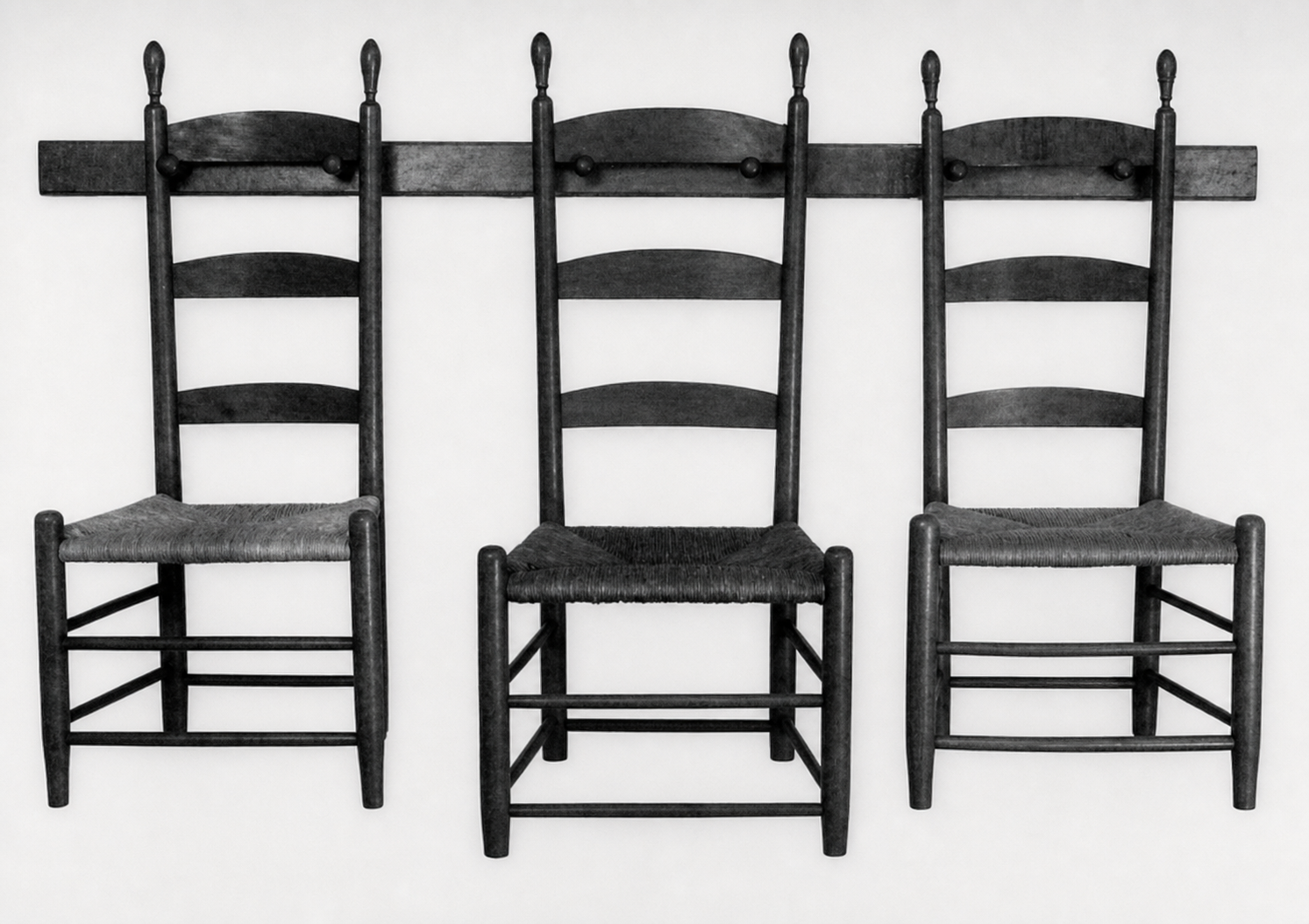
Shaker chairs hanging from pegs around the room and forming a ''crown"' which brings the room to life too; of course, using the ingenious pegs on the wall is part of it. But we do not easily understand a mentality which is both practical and spiritual at the same time. For us, it has to be either/or. It is either formal/geometrical -- and then not practical and functional -- or it is practical and functional but of geometric or spiritual. This conceptually limited view interferes with our efforts to understand the full, complex nature of life, and inhibits our attempts to create it.
The life which I am describing in this book can be created only when we understand that such a structure is 40th geometrical and functional and that it cannot be one without the
For a smaller version of this kind of thinking, let's look at the finger joints on a small Shaker box. It starts as a formal beauty: it uses GRADI- ENTS, DEEP INTERLOCK, and ALTERNATING REPETITION to get a beautiful organization. It is almost a pure ornament. But it happens to be deeply practical. Suppose, for instance, we merely lapped the one layer over the other, and other. It is not the two things added together. The conception of living centers which forms the crown is a conception which inc/udes the fact that the floor is clear and dust-free, inc/udes the spiritual state coming from this perfect emptiness, includes joy in the fact that the pegboard is a being-like structure made of centers which has life because of its internal geometry, and which is also practical and easy to make because of its geometry.
That wedding of geometry and function deep down in every center -- ¢hat is the origin of true function, and the wedding we must make in our minds.
set small brads into it. The part between the nails would be hard to glue down: the open edge would tend to wrinkle or spall up. So we place the nails, and then bring the shape of the lap close to the nail pattern, so the glue is always near a nail.
Did this start as a practical idea, which then just happened to be beautiful? I do not think so.
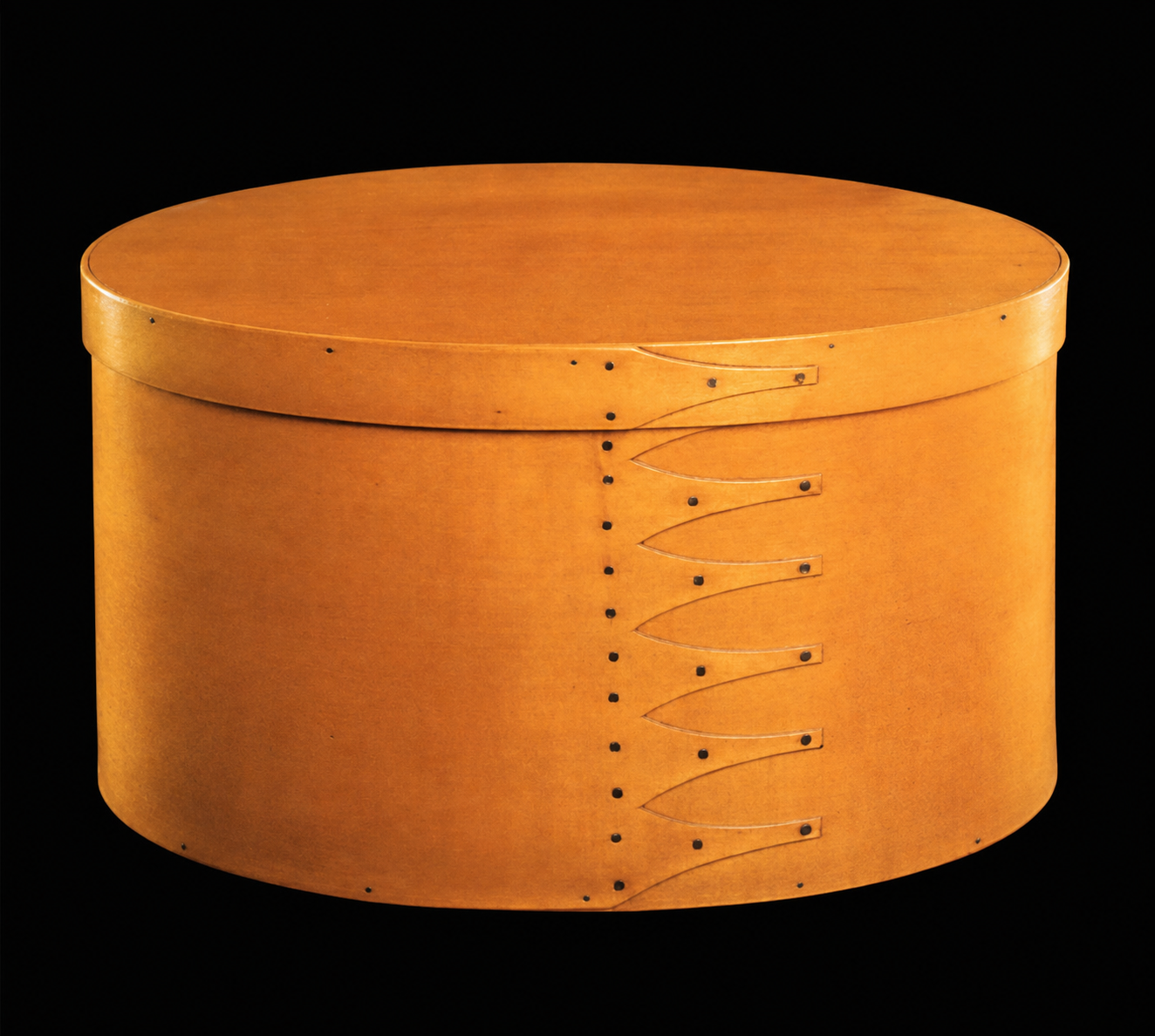
After thinking about it carefully, I am certain that it started as a formal intuition about the field of centers, even if the maker did not think in this language, and that it then gradually fitted itself to the functional problem at hand. Again, it started with an instinct for what is beautiful. I believe the maker therefore concentrated, while working, on the wholeness, what I call the field of centers. When he came to the lapped joint I suspect he explored mainly those possible versions in which the field of centers is strong. This inspired him, and led him to the beautiful and practical solution which we see in the example.
First, he realized while bringing the thin piece of wood around, that it would be a beautiful way to connect the two leaves to let one lap the other in a kind of interlocking pattern. The ALTERNATING REPETITION of the brads and spaces, the GOOD SHAPE of the curve which makes the lap, etc., all make the box beautiful and unified.
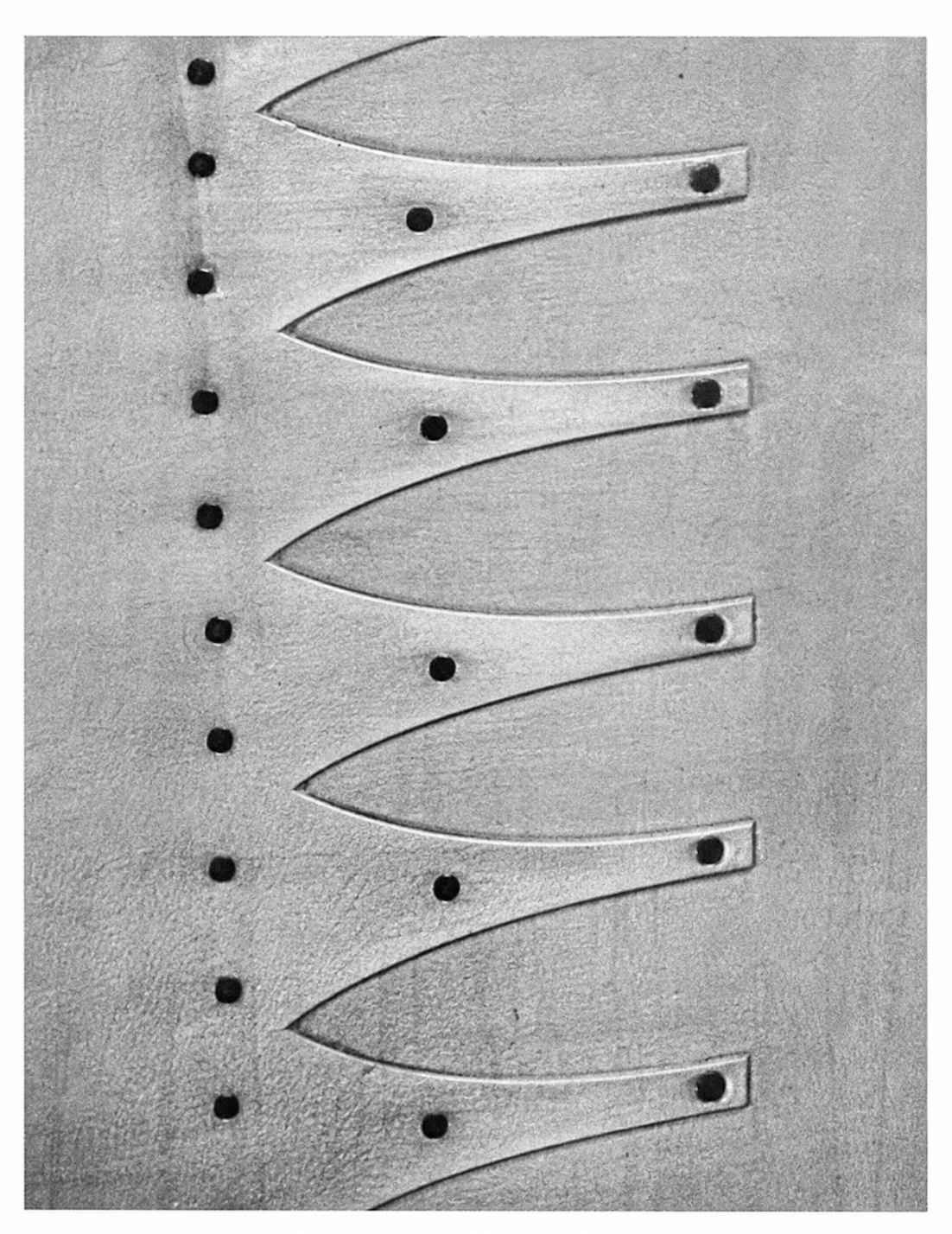
The beautifully shaped finger joints and the positions of brads smaller centers help to intensify the larger centers -- and make a field -- corresponds to a practical need which exists in the real materials of the real box, and which must be satisfied practically
in order for the centers in the real box to come to life.
Thus the good shape, which gives each piece that curve, makes the centers bulge at the left-hand end and thinly taper at the right-hand end, and so strengthens the other interlocking centers in the lower piece of wood as much as possible.
This has a practical advantage which follows directly from the structure of the centers. The center is fat where the brad is going to go, where it needs to be fat, and narrow where the glue is going to go, where it wants something thin which cannot curl and warp. Each of the ways the centers work together, in the formal sense, has a direct practical effect in the real thing.
It seems hard to understand the idea that people were able to invent something practical by starting with the phenomenon of the field of centers. It goes against the grain of our contemporary moral intuition. However, objectively, it is not hard to understand. The field of centers deals with the idea that centers have to be supported by other centers. If we start with a geometrical attitude in which we try to make a field of centers everywhere, this then establishes a kind of seed-bed for practical functions because the field tends to create a structure in which the various centers are able to help each other functionally.
If, on the other hand, we fix the shape of something by trying only to be practical, not thinking about the field of centers, it is possible to get good results -- but it is less likely. The field, I suggest, is the most fruitful structure that exists for function. If we ignore the field it does not mean that we cannot find our way towards it by purely practical and functional arguments -- but it is less likely to happen.
7 / Function Arising Out of Ornament
In hundreds of examples of deep function, as it occurs in buildings, I have found again and again -- without counter example -- that our ability to see the field of centers in a thing, and to produce the centers which are indicated geometrically, tends to produce an object which works better. This, I believe, was the experience of the craftsmen who made the things I have described. And I shall try to show that this is true in general.
Because of our still-prevailing 20th-century viewpoint, students are convinced that "beauty" comes about as a resu/t of the concern with practical efficiency. In other words, if you make it practical and efficient, then it will follow that it becomes beautiful. Form follows function! But if we look at the examples I have given, it seems very unlikely that this is what took place when they were made. They were made deeply practical, yes. But they became deeply practical because their makers tried to make the centers strong. Example after examples suggests emphatically that tis is what came first: making the centers beautiful was the driving force. The practical efficiency that came along with it was a vital part of the package. But it was never the driving force in the mechanistic sense that we believe in today.
Yet, today, this is so difficult to accept. In discussing these examples with students, I have often had a hard time convincing them that good and functional structures achieve their quality from a conscious effort by the maker to make the geometric field of centers. The essence of this point -- because it puts its emphasis on beauty, not on puritanism -- has seemed immoral, even heretical, to many of my students. They -- often the most ration al and most intelligent students -- have an almost moralistic passion in their desire to prove that these beautiful things must have been produced by purely functional thinking. When I point out that these structures have a highly for-
mal, geometric field of centers in them, they shy away from this thought -- possibly because it sounds to them as though I am claiming something flippant or immoral, while they are thinking that since these things are practical and efficient they must have been created from the point of view of functional and practical efficiency.
It is a natural mistake to make. Within the mechanistic world-view of our time, it is natural to assume that something efficient must have been shaped by the desire for efficiency. But even when I point out that modern attempts to make things practical and efficient cannot be relied upon to create this formal beauty, and therefore cannot explain it, the students still have a hard time grasping this circumstance.
Yet we may see this once again in the case of the nails. The geometry that occurs in the r4th-century nail produces life that has both functional and ornamental qualities to an extraordinary extent. By contrast, later examples -- a 19th-century nail for instance -- has less life, and the modern nail has almost no life or physical geometrical beauty at all.
In medieval times, even something as ordinary as a nail was viewed like this. In the r4thcentury nail shown below, we have a thing which has intense life. It is beautiful and has life as an object and as an ornament. It also works incredi-
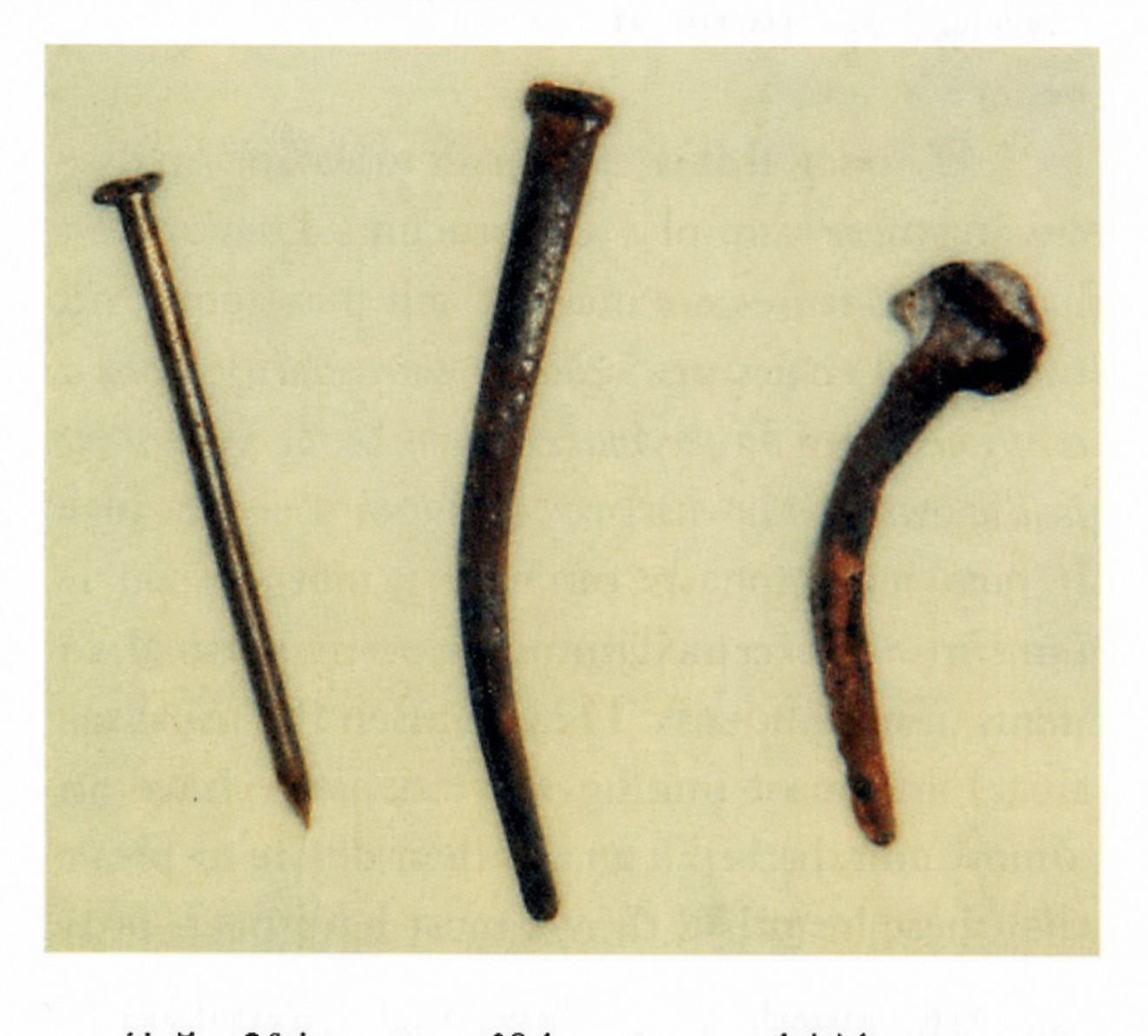
bly well. Because of its size, and the thickness of the head, it has a very long life and great strength, lasting in some cases 600 years -- something that a 20th-century nail could almost never do.
Is it a coincidence that the r4th-century nail works so well both as an ornament, and as a functioning long-lived nail? What is the connection between the ornament and function in the nail? It is not coincidence. Somehow the way the centers work, in the "ornament," the heaviness of the head, the "being-like" nature of the form -- somehow this is reflected, or duplicated, in the functional life of the nail, in its long-wearing capacity, its strength, its durability, the fact that the nail head will never shear or tear as a modern nail head will do.
In the French village studied by Hillier and Hanson, there was a cohesion which was intense. It was not merely some kind of functional life, due only to social cohesion. It was not merely some kind of geometric beauty due only to the physical coherence in the geometry. It was undifferentiated, primal, a kind of /ife that is inherent in space and society /ogether.
In the r4th-century nail, too, we have a life which is intense. Again, it is not only functional life. Again, it is not only ornamental life. It is simply /ife, a quality which appears to be an attribute of space itself.
', fh MP we
Sketches of the three nails, to bring out their features
8 / Life As an Attribute of Space and Matter
The architecture which follows in Books 2 and 3 is based on a conception of the world in which the air we breathe, the stones and concrete our city streets are made of -- all have life in them, or not; all have life, anyway, in varying degrees.
Our job, as architects, builders, citizens, is to create this life in the air and stones and rooms and gardens -- to create life in the fabric of space itself. This is not a merely a poetic way of talking. It is a new physical conception of how the world is made and how it must be understood, which -- if it were accepted -- would change, utterly, our conception of the world.
It is admittedly extremely difficult to visualize the idea that space and matter, the matter/ space itself, could, as an attribute, have life in varying degrees. Although I have managed to show earlier that the recursive scheme in which life spawns life, life comes from life, still, the idea of life as an undefined primitive feature of matter/space, without further meaning that can be expressed, is very, very difficult to swallow or to understand. If it were not for the fact that so many practical matters about architecture become comprehensible within this frame of reference, I think one would not even have a reason to attempt it.
And indeed, I shall not be able to attempt a thorough explanation of this idea until Book 4, THE LUMINOUS GROUND. For the time being, though, one needs something to grasp at, some idea which allows one at least a hint of what it might mean. In the remaining sections of this chapter I shall attempt it by suggesting, informally, that the appearance of life in space may be compared with some kind of awakening, almost as if -- as it comes to life -- space itself, the very matter, wakes up, awakens, and that it is this awakening of space in varying degrees -- indeed in infinitely varying degrees -- that we recognize when we see life in space, when we see life in buildings, in the mountainside, in a work of art, in the smile upon a person's face.
9 / the Hypothesis of Denis Diderot
So, what we have is that the analysis of all function should be done in terms of our effort to make every center precious. That means the basic rule of function is simply this: we try to make every part of the world precious, as far as we can. It sounds childish. But it is not.
In our normal Cartesian mode of thought, we try to explain the life we notice in the centers in the world around us as a mechanical result of other conditions. For instance, I tell you that the life of the window seat I showed earlier comes about because of small panes, because of the light coming from two sides, because of the pale color of the wood, because of the cushion on the seat.'" These observations are all true. But if] take another window with these characteristics, I may get life but it is certainly not true that I will get it to a predictable extent.
Certainly these things, the patterns, the properties, may play a role in my being able to create life in things. They actually do play a role. But they are far from certain. What is more certain is my "interior" sense of the life. Thus the life is really the primary thing, and the properties are really secondary. Because of the Cartesian scheme, I assume that the life is a construct, and that these primary characteristics are more basic. But this is just an intellectual assumption. And, I believe, under careful scrutiny this assumption shows itself to be untrue.
It is far more accurate, and more simple, to say directly that this window place has life, that
I can see that, and that the degree of this life can be directly observed by me.
Someone may say, Well, the degree of life is noticed by you, but how objective is it? Again, objectivity or the lack of it is not, I believe, the reason why people are reluctant to speak about such things in easy terms. It is more true that there is an intellectual prohibition against saying that the window place has life, than that there is really a factual dispute about the degree of life it has. As I have mentioned earlier, when paired comparisons are shown to people the people tend to agree about which example has more life. The idea that the window place has life is directly congruent with our experience.
Thus I must stress that the idea that every part of space has life in some degree does not violate our actual experience. If we look around in the world, at the different parts of space, it is relatively easy to say, "This one has more life, that one has less life." What is violated is only the picture of space which has been put in our minds by Descartes and by the assumptions of mechanistic science. Descartes specifically described space as a neutral and strictly abstract geometric medium." Almost all of modern physics, with its basis in the algebra and arithmetic of Cartesian geometry, has followed Descartes in this idea. But it is an idea, not an observed fact. It is not empirical. The Cartesian dogma and its assumptions are methodological teachings, useful models. As presently formulated, they are violated by the idea that every part of space has some life. But experience itself is not violated by it.
The necessity of seeing matter as potentially having life was taken up 250 years ago, quite directly, by Denis Diderot, one of the great figures of the Enlightenment. In the following passage from D'ALEMBERT'S DREAM, he refers to the idea that space has life as "a simple hypothesis." He writes: "You will come to feel that by refusing to entertain a simple hypothesis that explains everything -- sensitivity as a property common to all matter or as a result of the organization of matter -- you are flying in the face of common sense and plunging into a chasm of mysteries, contradictions and absurdities."!? In other words, in Diderot's view, the hypothesis that matter and space have different degrees of life is easier, less complex, and more straightforward than the hypothesis that matter/ space is a neutral machine which, as a machine, has tobe able to produce the almost magical qualities we see!
We will understand reality itself better if we can educate ourselves to abandon the mechanistic picture, which doesn't work, and concentrate on the picture of the living centers -- which, no matter how strange to our presentday mentality -- actually does work.
10 / Space Itself Carries the Attribute of Life
The examples I have given show cases where a building has an opportunity to intensify the life which exists in space. The creation of a window which is a "window place" intensifies the centers in the living room, makes them more precious, and increases the life which exists in space.
The normal way of understanding this example is to say that some system of needs or forces or processes exists and must then be resolved by the structure which is designed. But in fact this idea doesn't really make sense in the examples. We never really get a chance to understand what it means to say that the needs or forces are resolved. This whole "functionalist" way of talking about space is an elaborate circumlocution whose purpose is to make us feel that we understand -- without creating real understanding in our minds.
On the other hand, the view that space and matter can have life -- more of it, or less
of it -- as in the illustrated cases where the living room space takes on more life because of the organization inherent in the created field of centers, really does contribute to our concrete understanding -- provided we can swallow the idea that space itself really can have life in different degrees.
I have said that centers help one another come to life, and that this "helping" is both functional and geometrical. But if the visual helping between the centers and the functional helping between centers are connected, Aow are they connected? A first answer is that something is occurring in a deeper domain than either function or geometry. The question then is, What domain? The answer might be given as: the domain where all this is happening is some domain of emergent life, a domain of space somehow "waking up."
Hence when one region of space wakes up and then wakes up another region of space, there is also a functional connection which gets established. This mysterious structure, presented hitherto as centers happening in space, is actually a sequence of awakening in the more fundamental domain.
In this sense, what is going on is that life -- an emergent thing in the space itself -- appears as the space wakes up. When something works, or is "functional," its space is awakened to a very high degree. It becomes alive. The space itself becomes alive.
Just to be completely sure of this point, let us review once more a case of something which may seem to us like pure function: daylight in a room. We know that daylight gets better when the light comes from more than one side. This has been discussed at length in A PATTERN LANcuace." Further, if we examine carefully the real nature of the light in a room which makes us feel comfortable, we see that it is broken into a myriad of dappled patches of light, gradients of light varying on the plaster or the wall. The light which comes in, even from the trees and sky outside, is already dappled and then breaks into a thousand further dappled shining bits as it bounces around the room. This is a room which makes us feel comfortable.
On the other hand, a room which has flat, artificial light, which makes us feel uncomfortable, is a room in which this natural bouncing and breaking of the light is prevented, a room in which the light is artificially smoothed out and homogeneous, where there is no "play" of light.
The room where the light falls is a center. The fact that this center is intensified by the patches of light simply indicates that this center is supported in its life by the life of these smaller centers of light. If I try to understand what to do with the light, and give an analysis in terms of lumens per square foot, or the need for efficient energy use, I get nothing clear -- because I can multiply these kinds of reasons ad infinitum -- and will never know how to put them in balance, nor which ones to consider most important.
The issue becomes clear when I stop asking these mechanical questions about the light (which I can never evaluate anyway), and instead take a balanced picture of the whole, in which my sole interest is to intensify the life of the room as a center. To do this, I need to find ways in which the life of the room, as a center, depends on the life of smaller centers -- and I then need to elaborate these smaller centers in a way which makes this increase of life clear and definite.
You may ask how we can be sure that the light needs this sort of thing, or how we can be sure what indeed is greater life, whether in the patches of light themselves or in the room. The answer is simple but strange. I do not know why it should be true that the greater life of the room depends on the greater life of the individual patches of light -- but I do know that it simply is so.
The fundamental functional insight is to realize that the mechanistic functional analysis is all a myth anyway -- since there is no stopping in the endless regression of reasons for why something works. What actually fits our common sense, and what we really do when we think about such things, is always, and only, to create this greater life out of greater life -- and to make that answerable only to itself: There is no other reason behind it.
This is the surprising discovery about function, which makes us see function itself in a new way. If a thing gets its nature from its field of centers, and if the primary interaction between centers is the one in which they help to prop each other up by consolidating their centeredness, then what we commonly call ornament is not different, in principle, from function. If we understand the idea of the field of centers well, we shall have a picture of the universe as made of stuff -- space/matter -- which is potentially living stuff. It is a material in which the occurrence of centers produces more and more intensity of centers. The material actually transforms, comes to life, becomes transformed, "blazes" one might even say, as this field of centers is created in it.
Within this understanding, the distinction between function and ornament is spurious. Every emerging or unfolding field of centers is a
part of the universe which becomes vigorously alive -- privately, I like to think of this as a more blissful state of matter. As the whole emerges, the universe becomes ornamented by it. The rules of the emerging thing are exactly those which we have noticed for so-called "pure" ornament.
In this understanding a flower, or a river, or a person, or a building all have the same potential role. Each of them may be judged by the extent to which this pure blissful structure comes into being, and by the extent to which the light of the universe shines through as a result of this creation.
So we come back finally to the recognition that even what we think of as "life" or "function" is something which must ultimately be understood as pure structure, something lying purely in the space, as an attribute of the space itself. It is the matter/space itself which comes to life. And, when it does so, there is no difference, in principle, between what we have historically called "function" and what we have historically called "ornament."
11 / Throw Out All Functional Explanations in
I am suggesting that we can best assess function by assessing the degree of life in various centers; and we can get the clearest picture of what to do when faced with practical design choices by focusing on the life of individual centers. Intellectually, this technique leads to a remarkable change in our understanding of the world.
In the mechanistic positivistic way of thinking, we assume that we identify certain needs or functions -- and the design must then "meet" those functions. The geometry and function come, intellectually, from quite different worlds. In our minds, when we are thinking like this, the two things -- function and geometry -- are logically different in type.
But if the secret of balance lies in the life of the centers themselves, this leads to a conception in which space and function, function and geometry, are truly unseparated. We do not have function on the one hand, and space or geometry on the other hand. We have a single thing -- living space -- which has its life to varying degrees. It is the space which comes to life. All that we do, as architects, is then to arrange and rearrange this living space, in such a way as to intensify
its life."
The medieval blacksmith does this with his iron as he forges it, and makes the living nail. The architect or engineer does it and makes the living column base. The builder does it with materials -- plaster perhaps -- and makes a plaster surface come to life. The biologist does it with a living ecosystem, and makes a pond or a forest come to life. The region al planner does it with
oS
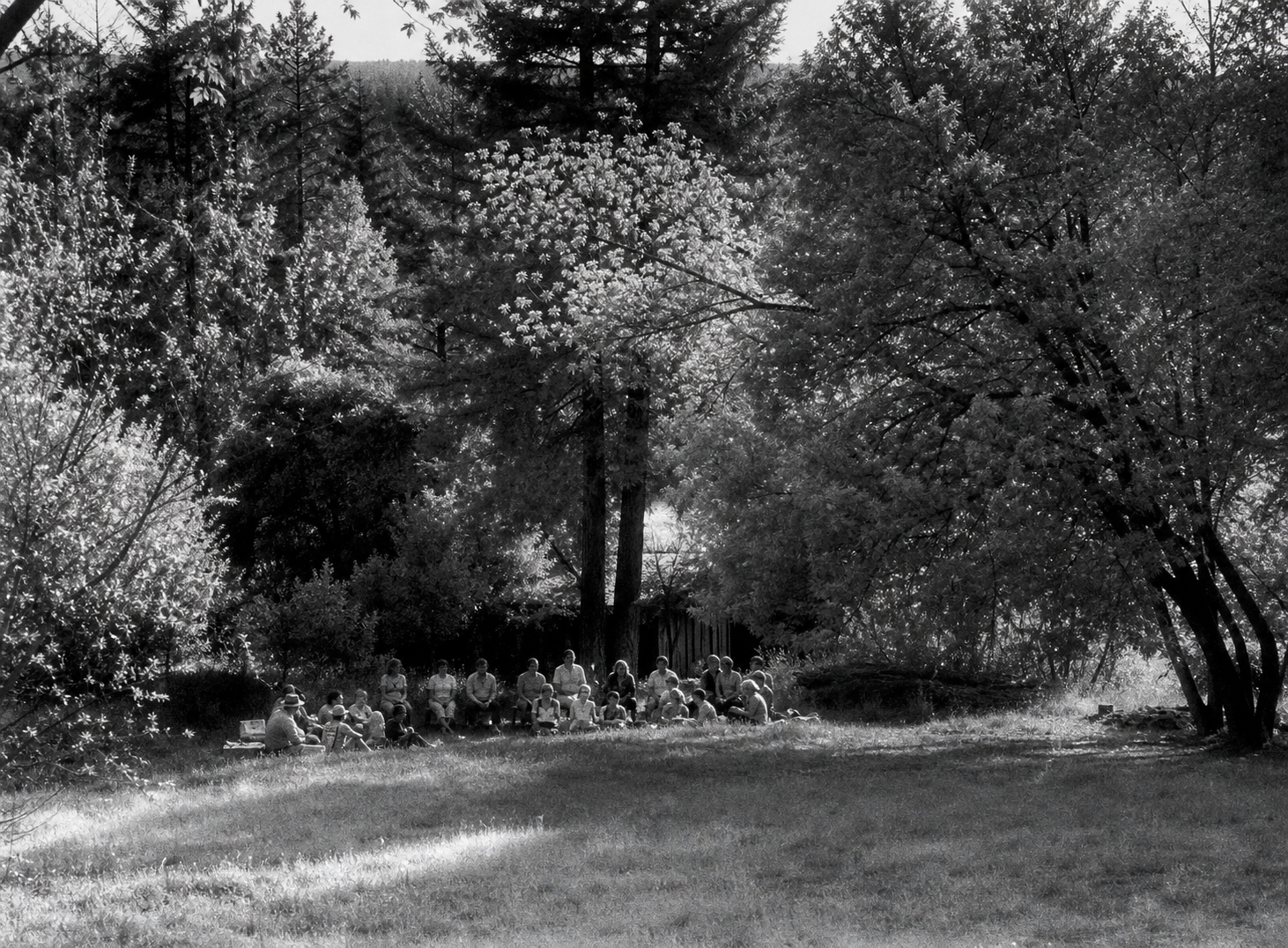
A meadow in the Berkeley Hills the distribution of human settlements, agriculture and transportation, and again makes living space as intense as possible. The painter does it with color, the carver does it with indentations, the tileworker does it with glazes and patterns. No one of these activities is any more ornamental than the others, or more functional. What is created in every instance, even the biological, is living space. It is all living space.
To come to grips with the idea that space/ matter itself might really be alive, let me describe a natural and much larger system: the organic system which I may call a meadow. Consider a meadow, a place in the hilly brushland of Northern California, where grasses, trees, shrubs, growing wild, have been cut back, pruned, in such a way as to create living space. This meadow is first of all, fire-safe. In an area prone to catastrophic wildfire, the spread of fire is slowed down, by a kind of planting arrangement in which many small meadows, with open grassland in the middle, some bushes and trees around the edge. Such a place is resistant to the spread of fire. The sunshine in the meadow invites use. The trees around the edge, provide a picnicking family with a place to lean against. The lower shrubs, forming barriers, and space enclosures, create a place for butterflies, and wild birds. Meadow wildflowers flourish in the open meadow. A lone oak, here and there, creates a majestic center, its trunks pruned bare, to reveal the canopy, and the spread of beautiful space which the oak creates for animals and human beings. Eucalyptus, invaders from Australia, are kept back, the acid leaves not able to contaminate the soil; Broom, transplant from Scotland or France, sparkles in the sunlight, but is also kept low and managed. The grasses, native grasses, create a turf full of seeds, rhimes, of wildflowers, and perpetuates the naturally occurring biological species.
The meadow has sTRONG CENTERS formed by the meadow itself and its BounDartEs. The rills of bushes and low grass alternate, providing cover for small animals and deer, and geometrically forming ALTERNATING REPETITION. Trees in their majesty form LocaL syMMETRIES. The slight declivity which provides a view over the San Francisco Bay, forms a subsidiary sTRonNG CENTER and subsidiary LOCAL syMMETRIES. Paths, formed by the deer and people, provide other LOCAL SYMMETRIES, and ECHOES in the landscape. The meadow forms a voip; each thing is barely distinguished from the neighboring structures, thus making NOT-sEPARATE- Ness from all of it. There are GRADIENTS of shade, gradients of moisture, gradients of plant type, gradients of height: these gradients assure combinations for a huge variety of plants and insects, thus making the place biologically richer.
There are ECHOES in each meadow, of the larger structure of the land and of the hills.
This place has life, certainly. But exactly what is it that is alive? Much of what we take to be alive, stones, paths, an old fence, concrete fence post, the earth and soil, are, strictly speaking non-organic, although they harbor smaller animals and molds. The life of the whole may be described as a web of interconnecting dependencies, among the various species which thrive in one another's company. But what is it that is alive?
It is alive, because the many, many, many centers help each other, in their mutual life. It is alive because of its structure, and because of its geometry. What is alive, is the earth, and rock, and space itself. The life includes the air, again inorganic. Yet, without doubt, the whole thing is alive.
I describe this -- I only know how to describe it -- by saying, frankly, that the whole system, the space itself with its material, has come alive. It is not life i space, not an inorganic mechanical substrate, filled with a few living organisms. It is one living thing, the space has come to life, it is nonsense to separate the two.
And if you too feel something like this, then with Diderot, you may frankly say this idea is simpler, and more direct, than saying that there is a dead mechanical world, in which a few living creatures have appeared... far simpler to say that it is all alive in its cooperation, and that space itself, the space we formerly thought of as a dull, mathematical, cold, inorganic medium which houses a few living things, is itself -- rather -- touched, sparked, and burning.
To come to grips with the idea that space/ matter itself might really be alive, let us try the same thing, once again, but now with a much smaller system. Let me describe an isolated Japanese ridge tile I have in my house. It is a lovely traditional ridge tile which is to be placed at the gable end of the peak of the roof."
By looking at this tile, let us try to come to grips, more vividly than before, with the meaning of this pure life, or pure "centeredness" which can happen in a thing. Look carefully at the tile. You notice, of course, that the tile works as a living center. But probably you do not fully realize, at first, that this quality of being a living center comes from the interdependence of other living centers which it contains. At first we see only that the center we see as the tile is literally "in the middle." It is the big upside-down Ushaped space in the middle of the whole thing.
Now when we study it, and try to understand why this upside-down U works as a center, we notice that the centeredness comes from the existence, around this upside-down U, of other centers: the boundary, the ridges which contain the boundary, and the nearly spherical balls or circles which appear along this boundary.
So, like so many other examples I have used, the tile gets its centeredness from the cooperation of many smaller centers which it contains. The small balls or circles around it form powerful but minor centers. It is the way they ring the main upside-down U-shape which gives the U its strength. The boundary line is itself'a center, and its strength or life as a center also contributes to the force and power of the center which the whole tile creates. And, of course, the subtle and beautiful shape of the tile as a whole also adds to the feeling of life in the center which is created there.
What is it then? What is the center that has been created? We keep coming back to that question. What has happened in space as a result of this geometric disturbance that we call its
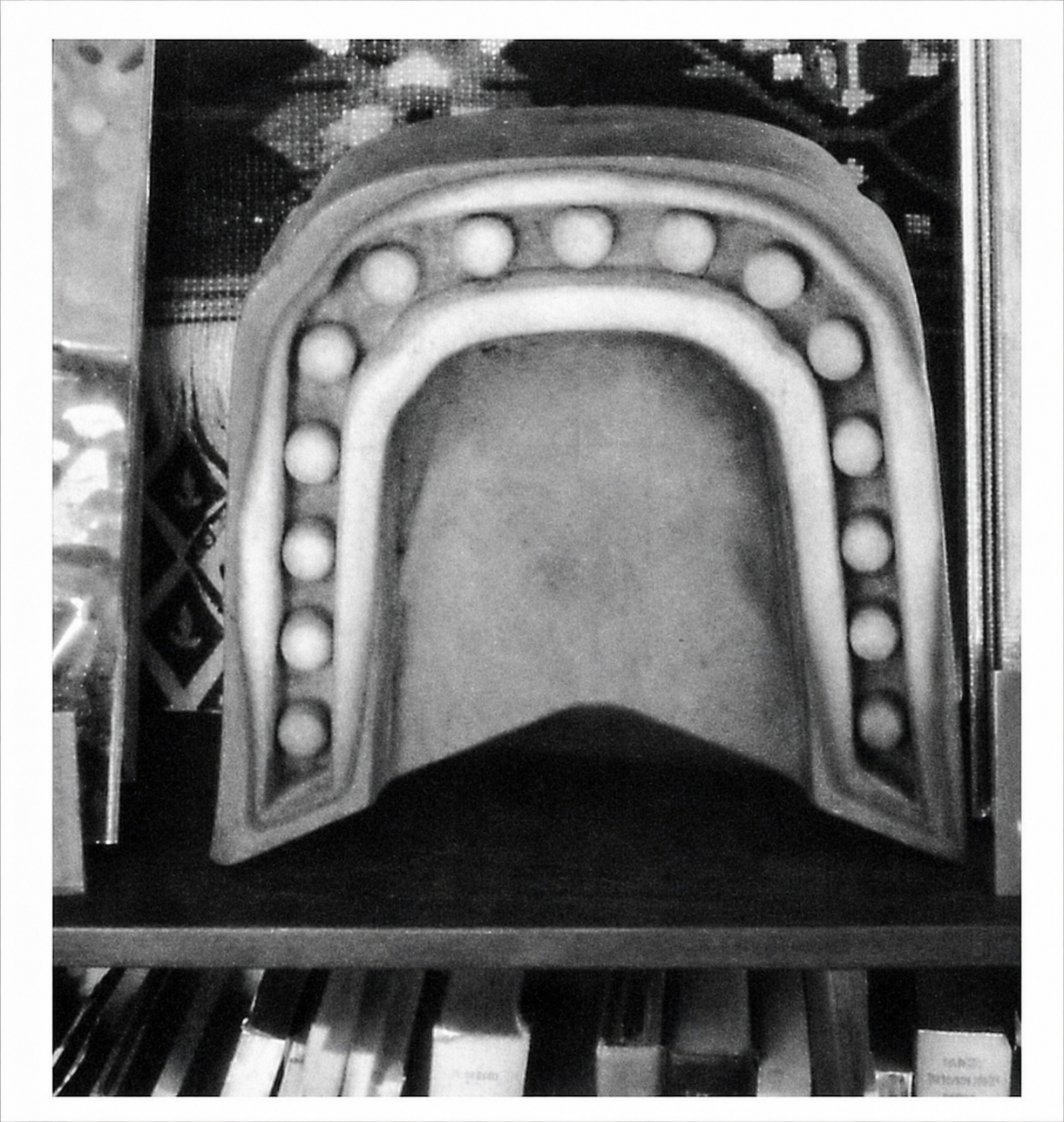
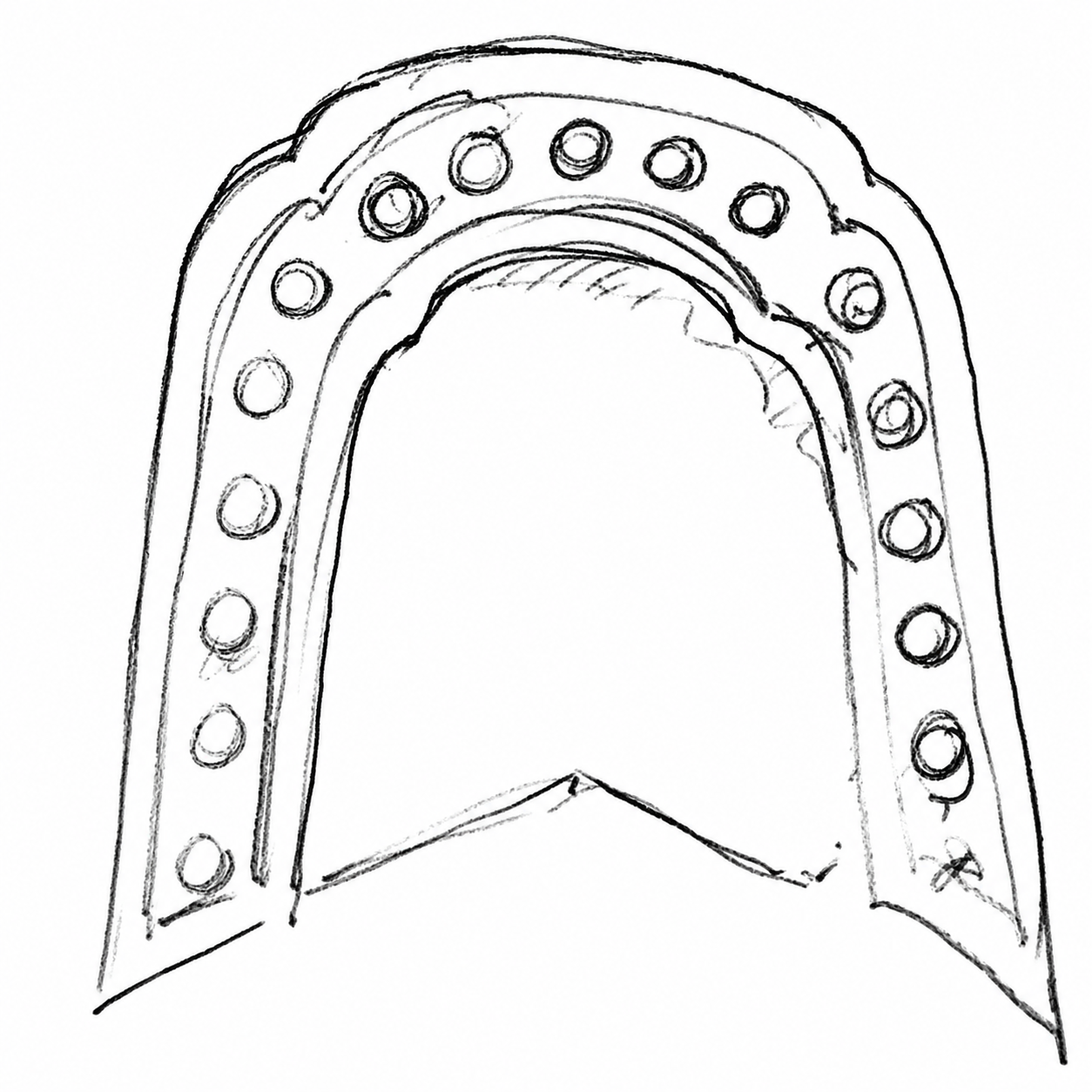
To grope for an answer to this question, I want to make an observation about the centers: each of the centers in the tile gets its own feeling, its own depth, from the fact that it is helping the larger center come to life. This is an important idea. The balls around the edge have a special living quality. They aren't just "circles." If you look at them carefully, try to understand their life, and examine your own feeling about their life carefully by introspection, you will notice that it comes about because each of them, and all of them together, are helping to create the life of the tile as a whole. It is their presence in the whole, and the fact that they are helping the life of the whole, which gives them their individual life as individual centers. And in the process, they become precious.
You may grasp the same idea -- more vividly perhaps -- if you think about a person's foot. The foot is a center. It gets its life as a center as it is helping the whole organism. Its life as a center comes from the fact that it is helping to create the larger life of the person as a center. That is what makes the foot profound. The foot literally cut off, viewed in isolation, or literally hacked off a living person's leg, does not have that special quality, because it is no longer helping to promote and maintain the life of the larger whole.
center:
These two things are true of every living
1. Each center gets its life, always, from the fact that it is helping to support and enliven some larger center.
2. The center becomes precious because of it.
It is the second of these, above all, which is the key. Again, it is useful to look at the circles in the Japanese roof tile. They are not merely circles. They have become precious. A center occurs in space as the space becomes (or is made) precious. It becomes precious because it is helping some other larger center to exist, and to have life, and to be precious. But in the process, it itself becomes precious. So, suddenly, space is transformed. It starts out neutral. But as it becomes a stronger center, it is made precious. This preciousness is the vital core of every center.
12 / the Recursive Character of Life
The nearly miraculous nature of the field of centers may now be almost visible. Let us consider the recursive nature of the field of centers once again through examples.
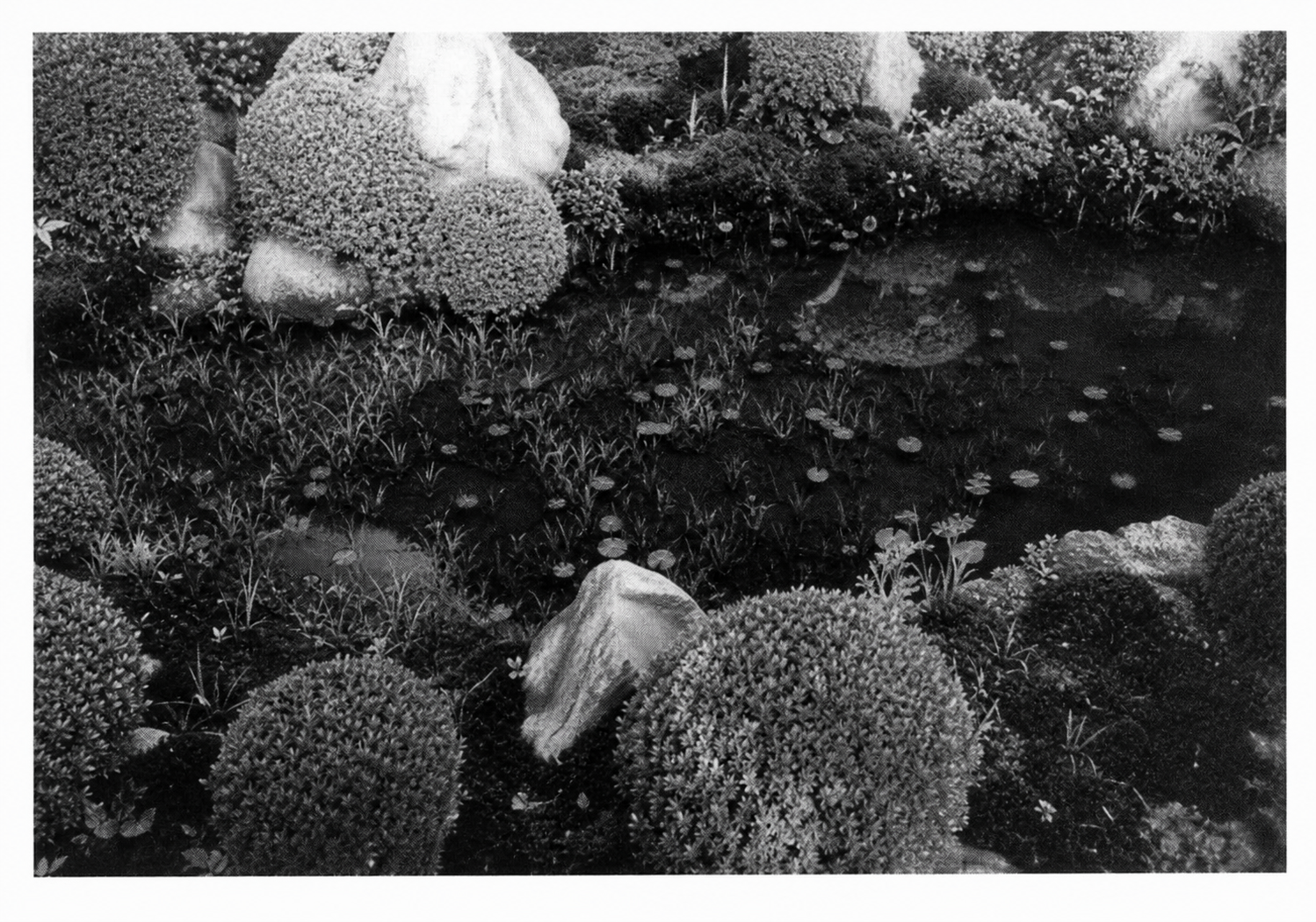
First, on this page, look at a fish pond illustrated below. Here we have the water, the waves, the fish, the plants, the overhanging bushes, the lilies in the pond, the lily leaves, the mud on the bottom, the caddis, the moss on the rocks, the slime in the water, the flow of water through the pond. Each of these centers, too, is brought to life, and has its life intensified, by the other centers. The fish themselves, for instance, live more intensely when the stream is flowing, so that the dissolved oxygen is constantly replenished. The shade, within the water, formed by the rocks and lily pads, allows the fish a place to cool themselves. The stream flow itself is brought to life, intensified as a center, by the eddies and turbulence at the edge, which make the pond.
Next, opposite, a front door with benches and plum trees. At the front door, we have the door, the steps, the seats, the fence, the purple tree, the space between the stoop and the street. The door makes the space more alive: the life of this space makes the benches more alive. The
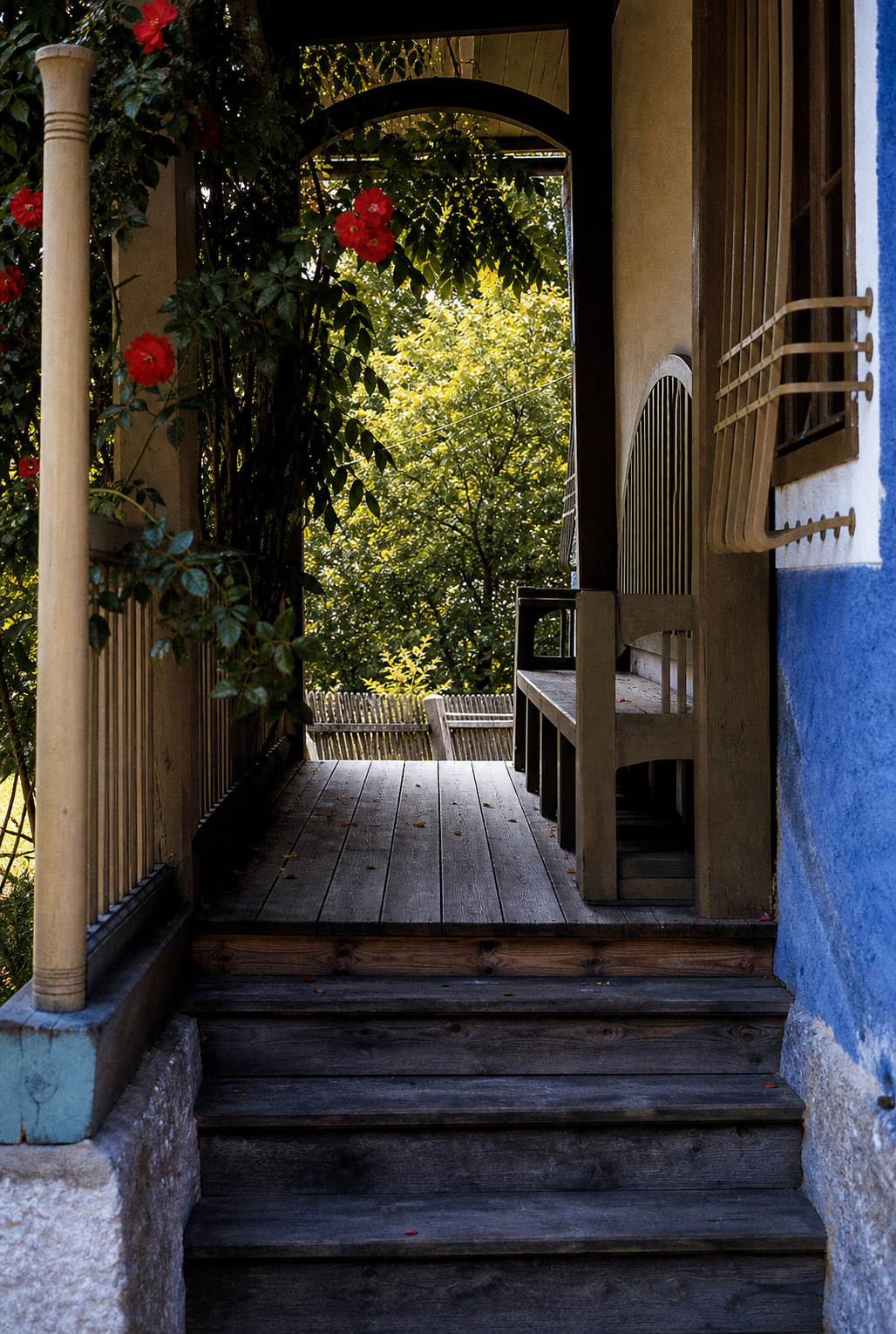
purple tree makes the benches more alive: the protection of the fence makes the tree more alive, by shielding it from animals and passing cars.
In these cases the crux of the whole thing, then, is what happens when one center helps another come to life. The particular form the helping takes is different each time. But the fact that each time the helping occurs, and each time the centers being helped become more alive -- these are the only common factors. That is the nature of the phenomenon of life. In a mechanistic frame of mind we seek a different mechanism for each example of helping -- and focus mainly on the differences. However, I have gradually come to the conclusion that it is the fundamental similarity of all kinds of helping between centers which is most important, even though this appears to be an un-analyzable concept which cannot clearly be expressed in terms of anything else.
In each case, the life which exists in each center itself becomes more intense as a result of the other centers, and their life, and the way that they become more intense. This effect is both geometrical and functional. It happens in the space. But it works in such a way that the common or ordinary life in the thing is what we see intensified.
Thus life itself is a recursive effect which occurs in space. It can only be understood recursively as the mutual intensification of life by life. The field of centers, which intensifies centers by virtue of their pure geometry, then creates life through this helping action in the geometric field.
13 / Tofukuji
If it is true that the nature of order lies in some kind of unexpected substrate of space and matter where life, seen both as ornament and as function, appears as an awakening of matter -- then we might expect to have at least occasional intuitions to support this point of view. From time to time, I have had glimpses of these intuitions.
I was visiting Japan in 1967. A friend, Tsune Sesoko, knowing my interests and my feelings about things, discussed my upcoming visit with two sixty-year-old calligraphers, who were then still part of the original Zen tradition, to get their advice. They told Tsune that I should visit a particular temple in Kyoto -- a place called Tofuku-ji -- "The only place left, where the old way is still visible, and understood." I agreed to do it. I wrote the name down, and arrived in Kyoto, where I was to stay with another friend, a German architect. I told him of my desire to visit Tofukuji, and he said, "No, no, not Tofuku-ji, you must visit the greatest place of them all, the great Daitoku-ji." I hesitated, said that I preferred to follow the advice I had been given, but he insisted that it was not good advice, that he would personally take me to Daitoku-ji, and I would see for myself. I argued. To no avail. He insisted. Since I was his guest, I had to submit with good grace.
The next day we went to Daitoku-ji. I didn't like it. Though beautiful in form, it seemed like an empty shell, a kind of tourist place, protected for tourist visits, no longer a living thing at all. For instance, beautiful paths, passing through moss gardens, were separated from the moss by heavy chains and little "Don't walk on the grass" signs. After a few minutes, I couldn't stand its artificiality, and decided that ] must leave and find my own way to Tofuku-ji. I apologized to my friend, and went to find a three-wheeled bike-taxi.
I said the name To-fu-ku-ji syllable by syllable over and over again, until the driver understood. We drove far across town. I had no idea where we were. Almost an hour's ride, out into the areas beyond the town, to the very edge, where the hills meet the town, almost out in the country. We stopped in a deserted place, outside a huge stone wall. The driver motioned with his
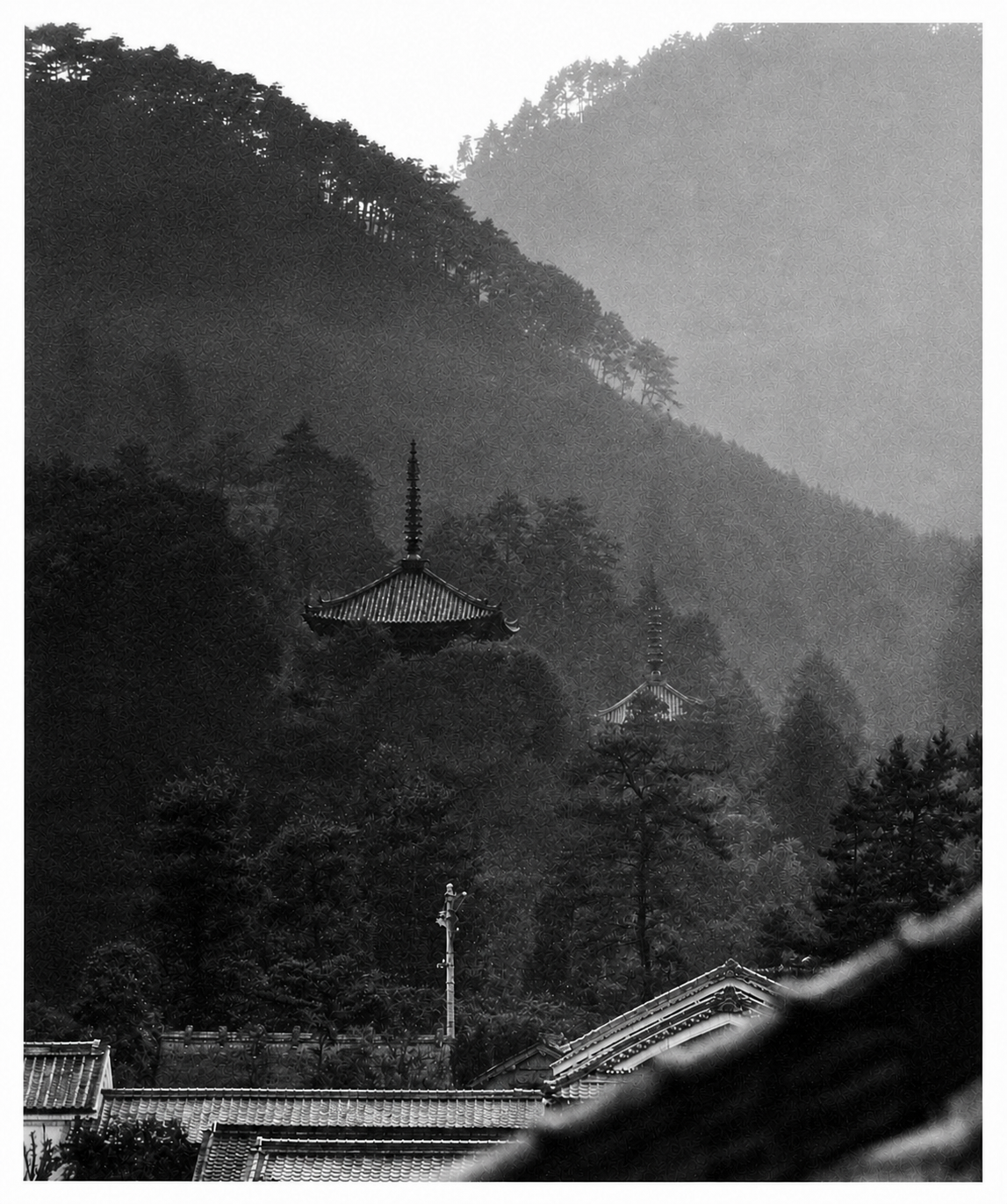
The temple in the forest hand that he would wait there for me. I got out, passed through the walls, into the temple complex. Inside the atmosphere was astonishing: wild grasses, bushes, stones. It was like overgrown nature, almost completely wild, and yet I felt that it was cultivated, and in use. I walked about past giant, simple buildings, in a state like that of a working but slightly derelict farm, well kept, not perfect, but every part in use. After an hour or two of walking around buildings, visiting a small sand garden, a wooden bridge over a gorge, and the main temple building -- I found myself on a tiny path that seemed to lead away from the temple, up into the hillside. I followed this path up steps cut in the hillside, partly stone, set into the grass. The path went on and on, a shallow staircase, up into the hill, between two hedges. It was getting narrower and narrower all
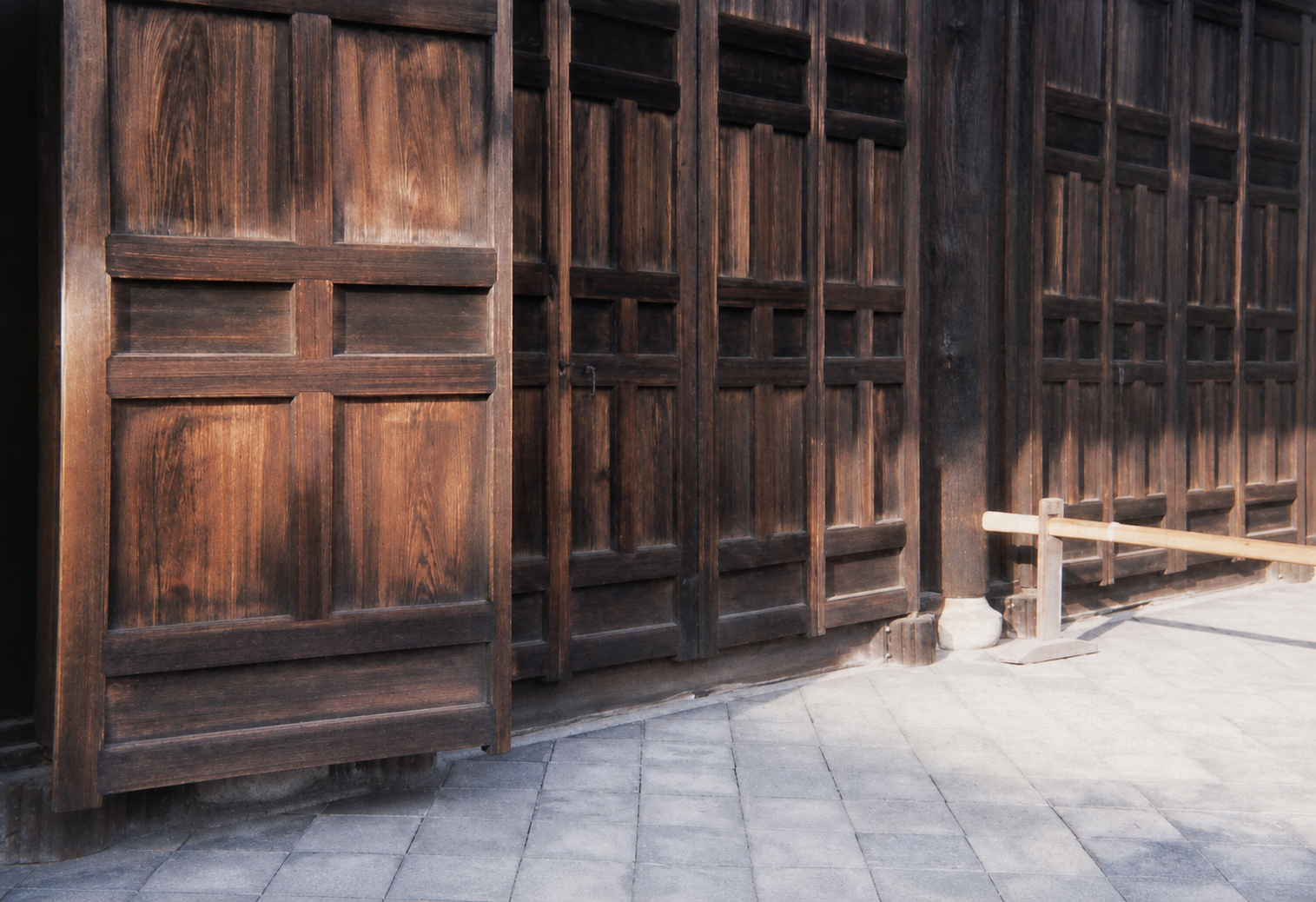
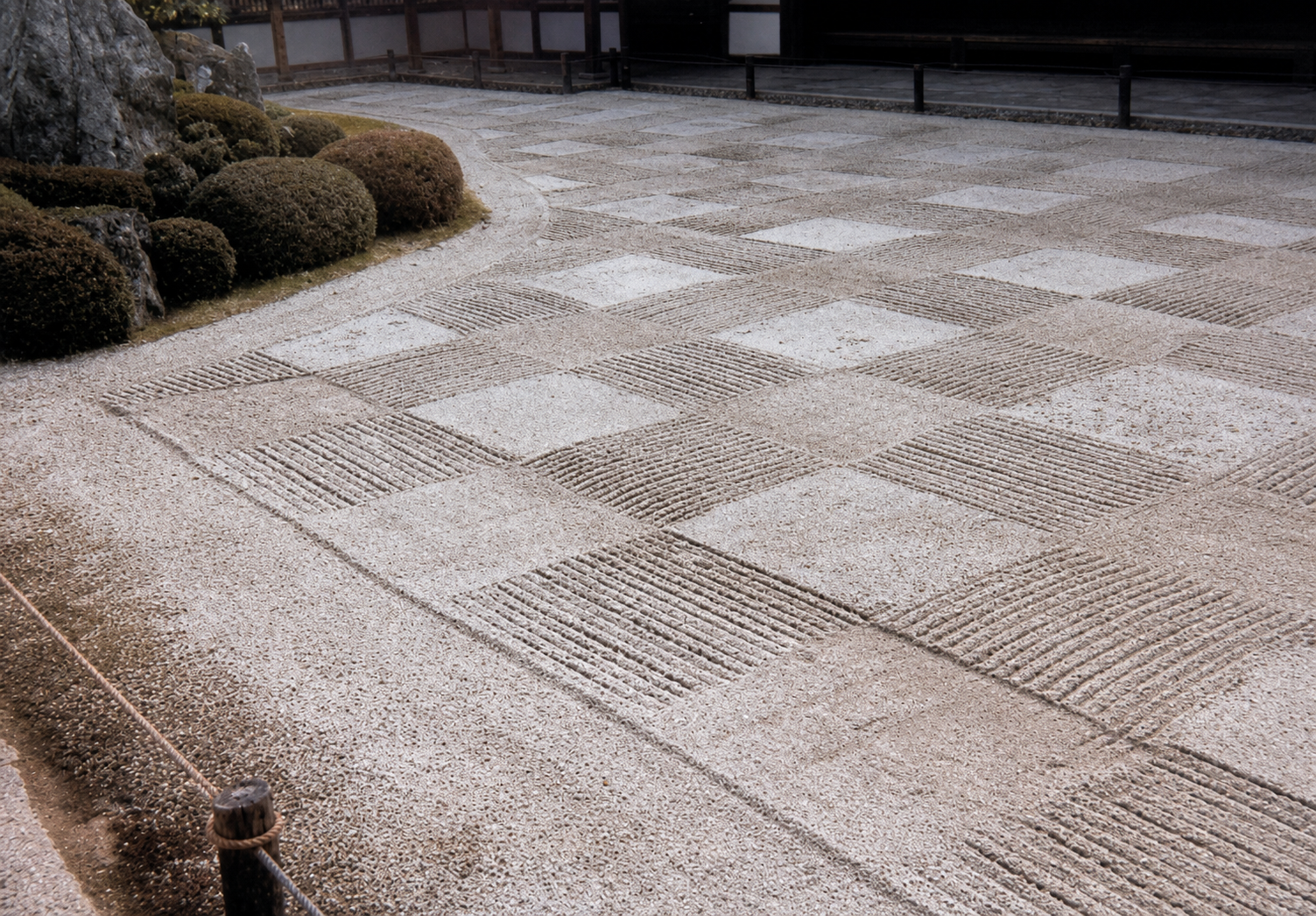
top of the stair. I turned around and sat down.
Suddenly it ended. To my surprise, ] could -- There was nowhere to sit, except on the top step, not go further. The path just stopped. The -- and that is where I sat, looking down on the
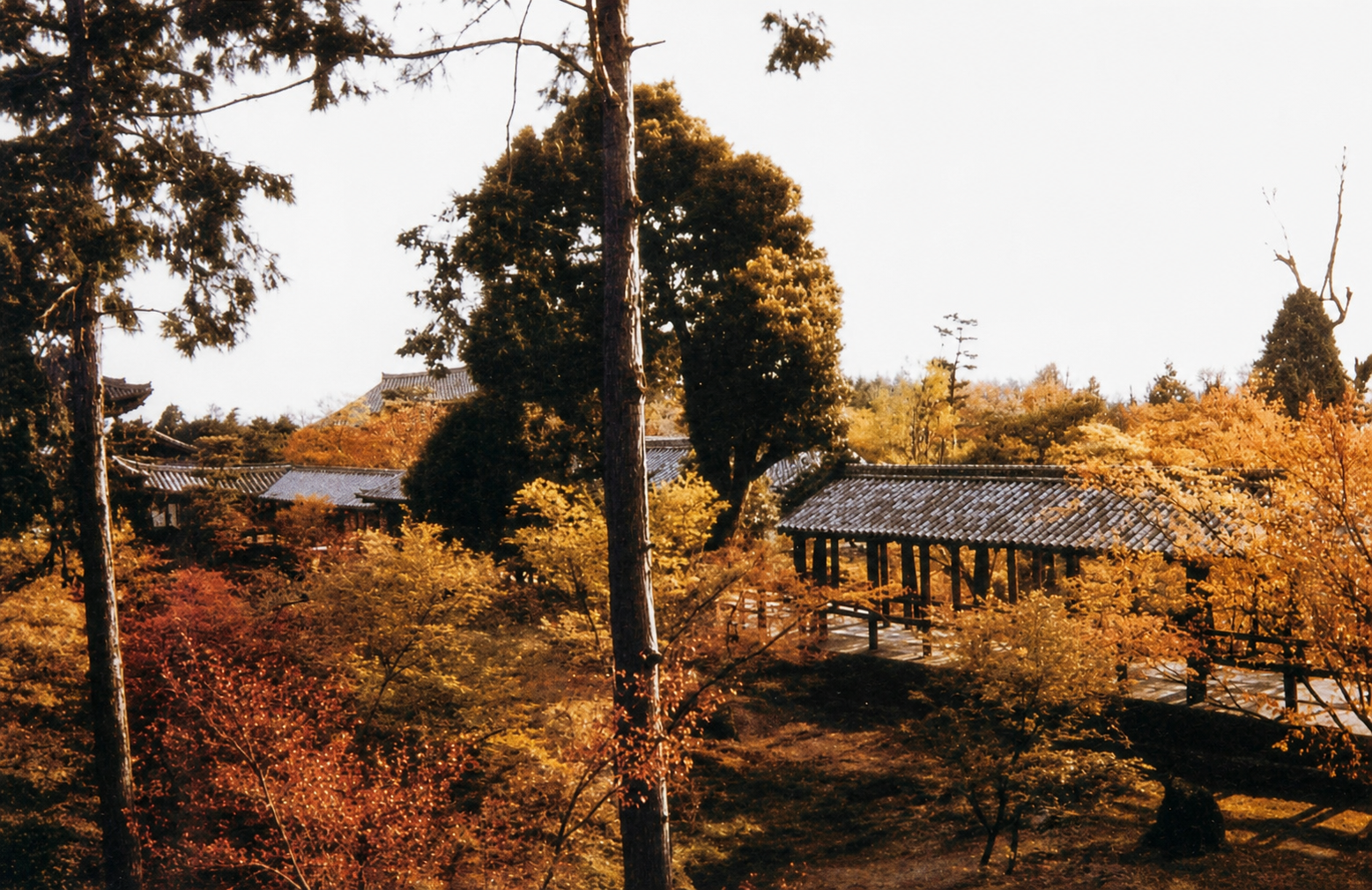
The bridge at Tofuku-ji temple precinct, watching it, tired, happy to sit there, quiet, only the wind now instead of the sounds of temple business. As I sat there, a blue dragonfly came and landed on the step beside me. It stayed. And as it stayed I was filled with the most extraordinary sensation. I was suddenly certain that the people who had built that place had done all this deliberately. I felt certain -- no matter how peculiar or unlikely it sounds today, as I am telling it again -- that they had made that place, knowing that the blue dragonfly would come and sit by me. However it sounds now, at the time when it happened, while I sat on that stair, there was no doubt in my mind at all that there was a level of skill in the people who had made this place that I had never experienced before. 1 remember shivering as I became aware of my own ignorance. I felt the existence of a level of skill and knowledge beyond anything I had ever come across before.
I sat there for two or three hours -- and then stayed in the temple all day long, filled, for the whole day, by my awe in the face of what these people had known, and by the beauty of the place. Most of all I was simply shocked by the certainty that the people who made this place had done it with a level of skill far beyond anything that I had ever experienced -- and that the grasses, the steps, the wind, the dragonfly, were all deliberately placed by their hands.
To this day, I have never again had such a shaft strike me. I have not seen again the possibility of such perfect human knowledge of nature. Every part of that temple, as I think back, was formed by the field of centers. Even in the little path I walked on it was crucial. Geometrically, structurally, each time the life came from some kind of sequence, from a layered structure which embodied a field of centers. On the path it was especially obvious, reaching finally to the top step where I met the dragonfly.
Every part of every place was slightly irregular. The sensation of nature waking up, and human beings helping to make it wake, was luminous, like a hum. I feel a heavy longing, remembering it, it was so vivid, so quiet, so perfect. Yet it changed my life to see it, and to walk through it."
14 / the Awakening of Space
The ideas of this chapter fill out the structural conception of buildings which I began in chapters rand 2. In this conception life is something which exists in every event and building, even in everyday functional life -- the burst of living -- as a consequence of the structure of space.
In essence this conception is ancient. What is new is only the idea that it might be explained, and understood, in a structural form consistent with other scientific thinking. Even in modern physics, a similar idea, though strange to Cartesian ears, has been proposed by Eugene Wigner. Similar views have appeared historically within the ideas of Buddhism and within the world-view of American Indians." The Buddhist conception of the world, in which some degree of life exists in everything, has been put forward by innumerable ancient texts. It is summarized clearly and succinctly for one specific case by Francis Cook. A more contemporary modern biological version of the same idea has been formulated by the Japanese biologist Imanishi." A similar conception existed throughout Alfred North Whitehead's thought and writing.
In this conception, each part of the world -- building, stone, blade of grass, pane of glass, door, painting, brick, spot of color in a painting -- has some life. In Whitehead's view there is nothing which does not have some life. The possibility of life is inherent in matter. It is not an accidental thing which happens in organisms as matter gets highly organized. It is the very nature of order for matter to be alive. And of course, in this view, every building -- like any other part of space -- has life to a greater or lesser degree, and every part of every building has life to a greater or lesser degree.
I have tried in the last eleven chapters to present a structurally detailed account of this idea, to show how it might work. Within this framework, the idea that every building has its life -- and that every part of every building also has its life -- is a necessary and practical point of view, which can be understood concretely in terms of structure, and which follows naturally from the existence of living structure, the field of centers, and the intensity of this field, as a definite and real structure in space.
Even at this stage, the essential task of architecture -- the nature of centers, and the task of making a single center -- may still be far from clear. In order to understand it well, we need to recognize explicitly that each center is a kernel and spark of life in the fabric of space. That is, we have to understand, in an almost animistic way, that each center is a spot where space awakens, or comes to life -- and that all function, all ornament, all order, comes into being, as the center takes on life whose potential existence is inherent in the space itself."
All this has intellectual consequences. If we want to make sense of the way that centers work, we cannot easily avoid the idea that space itself has the power to come to life -- and that a center is an emerging spot of life in the material substance of space itself. This is disturbing, or at least surprising, because it is inconsistent with Cartesian mechanics.
But even if we might want to accept it, I have said little yet which can help us to understand it. What is this life which happens in space as space "comes to life'? What is the life of a center, which then multiplies and blossoms to form the life of buildings, ornaments -- and perhaps even the life of living things?
Everything I have been talking about depends on this idea. It is this idea which forms the underpinning for the objective reality of wholeness, and for the basic idea that architecture can be understood in an objective way." In appendix 4 of this book I have sketched the nature of space, as it might have to be understood mathematically, in order to bring this idea into the framework of modern physics.
In Books 2 and 3 and 4 we shall study this idea of "life" more deeply. We need to know how to measure it, how to estimate the degree of life inherent in a given center, and above all to find
out what it is. I shall try not only to provide an empirical basis for this idea, but also to show that it requires a new and surprising concept to make sense of it.
In Book 4, I shall suggest that ultimately we must understand the awakening of space, which occurs when a center gets more life, as a measure of the degree to which that center becomes associated with the human "I", or self. When a center arises, there is a feeling of space awakening, and the feeling of it is clear. The experience of this is so vivid that it is difficult to express. Anything that one can say about it sounds vague. Since it is awkward within the narrow Cartesian framework to recognize such an awakening, people suppress it. But the idea that space itself, like a bud opening to flower, is awakening somehow wherever a center occurs implies something strange about space.
When a building works, when the world enters the blissful state which makes us fully comfortable, the space itself awakens. We awaken. The garden awakens. The windows awaken. We and our plants and animals and fellow creatures and the walls and light together wake.
In order to make it possible to have an idea like this, we need to understand space as a material which is capable of awakening. This is what I shall later refer to as "the ground." The ground is just that "something" in the fabric of space which is capable of awakening. We may imagine it as lying behind the space or in the space or under the space conceptually. Or we may imagine it as the space itself, but then recognize space itself as something immeasurably deeper than the way we used to think about space in 20th-century physics.
Notes
1. A general account of function in architecture, in a fashion which predates this account, is given in Christopher Alexander, Sara Ishikawa, Murray Silverstein, Max Jacobson, Ingrid Fiksdahl-King, and Shlomo Angel, A PATTERN LANGUAGE (New York: Oxford University Press, 1977).
2. Strangely, there are relatively few books on architecture which have dealt with this intensity of life and its relation to architecture, in a way that really sheds light on the architecture. One is Bruno Taut, Houses AND PEOPLE OF JAPAN, 1937 (Tokyo: Sanseido Co., Ltd, 1958). Another is John Ruskin, THE STONES OF venice (New York: J. Wiley, 1851) especially the extraordinary first chapter on the making and nature of a stone wall.
3. In the following examples, I shall not only show how centers necessarily work, but also explain how these centers will, in general, benefit from the fifteen properties that make them help each other. Some of these examples are discussed in A PATTERN LANcuace. In what follows I have given relevant page numbers for these references as APL. The discussion in APL is more "functional." At the time my colleagues and I wrote that book, the geometricfunction al unity of space, based on the wholeness, was not yet fully clear to me.
4. APL, INTIMACY GRADIENT, p. 610.
5. APL, corRNER DOORS, p. 904.
6. See discussion of ceiling heights and room volumes in APL, CEILING HEIGHT VARIETY, p. 876, and THE SHAPE OF INDOOR SPACE, p. 883.
7. APL, winpow PLACE, p. 833.
8. The small altar-like niche in some traditional Japanese rooms, where ceremonial objects or beautiful objects are displayed.
10. See APL, winDows OVERLOOKING LIFE, p. 889.
ut. APL, Poots oF LIGHT, p. 1160, for discussion of lights.
12. For other versions of the idea that ornament and function are merely versions of a single structure, see Cyril Stanley Smith, A SEARCH FOR STRUCTURE: SE- LECTED ESSAYS OF SCIENCE, ART, AND HISTORY (Cambridge, Mass: MIT Press, 1981).
13. Bill Hillier and Julienne Hanson, THE sOcIAL Locic oF space (Cambridge: Cambridge University Press, 1984). Hillier and Hanson provide a successful and fascinating quantitative analysis of various social relations in villages and communities, and the way that social interactions are interdependent with the spatial organization in which they occur. Earlier writers on the relation between social events and space, often presented their analyses as if they were analyses of social events, and the way these social events depend on or are affected by space as their necessary background. In the view presented by Hillier and Hanson, they make it clear that, for them, and to make sense of the empirical results they have obtained, it is necessary to view space and social system as a single indivisible entity. Like Hillier and Hanson, I am convinced that the two must be viewed as a single thing, and I do not think a separation between social events and the space in which they happen is a helpful one.
14. Ibid., especially pp. 262-68.
15. Ibid., p. 26.
16. I should make it clear that I am not, of course, claiming that the artisans who made the column base on page 418 consciously used the idea of centers as I have formulated it. The same is true for the other examples which are to follow. What I am claiming is that these artisans were doing something which was essentially equivalent to the idea of intensifying the life of the centers. One form this may have taken in traditional cultures, is discussed in Book 4, chapters 4 and 5.
17. Chapter 5, throughout, and see especially the end of the chapter, pp. 236-42.
18. See R. Catesby Taliaferro, THE CONCEPT OF MAT- TER IN DESCARTES AND LEIBNIZ (Notre Dame: 1964), especially p. 33.
19. Denis Diderot, D'ALEMBERT'S DREAM (1769; reprint, New York: Penguin 1976), pp. 158-59.
21. No matter how many times I say it, the concept is nevertheless very hard for us to grasp -- because we have grown up in the mechanistic positivistic way of thinking. It is really almost impossible. Even if 1 keep repeating it to myself, again and again and again, my way of thinking, which I have inherited from the last several decades, keeps making me think of the two things -- function and geometry, function and ornament -- as separate. But slowly, gradually, my mind is coming back together, healing itself, as I grasp the essential idea that there is not this separation, and that it is all just one kind of living space, and that my task is only to intensify its life.
22, This tile was a present from my associate and colleague, Professor Hajo Neis. Hajo got it from one of our subcontractors in Japan and gave it me for Christmas. Even by itself, it forms a very beautiful center.
23. I visited Tofuku-ji again in 1992. With enormoussorrow, I found out that by then, it had been modified for tourists, and was now of the same genre as Daitoku-ji. The atmosphere I have described in this chapter had largely disappeared. The little path was gone altogether, swallowed by a nearby development.
24. Eugene Wigner, "Limitations on the Validity of Present-day Physics," in Richard Q. Elvee, ed., MIND IN NATURE: NOBEL CONFERENCE xviI (San Francisco: Harper and Row, 1982), pp. 118-33, especially 129-30.
25. For instance, the Cheyenne chief, Old Lodge Skins, in Thomas Berger's novel LITTLE BIG MAN (New
York: Dial Press, 1964): "But white people believe that everything is dead: stones, earth, animals, and people, even their own people. And if, in spite of that, things persist in trying to live, white people will rub them out" (p. 214).
26. Francis Cook, HUA-YEN BUDDHISM: THE JEWEL NET OF INDRA (University Park: The Pennsylvania State University Press, 1977).
27. Professor Kinji Imanishi, sH1ZENGAKU NO TEISHO (IN suPPORT OF GEOCOsMOLOGY) (Kyoto: 1983) and sEI- BUTSU NO SEKAI (THE WORLD OF LIVING THINGS) (Kyoto: 1941).
28. See Lawrence Bright, O.P., WHITEHEAD'S PHI- LOSOPHY OF PHysics (London: Sheed and Ward, 1958).
29. So far, this still seems mysterious. You may say, This is all very well, but what is the life of a center? How do you measure it; how do you observe it? My answer at this stage would go something like this: Please, do not be impatient. Experimental and operation al techniques are important. The experimental methods given in chapters 8 and g need to be developed. However, the first thing to establish is not the detailed operation al measuring techniques, but the general idea of whether this seems a plausible and workable view of things. John Dalton proposed the existence of atoms and molecules, in about 1810, to account for arithmetic results which occurred in various chemical experiments. It was not unti] more than 100 years later that one could actually see atoms, or verify their existence by direct observation. In the same way, ecologists have recently introduced the idea of ecological "niches" to explain various structures in an ecological system. At the time this proposal was first made, what mattered was whether one got a roughly convincing idea of what it means, and whether it helps to understand things and make them more coherent and sensible. Ina perhaps similar fashion, the idea that centers are structures that appear in space, and have life in themselves, is so startling and surprising as an idea, that the first thing we need to get clear is whether this idea has promise, and what we can do with it. Measurement, and detailed problems of objective evaluation of the type I have described in chapters 8 and 9, necessarily come a little later.
30. I Aave already shown, in chapter 4, that if we accept the idea of the life of centers as something real, then we can use it to explain how the life of other centers comes into existence recursively. In short, if we suspend our disbelief, and agree that there is such a thing, then we see how the lives of different centers depend on one another, and how the life of a building is created by the life inherent in its various component centers.