Appendices
Mathematical Aspects of Wholeness and Living Structure
This is the first of a series of technical appendices, which together seek to lay out the groundwork for my claim that what is reported in this book is not merely a new way of understanding architecture, but also a small step to a new way of understanding matter itself.
The wholeness, W, is a feature of physical space which appears everywhere, in every part of matter/space. It is, I believe, susceptible to a clear mathematical definition and is characterized by a well-defined mathematical structure.
Consider any region of space, R. We may, for convenience, impose a grain or mesh on the space, so that the number of points is considered finite, not infinite. Let us say that R contains 2 points. In cases which model the real world, there is usually some "coloring" or differentiation of type or character among the 7 points of R, so that the region R has a visible or identifiable structure. The simplest coloring which produces a structure is a coloring in which some points are black, others white. In the two-dimension al case, R would then be a drawing in which we see some particular object. In the case where the coloring is not abstract, but material, points may be assigned labels corresponding to actual physical materials; for example, they might include solid and void, or various physical or chemical attributes. The region R is thus intended to represent a part of the real world in its overall geometric form and organization.
I shall now explain how to construct a wholeness Won the region R. Within the region of space R, which contains 7 points, there are 2" distinguishable subregions. Call a typical one of these subregions S;. In what follows, we construct W by recognizing that there are different relative degrees of coherence which may be observed in the different subregions S;.
It is a common fact of experience that we see regions of space which have different degrees of coherence. For example, we consider an apple to be coherent. If we consider the set of points that consists of half the apple, we shall probably consider it less coherent than the apple as a whole. In a similar fashion, the pips of the apple are coherent. And this idea of relative coherence does not only apply to sets which are in some sense complete wholes. A portion of the apple which includes the core plus the hull that houses the pips is moderately coherent. A random section of the middle of the apple would be less coherent, but still coherent in some degree. A disconnected set of points, including bits of skin, core, pip, etc., mixed up, would be still less coherent.
Although it may be impossible to construct a complete rank order on all the different possible subregions, it is clear that our intuition does typically assign some relative degree of coherence to each different subregion. We do recognize coherence in the world. This coherence, is just that attribute which I have referred to throughout Book 1 as /ife. The structure of the wholeness W relies on the fact that we shall make such distinctions of life explicit, and use them to erect a structure.!
To make the idea of different degrees of life explicit, we introduce a measure of life c, on the subregions of R. Call each possible subregion of R, S;, where i ranges from 1 to 2". The life of the i-th subregion S; is then to be ¢;. Each ¢; is a number between 0 and 1, and every subregion of R is to be given its measure of life. The most coherent regions have a ¢; which is close to 1, the least coherent regions have a ¢; which is 0 or close to 0.?
There are many different possible measures of life c, which may serve this purpose. Some cs may be measured empirically, others may be calculated mathematically as functions of the structure in R. In the end, I believe that there is an objective measure of life, which may be determined empirically, for any given region within a
given wholeness. Experimental methods of finding this c are discussed in chapters 8 and 9. However, it is also possible to define various approximations to this empirical life, which may be obtained by calculating the life of S; as a function of the internal structure of R or W. An example of this type is given in the following appendix.' For the rest of this appendix, I shall not be specific about the way in which c is going to be measured or calculated. In all that follows, regardless of the specific definition of ¢, ¢; is simply to be understood as some measure of relative life, in which the most coherent regions S; have a life 1, the least coherent have a measure 0, and others have intermediate values.
I call the most coherent subregions of R, centers. A region will be considered more or less centered according to its life. The most coherent subregions S;, which have a ¢; close to 1, will be called the centers of R. Even among the centers, there are still degrees of relative life -- some are more coherent than others -- but all of them establish, through their life, a phenomenon of centeredness in space.
To further simplify our understanding of W, we may make an approximation in which we ignore most of the highly incoherent regions of R, (the bottom ninety-nine percent of the rank order), and keep only those few regions which are centers with significant life. The remaining structure is much smaller than W, but far more manageable than W. We can still call it W, but understand it as an approximation. In this approximation, the wholeness W is to be understood as a system of centers, containing the most coherent regions in R, rank-ordered according to their relative degree of life. For example in a real region of space, studied at a mesh which gives it a million points, W contains 2! subregions. Of these possible subregions, the wholeness might be sufficiently well defined by 1,000 subregions -- which would be a tiny proportion (far less than 0.000000000000001 percent -- actually 1 in 2°) of all the subregions of R. This drastically reduced system W, although based on a tiny fraction of the subregions of R, still has 1,000 centers rank-ordered according to their relative life, and may still nicely summarize the wholeness of the region R.
byc.
I define the wholeness W as the system which is created by the region R, together with the measure c and all those subregions which have measure more than some threshold and thus qualify as centers. For all practical purposes, the wholeness W is created by the interaction of the geometry of the region R and the rank order which is created on the centers of R
The nature of the wholeness W may be clarified by considering it as a generalization of the topology ofa figure. The idea of topology may be summarized like this: it depends on the intuition that the character of a particular multidimension al configuration R depends in some way on the system of those subsets of R which are connected.' If we give all the connected subsets the measure 1, and the remaining (non-connected) subsets the measure 0, then the sets of measure 1 establish the connectivity of R.°
Although the subject of topology is rich and profound, it all originates from this simple intuition: namely, that the character of a configuration is given by the particular system of subregions that are connected, and by the way these connected subregions overlap and lie within each other.°
The work which I am describing in this appendix is based on a similar, though more complex, intuition. This intuition says that the order we perceive in any region R a/ways depends essentially on the relative degrees of life which exist in the different subregions of the region R.
But unlike the topological case, where subregions have only two possible degrees of coherence (0 if not connected, and 1 if connected), we now contemplate a system in which the various subregions of R can have a range of life. Some sets may have life 1, others might have life 0.9, others a life 0.5, others a life 0.001, and others a life 0.000001.
Note that this argument requires that we accept the intuitive idea that different subsets (or subregions) of R do indeed have different degrees of life.
This assumption, which corresponds to intuitive observation of degrees of life as discussed in the text, does not have a formal counterpart in present measurements or observations that exist in physics.' The wholeness W is more general than the topology, and much more interesting, since it identifies and distinguishes configurations in the ordinary world of real objects. Again, we start with a certain set R. Instead of merely having two classes of subregions -- open and closed, as in the case of topology -- we erect a measure of life on the different subregions of R, and we recognize that there are different degrees in the life or connectedness of the various subregions.
Notes
1. The idea of representing all space as a system of nested centers was, I believe, first formulated by Alfred North Whitehead, in a paper whose reference I can no longer find on the "Boolean algebra of sets." Whitehead proposed a system of coherent entities which he called organisms. His general idea was that all of reality could be understood as a system of "organisms" in space -- the organisms being nested and overlapping. Whitehead's "organisms" are, I suspect, much the same as the entities which I describe throughout this book as centers.
2. The subregions §; are technically subsets in space -- they are not necessarily connected, and do include points which are distant from one another without the intervening space.
3. See appendix 2, page 449, and appendix 6, page 469, where local symmetry is used as a measure of life.
4. Suppose we have some figure R (a Mobius strip, or Klein bottle, for instance). The topology of the figure R is defined by a system of connected subregions of R. The set 7; which includes all the connected subregions of R, is the topology of R. As we know, this system 7 allows us to identify certain particular configurations, which are determined by the relative connectedness which exists among their subsets. Loosely, we may say that the overlapping of subsets in 7 defines the way in which the figure R is connected, and thus creates what we intuitively grasp as its topological connectedness.
5- Combinatorial topology uses this essential intuition to describe approximations to a given figure, by a finite covering in which the sets of measure one are the simplicial complexes of R. General topology extends this intuition to the infinite case, where the sets of measure one are then defined as open sets, while all other sets are given measure zero. For definitions and surveys of elementary topological concepts, see, for example, L. S. Pontryagin, FOUNDATIONS OF COMBINATORIAL TOPOLocy (Rochester, N.Y.: Graylock Press, 1952), or M.H. A. Newman, ELEMENTS OF THE TOPOLOGY OF PLANE SETS or points (Cambridge: Cambridge University Press, 1951).
6. The topological invariants (groups and so on) are really nothing but shorthand ways (albeit very profound ones) of writing down the different possible kinds of connectivity.
7. See the extended discussion in chapters 8 and 9. The fact that, in any given configuration, some sets are more salient than others has been carefully discussed by the gestalt psychologists Max Wertheimer, Kurt Koftka, and Wolfgang Kohler in a series of publications. See references in chapter 3. It has also been the subject of recent mathematical work by René Thom, semiopHysics: A SKETCH (Redwood City, Calif: Addison Wesley, 1990),
376, 41-43.
I hope that, in the future, mathematically inclined readers will develop the theory of wholeness by giving explicit mathematical descriptions (by computer methods or others) of the way the wholeness works. Nikos Salingaros and others have begun this work. For such readers, who would need to be very precise about the detailed meaning of Was given in appendix 1, I include this second appendix as a supplement to the first. It contains a single worked example. The example is intended to illustrate the abstract definitions of Win a concrete manner by calculations worked through in complete detail.
This example is, of necessity, very small indeed. The nature of W relies on the relative life of the subsets ofa given pattern R. If Rcontained 100 points, say, there would be 2™ possible subsets, all potentially playing a role in WV. To examine these subsets in detail would be an unworkable labor. Yet in order to understand what W really is, and what it means, I believe it is necessary to see clearly what the relative life of the different subsets is like, set by set, in an actual worked example.
I have therefore chosen a very small pattern (illustrated on this page) which, at the level of approximation I choose, has only seven points. It therefore has only 2' = 128 possible subsets, a small enough number to allow us to look at all of them, visualize them, and discuss them. The example I have chosen has one other advantage. In experiments I did with colleagues at the Center for Cognitive Studies at Harvard, in about 1960, this pattern and several others like it were studied experimentally.' Published data describe the relative coherence of this pattern, compared with others.' These data have been summarized in chapter 5."" Other published data describe the way different subjects saw the pattern and its similarity to other patterns. These data are summarized in appendix 3.'' Using this example, it is therefore possible to see how the wholeness MW, as defined by theory, allows us to make concrete and successful predictions about the real empirical impact of its wholeness.
Thus the example is both small enough to allow detailed scrutiny of its subsets and centers and has a background of empirical study which allows us to compare the results of theory with the results of experiment.
The pattern illustrated at the bottom of this page is a strip seven cm long, one cm wide, lying on a gray background and containing seven squares one cm by one cm, each square colored either black or white. In the case of the pattern illustrated, three of the squares are black, four are white. I will call this pattern R. Though it is constructed from seven squares, divisions between adjacent white squares are not shown.
To get the wholeness of the pattern R, we need to look at all the different subsets of R, and examine their relative life. The wholeness W is the system consisting of the most coherent subsets of R. To simplify examination of the subsets, we use the very crude one cm mesh to divide up R up into "points," which are actually squares 1cm by1cm. In this version, R then has seven points. This allows us to get a first approximation of the wholeness W for R.
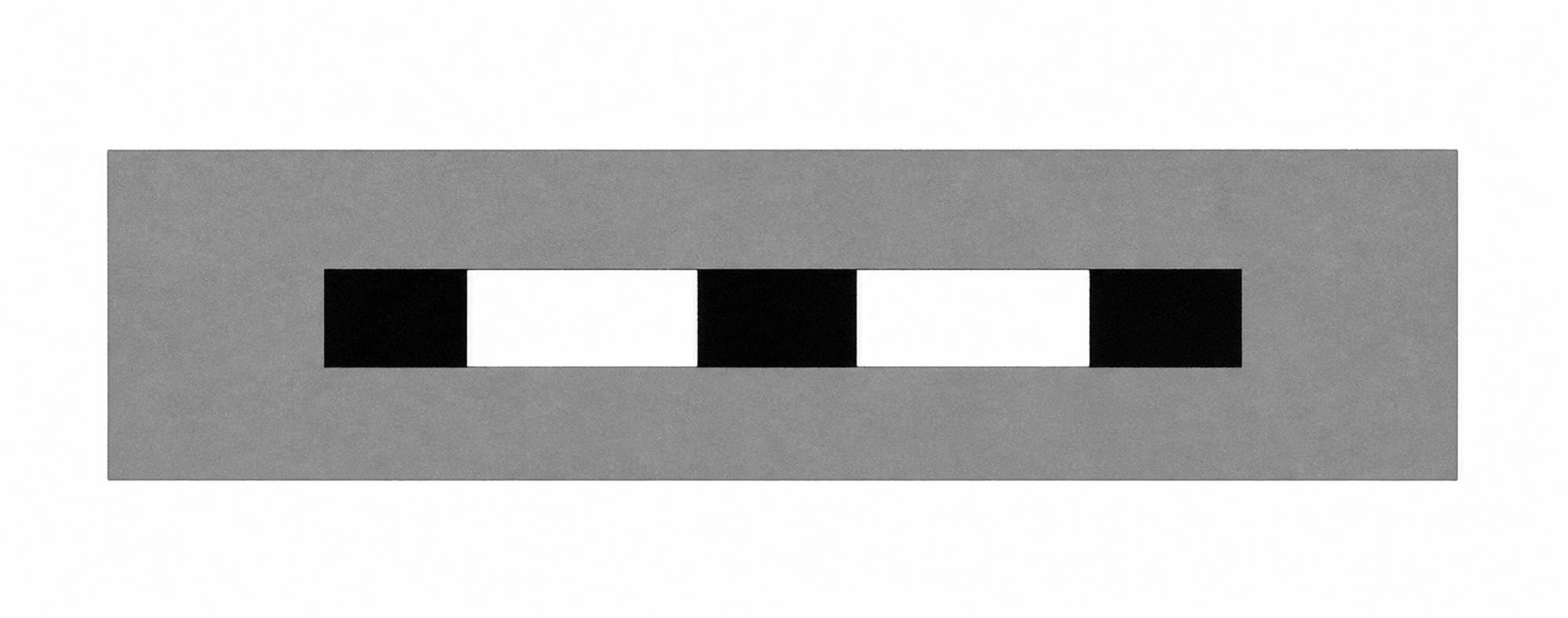
Since there are seven points in R, there are 2', or 128 possible subsets 5; of R. Only a few of these subsets are "coherent" in some sense; and it is these coherent sets taken together, as a system, which form the wholeness of R. To simplify the task of examining the subsets of R, let us throw away all those sets which have disconnected points [like (13) or (27)], and consider only the connected sets of points like (123) or (3456) [I use the numbers to identify points reading from left to right, so that (13) is the set consisting of the first and third squares in the pattern]. Of the 128 possible subsets, 100 are disconnected. I disregard them because they are so weak as centers that they play no significant role in the wholeness. I also disregard the seven sets consisting of individual points. The remaining twenty-one subsets of R all have more than one point and are connected. There is one of length seven, two of length six, and so on down to six of length two. These twenty-one connected sets are the most interesting sets in R, and do the most to contribute to the wholeness of R.
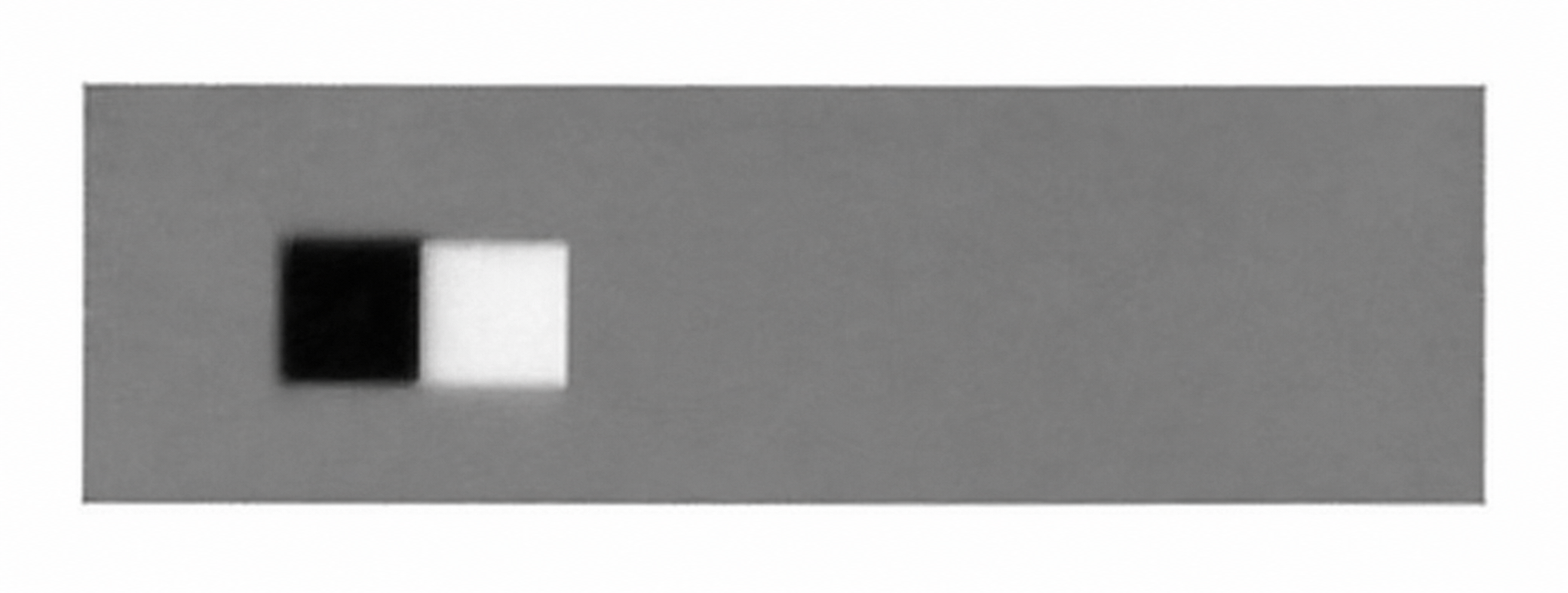
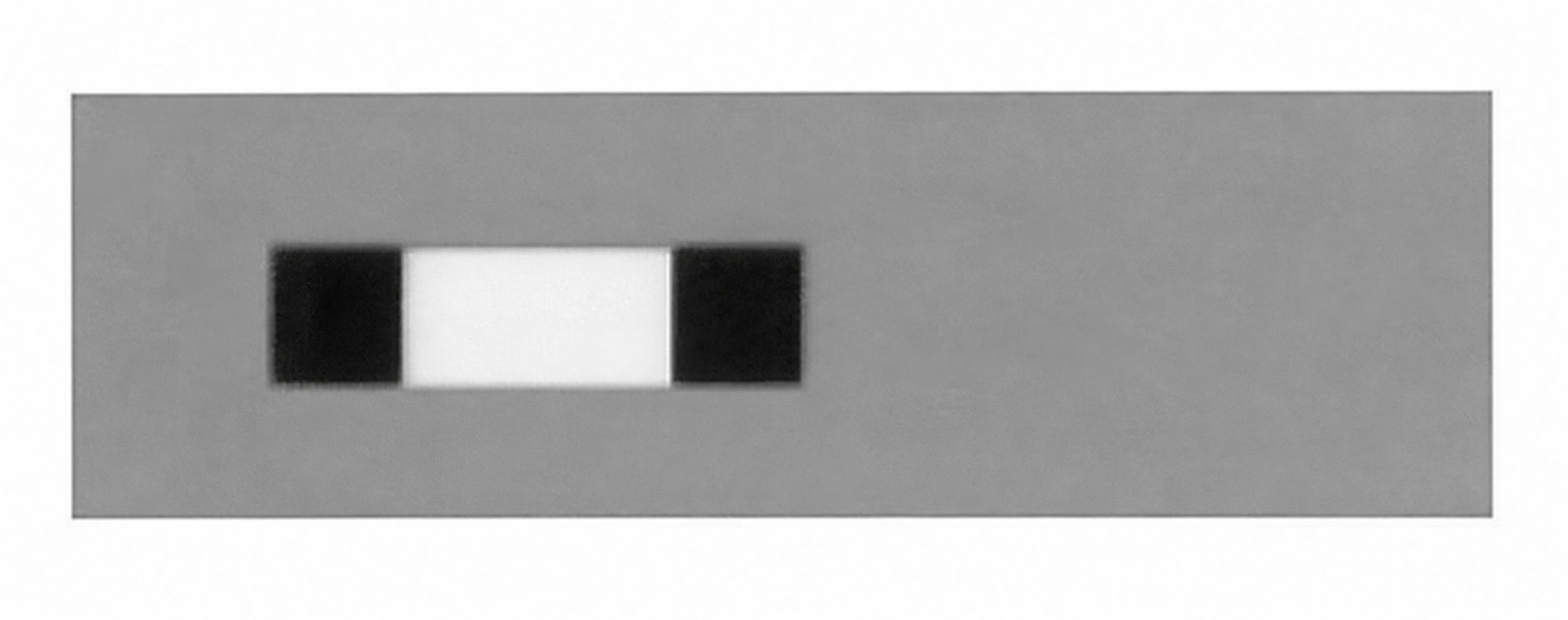
Let us consider some of these connected sets. Consider, for example, the set (12), which has a black square on the left and a white square next to it. Within the pattern R, this set has no marked life or coherence and plays little role in the gestalt of R. On the other hand, the set (1234) consists of two black squares forming a sandwich around two white ones in the middle. This set has strength as a center. It is clear that
We could examine each of the 21 connected subsets of R one by one, and decide on its life, or relative life, to determine whether it forms a center. If we did this, the system of all the coherent sets -- the centers -- would give us W.
Instead of doing this, which is laborious even in this simple case, I can get an approximation for W by choosing a mathematical function which gives us an approximation to the life for each subset. One simple example of such a func- THON 18 Cyn (8):
0 if S; is not connected 1 if S; is connected and Cham(S;) = bilaterally symmetrical 0 if S; is connected and not bilaterally symmetrical
This function is based on the local symmetry of the subset. It gives each connected symmetrical subset the measure one, and all other subsets measure zero. Expressed differently, it says that the strongest centers of R are the locally
aul en
Z| 2)
(wd (BA
The pattern R has, within it, the eight centers formed by local symmetries, as shown above. To a first approximation, the system of these eight centers together, with their embeddings, constitute the wholeness WV for the pattern R.
symmetric connected sets.'? The wholeness W,,,,», for R, defined by this artificial measure of life Cynny is Shown in the diagram below. As we see, R contains just seven symmetrical segments more than one square long: they are shown below. Approximately, we may say that these seven symmetrical segments are the strongest centers of the pattern, and this system of seven centers is the wholeness WV,,,,,, for this pattern.
This particular function ¢,,,,, is significant because, roughly, it does indeed correspond to the centers we experience in the wholeness. For instance, the set (12) mentioned above which is not coherent, is asymmetrical. The set (1234) mentioned above, which is coherent, is symmetrical.
And the wholeness W/,,,,, described by this measure of life ¢,,,,, even though simplified, turns out to have surprisingly good predictive power. As I have mentioned in chapter 5, the perceived life of the 35 patterns similar to R, as measured experimentally by various measures of cognition, memory, speed of perception, ease of description, etc., has been determined. The pattern R is about eighth in the rank order of the 35 strips which were examined, It is less coherent than some, more coherent than others. As it turns out, the particular version of the wholeness W,
symm predicts this experimentally determined rank determined by the symmetry measure, order (in comparison with other patterns) extremely well -- not perfectly, but extremely well. Thus W,,,,, can predict, and explain to some degree, the way these patterns are experienced cognitively.' In appendix 3, we see that it also gives a first approximation to the similarities in wholeness that different observers experience.
However, in spite of these empirical successes, it is important to recognize that ¢,,.... the
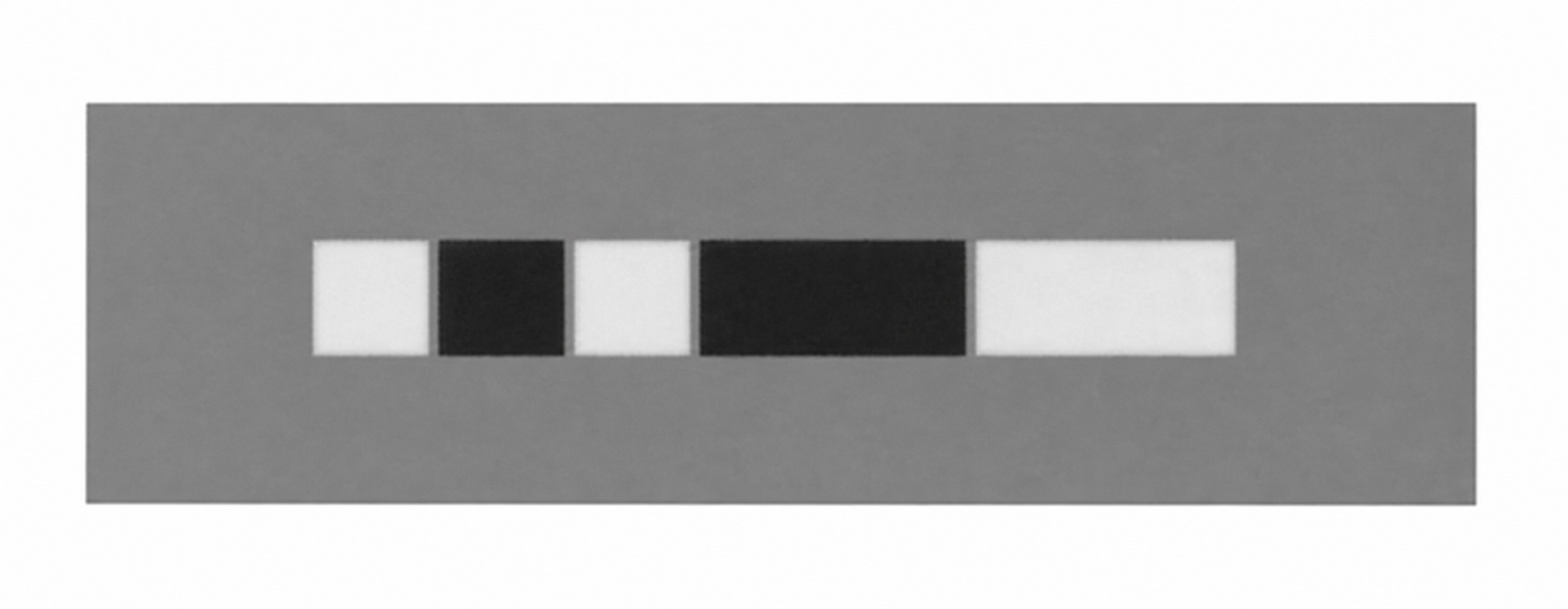
The pattern WBWBBWW local symmetry of sets, is only an approximation, and will not perfectly identify the naturally occurring centers in a pattern. For example, in the pattern (WBWBBWW), the segment (2345), which goes (BWBB), is clearly perceived as a dark lump with a white middle, and hence as a center in the acfua/ pattern. Yet it is not symmetical, and will therefore not be identified by én Thus ¢,,,,, makes mistakes. It will not pick out all important centers.
Further, in the pattern R (BWWBWWB), the set (1234), with its strong black-white contrast, is actually a stronger center than (23), which is just a white bar. However, both are symmetrical and Cyn, = 1 for both these sets. In the real W for R, 3; should therefore be bigger than ¢;. The ¢ynn is inaccurate in this respect. Otherwise stated, ¢,,,,,, does not correspond, exactly, to the rank order of life of the subsets as they occur in R, and therefore only constructs an approximate W, which only approximates the actual W that exists in the world.
Even s0, it is significant that cy. gives such a remarkably good approximation. It predicts, correctly, the relative overall life of different black and white patterns, as measured experimentally by Alexander and Carey." And it predicts correctly the overall similarities among black and white patterns, as measured by Alexander and Huggins."
As I have said, the mathematical structure Wynny though sophisticated and precise, is still not quite right, and must be viewed as an approximation. To get closer, we could, for example, use a more sophisticated mathematical measure -- Ceeondonterymm -- Which calculates, for each of the 28 connected subsets, how many local symmetries it contains, and therefore what its expected life might be. This would then be fed in to form the measure for a new more complex W, which we might call W,..., and hard to calculate. And even this second more onterymm Lhis would be complex complex W would sti// only be an approximation to the real W, W,,,., which depends on the empirical degree of strength of the various centers in the pattern, as perceived.
Other more complex arithmetic functions to use as possible measures for the life of centers have been proposed by Salingaros, and by Klinger and Salingaros."© The measures they propose include the local symmetry, but add other features into the computations. They get very good agreement with empirical determination of relative life in different buildings.
Thus we have many possible ways of trying to get W, empirically and mathematically, by choosing different functions to approximate the degree of life of different centers. Ultimately, as in mathematical physics, one might arrive at a deep enough understanding so that a mathematical W could be defined which would be a very high-order approximation to the true wholeness and would, to all intents and purposes, then serve as a readily calculable W,,,..
Using computer techniques, it is also possible to contemplate a recursive function, which works iteratively. We would use a certain measure to calculate a first approximation of ¢; for all the sets. We would then feed this back, and use this first iteration, as a basis for calculating a second iteration, and so on, for as many iterations as we wish. This technique would come close to the recursion contemplated in the fundamental mathematical definition of the degree of life of any given wholeness that is specified in chapter 4. I hope this example gives the reader a feel for the nature of W. The ideal, which we should perhaps call Werue, based on the real relative strengths or life of different subsets, is difficult to obtain, because it would require a very large number of empirical measurements on all the different subsets of R. Nevertheless, it is this ideal Wwhich is the wholeness, as it occurs, and is, ultimately the subject of this work. However, as we have seen, even mathematically constructed approximations like Wsymm, using symmetry and other measurements on subsets, may give us very useful and surprisingly accurate approximations to the wholeness. Like any scientific models, they are imperfect, but may nevertheless give considerable insight into the actual behavior of the structures being studied.
Notes
8. Experiments on the way people see these and other black and white patterns were first published in Christopher Alexander and Bill Huggins, "On Changing the Way People See," PERCEPTUAL AND MOTOR SKILLS 19 (1964): 235-53.
9. Experiments on the perceived relative life of the black and white strips were first published in Christopher Alexander and Susan Carey, "Subsymmetries," PERCEP- TION AND PSYCHOPHYSICS 4, no. 2 (1968): 73-77.
10. Chapter 5, page 189.
11. Appendix 3, page 456.
12. We may say that, according to this measure, centers are defined as sets whose ¢; = 1.
xy. As given in Alexander and
"Subsymmetries."
14. Ibid.
15. As given in Alexander and Huggins, "On Changing the Way People See."
16. Nikos Salingaros, "Life and Complexity in Architecture from a Thermodynamic Analogy," prysics ESSAYS (1997, Vol. 1, no. 10), 165-173, and Allen Klinger and Nikos Salingaros "A Pattern Measure," ENVIRON- MENT AND PLANNING B: PLANNING AND DESIGN (2000, volume 27) 537-47. Division of Mathematics, University of Texas at San Antonio, San Antonio, Texas, and Department of Computer Science, UCLA, Los Angeles.
Carey,
It is not always easy to see the wholeness which exists in the world. Our verbal structure can mislead us and make us pay more attention to certain features of a situation than to others, so that we then see a biased or distorted picture of the wholeness which confronts us, not the wholeness itself.
I have suggested in chapter 3 that the human process of perceiving a distorted wholeness is responsible for many ills of architecture. A similar suggestion was made by David Bohm. Thus: "Ofcourse the prevailing tendency in science to think and perceive in terms of a fragmentary self-world view is part of a larger movement that has been developing over the ages and that pervades almost the whole of our society today.... As has been indicated, however, men who are guided by such a fragmentary self-world view cannot do other, in the long run, than to try in their actions to break themselves and the world into pieces....""
Indeed, we can see that the wholeness of the world is being misunderstood, or not perceived at all, simply from the building construction we see in so many places in our towns and countryside, and from the violent way it so often violates the wholeness which exists, thus ruining both landscape and townscape. The overwhelming problem, with modern building, is that it often fails to enhance, support, the wholeness which exists. That is why we are so dismayed by it, and why it seems so uncomfortable, so far at odds with life.
This topic is taken up at great length in Book 2 -- especially chapters 13 to 15. Indeed, the whole of Book 2 may be understood as an essay which describes the process which is needed, in the world, to make sure that each act of design, planning, or construction, is consistent with, and contributes to, the wholeness which exists. That is the whole ballgame. That is she basis of life.
But the problem is, if we cannot see the wholeness which exists in the world, then of course we cannot take actions which are consistent with the wholeness which exists.
I was astonished, many years ago, to find out, in the course of an experiment I was doing with Radcliffe students, that most of them did no¢ see the wholeness of simple patterns. They saw, instead, a distorted picture of these patterns, viewed them with arbitrary intellectual devices rather than responding to the deeper wholeness that was present in them. I found out, too, that it took immense effort to dissuade them from their distorted cognition, and to help them to see wholeness as it is. I shall briefly summarize the results of my experiments.
In the base experiment, I used the same 35 black and white patterns described in chapter 5. In this experiment, I asked people to play with the strips on a gray board and group them according to their similarities: to lay them out in such a way that similar ones were together.
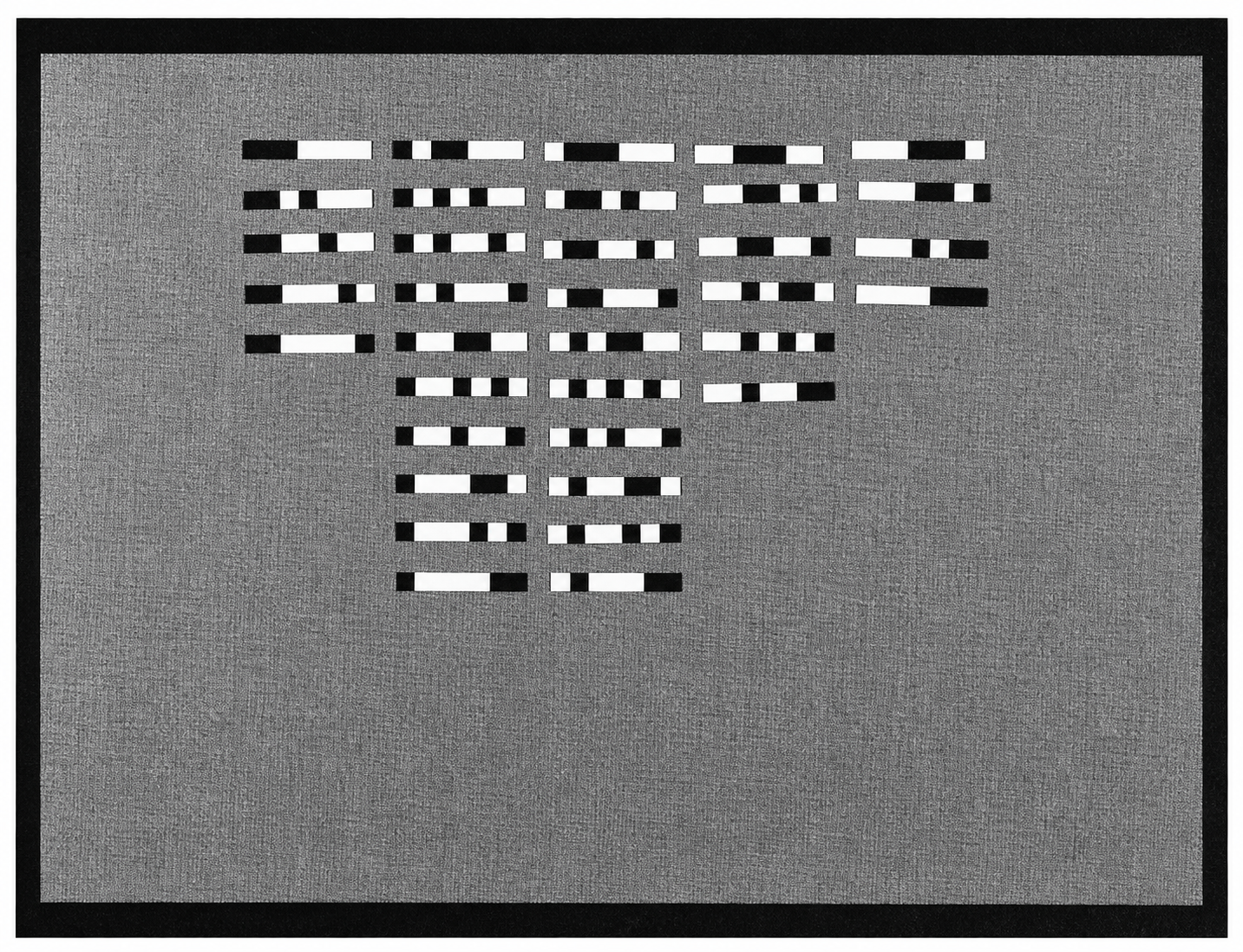
It turned out that the subjects in our experiments (Radcliffe students) always made versions of two broad kinds of layout: one (upper illustration on the following page) in which the strips were grouped by reading the strip left to right; and one (lower illustration) in which the strips were grouped by their overall pattern or configuration.
In the upper layout, the patterns are grouped as they might be in a library, by reading the pattern from left to right. The first column contains all those which start with two black squares; the next column all those which start with one black square; and so on. This is certainly one ration al way to group these patterns, and very much in keeping with the way our minds have been trained.
In the lower layout, the strips are grouped by their pattern. Those with similar structure or similar configuration as a whole are placed near
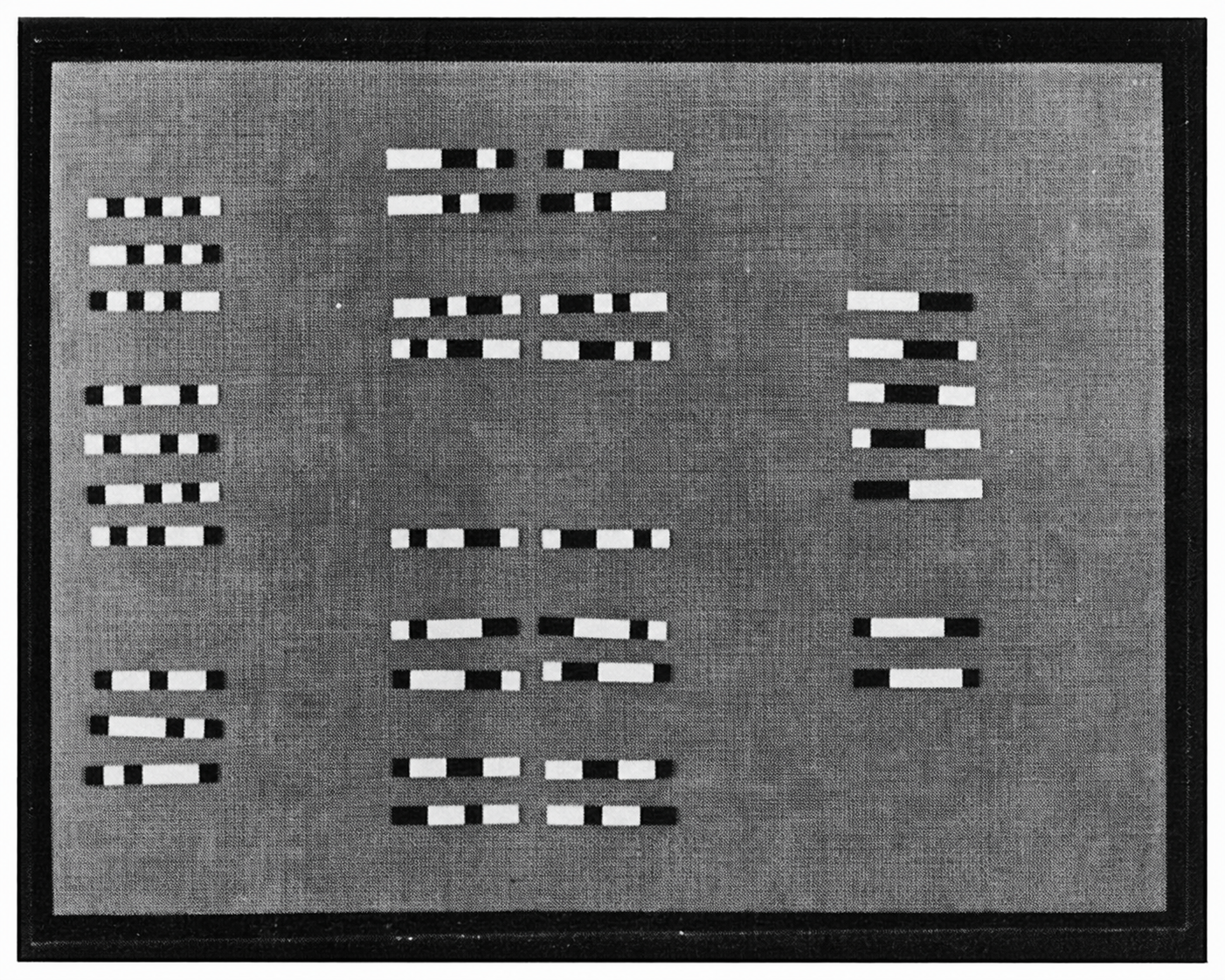
Typical layout based on the wholeness of the patterns each other. For instance, on the left, one sees all those patterns with a staccato pattern made of many small units; on the right, one sees a group of all those with a slow, lazy pattern of long bars. All those which contain the figure two black, one white, and then one black, whether this figure is left to right, right to left, at the end of the strip, or in the middle, are grouped together.
The second layout is based on wholeness. The first layout, on the other hand, is based on an arbi-
trary way of classifying the patterns, but of on their wholeness. Bill Huggins and I discovered in 1960 that among Radcliffe students most did not see the wholeness, and could not see the wholeness. Moreover, that it was extremely difficult to get them to change their perception so that they could see the wholeness.!? On the other hand, in other experiments, we found that young children routinely saw the wholeness, and that mentally retarded people, too, usually saw the wholeness." Only the adult and highly educated Radcliffe students grouped the patterns by reading them leftto-right, thus ignoring the wholeness of the patterns.
Let us first see what it means to say that the second way of grouping the patterns is based on their wholeness, while the first way of grouping them is not. Consider the black and white pattern described in appendix 2, which goes BWWBWWB. In the wholeness of this pattern, the following sets are strongest: The sets BWWB and WWBWW are strongest. The sets WW, and B...B...Bare slightly less strong but still very important. The system of these strong centers defines this particular wholeness. A holistic perceiver sees this pattern more or less as it is, and therefore groups this pattern with others which have similar configuration, that is, with other patterns in which a similar system of centers occurs: for example, the patterns BWWWBWB and BWBWWWB which also contain long white bars trapped between black squares.
But a perceiver who looks at the pattern by reading left to right in the sequential mode is not seeing the structure of the wholeness, but is instead paying attention to some different structure in which the relative strengths of different centers (the crux of the wholeness) is distorted. She chooses to see sets B, BW, and BWW at the left-hand end as strongest -- not because they actually appear strong, but because she has decided to make them strong in her mind, so as to use a kind of "alphabetical" classification system.
Huggins and I were very surprised indeed to discover that 80 percent of our Radcliffe students -- highly educated, intelligent people of the 1960s -- focused on an arbitrary and, I would suggest, insignificant aspect of the patterns.
Itmight be argued that the two groups of perceivers both chose aspects of the patterns which were valid, and that their two modes of perception are equally valid. It might also be argued that the perceivers who chose to arrange the patterns on the basis of left-right reading might have been perfectly ab/e to see the wholeness, but simply chose to use another aspect of the patterns as a basis for sorting them.
But I believe this experiment suggests that most educated people do not see the wholeness of the world around them. Thus our experiment was merely a laboratory version of a far more serious cultural and societal problem: the fact that in a culture which is based on mechanistic views of reality (especially in the culture we have today, which is not only mechanistic but also highly verbal) the atomistic/sequential view of reality is typical, and people's ability to see wholeness is, in general, very much diminished.
This was not always so. In many so-called primitive societies, holistic perception was the normal mode of perception. There is considerable evidence that people from so-called traditional cultures -- the cultures that we often admire for their ability to produce great art -- had a mode of seeing in which they saw things in their wholeness. Our notion that they were primitive, and that we are sophisticated, is mistaken, I think, when we consider that they saw the all-important wholeness correctly, while we so often fail to see it.
Children are also better at seeing the wholeness than adults. This is, I believe, because the wholeness comes to us, it is visible at allonly when our minds are open. It is words, and learning, which have the power to distort the wholeness, and to prevent us from seeing it. If we have notions, or theories, or preconceptions about the parts, we focus our minds on individual things, and fail to see the system of centers in its balance as a distributed, distended unity.
More worrying, it appears that it is not easy for an educated, "modern" person to recover her or his natural holistic perception. In a second se-
ries of experiments which Huggins and I also did with Radcliffe students, we found out that it is extremely difficult to teach a person to see holistically once she has been educated to see sequentially. We tried to devise forms of training which would move a person's perception toward perception of wholeness. Since we had an objective method of testing the way that a person sees the black and white strips, we could test people, after.
exposing them to various types of training, to see if their ways of seeing really had shifted toward the holistic mode.
Over a period of months, we tried many different training techniques. We asked people to play with the patterns, build things with them, look at them from a holistic point of view, close their eyes and dream about them. None of these things worked. These techniques had virtually no effect. Only one technique that we ever found successfully changed a person's perception toward holistic.
The successful technique went like this: the subject was shown one of the thirty-five patterns and allowed to look at it for a few seconds, until she knew which one it was. She was then shown a large rectangular array of thirty-five different patterns jammed up close to each other in a very confusing way, and without any visible order to the arrangement. This array was flashed on a screen for just one second. During this one second, the subject had to find the particular pattern she had been shown. If she succeeded, she won a nickel (in 1960, enough to buy a cup of coffee). But it was hard to win the nickel. The task is very hard, roughly comparable to the difficulty of finding a single word on a page, in one second, without having time to read even a single line.
Under these conditions, looking at the patterns one by one just doesn't work. There isn't time to do it. But under the pressure of the experiment's one second deadline, doing it again and again, subjects gradually found a way in which they could find the pattern they were looking for, in the one second they had available. What they did, and had to do, to make it work was to gaze in a blank, unfocused fashion at the whole array, trying to allow themselves to be blank, receptive, and to see the board all at once. Try it yourself. In this receptive mode, you have to move "back" mentally, away from the patterns, and then begin to see differently: you almost have to let your eyeballs move backward in your head. Mentally you back away from the screen, and open your eyes very wide, so you are not looking for anything in particular, but see everything. This forces you to see "the whole."
In this state, even in the short time of one second, you can often "see" the one you are looking for. You don't see it perfectly, because you are not looking at it. But you are aware of it, within the field as a whole. It is a state of perception in which you are unfocused and therefore extremely passive and receptive: then the pattern you are looking for almost seems to come to you. You don't search for it. It comes to you.
More than half of the people who were exposed to this high-speed search technique then learnt to see holistically, where only twenty percent had seen holistically before. Apparently, this exercise did enough to change the taught and "verbal" or conceptual form of looking at patterns, and replaced it with a holistic way in which people really saw the wholeness that was there."!
This experiment is very instructive. It tells us that the ability to see wholeness as it is requires an unfocused view in which we do not select what we pay attention to or force attention in a certain mental direction. Instead we see, watch, drink in the configuration of the wholeness which we see before us.
As I have stated in chapter 3, words, concepts, and knowledge all interfere with our ability to see wholeness as it is. To see wholeness accurately, we must not pick out those artificially highlighted centers which happen to have words as names, since these are often not the most salient wholes in the real wholeness. What we must do instead is to watch, quietly, receptively, and in an unfocused state, for those centers which are most salient in the real configuration as it is.
A similar experiment, also trying to help people abandon their focus and attention and
see reality as it is, was described at great length by the French psychiatrist, Hubert Benoit, in LET Go." Again, in that experiment, Benoit demonstrated that by abandoning our adherence to verbal structures, we come closer to seeing reality as it really is. The reality he describes, the Zen reality, is essentially the same as the wholeness I describe.
Notes
17. David Bohm, FRAGMENTATION AND WHOLENESS (Jerusalem: Van Leer Jerusalem Foundation, 1976), 14-15.
18. Alexander and Huggins, "On Changing the Way People See."
19. Ibid.
20. The experiments with young children and with mentally retarded subjects are unpublished.
at. Nelson Zink and Stephen Parks independently discovered the same phenomenon. They found that a small light hung in front of a person's eyes focuses the vision so narrowly that peripheral vision broadens, deepens, and forces the view to focus on the whole. See Zink and Parks, "Nightwalking: Exploring the Dark with Peripheral Vision," WHOLE EARTH REVIEW (Fall 1991): 4-9.
22. Hubert Benoit, ter co (New York: Samuel Weiser, 1973), originally published in French as LACHER prise (Paris: Le Courrier du Livre, 1958).
The picture of awakening space presented in chapter 11 requires a new mathematical view of space. It may be stated simply. We are considering a center as a geometric field-like phenomenon in space. In this sense, a center is a purely geometric thing, something which depends only on the arrangement, in space, of other centers. What we call its "life" is a geometric, structural feature which is a measure of the intensity of this field.
The suggestion is that a center is a pinpoint of actual life, a center of life, in the everyday and ordinary sense, which simply appears in space. Thus the geometric center which we first learn to see as a purely geometric thing is also a center of real life. The life emerges from matter through the organization of matter itself. All this arises from the pure recursive structure of the field of centers.
In order to describe this idea in consistent mathematical and physical terms, we have to make an important adjustment in our picture of physical reality. Most of us alive today have grown up with a certain view of physical reality -- essentially the one created by physics. This view, which describes the matter in the universe in terms of a small number of interacting fields -- gravitational and quantum mechanical -- has been triumphantly successful in describing our physical universe, both at microscopic and at macroscopic levels.
Nevertheless, the mathematical picture of space as it must be, in order to account for the phenomena I have been describing in this book, requires a picture of space and matter which has an addition al feature -- only hinted at in mathematical physics so far.
In chapter 4 I showed, for a column, how each center helps to strengthen the others, and how the whole column may be seen as a cooperating "field" of centers. In later chapters, we have seen more complex examples of a system of centers -- like Paris in the neighborhood of the Seine -- which pile function on function, and have seen how this system then performs deeply, in a functional way.
But it may not yet be clear how profoundly this idea shakes our current physics. The extraordinary thing does not lie in the "system" of these centers, nor in the fact that they cooperate to form a system. It is part of our general understanding of the world that systems cooperate to form more complex systems with new properties: that kind of thing is common in our present understanding of physics, biology, chemistry.
What is extraordinary here is something else. I have described the fact that each center has a certain life or intensity. By itself the original column has a rather low level of intensity. I have explained that, when the space between neighboring columns itself also forms a strong center, then the column "gets better." This means that the intensity or life of the center defined by the column becomes bigger at the moment when the center next to it -- the void between the columns -- appears on the scene. Similarly, when the capital appears on the scene -- another center enters the field -- then the center formed by the column itself and the center formed in the space between the columns doth jump up in intensity again. And of course the center formed by the capital itself is also now more intense -- because of the presence of these other two centers -- than it would have been alone. And then, as we add the molding to the capital, once again the levels or intensities of all the other centers jump up again.
This is the thing which is peculiar. It is a type
of behavior which is not typical of Newtonian space at all. Indeed, it is a type of behavior which is also not typical of relativistic space, nor even of quantum mechanical space.
In our present view of physics, and of the physical universe, we often have systems made up of elements. It is commonplace that a system as a whole has properties which are caused by cooperation of elements. It is also commonplace that the behavior of the system as a whole may therefore be new or unexpected. In mathematical terms, this means that the measure or function which describes the whole system's behavior is often different from simple arithmetic combinations of the measures associated with the individual elements. It may be a very complex function of the measures associated with the elements. However, the measures associated with the individual elements do not themselves change as a result of the presence of these elements in the larger system."
This is typical of the mechanistic picture of the universe. When we make a clock, the various parts of a clock are, in their basic properties, unchanged by their presence in the clock. In the mechanistic view of things, the cooperation of different elements can produce new measures in the whole. However, the individual measures of the individual elements are always defined locally, not globally, and remain unchanged as the elements enter into combinations.
But what I have just said about the centers in a field of centers is quite different. The life of any given center depends on the whole field of centers in which this center exists. This means that the most fundamental property of each center -- its degree of life -- is defined not by the center itself but by its position in the entire field of centers.
This idea is reminiscent of Mach's principle -- the idea that the behavior of any one particle is affected by the whole universe. In fact, the general idea that the life of each center in the universe is, somehow, dependent on the life of other centers might even be viewed as a generalization of Mach's principle." It says that, as far as centers are concerned, the most fundamental property of each individual center (its intensity or life or centeredness) is affected by its position vis-a-vis all the other centers. Thus the intensity of a center can never be understood as a /ocal property of that center itself, merely in terms of its own local structure. It is always a global property. It is affected by everything else. It cannot be measured by itself, since it depends entirely on its position in the whole. This idea requires an entirely different view of the physical substance we call space or matter.
This is the essence of the recursive definition of a center, which I have already laid out in chapter 4. But what I have not made clear before is that we do not currently possess any convenient mathematical representation of such a recursive field.
When I say that the conception of this recursive field lies outside our present conception of space and matter, what I mean is that we currently have no mathematical conception of any field in physics which has the recursive property defined in chapter 4 or chapter 11.
The classical fields have a field strength which is always dependent on something else, outside the field, and which produces the field. For example, the gravitational field takes values throughout space. These values are given as functions of the distribution of matter throughout space. It is true that the distribution of gravity will make the matter redistribute itself, and thus cause changes in the field, through time. But the gravity is not a function of the force of gravity itself. The electromagnetic field has two fields -- an electric field and a magnetic field; each one is dependent on the rate of change of the other. Again, the system interacts with itself, in a way that causes very important effects. But the value of the magnetic field is not a function of the value of the magnetic field itself at other locations. Each of these fields is dependent on something else outside itself (the magnetic field is a function of the rate of change of the electric field, for instance), and can be calculated from knowledge of this something else.
But the intensities which occur in the field of centers, as I have described them in chapter 11, depend on the field's own values. The field apparently has the property that the field strength, at a given point, is a function of the many field strengths distributed through space in its vicinity. The field strength is a function of the other field strengths themselves. So, the field is selfdependent somehow.
There is no field of classical physics which is self-dependent in this fashion. I have not yet been successful in my own attempts to create a mathematical model of such a self-dependent field. Iam fairly sure that the field must be some kind of hierarchical structure, in which different field strengths are nested inside each other. I would also guess that the field strength is strongly associated with the local symmetries described in chapters 4 and 11. But so far, I have been unable to construct a field with the necessary properties.
At each stage in our understanding of the physical world, we have always assumed that space has a certain mathematical structure. It is this mathematical structure of space which gives the world the properties we know. In particular, the mathematical description of space that is currently popular assumes that causal effects are local. This is a result of the neutral geometrical structure of the mathematics which we use to describe space." It is precisely this assumption about space which is being challenged by the idea of the field of centers. In order to see space in a way which allows the field of centers to work in the way that I have been describing in this book, we need a different model: space itself must have a different mathematical structure.
We want to associate, with each point of space, a measure. I will call this measure "the intensity of the field" at that point. The intensity of the field measures how strong a center we have, how much life the field has at any given point.
If the field behaves in the way that we have seen empirically in many examples, and in the way that I have described for the example of the column, we need a type of field which has the following property: as we increase the intensity of the field at certain points, the intensity of the field also increases at other points. In fact, the intensity at each point is a function of the intensities of the other nearby points. We may visualize this easily if we imagine a light bulb at each point in space. The intensity of the field at that point is given by the brightness with which the light bulb at that point glows. Somehow the light bulbs are linked. And we want a type of linkage which has the property that, when we make some bulbs glow more brightly, or screw in a new light bulb in a certain place, this also then makes certain other light bulbs in the system glow more brightly. The idea that space is a kind of substance in which centers and their life depend on the configuration of centers as a whole, or even on some non-local extended field, holds extraordinary promise. It implies that the world is unpredictable in an entirely new kind of way -- because the field of centers can produce levels of life, in the individual centers, that are not understandable from their local structure. In particular, it even contains a possible answer to the question "what is life," meaning "what is the quality, not the mechanism, of life?" -- a mysterious question which has not yet been answered in three hundred years of mechanistic physics and biology. Every living system is a field of centers. Within the view that I have just explained, it becomes possible to imagine that certain configurations of centers have such organizing force that they create entirely new levels of intensity within the centers themselves -- and therefore utterly transmute the material character of space itself. Thus the bootstrap effect -- the way that centers affect one another, and mutually intensify each other, conceived as a basic property of space and matter -- may give us a coherent understanding of the way that life, a new and nonmechanical phenomenon, can be created within the so-called dead matter. But all this can only be understood within a framework where we recognize that matter itself -- space itself -- is a different sort of substance from the one which
we have understood before, because it allows the presence of a recursive field to occur.
What all this boils down to is that we may have to modify our picture of the world in a very fundamental way indeed. For more than a hundred years, we have conceived the matter in the universe as made of particles, floating and moving around in space. In recent years, it has become clear that the space itselfalso has a fine structure (something like a foam of bubbles, even in the socalled vacuum) and that the space where matter appears is only slightly different from the space where there is a vacuum. Thus we have been moving toward a picture of the universe as made of a kind of space, and where "ripples" occur in this space, what we call matter appears.
But the new picture which I propose here would make matter itself more dynamic than we have assumed so far. Up until now, we have treated the "ripples," which appear in this space, as essentially fixed in their nature. The elementary particles, for example -- atoms, electrons, whatever -- have always been assumed to have a more or less unchanging character, as they enter into combinations, and we have so far tended to think of matter as a kind of pattern of arrangements of elementary particles, which themselves then appear more or less unchanged in the combinations they create.
In the view that I am putting forward here, this would not necessarily be true. The centers that appear in space might be different, according to the context in which they appear, and might become more and more powerful, according to that context. Of course, it has always been known that an electron in an atom is not quite the same as a free electron, and that an atom in a molecule is not quite the same as an atom by itself -- but we have assumed that this kind of difference is minor and still easy to explain within the framework of thought that treats combinations as arrangements of the elementary particles.
The nature of a center and of the field of centers -- if they have the character of the recursive field I have suggested -- would indicate that space and matter have a more mysterious, more open-ended nature. It would appear that the space/matter itself can actually change -- I mean by this that the space really somehow changes fundamentally in its local nature -- as it becomes progressively more organized. All space has the capacity to have centers in it. When a center appears there, other centers are intensified by the presence of this center. The overall configuration of centers affects the space itself. Since each center intensifies others, we have a substance (the space/matter) which apparently has the capacity to generate life within itself almost spontaneously, since the production of order at any one point (a center) can increase the overall orderliness, and intensify the order which appears in other centers.
This view is consistent with the non-local interpretation of quantum mechanics, which holds that the behavior and character of one particle may be affected by structure in other regions of the universe, even by those regions which cannot have any causal or mechanical interaction with it."
Where a center is formed, the space itself gradually comes to life. What we know as life is the condition which occurs as this precious life -- or centeredness -- is geometrically induced in space in the recursive way I have described; that is, from a mathematical point of view, what we would have to understand from the "awakening" of space.
Notes
23. See, for example, the picture of field equations given in Erwin Schroedinger, spACE TIME STRUCTURE (Cambridge: Cambridge University Press, 1960), throughout, or Charles Misner, Kip Thorne, and John
Archibald Wheeler, GRAVITATION (San Francisco: W. H. Freeman, 1973), chapters 1, 3, 4, 10-11, 20, 22-26,
24. Ernst Mach, space AND GEOMETRY (La Salle, Illinois: Open Court Publishing Company, 1960). For dis-
cussion of Mach's principle, see Thorne, Misner, Wheeler, GRAVITATION, section 21.12, 43-49.
25. The uniform spatial scheme of analytic or coordinate geometry, which has made us think of space as a neutral, lifeless, and dead substance, is due to Descartes. He first described this scheme in his GEOMETRY, vol. 6 of OEUVRES DE DESCARTES, which may be read in the uniform edition by Charles Adam and Paul Tannery (Paris, 1897-1913).
26. Again, see Mach, sPACE AND GEOMETRY. The same idea was also discussed in general philosophical terms, in Alfred North Whitehead, pRocEss AND REAL- 1Ty. The more specific idea that the existence of life in the universe causes deep changes at the quantum mechanical level, and thus happens with changes in the actual structure of space and matter, has recently been discussed by a number of writers, including Roger Penrose, THE EM- PEROR''S NEW MIND (Oxford: Oxford University Press, 1990), and Howard Pattee, "Biology and Quantum Physics," in TOWARDS A THEORETICAL BIOLOGY: I. PROLEcomena, C. H. Waddington, ed. (Chicago: Aldine Publishing, 1970).
27. For example, the experiments of J. Clauser, reported in S. Freedman and J. Clauser, Prys. Rev. Lerr. 1972, 28, 934 41, and the experiments of Alain Aspect reported in Alain Aspect, P. Grangier and G. Roger, Prys. Rev. Let. 1981, 47, 460 66; which indicate the existence of non causal connections between phenomena too far apart to allow speed-of-light causal interactions to pass between them.
The fact that the behavior of the world depends on the wholeness which exists in space is not peculiar to buildings or to works of art. It is something fundamental about the world which controls even the behavior of subatomic particles. Recent discoveries in physics have shown that the behavior of matter at the subatomic level is modified -- perhaps entirely governed -- by the wholeness.
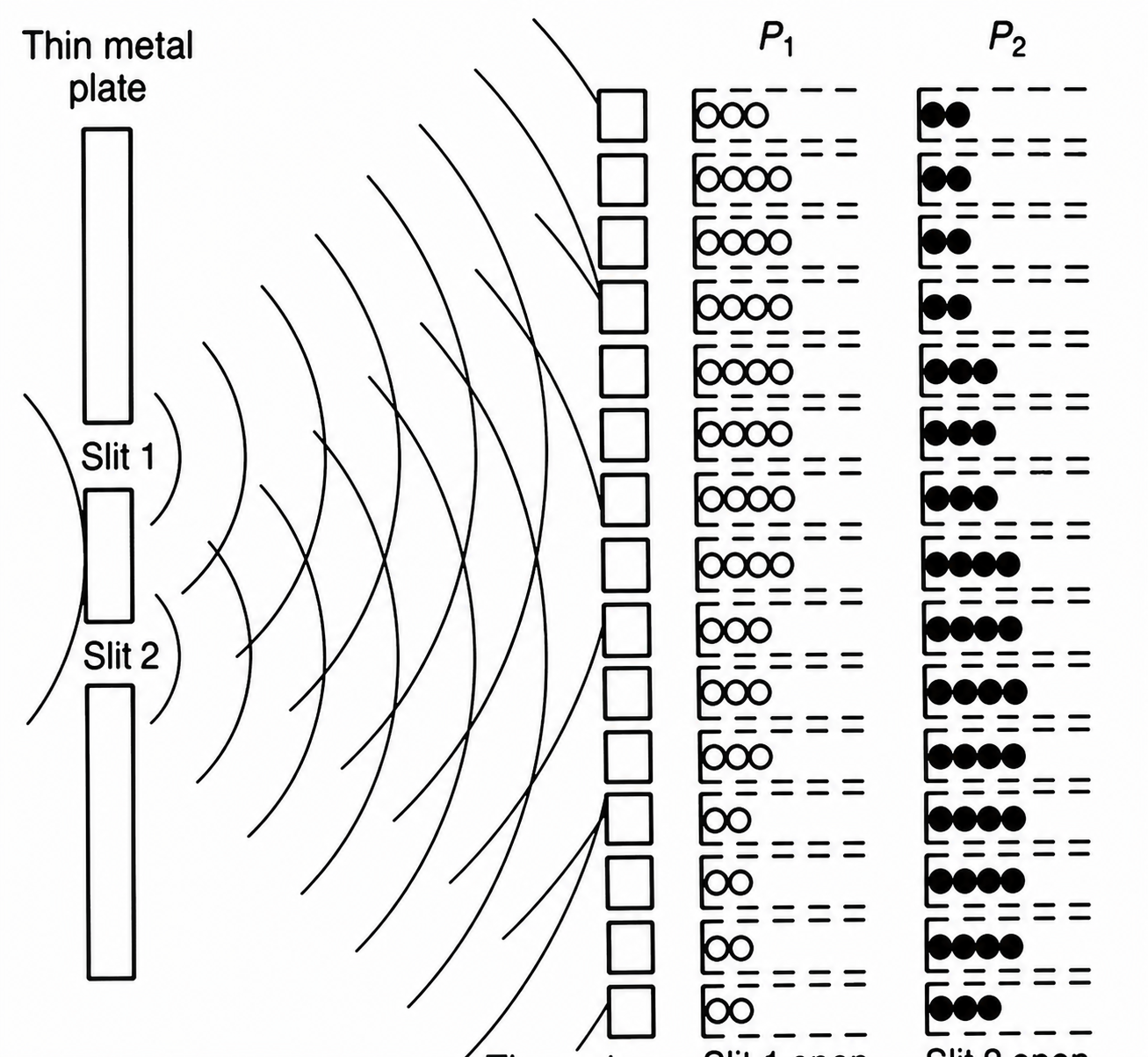
The problem is crystallized in the famous two-slit experiment. In this experiment, a hot wire sends off electrons, and these electrons are made to pass through two parallel slits and then hit a wall. You can see the experimental arrangement in the diagram below.
In order to understand the following discussion, you have to understand that each electron is
Thin metal plate
Electron gun
cc)
Stit
)
Slit
OOOO Gon poo
Elements of phosphor detector screen a little station ary wave (almost like a turbulent tiny whirlpool) which flies like a bullet through the air. In the illustration on this page, bottom right, which is hugely enlarged, you can see little bright spots. Each bright spot marks the spot where one electron has hit the wall (a photographic emulsion). They are the bullet marks.
In addition, you have to understand that the hot wire can be controlled, so these bullets go intermittently, one at a time. So the stream of electrons is not a big stream where they all interact with each other, but a very slow stream, a radically slowed-down process, where one electron at a time comes off the hot wire, goes through the slits, and hits the wall.
Now consider the mysterious and wonderful behavior of these electrons. When just one slit
'! KXPERIMENT W
Slitt open Slit2 open Slit2closed Slit 1 closed
Slits 1 and 2 open
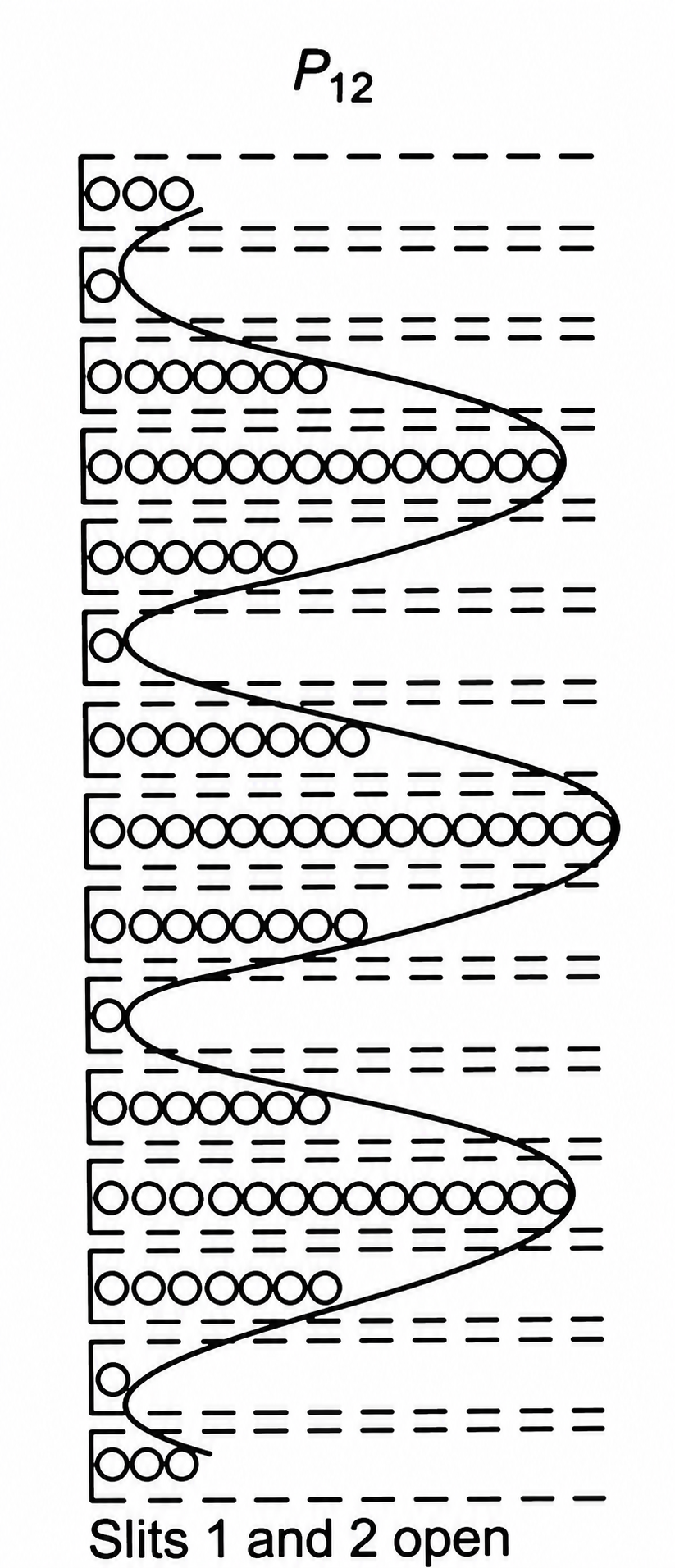
P, and P; show the distributions that arrive on the wall when slit 1 and slit 2 are open by themselves. P1; shows the distribution that arrives on the wall when both slits are open together.
is open, the electrons that go through the slit make a smudged overall pattern on the wall. It is the same kind of pattern you would get from a spraying paint through the slit: thick in the middle and falling off towards the edges. The electron hits are most dense at the point closest to the slit where the electron's path would be a straight line, less dense at points on the wall further from the slit, and falling off smoothly as they get still further away. In effect the bullethits on the wall make a normal distribution on the wall. You can see this normal distribution in the diagram on the previous page. Column P, shows what happens when slit 1 is open (by itself). Column P, shows what happens when slit 2 is open (by itself). All this is rather straightforward.
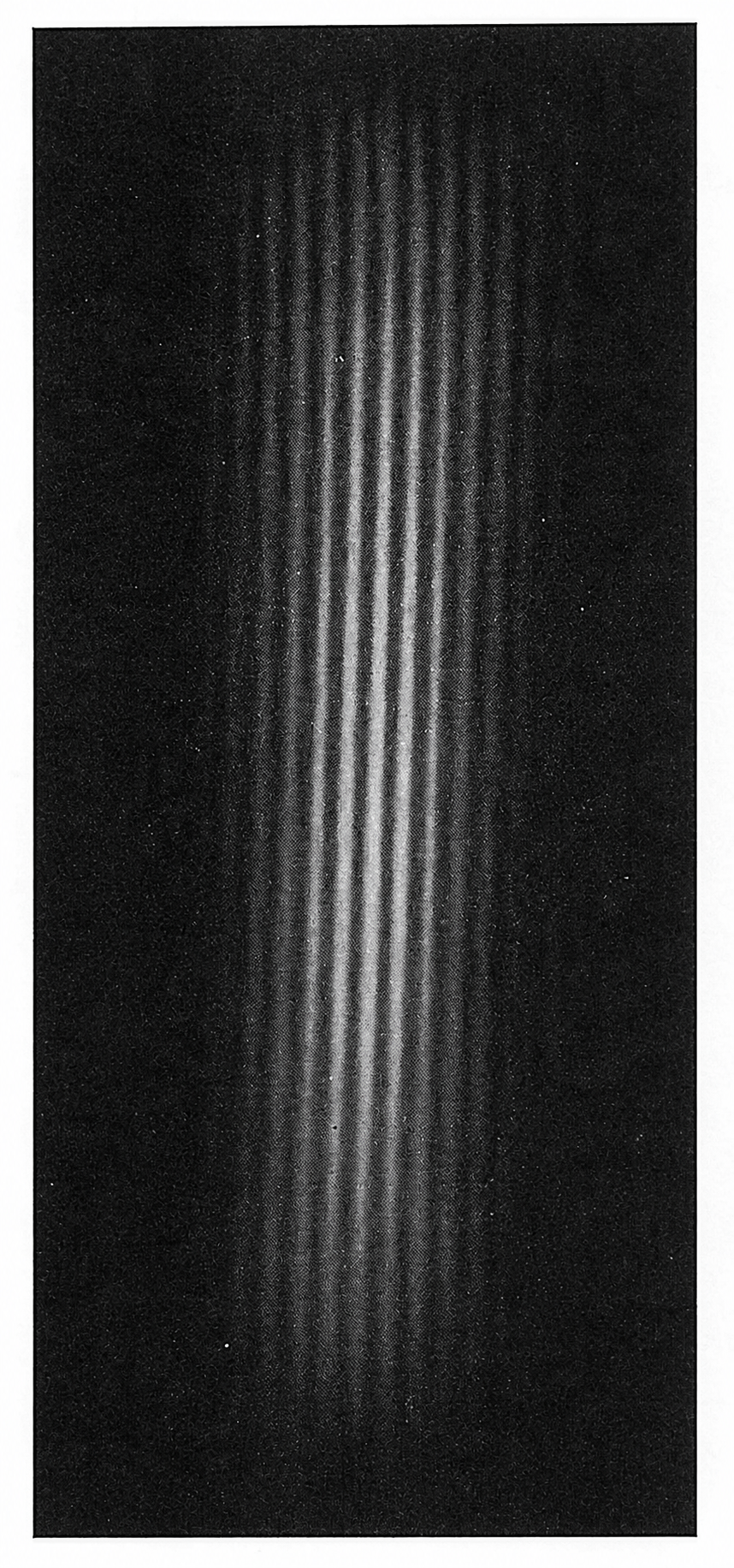
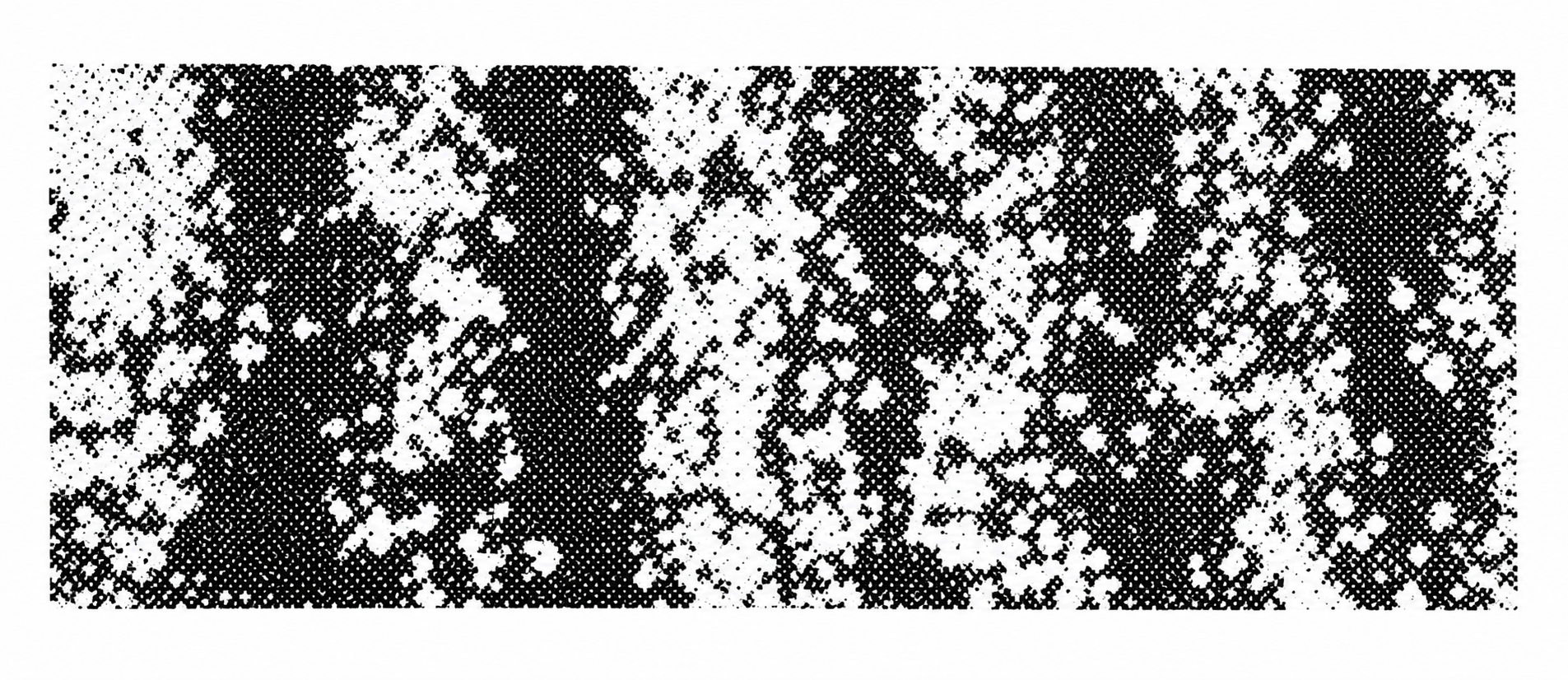
What happens when both slits are open at the same time is dramatically different and not straightforward at all. The pattern made by the electrons hitting the wall now becomes an alternating pattern of dark and light bands, where virtually all the electrons have gone to the light bands, and almost none to the dark bands in between. This pattern is shown in the photographs on this page, and in column P,, of the diagram on the previous page.
A similar pattern is familiar in the case of light. The interference of light waves, to form interference fringes, as they are called, was discovered two hundreds years ago, by the French physicist Augustin-Jean Fresnel. Mathematically, it is explained by the fact that the wave fronts go through both slits, and thea, as they hit the wall, cancel, or do not cancel, and thus form light and dark zones. For the electron, there is also a wave-like explanation, which is similar to the case of light, and whose mathematics explains this phenomenon perfectly. This is the famous wave equation of quantum mechanics. So, on a mathematical level, the two-slit experiment is worked out, and perfectly understood.
But rea/ly understanding what is happening is quite another matter. The problem is that the electrons, though wave-like in certain respects, really are like little bullets. You can see their bulletlike character in the bright spots on the photographic emulsion in my photographs. In the case of waves, the explanation of the fringes works because the waves coming from the light source go through doh slits and then interfere as they
Enlargement of the interference fringes shows individual dots of light made by individual electrons, thus showing that electrons go one at a time, like bullets. Yet the interference fringes are caused by wave berhevior. It is this crucial point which shows that the electrons must be moving under the influence of some guiding wholeness of the configuration.
come together. Buta particular electron, one electron, is like a little bullet. It cannot go through both slits. It only goes through one slit. It either goes through slit 1 or through slit 2. When we take this into account, and try to understand how the pattern of dark bands and light bands is built up, this is where the mysterious puzzle comes in.
Remember, the electrons are coming slowly, one at a time, to build up the pattern on the photographic emulsion. Let us imagine the case where only slit 1 is open. Slit 2 is closed. Look at the place on the wall which corresponds to a spot marked by my black arrow (diagram on page 463). In column P, we see four white balls there: meaning, in that zone there are four hits. This is one of the relatively dense spots in the normal curve. Quite a few electrons are going through slit 1 and landing in that spot.
Now look what happens when I open slit 2 (column P,,). Suddenly, this spot turns into one of the blank places on the wall. Electrons are now no longer hitting this part of the wall (where my arrow is). The remarkable part is that this is affecting all the electrons. If it were somehow affecting electrons going through slit 2, that would not be so mysterious. But this, the opening of slit 2 is affecting electrons which are passing through slit 1. Even those electrons which were formerly going through slit 1, and hitting the part of the wall where my arrow is, are now suddenly no longer doing it. Now they are moving so that they only hit the wall where the bright lines are, not where the blank, dark, shadows are.
Thus the opening of slit 2 is changing the mechanical behavior of the way an electron fiies through slit 1. Yet that very same electron has no physical interaction with slit 2, nor with any other electron (remember they are coming one at a time). How is it possible for the opening of slit 2 to affect the motion of the electron that flies through slit 1?
It is this experiment which caused a revolution in physics, and underlies the importance of quantum mechanics. What kind of physical action is at work here? What is the physical, mechanical explanation of this extraordinary phenomenon? For seventy years now, physicists have been trying to understand it.
The problem, for a physicist, is the following. According to the normal assumptions of modern physics, a particle of matter can only be moved by collision with another bit of matter, or by a force: electromagnetic, gravitational, strong force, or weak force.
Yet in this experiment, we have a situation where the electrons going through slit 1 are moved (their motion is modified) by opening slit 2. As I have said, the mathematics is perfectly and beautifully worked out. Quantum mechanics, the name we give to that mathematics, can perfectly predict this phenomenon, in all its details. But what is the meaning? What is going on? What force is making the electron move like this?"*
Richard Feynman's explanation is charming: the mathematics works, but you cannot understand it. In his own words: "My physics students don't understand it either. That is because I don't understand it. Nobody does... The theory of quantum electrodynamics describes Nature as absurd from the point of view of common sense. And it agrees fully with experiment. So T hope you can accept Nature as she is -- absurd. In short, there is no way to visualize what is going on. The theory of quantum mechanics explains it perfectly, to unbelievable mathematical accuracy. And that is all you need to know."
Other physicists have been less ready to accept the fact that the mathematics works, without an explanation. Einstein himself was uncomfortable with this kind of explanation and, up until the end of his life, considered quantum mechanics flawed because of it. And many other physicists, less matter-of-fact than Feynman, have also tried to find an "interpretation" which lets us see what is going on. Not a year goes by without some further attempt to explain it. This problem has been a subject of ongoing debate since about 1930, with no clearly agreed-on end in sight, even though the mathematics itself is perfectly understood -- and is, in cases like the experiment here, able to predict what happens
| \ HANS lj
to a level of accuracy hardly ever before attained in physics. The variety of attempted explanations is large, and includes some of the most farfetched explanations ever given in the history of physics. Ideas that have been tried include the idea that the electron is not really there and is merely a wave of probabilities until it is observed; the idea that the universe is splitting constantly into billions of alternative and parallel universes. These apparently crazy ideas are not science fiction. They are sober proposals, well known in the physics literature." They have been introduced because, within the normal assumptions of physics, opening slit 2 just cannot have a direct mechanical effect on the movement of an electron going through slit 1 -- so no one can make any intuitive sense of the electron and its behavior, and what it is that makes it move this way.
But there is a straightforward way of understanding all this, without involiving such strange assumptions. We may assume that the electron's behavior is directly influenced by the wholeness of the experimental configuration. To make this explanation work, we must assume that the electron "wants" to go in harmony with the wholeness. That is, the electron somehow sees the wholeness as a real structure and behaves accordingly.
Some physicists are slowly coming to the conclusion that this -- unexpected as it is -- must be what is happening. Even the founder of quantum mechanics, Niels Bohr, foresaw it clearly. Bohr emphasized over and over again that we must learn to understand that "it is the whole experimental setup as one undivided system which is the key to the behavior of the particles."*! But during most of the past century, the idea that a large-scale geometrical configuration alone could affect the behavior of the electron has been too hard to swallow -- because it is too much at odds with the assumption that only collisions and forces can make things move. We see this in Bohr's own writing: "it is only the circumstance that we are presented with a choice of either tracing the path of a particle or observing interference effects, that allows us to
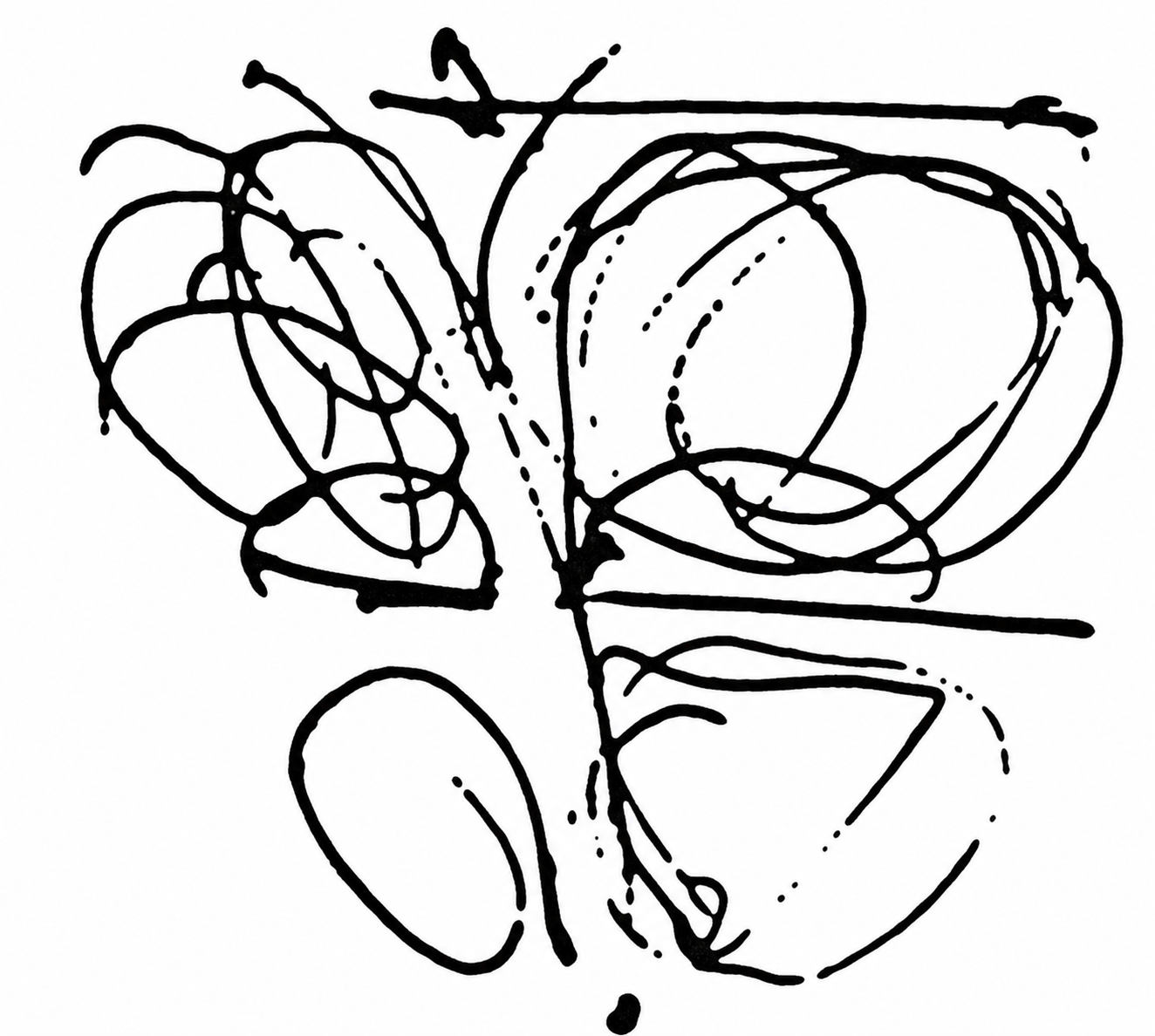
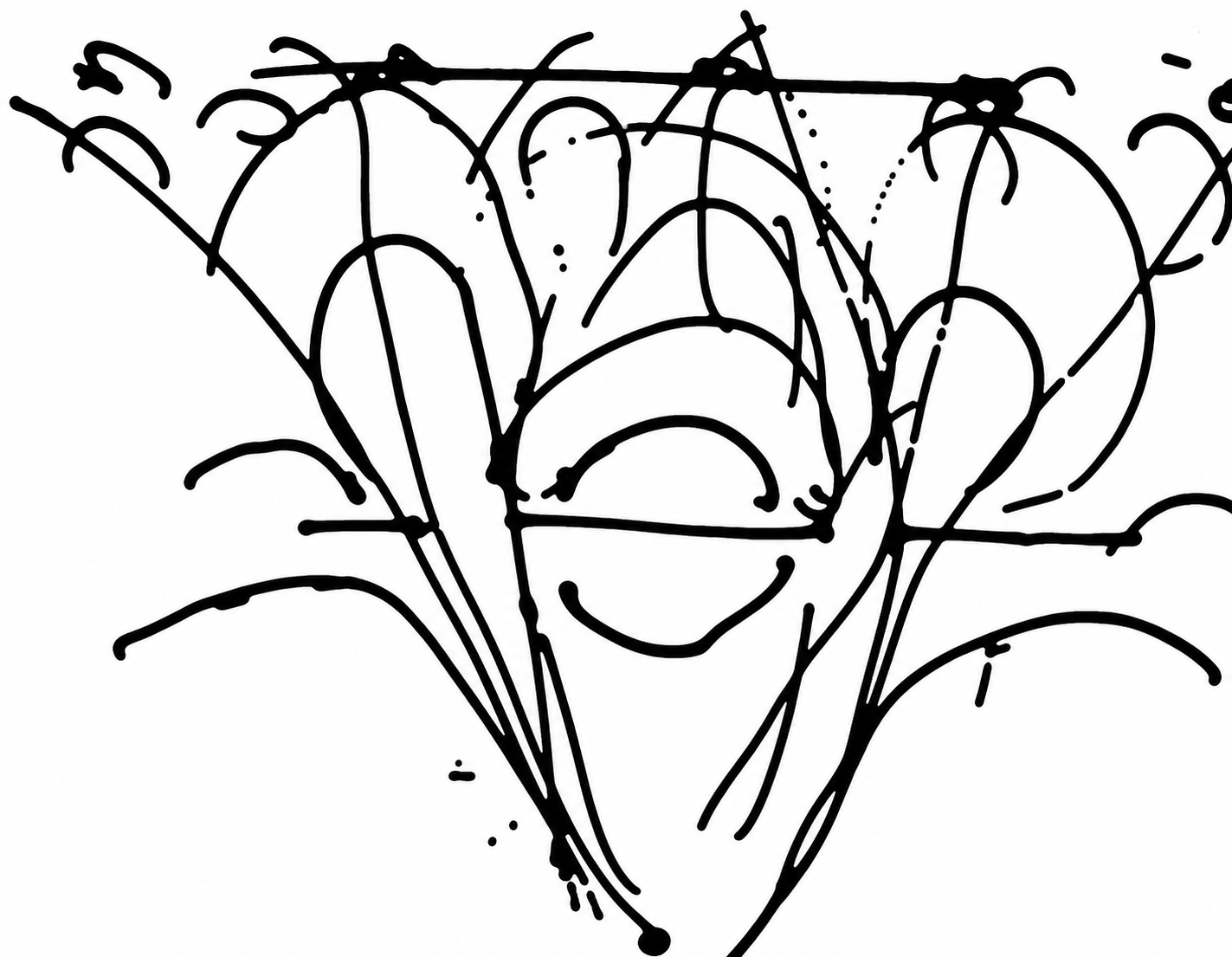
The wholeness of the two-slit experiment
escape from the paradoxical necessity of concluding that the behavior of an electron should depend on the presence of a slit through which it could be proved that it did not pass." In other words, the whole paraphernalia of modern physics (complementarity, uncertainty, etc.) are all elaborate circumlocutions in effect designed precisely to avoid the interpretation that the electron is affected by the wholeness, because physics has had no way of expressing this idea. In addition, no one has really known how to make any precise sense out of the idea of "the whole." We need to learn to see the wholeness of a given region of space as a precisely specified structure.
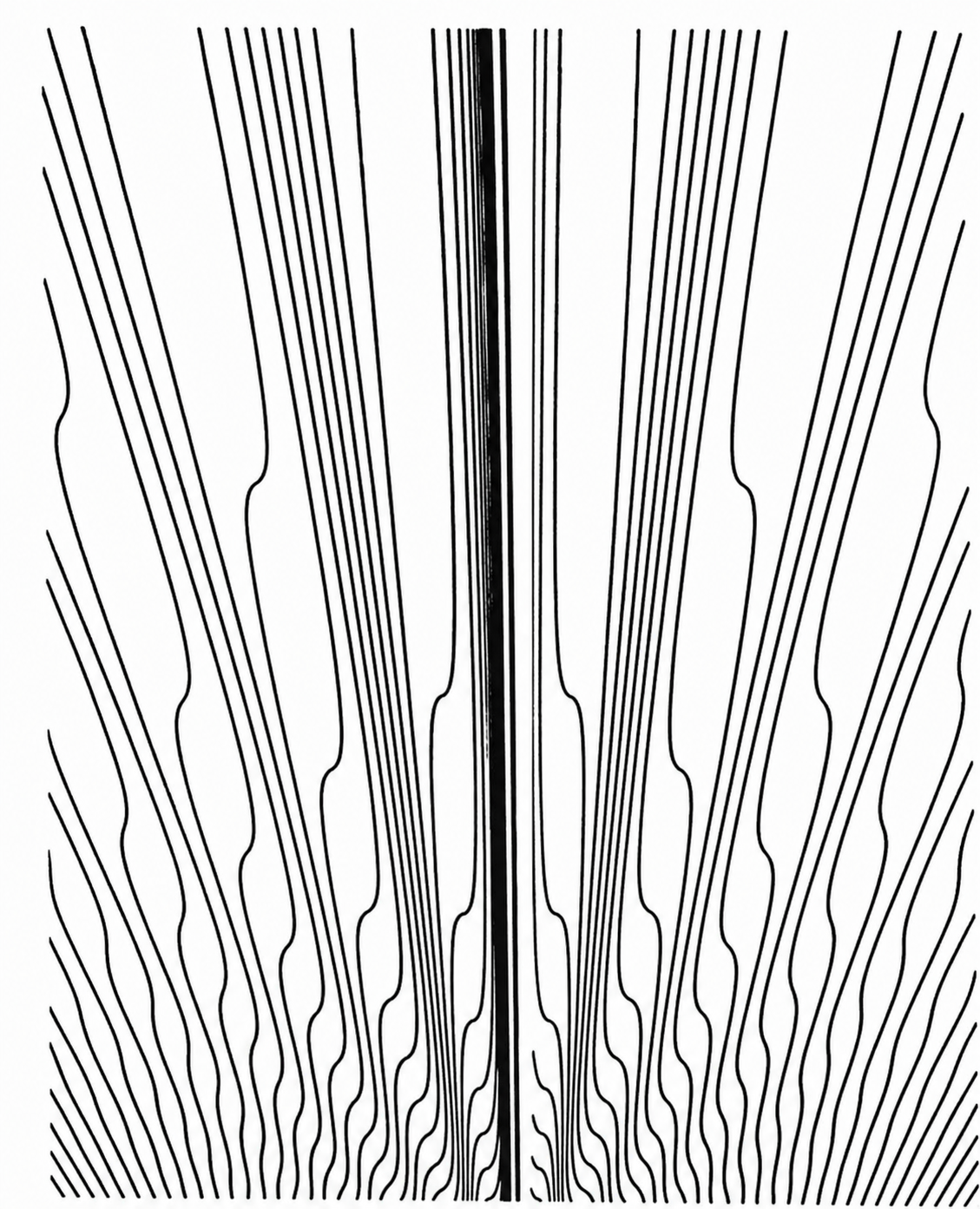
Once we look at wholeness as a real structure, we can make precise attempts to show how the different behaviors of the electron actually correlate with differences in the structure of the wholeness. Look at the two experimental configurations in the two-slit experiment. In one case, we have a system of centers which is asymmetrical and flattened out. It is not hard to see that this system of centers might create the smudged-out distribution of hits on the wall. In the other case, we have a symmetrical system in which two similar systems of centers overlap in a way very similar to the overlap in the ripples going out from two pebbles thrown into a pond. It is not hard to imagine this system of centers guiding the electrons to create the interference fringes on the wall. And indeed, one possible explanation along these lines has been worked out by David Bohm's coworkers. On this page, I show the quantum potential, worked out by Bohm and his coworkers, to show a geometric explanation of the way the wholeness of the space itself can explain the mathematical results of quantum mechanics. In 1988, Bohm told me in conversation that in his mind the wholeness defined in Book 1, is essentially the same structure as that which he calls the "implicate order," and considers responsible for the motion of the electrons.
Full acceptance of this idea, if it is one day accepted, will cause a revolution in physics. The idea that the wholeness might actually be powerful enough to cause a change in the motion of an electron, would greatly change our idea of how matter behaves. And the mental context of this confirmation would then make the role of the wholeness as the underpinning of all architecture, much easier to grasp.
Whether Bohm's particular version ultimately turns out to be true or not, the main point still remains. The experiments of 20th-century physics have shown conclusively that the electron is guided by the wholeness in which it moves. This is what a sober appraisal of the two-slit experiment does lead to. Indeed, whether we accept it explicitly or not, that is what quantum mechanics does anyway. Quantum mechanics asserts, via the mathematics, that particles are physically affected in their behavior by the wholeness of the space in which they move.
In the words of Vigier et al.: "The interpretations of Bohr and of de Broglie-Bohm-Vigier both emphasize that the fundamentally new feature exhibited by quantum phenomena is a kind of wholeness completely foreign to the post- Aristotelian reductionist mechanism in which all of nature in the final analysis consists simply of separate and independently existing parts whose motions, determined by a few fundamental forces of interaction, are sufficient to account for all phenomena.""
It might be said that this is the most important discovery of modern physics. Subatomic particles cannot be viewed as isolated elements which only interact mechanically with other elements through the medium of forces and collisions. Both their existence and their behavior are controlled by their relation to the wholeness of the world around them. It is the wholeness -- either in the particular sense which I have defined, or in some other very similar sense -- which is the governing structure of reality.
If true, this implies that the general view I have presented throughout Book 1 -- with its emphasis on the functional importance of the wholeness -- is not restricted to buildings or works of art, but is valid and essential even in those parts of the world we have historically believed to be mechanical in nature.
Notes
28. David Bohm, quantum THEORY (Englewood Cliffs, N.J.: Prentice Hall, 1951), especially chapter 8, "An Attempt to Build a Physical Picture of the Quantum Nature of Matter," 144-72.
29. Richard Feynman, QUANTUM ELECTRODYNAMICS (Princeton, N.J.: Princeton University Press, 1985), 9-10.
30. The most peculiar interpretations have been well summarized in Nick Herbert, QUANTUM REALITY.
31. Niels Bohr, "Discussion with Einstein on Epistemological Problems of Atomic Physics," first published 1924, reprinted in Wheeler and Zurek, eds., QUANTUM THEORY AND MEASUREMENT (Princeton, N.J.: Princeton University Press, 1983), 30.
32. Ibid., p. 24.
33. J. P. Vigier, C. Dewdney, P. R. Holland and A. Kyprianidis, "Causal Particle Trajectories and the Interpretation of Quantum Mechanics," in B.J. Hiley and F.J. Peat, eds., QUANTUM IMPLICATIONS (London, 1987), 169-204.
34. Taped public dialogues, Krishnamurti Center, Ojai, California, 1988.
35. See David Bohm, WHOLENESS AND THE IMPLI- CATE ORDER (London: Routledge Kegan Paul, 1980).
36. In recent years the theory of quantum mechanics based on wholeness, has been accepted by physicists as the most economical and most accurate way of understanding the motion of electrons. The sense of mystery and ambiguity that used to surround quantum mechanics (in its Copenhagen form) has almost disappeared, and given way to a view that this is the most practical and commonsense way to deal with the physics. For a standard exposition see Peter Holland, THE QUANTUM THEORY OF MO- TION: AN ACCOUNT OF THE DE BROGLIE-BOHM CAUSAL INTERPRETATION OF QUANTUM MECHANICS (Cambridge: Cambridge University Press, 1993).
37. P. Vigier, C. Dewdney, P. R. Holland and A. Kyprianidis, "Causal Particle Trajectories," 201.
CALCULATING DEGREE OF LIFE IN DIFFERENT FAMOUS BUILDINGS: A FIRST APPROXIMATION TO A FULLER MATHEMATICAL TREATMENT
In chapters 4 and 7, and again in the conclusion, I have repeatedly referred to the fact that life, as I have defined it, is mathematical. By this I mean that it arises because of the mathematics of space itself. Since living centers arise primarily as symmetries and structures of symmetries, their presence and their density can, in principle, be calculated for any given configuration. That means, then, that the life is, in principle, a computable property, which arises in space as a result of the configuration of the space. Some of the conceptions presented in appendixes 1, 2, and 4 begin to show how this may be made precise.' And in chapter 5, pages 188-192, I have given a detailed treatment of thirty-five black and white patterns, showing how the rank order of "coherence" (an early experimental form of what I have called life throughout this book) for the thirty-five patterns is predicted almost exactly by counting the Lo- CAL SYMMETRIES that appear nested throughout the structure at all its levels taken together."
In spite of these explicit successes, I believe we are still rather far away from the possibility of making useful large-scale calculations in buildings. This is because the mathematical problems described in appendices 2 and 4 are difficult, and will, I am sure, remain inaccessible to a full treatment for some time to come.
However, a recent study which presents a first rough approximation shows strong results, albeit with crude means. I believe it is important to show this result simply to underline the fact that living structure is, in principle, susceptible to mathematical treatment, and may therefore be regarded as a part of physics.
In 1997, Nikos Salingaros, professor of mathematics at the University of Texas, constructed a first approximation for a measure of life, L, derived largely from the theory in this book, and showed how to apply it to make approximate calculations of degree of life for a variety of buildings. In a paper published as "Life and Complexity in Architecture from a Thermodynamic Analogy," he has shown that this measure L gives a preliminary approximation for twenty-four well-known buildings, ranging from ancient to modern, including the Parthenon, the Pompidou Centre, Salisbury Cathedral, the TWA terminal at JFK airport in New York, the Sydney Opera House, Hagia Sophia, the Alhambra, the Maison Horta in Brussels, the chapel at Ronchamp, and the Norman Foster bank in Hong Kong."
Roughly we may consider Salingaros's measure L in the following way. The measure L which I have put forward in appendix 2 counts living centers by counting locally symmetric sets."! That is possible in a very small structure (like the black and white strips I used), harder in a larger structure. It also makes no explicit use of the addition al recursive information inherent in the other fourteen properties.
Salingaros has composed a measure which can be applied to a relatively large configuration, not by actually counting living centers, but by est mating them statistically. This allows his measure to be applied to large and complex structures.
His measure is based on two component measures that he calls H and 7 H, what he calls harmony, estimates the number of LocaL SYMMETRIES present in a configuration by assigning scores to five different features of the symmetries. H is therefore somewhat similar to the use of local symmetries as the primary component in the measure, but is used so that one does not have actually to count thousands of symmetries, but instead estimates, by inspection, the overall density of local symmetries.
T, which Salingaros calls temperature, estimates LEVELS OF SCALE, CONTRAST, BOUND- ARIES, and perhaps also sTRONG CENTERS -- once again, in a broad-brush approach which does not attempt to count individually the strong living centers, but rather estimates the density of occurrence of these properties.
By multiplying T'and H to get L, Salingaros's L then gives a very rough measure of local symmetries, strong centers, levels of scale, boundaries, and contrast in the configuration.
In his paper he provides the rules by which he obtained the estimates needed to calculate T and H for the different buildings. Each of these two measures is the sum of five parameters, each able to take only three values, o, 1, or 2 (missing, partly present, or strongly present), which are to be estimated by the observer. This makes measurement easy to do, and reasonably objective.
The following table gives values of H, 7; and L for twenty-four important buildings, derived by measurement according to Salingaros's procedure. They appear here just as published in his paper.
i Burpinc _ __ | veace | arenrrecr [7 [wv [ae | pare ALHAMBRA | Granada | unknown [re |e | 9 _ the.
|_r7th c. TA] MAHAL
Agra | unknown -- _|9 | 90
qhe, | DOME OF THE ROCK > Jerusalem | _ unknown 9 9 a
6the. _| HAGIA SOPHIA | Istanbul__| Isidoros, geometer to | 8 | 8% the.
KONORAK TEMPLE __ Orissa | _ unknown _ - 8 8 64 gthe, | PALATINE CHAPEL _____|_ Aachen | Odo of Metz, builder | 7 9 63
[ith c. PHOENIX HALL __| Kyoto _ unknown 3th c. _CATHEDRAL _ Salisbury unknown 719 63
7 9 | &
€-1700 | | GRANDE PLACE ___| Brussels |_ unknown 9 7 | 8
16/t7th c. | ST. PETER'S Rome | Bemini | 10 | © | 60 sth, sc
PARTHENON _|_Athens | _Iktinos, builder 7 8 P 56
' i/r4th c. 1898 MAISON HORTA Brussels
BAPTISTERY _ Pisa Salvi, builder 7 | 8 | 56 Horta 7 56
WATTS TOWERS _ Warts | Rodia rw | 4 | 40 Brussels | Kroll 7 la |
1986 | BANK - 7 Hong Kong | Foster __| 3:. a FALLING WATER |, Bear Run_| Wright + _|s | | i936 1973 OPERA HOUSE _ ____|_ Sydney 1958 SEAGRAM BUILDING _ New York
Utzon 4] 5 | 20 Mies van der Rohe I 8 8 |
1965 SALK INSTITUTE La Jolla Kahn pr 1955 CHAPEL _ ee _ _Ronchamp
TWA_TERMINAL _ New York Saarinen 3 2 6 6 6 | Le Corbusier 1 2 2 |
I find these preliminary experimental results highly instructive. The Alhambra and the Taj Mahal have a very high score, 90, Hagia Sophia 80, Salisbury Cathedral 63. At the low end, the TWA terminal has a very low score of 6, Wright's Falling Water has 20, the Seagram building 8, and the Sydney Opera House 20. At an intermediate level, Watts Towers has 40, Gaudi's Casa Batlé has 40, and Sullivan's Carson Pirie Scott building has 56.
You may say these numbers are childish, since of course the assignment of numbers is mechanical, and hardly commensurate with the subtlety of the question. And, indeed, there are odd points, if we compare them with the judgement that would be reached by applying the criterion of life (as in chapters 1 or 2, or 10), or indeed commonly accepted judgement by architects or others. The Taj Mahal, at go, is too high; the Parthenon, at 56, too low. Le Corbusier's Ronchamp at 2, is somewhat too low. Yes, by all means, there are mistakes. The function does not work, perfectly, to predict degree of life. But it does work to an unexpected degree. The success of the experiment outweighs the mistakes.
It is telling that a simply constructed arithmetical function, based on the considerations of the nature of living structure, no matter how crudely, could get these kinds of results at all. It shows that, while the question itself may be a million times more subtle, there is something tangible, and ultimately measurable, in the degree of life the living structure has.
Of course, the specific measurements which Salingaros has reported in his table, are over-simplified, even for his own measure. These measurements are based on a single photograph of each building and deal, therefore, only with the organization of the facade. This is, certainly, only a start. Furthermore, the measurements of T'and H are very sketchy, certainly not yet of the level of sophistication required by a detailed analysis of life. Nor does Salingaros's measure deal with the recursion inherent in the field of centers.
But still, when one considers the fact that there are so many "buts," and yet that the results are somewhat close to one's intuitive assessment of these buildings, ome must marvel that in such a crude net he has caught so much.
It is a time-honored tradition in physics to make a rough calculation, to get quick and dirty results, merely to see if a given theory is correct, even to within an order of magnitude. That one can hardly doubt. To me, given the crudity of the measures 7; H, and L, as defined, it is truly remarkable that they give results that are consistent with our feelings about life.
This does not mean that they represent the last word of what is possible. Of course they do not. Many of these results would need refinement in a more careful analysis. For example, Ronchamp does have a massive, dark, and brooding silence. Whatever life it has in its interior is not yet captured in Salingaros's measurement. That is to be expected, given that he examined only the exterior. But also the weight, the heaviness, the cool atmosphere of the chapel, these create a life which is more difficult to capture arithmetically. Depending as they do ON ECHOES, POSITIVE SPACE and INNER CALM within the structure, they are properties that are not yet caught by this first version of Salingaros's L."
Bernini's St. Peter's is indicated to have more life than one would accord to it, intuitively. That is probably because the Salingaros measure is too greatly dependent on what he calls the temperature (the busy-ness of structure). A more sophisticated measure -- a second draft of L, perhaps -- will have a way of recognizing mere busy-ness as noise, and will lower the L accordingly.
A few architects tend to dismiss the findings of Salingaros's experiment on the grounds that he does not know enough about architecture. This, I believe, comes about because so many modern heroes of architecture fare so badly on this measure. Kahn's Salk Institute is second lowest on the list. Even those who are open-minded to the need for a new way of
thinking may not be ready to accept such drastic evaluations -- and will therefore find refuge in the idea that Salingaros does not know enough. But here I think they are mistaken, and perhaps self-delusion al. The Salk Institute and the Seagram Building may well be icons of the modernist movement. But according to the analysis of life which I have given, they must be discounted as having any particularly high degree of life.
In this respect, Salingaros's measure picks up these difficulties with many modern buildings rather accurately, and forces us to examine, more carefully, which buildings are truly alive, and which are not. It might be said that just because Salingaros is ignorant of architectural fashion, his measure is therefore to be trusted more: it has no built-in prejudice. It comes only from the wish of a physicist, to find a measure that accords with experience as nearly as possible.
Degree of life, as measured by Salingaros's L, corresponds reasonably to the experience of life in these buildings, as it might be measured, for instance, using the mirror-of-the-self test from chapter 10. The strength of this result is greatly encouraging. It may be considered even more encouraging when one recognizes that the arithmetical measure presented in Salingaros's paper is an extremely rough first approximation. Yet it gets results that match and predict experience with surprising accuracy. It does manage, in approximate form, to estimate the extent of living structure in the buildings -- that is, the degree to which living centers appear and support each other.
Professor Howard Davis (from the Department of Architecture, University of Oregon), after examining Salingaros's result, has commented to me that he believes a sequence of measures of this kind should be tested until one that is even stronger can be found. It is his view that plans and sections, not only elevations, should be tested. He points out, also, that much of the rank order that one feels among these buildings is explained by H (the symmetries), and that the temperature T is doing relatively less work than H in predicting this rank order. Tis also creating the excessively high scores for St. Peter's, for the Taj Mahal, and for the Foster bank, while giving scores that are too low for Ronchamp and the Parthenon.
After careful experimentation, I believe a measure of simplicity, coupled with levels of scale, which counts occurrences of THE VOID, INNER CALM, and gives more weight to LEVELS OF SCALE, ought to be incorporated, and would produce a measure that predicts life with a higher degree of accuracy.
In any case Salingaros's work opens the door to a rich field of study. Measurements of degree of life in different buildings, as gauged by the observer's felt wholeness or by the mirror-of-the-self test, coupled with efforts to build arithmetic functions of the fifteen properties in the buildings, should soon lead to more and more powerful measures.
All this measurement is possible because centers are formed from symmetries and differentiations, and these arise within the mathematics of a configuration, which can be computed. Thus life itself arises as a result of mathematical Operations in the space. When in the future we make more subtle, more complex determinations of the space, its symmetries, its centers, and the recursion, we shall, I hope, get more subtle results still. We just need to work hard to decipher it.
But the relative degree of life is already there, in the computable, mathematical, structure of the space.
Notes
38. See pages 446-8.
39. See pages 188-192.
40. Salingaros, "Life and Complexity in Architecture from a Thermodynamic Analogy," op. cit., 165-73.
41. See page 450.
42. Salingaros has begun efforts to refine and extend his first draft measure, in a second-draft measure where he places more emphasis on levels of scale, and on nesting of centers. See Klinger and Salingaros, op. cit.
43. Person al communication, May 1998.
My nearly boundless gratitude for all the help I have received with the content, ideas, discussion, and production of these four books from many, many people during the last twenty four years is expressed, with love and deep personal emphasis, on the eight pages that appear at the end of Book Four.
In addition, in this book I gratefully acknowledge the use of pictures, photographs, and illustrations owned by the following persons and institutions. All illustrations not mentioned belong to or are the work of the author.
Preface p-9 © 1990, Amon Carter Museum, Fort Worth Texas, Bequest of Eliot Porter; p. 1 FW. Funke; p. 12 left: Arthur Upham Pope, 4 Survey of Persian Art, Soroush Press, p. 419; p. 12 right: Kenzo Tange and Noburu Kawazoe, Prototype of Japanese Architecture, MIT Press, 1965, p. 130; p. 13 top left: Georg Kohlmaier and Barna von Sartory, Das Glashaus, Prestel Verlag, 1981, plate 612, p. 655; p. 13 top right: Georg KohImaier and Barna von Sartory, Das Glashaus, Prestel Verlag, 1981, plate 487, p. 543; p- 13 bottom: Yoshio Watanabe; p. 14 left: Leon ardo Benevolo: The History of the City, MIT Press, 1980, fig. 1364; p.14 top right: Thom Jestico; p. 14 center right: Lee Nichol; p. 14 bottom right: Hiroshi Misawa;
Chapter 1 p- 19 right: Artemis Verlag; p. 20 Paschall; p. 21 Jan Derwig; p. 31 K. Nakamura; p. 33 Ace; p. 34 © 1990, Amon Carter Museum, Fort Worth, Texas, Bequest of Eliot Porter; p. 35 © 1990, Amon Carter Museum, Fort Worth, Texas, Bequest of Eliot Porter; p.36 Magnum Photos, Inc., ©1946 Henri Cartier Bresson; p- 37 bottom: Alfred Eisenstaedt/LIFE Magazine © Time, Inc.; p. 39 Henri Cartier-Bresson; p. 40 Hirmer Verlag; p. 41 Hans Jrgen Hansen; p. 42 Roland and Sabrina Michaud/Rapho; p. 43 top: Andre Martin; p. 43 bottom: Japan Folk Crafts Museum, Tokyo;p.44 topleft: Andre Martin; p.44 bottom right:Staatliche Museum, Berlin-Preussischer Kulturbesitz. Muscen ft Islamische Kunst; p. 45 Roderick Cameron, Shadows from India, William Heinemann, Ltd., 1958, p. 73; p. 46 Carl Nordenfalk, Celtic and Anglo-Saxon Painting, George Braziller, 1977, plate 1, p. 33; p- 47 top: Soetsu Yanagi, The Unknown Craftsman, Kodansha; p. 47 bottom left: Inge Morath; p. 47 bottom right: © Smithsonian Institution, Freer Gallery of Art; p. 48 top left: Gunvor Ingstad Traetteberg, Folk Costumes of Norway, Dreyers Forlog, 1966, p. 28; p. 48 top right: José Ortiz Echage; p. 48 bottom: Roland Michaud/ Rapho; p. 49 Ajit Mookerjee, Tantra Art, Kumar Gallery, 1966, plates 2-4; p. 50 Art Resource; p. 51 Alfred Eisenstaedt/LIFE Magazine © TIME, Inc.; p. 52 top left: Artemis Anninou; p. s2 top right: H.S.K. Yamaguchi; p. 52 bottom: Alfred Eisenstaedt/LIFE Magazine © TIME, Inc.; p. 53 top: Artemis Anninou; p. 53 bottom: Michel Hoog, Paul Gauguin: Life and Work, Rizzoli Internation al Publications, 1987, p. 185, plate 128; p. 54 top: Hal Davis; p. 54 bottom left: Kaku Kurita/Gamma-Liaison; p. 54 bottom right: Jean Leymarie, Herbert Read, and William S. Lieberman, Henri Matisse, University of California Press, 1966, p. 112, plate 82; p. 55 top: Pedro Guedes, Encyclopedia of Architectural Technology, McGraw-Hill Book Co., 1979, p. 304; p. 55 bottom: Andreas Feininger; p. 56 Alfred Eisenstaedt/LIFE Magazine © TIME, Inc.; p. 57 The Metropolitan Museum of Art, Mr. and Mrs. Henry Ittleson, Jr., Fund, 1956 (56.13); p. 59 bottom: Elliot Kaufmann Photography; p.6r Magnum Photos, Inc. ©1955 Henri Cartier-Bresson
Chapter 2 p. 64 left: Bruce Dale, © Nation al Geographic Society; p. 64 right: Joseph Rodriguez, Nation al Geographic Society Image Collection; p. 69 top left: Magnum Photos Inc. © 1959 Bruce Davidson; p. 69 top right: Vallhonrat; p. 70 bottom left: © Kevin Fleming; p.70 bottom right: Joanna Pinnco; p.71 left: Photo Stuart Franklin; p. 71 right: Photo Stuart Franklin; p. 73 right: Elliot
Kaufmann Photography; p. 75 left: Carl Nordenfalk. Celtic and Anglo-Saxon Painting, George Braziller, 1977, plate 1, p. 33
Chapter 3 p. 88 Ullstein Bilderdienst; p. 91 Photo Emil Otto Hoppe, © 1994 The E.O. Hoppe Trust, All Rights Reserved; p. 93 Magnum Photos, Inc. © 1962 Henri Cartier-Bresson; p. 97 top: Jack D. Flam, Matisse on Art, E.P. Dutton, 1978, p. 118; p. 97 bottom: Jack D. Flam, Matisse on Art, E.P. Dutton, 1978, p. 136; p. 99 top: Tony Hey and Patrick Walters, The Quantum Universe, Cambridge University Press, 1987; p. 99 bottom left: Tony Hey and Patrick Walters, The Quantum Universe, Cambridge University Press, 1987, P- 10; p. 102 © Ken Heyman; p. 103 top: Magnum Photos, Inc. © Henri Cartier-Bresson; p. 103 bottom: Byzantine Institute; p. 104 top: © Ken Heyman; p. 104 bottom: Magnum Photos, Inc. © 1938 Henri Cartier-Bresson; p. 105 Manuel Alvarez/Bravo
Chapter 4 p- 117 top: Bob Gibbons; p. 117 bottom: Gareth Lovett Jones; p.123 The British Architectural Library, Institute of British Architects; p. 126 left: Artemis Anninou; p. 126 right: Martin Hurlimann; p.127 Georg Gerster; p. 133 right: Gwathmey Siegel and Associates, Photo David Hirsch; p. 135 top: Magnum Photos, Inc. © James Nachtwey
Chapter 5
Konstantinidis; p.169 ©1990 Amon Carter Museum, Fort Worth Texas, Bequest of Eliot Porter; p.170 top: Art Resource/Scala; p. 170 bottom: Fabio Galli; p. 171 Ishimoto Yasuhiro; p. 172 Christie's Images; p. 173 Nolli plan of Rome; p. 174 top: Soetsu Yanagi, The Unknown Craftsman, Kodansha; p. 175 top: Serare Yetkin, Turk Hali Sanati, Bankasi Kultur Yayinlari, 1974, color plate 1; p. 175 bottom: Staatliche Muscen zu Berlin-Preussischer Kulturbesitz-Museum fr Islamische Kunst; p. 176 top: Private Collection; p-176 middle: Werner Stuhler and Herbert Hagemann, Venetia, Universe Books, Inc., 1966, plate 23; p.176 bottom: Arthur Upham Pope, A Survey of Persian Art, Vol. 11, Soroush Press, p. 171, fig. F; p. 177 top left: Hisao Koyama; p. 177 top right: © George Heinrich, 1999; p.177 bottom: Yukio Futagawa; p. 178 left: © Moshe Safdie and Associates; p.178 right: Reha Gunay; p.179 left: Yanni Petsopoulos, Tulips, Arabesques and Turbans, Abbeville Press, Inc., 1982, p-2;p.179 right: Novosti Press Agency; p. 81 top left: Japan Folk Crafts Museum, Tokyo; p. 183. top: Novico; p. 183 bottom: Musée Historique des Tissus, Lyons, no. 35488 (972.1V.I); p. 184 top: Roar Hauglid, Norske Stavkirker, Dreyers Forlag, 1976, p. 173, fig. 143; p- 184 bottom: Arthur Upham Pope, Masterpieces of Persian Art, The Dryden Press, 1945, plate 27; p. 185 Yukio Futagawa; p. 186 top: M. Wenzel; p. 186 bottom: The Library of Congress; p. 187 Oleg Grabar, The Alhambra, Harvard University Press, 1978, overleaf; p. 188 Don Juan Antonio F. Oranzo; p. 192 Ab Pruis; p. 193 Francoise Henry, The Book of Kells, Alfred A. Knopf, 1974, plate 123; p. 194 Hans C. Seherr-Thoss; p. 195 left: Kiyosi Scike, The Art of Japanese Joinery, John Weathcrhill, Inc., 1977, plate 1; p. 195 right: Roar Hauglid, Norske Stavkirker, Dreyers Forlag, 1976, plate 278; p. 196 top right: Hiroshi Morimoto; p. 196 bottom: David Sellin; p. 197 top: Seth Jocl, Metropolitan Muscum of Art; p. 197 bottom: Kiyosi Seike, The Art of Japanese Joinery, John Weatherhill, Inc., 1977; p- 80, fig. 51; p.198 Roland Michaud/Rapho; p. 199 Art Resource; p. 200 Charles K. Wilkinson, Iranian Ceramics, Asia House/Distributed by Harry N. Abrams, Inc., 1963, plate 49; p. 201 top left: Elias Petropoulos; p. 201 top right: Hans C. Seherr- Thoss; p. 201 bottom: Smithsonian Institution, Freer Gallery of Art; p. 202 William F. Winter; p. 204 top: Evelyn Hofer; p. 204 bottom: Leon ardo Benevolo, The History of the City, MIT Press, 1980, p. 314, fig. 497; p- 205 Scala/Art Resource; p. 206 top left: Elias Petropoulos; p.206 top right: Bildarchiv Preu_ icher Kulturbesitz; p. 206 bottom left: Staatsbibliothck Berlin, Picture Archive; p. 206 bottom right: Ludwig Goldscheider, Leon ardo da Vinci, The Phaidon Press, 1951, No. 40; p. 207 top: Ursula Pfistermeister, Artelshofen; p. 207 bottom: Stecn Eiler Rasmussen, Experiencing Architecture, MIT Press, 1962, p. 140; p.208 John van der Zee, The Gate, Simon and Schuster, 1931, endpaper; p.209 Werner Stuhler and Herbert Hagemann, Venetia, Universe Books, Inc., 1966, plate 56; p. 210 © Smithsonian Institution, Freer Gallery of Art; p. 212 bottom: Andre Martin; p. 213 Otto E. Nelson; p. 214 top: Eugenio Battisti, Fi/ippo Brunelleschi, The Complete Work, Rizzoli, 1981, p. 71; p. 284 bottom: Bernard Rudofsky; p. 217 top: Dr. Eva Frodl-Kraft; p. 217 bottom: Yukio Futagawa; p. 218 bottom: Otto E. Nelson; p. 219 top: Everest Films, Norman Dyhrenfurth; p. 219 bottom: Edward Allen, AIA; p. 220 top: Steen Eiler Rasmussen, Experiencing Architecture, MIT Press, 1962, p. 68; p. 220 bottom: Gunner Bugge and Christian Norberg-Schulz, Stav og Laft I Norge (Early Wooden Architecture in Norway), Byggckunst, Norske Arkitekters Landsforbund, 1975, p. 122; p. 221 Gunner Bugge and Christian Norberg-Schulz, Stav og Laft I Norge (Early Wooden Architecture in Norway), Byggekunst, Norske Arkitekters Landsforbund, 1975, p. 122; p. 223 bottom: Turizm Tanitma Bak; p. 224 top: Arthur Upham Pope, 4 Survey of Persian Art, Vol. IX, Soroush Press, p. 5613p. 224 bottom: Magnus Bartlett; p.225 Rijksmuscum, Amsterdam; p. 226 left: F.W. Meader, I/lustrated Guide to Shaker Furniture, Dover Publications, Inc., 1972, fig. 162, p. 82 p- 227 top: David Sellin; p. 227 bottom: Yukio Futagawa; p. 228 Janice S. Stewart, The Folk Arts of Norway, Dover Publications, Inc., 1972, p. 15, fig. 7; p. 229 Roderick Cameron; p. 230 F.W. Funke; p. 232 top: Bruckmann; p. 232, bottom: Hans Jurgen Hansen, Architecture in Wood, The Viking Press, Inc., 1971, p. 88; p. 233 Yukio Futagawa; p. 234 Norman Carver, Jr.; p. 235 Michel Hoog, Paul Gauguin, Life and Work, Rizzoli Internation al Publications, Inc., 1987, p. 70, plate 40
Chapter 6
Chapter 7 p. 300 Colin Thubron, Jerusalem, Time-Life Books, 1976, p- 123; p. 301 Rijksmuseum; p. 303 bottom left: Kari Haavisto; p. 303 bottom right: Christies Internation al Magazine, September- October 1988, p. 47; p. 304 top: Mountain Travel, Sobek: 1993 Adventure Annual by the Adventure Company, p. 12; p. 304 bottom: Kari Haavisto; p. 307 top left: © The Henry Moore Foundation; p-307 bottom: Marguerite Duthuit-Matisse and Claude Duthuit, Henri Matisse, Vol. I, Claude Duthuit, Paris, Cat. #464, plate 70; p-310 © Ken Heyman; p. 311 © William Garnett
Chapter 8 p- 322 top: Walker Evans; p. 322 bottom: Theo Crosby; p. 323. left: Gonul Oncy, Turk Cini Sanati: Turkish Tile Art, Yapi ve Kredi Bankasi'nin bir Kultur Hizmetidir, 1976, p. 116; p. 323 right: Kakiemon Kiln; p. 324 left: Lefevre & Partners, London, Catalog of 71 Rare and Oriental Carpets and Textiles, Friday, February 3, 1978, #13; p. 324 right: Lefevre & Partners, London, Catalog of 71 Rare and Oriental Carpets and Textiles, Friday, February 3, 1978, #14; p. 325 Eric Arthurand Dudley Witney: The Barn: A Vanishing Landmark in North America, M.F. Feheley Arts Company Limited, 1972, Pp. 110, fig. a; p. 326 Arthur Upham Pope, 4 Survey of Persian Art, Vol. VII, Soroush Press, plate 200; p. 327 F.W. Funke; p. 328 top: Hirmer Fotoarchiv, Munich; p. 328 bottom: Magnus Bartlett; p. 329 top: D.A. Harissiadis; p. 329 bottom: Chicago Historical Society; p. 330 top left: Robert Grant; p. 330 top right: The Mics van der Rohe Archives, The Museum of Modern Art, New York; p. 330 center left: Leon ardo Benevolo, History of Modern Architecture, Vol. II, MIT Press, 1971, p. 453, fig. 510; p. 330 center right: Boesiger/Girsberger, Le Corbusier 1910-60, George Wittenborn, Ind., 1960, p. 53; p- 330 bottom left: Aris Konstantinidis; p. 331 top left: George Knight; p. 331 center left: Paul Warchol; p. 331 center right: Michael Graves; p. 331 bottom right: Lucien Herve; p. 332 top left: Courtesy the Frank Lloyd Wright Foundation; p. 332 top right: Ezra Stoller, © ESTO; p. 332 bottom left: T. and R.
Annan; p. 332 bottom right: Martin Charles; p. 333. top left: G.C. Mars, Brickwork in Italy, American Face Brick Association, 1925, p. 119, plate 124; p. 333, bottom left: Aris Konstantinidis; p. 333 center tight: Leon ardo Benevolo, History of Modern Architecture, Vol. Il, MIT Press, 1971, p. 759, fig. 981; p. 333, bottom right: Dimitris and Suzana Anton akakis, Lyttos Hotel, Wien, March-April 1988, p. 9; p-338 top: Alex Starkey; p. 338 bottom: Barry Shapiro; p. 339 top: Hans Jurgen Hansen, Architecture in Wood, The Viking Press, Inc., 1971, p. 85, fig. a; p. 339 bottom: Foto Marburg; p. 340 top: © Eames Office; p. 341 Gonul Oney, Turk Cini Sanati: Turkish Tile rt, Yapi ve Kredi Bankasi'nin bir Kultur Hizmetidir, 1976, p. 34; p. 341 bottom: Chic Harris; p. 345 top: The Metropolitan Muscum of Art, Rogers Fund, 1958, © 1999, MMA; p. 345 bottom: Yanni Petsopoulos, Tulips, Arabesques and Turbans: Decorative Arts Srom the Ottoman Empire, Abbeville Press, Inc., 1982, p. 72, plate 54; p. 346 top: Ulrich Schurmann, Caucasion Rugs, Klinkhardt and Biermann, Braunschweig, p. 73, plate 9; p. 346 bottom: Kurt Erdmann, The History of Early Turkish Carpet, Oguz Press, 1977, color plate II; p. 347 top: © The Metropolitan Museum of Art, photograph by Seth Joel; p. 347 bottom: © The Metropolitan Museum of Art, photograph by Seth Joel; p. 348 top: Art Resource; p. 348 bottom: Art Resource
Chapter 9 p-358 V&A Picture Library, Photo Peter MacKinven
Chapter to Pp. 384 to 392: Courtesy the Estate of Andre Kertesz; p. 410 Country Life Picture Library.
Although every effort has been made to trace and contact copyright holders before publication, this has not been possible in a few cases. If notified, we will be pleased to rectify any errors or omissions at the earliest opportunity.
$75.00
T0N iit